Yanni Cai (2023). Community interface of gated communities as a docking space for future unmanned distribution. In: Human Factors in Robots, Drones and Unmanned Systems. AHFE Open Access, vol. 93, pp. 142–147. https://doi.org/10.54941/ahfe1003756
The research aims to integrate the system of unmanned logistics with community design to help communities cope with major public health crises. Through literature research and field investigation, it is found that the lack of community docking space and personnel is an important reason why unmanned logistics cannot be applied on a large scale at present. The study also observed that the last-mile delivery during the epidemic was physically hindered by the walled boundary of gated communities in China, which also made this type of space become a temporary transit place. It has the potential to become the touchpoint to integrate unmanned distribution and community space. This research uses the interface of the community as the transition medium for future unmanned distribution with the modular docking device attached to it. After the epidemic, such space can also be expanded into a diversified space with community social and entertainment attributes. Through the socialized development of logistics infrastructure, it can establish an interface-based logistics cooperation network to utilize the labor force active near the interface space and help the node connection of unmanned vehicles. In conclusion, this research can realize the diversification and socialization of unmanned logistics in the future, integrate distribution facilities into the community design through community interface, and promote the resilient development of community logistics to respond to the public health crisis.
The city lockdown policy during COVID-19 has facilitated the rapid gro- wth of numerous takeaways, vegetable shopping, community group buying, and other businesses (Villa and Monzón, 2021). Last-mile delivery became an important livelihood support during the epidemic (Castillo et al., 2022). At the same time, as viruses can be transmitted through aerosols, the need for contactless delivery for last-mile delivery has gradually increased, thus accelerating the use of unmanned logistics to some extent.
However, there are now a lot of issues with the current application of unmanned distribution. For example, the community space is not suitable for the operation of unmanned delivery facilities due to the lack of supporting logistics infrastructure (Tang, 2020). In addition, the current technology is unable to complete the delivery process and requires the collaboration of relevant space as well as personnel to help dock unmanned delivery nodes.
Community Interface of Gated Communities as a Docking Space 143
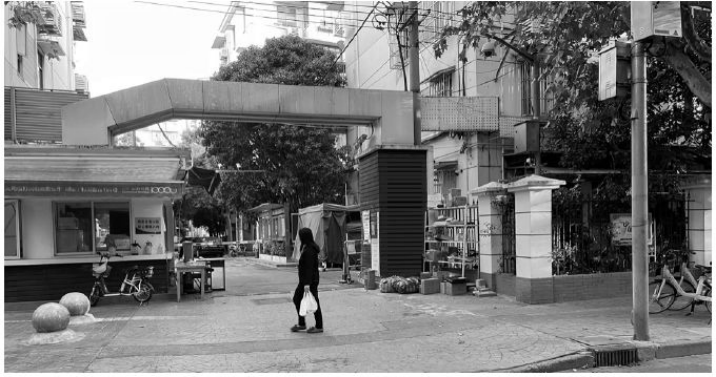
Meanwhile, the role of distribution has become more complex. For com- munities undergoing isolation management, material distribution has become an act of necessity at this stage. China’s special closed community manage- ment has made this behavior occur near the community wall boundary space (Figure 1), making this space a new interface for human distribution activi- ties. Such space has the potential to provide a transition function for new types of future delivery devices.
Current research on unmanned logistics has focused on smart device design and the macro urban space aspect (Jiang and Yuan, 2019), with less resea- rch on the integration of unmanned logistics and communities. Therefore, based on the social context of Chinese gated communities and a community design perspective, this study aims to explore new interface space carriers for unmanned logistics, so as to promote the rapid diffusion and applica- tion of unmanned community delivery in the post-epidemic era and help communities cope with public health crises.
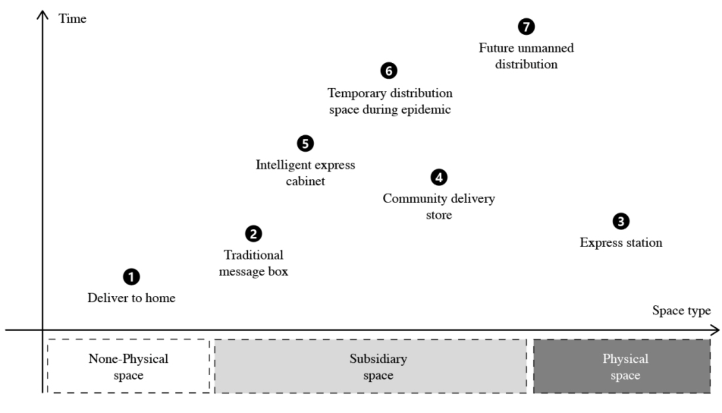
Reasons Why Unmanned Delivery Could Not Be Applied During the Epidemic Community distribution is not the product of modern society. It has been the behavior of logistics distribution for many years ago. Urban development and commercial development in different periods will lead to unique com- munity distribution modes. Therefore, today’s community distribution has experienced a long evolution process. Currently, the main types of commu- nity distribution are classified into three types, namely, store distribution, door-to-door delivery, and express cabinet. The space types under this service mode are mainly divided into three types, one is physical space, one is not physical space, and the other is dependent space (Figure 2). These three spa- ces become different types of spaces for community distribution. Unmanned
Figure 1: Distribution behavior of last-mile delivery at the boundary of the residential area.
144 Cai
Figure 2: Space type of last-mile delivery.
distribution is the development goal and trend of distribution in the next stage.
The inability of unmanned delivery to be used on a large scale at present is the result of a combination of multifaceted factors. First of all, logistics is at the end of the spectrum in community design and is rarely considered. In the beginning, there was no corresponding physical space for community distribution, such as door-to-door distribution service. Then, with the pro- motion of the economic model and service, the residential community began to adapt to the new equipment. Most communities implant the devices based on the original community design, instead of reserving the corresponding space before the community was built. It more relies on the original space to provide services. Therefore, their docking flexibility for high-tech logistics facilities is very weak.
Most importantly, the current unmanned distribution cannot complete a whole set of material distribution processes independently and requires space and manpower support at the node docking. The technology of today’s unmanned delivery robots and other delivery devices cannot meet the diverse delivery needs of different types of parcels, such as fresh parcels and large parcels. Influenced by a variety of factors such as size, location, weather, and power sustainability, the application of unmanned equipment in community delivery still requires further systematic consideration.
At the same time, with the advent of the new retail era as well as the e- commerce era, the development of community delivery has become more mature, and diversified types of delivery have started to emerge. Various robots, drones, and other unmanned vehicles for unmanned delivery are ite- rating at an extremely rapid pace. However, the current lag of space design within the community makes various docking spaces in disorder. Communi- ties need to establish service standards and space types that are compatible with intelligent unmanned delivery devices.
Community Interface of Gated Communities as a Docking Space 145
Therefore, the mode of community distribution is iterative and constantly changing with the development of technology and the economic mode, and its spatial mode is also changing. The generation of new logistics technology and logistics services in the future will also prompt the birth of new spatial modes to adapt to logistics services. For Chinese communities, it is necessary to explore the construction of community distribution adaptation space at the level of the ecological chain from the whole system level. The application of logistics transportation equipment, such as drones and unmanned vehicles, requires the support of communities to provide new logistics docking spaces.
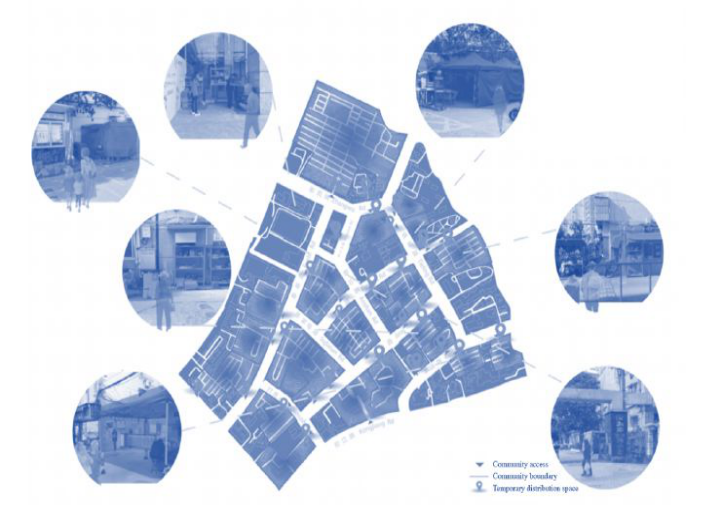
Community Interface as a Supportive Space for the Application of Unmanned Logistics The research is based on the social background investigation of the con- struction of closed communities in China. Through the observation of the distribution behavior of community residents in the field observation, the potential opportunities to promote the docking of unmanned logistics and community space are observed. The study found that some residents would exchange goods around the fence during the lockdown management policy period of the community (Figure 3), while in the daily period, many mobile vendors would be active near the boundary of the street fence. The fence boundary, while hindering logistics, is also a potential space between the distribution place and the social function attribute, and has the potential to become an intermediary field for the community to connect with the unmanned logistics.
Figure 3: Distributed community boundary space for last-mile delivery.
146 Cai
Therefore, based on the concept of community micro-renewal, this research can establish a distributed unmanned delivery resilient landscape system with the walled boundary space as the carrier. It will promote the rapid popularization of unmanned delivery in the future. It can also facilitate the sustainable development of unmanned delivery in daily and emergency peri- ods, and extend the originally unused walled boundary space into a resilient urban unmanned delivery intermediary space. The combination of unman- ned delivery and community boundary space system will become a symbiosis combining delivery and urban landscape. Thus, it will help realize the transiti- onal use phase of unmanned vehicles and unmanned robots in the distribution process and meet the demands of last-mile delivery in the digital economy era (Figure 4).
In addition, the plug-in system based on the community interface is esta- blished, and the boundary space of the community wall is used as the interface for docking plug-ins. The plug-ins are marked with different diver- sified elastic functions. While providing the docking function with unmanned distribution, it is envisaged that multiple service functions can be combined and used as public living space units, so that unmanned distribution can truly integrate with community design. Plug-ins in different communities can be assembled as a whole. It not only meets the function of unmanned distribu- tion and docking, but also undertakes the functions of rest, entertainment, and service of urban furniture, providing charging, guidance, publicity, and other functions.
Therefore, the function of such social services will enable the delivery inter- face to accommodate related stakeholders of the street. From this perspective, the unmanned distribution system can build a human-machine collaborative network with the help of the labor force of mobile service groups active in the boundary space of the wall. Finally, the distribution space is transformed from the original unitary community cabinet into a community elastic land- scape system with social, growth, and intelligent attributes, helping to realize
Figure 4: Schematic diagram of unmanned distribution interface.
Community Interface of Gated Communities as a Docking Space 147
the combination of normal and epidemic responses to major public health events in the community.
When the epidemic comes, the new interface for unmanned delivery will provide citizens with safe, contactless procurement and rapid delivery services. Thus, it will become a new space type to dock urban emergency distribution functions and form a resilient emergency distribution network.
CONCLUSION
The outbreak of the COVID-19 epidemic has made isolation an effective means of controlling transmission, thus driving the practical application of unmanned delivery that meets the needs of contactless delivery. At the same time, the epidemic era has promoted the comprehensive populariza- tion of online service, making last-mile delivery more and more important. However, the current community delivery problem of the last mile of the community is still difficult to be solved with the intervention of unmanned delivery. Unmanned delivery is exposed to deficiencies in actual community applications.
Through literature review, this research found the main obstacles to the development of unmanned logistics from the perspective of community design. This is the contradiction between the demand for new use modes and the lagging space system. The equipment and technology of material distribution are undergoing rapid innovation. Various new types of drones, unmanned vehicles, and other intelligent distribution facilities have emerged in a short period. However, this high-speed innovative logistics technology and equipment cannot be applied on a large scale in the community. The slow development of community design and space facilities has limited the use of new unmanned distribution equipment to a certain extent.
This research proposes to make it a docking interface for the future unman- ned logistics distribution through the reuse of the originally abandoned boundary space of the community, so as to promote the rapid popularization of unmanned logistics in the future through the micro-renewal of space, and at the same time assist in the daily diversification of activities and services, and create a more flexible and beautiful community life in the post-epidemic era.
REFERENCES
R. Villa and A. Monzón. (2021). Mobility Restrictions and E-Commerce: Holistic Balance in Madrid Centre during COVID-19 Lockdown. Economies, 9(2), 57. C. Castillo, M. Viu-Roig, E. J. Alvarez-Palau. (2022) COVID-19 lockdown as an
opportunity to rethink urban freight distribution: Lessons from the Barcelona metropolitan area. Transportation Research Interdisciplinary Perspectives, 14, 100605 Yuliang Tang. (2020). Feasibility study on contactless robotic delivery for civilian use in both normal epidemic communities. Architecture Technique, 03, 108–110. Yiping Jiang and Yufei Yuan. (2019). Emergency Logistics in a Large-Scale Disaster
Context: Achievements and Challenges. International Journal of Environmental Research and Public Health, 16 (5), 779.
LISTED IN THE AHFE DIGITAL BOOKSTORE CATALOGUE
Explore the complete digital volume
Human Factors in Robots, Drones and Unmanned Systems
Read this individual research paper free through the original publisher, or explore the full digital proceedings book.
ISBN 978-1-958651-69-8
Explore this ISBN in the AHFE Bookstore ↗Listed in the July 2026 bookstore catalogue; search by ISBN to confirm current availability · Digital book purchase optional