Shu Yuyu (2022). Calculation of color visual beauty in the foreground of text coverage on the interface of rehabilitation robot. In: Ergonomics In Design. AHFE Open Access, vol. 47, pp. 318–322. https://doi.org/10.54941/ahfe1001951
The interface color of medical rehabilitation robot directly affects the operation experience of rehabilitation doctors. Text overlay image of visual interface type is one of the common interface layout methods. This paper aims to explore and experiment the influence of color contrast on picture clarity and balance in the man-machine interface with text covering part of the foreground. This paper has two hypotheses. In order to test the hypothesis, relevant pictures will be prepared before the experiment; Using the method of subjective questionnaire and objective MATLAB quantitative calculation data, the experimental data related to the hypothesis are obtained and analyzed, the conclusion is obtained and further discussed. The experimental conclusions are as follows: first, as the color contrast between the text and the foreground in the picture increases, the definition increases. When the color contrast reaches the maximum, the definition may be slightly reduced due to too strong color stimulation; Second, as the color contrast between the text in the picture and the foreground increases, the color weight of the area covered by the text in the foreground increases, and the balance of the picture will change.
Medical rehabilitation robot can replace doctors to carry out certain intensity repetitive training and improve rehabilitation efficiency. The rehabilitation division operates the robot through the machine interface for exchanging information. Interface design involves multi-disciplinary and multi domain concepts such as ergonomics, cognition, chromatology and design aesthetic principles. It often emphasizes the design concept of “user-centered”. Huma- nized software interface can make computer devices win the satisfaction of users (Zhao, 2017). The interface with only function as the decisive factor may lead to poor man-machine communication channels, resulting in user operation errors and affecting the user experience. At present, there are a lot of research methods that can be applied in various fields related to inter- face, especially in industries, aerospace, medicine and other fields that need large equipment and top technology. Beauty is very important in human- computer interface design. Aesthetics plays an important role in the design of the overall visual interface (Lai, 2010). These features can be expressed
Calculation of Color Visual Beauty in the Foreground of Text Coverage 319
qualitatively or quantitatively. The beauty intention of the interface is one of the ways to qualitatively express the characteristics of the interface. The intention of interface beauty is divided into four categories: balanced beauty, concise beauty, proportional beauty and echo beauty.
RELATED WORK
The commonly used beauty intention is the balanced beauty of the interface. In order to maintain balance, the intensity elements of each color block must be synthesized in two-dimensional space, and the balance of psychological feeling around the visual center must be realized by studying the relative rela- tionship between the number, position density and others (Liu and Yu, 2010). The evaluation experiment of bauerly and Liu (2006) shows that symme- try is closely related to the beauty of abstract image block pages. Therefore, the composition of man-machine interface can be abstracted into image blo- cks. There are many calculation models for text and background foreground pictures, among which the text is separated from the foreground and is only a simple layout and arrangement of man-machine interface (Lai 2010). How- ever, this does not meet the growing aesthetic needs of users in the interface layout of existing rehabilitation robots. The color contrast of man-machine interface will affect the clarity of rehabilitation doctors’ observation inter- face. Clarity is a basic requirement of the interface, especially when it is used to distinguish text and image types. The visual effect and clarity of high color contrast pictures attract doctors to observe the contents of the pictures, forming an unbalanced effect of the pictures visually mapped to the heart.
Therefore, this paper aims to explore and experiment the influence of color contrast on picture clarity and balance in the man-machine interface with the foreground of the text coverage part of the rehabilitation robot. Hypothesis 1: as the color contrast between the text and the foreground in the inter- face increases, the definition increases. When the color contrast reaches the maximum, the definition may be slightly reduced due to too strong color sti- mulation; Hypothesis 2: as the color contrast between the text in the picture and the foreground increases, the color weight of the area covered by the text in the foreground increases, and the balance of the picture will change.
METHOD
The irregular color blocks of red, orange, blue and green are randomly sele- cted as the foreground. The color is relatively simple and similar, and the picture has no texture, which meets the requirements of interface picture in the direction of medical rehabilitation. Select a light color of the same color system as the background color. At the same time, the background color should be compared with the foreground, and the subjects can easily distin- guish the foreground and background in a short time. The proportion of the foreground in the picture should be greater than one quarter and less than or equal to one half, so as to ensure that enough areas can coincide with the foreground in the next step, so as to avoid the unclear change of the balance of the picture due to the excessive foreground. The text used in each picture
320 Shu
is the same, the quantity is moderate, and the top, bottom, left and right are aligned in the middle. Each text coverage has five color changes in the same way.
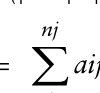
The subjective information of subjects was collected by questionnaire. Sub- jective factors, human visual sensitivity, objective factors, background color and laboratory environment color will interfere with the experiment. There- fore, this paper uses MATLAB procedure to calculate the color contrast and clarity of the image area covered by text. The balance degree of man-machine interface examines the mass balance on both sides of the symmetry axis of the interface, and calculates the difference between the overall weight of elements on both sides of the horizontal and vertical symmetry axis (Zhou, 2013). The calculation formula is: Db · a = 1 −(| wL −wR max(|wL| · |wR|)| + | wT −wB max(|wT| · |wB|)|)/2
Equation reproduced from the original PDF.
Where L, R, T and B represent the left, right, upper and lower of the interface space respectively; aij represents the area of object i in part j; dij represents the distance between the object center line and the interface center line; At the same time, nj represents the number of objects contained in a certain part. Convert such a calculation formula into MATLAB procedure to avoid manual calculation and improve efficiency.
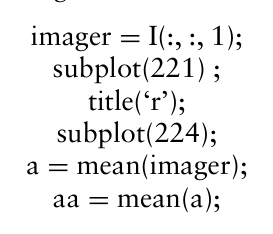
This paper imports the foreground map into Matlab through imread pro- cedure, picks up the RGB values of different colors used in the foreground through imager procedure, imgeg procedure and imgeb procedure, averages them, and obtains an average value. The following procedure describes the process of image R-value average:
Equation reproduced from the original PDF.
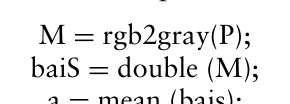
In order to calculate the definition of the overlapping area, first import the foreground image into Matlab and grayscale it, pick up the maximum and minimum grayscale value in the foreground grayscale image and average it to obtain a mean value. The MATLAB procedure used in this step is:
Equation reproduced from the original PDF.
When calculating the overall color balance of the picture, the color compo- site image is imported into Matlab for grayscale processing through imread
Calculation of Color Visual Beauty in the Foreground of Text Coverage 321
Table 1. RGB mean difference.
Table available in the original PDF paper.
Foreground Color System Red Text Orange Text Green Text Blue Text White Text Red 198, 154, 142 198, 142, 142 210, 142, 142 210, 154, 130 198, 142, 130 Blue 134, 174, 220 146, 162, 220 134, 162, 220 146, 174,208 134, 162, 208 Green 160, 161, 162 148, 149, 162 160, 149, 162 148, 161,150 148, 149, 150 Orange 215, 165, 73 207, 154, 80 215, 153, 80 219, 166,68 207,154,68
Table 2. Gray value difference.
Table available in the original PDF paper.
Foreground Color System Red Text Orange Text Green Text Blue Text White Text Red 163 159 166 169 158 Blue 167 160 164 155 1598 Green 158 151 150 161 150 Orange 171 161 165 169 162
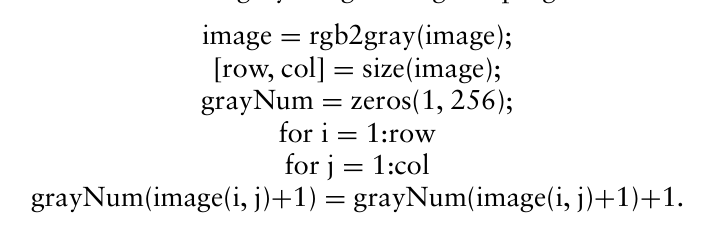
program, and the gray mean value is extracted and compared. The matlab program listed below is the gray image histogram program of visual image:
Equation reproduced from the original PDF.
CONCLUSION
The results of the questionnaire show that the hypothesis is true, but this result is not enough. The evaluation of color by human eyes will be affected by many factors. Import the pictures used in the experiment into the first program in the previous chapter. The objective data analysis is shown in the Table 1.
It can be seen from the data that the greater the difference between the average RGB value of foreground and text color, the stronger the contrast. Import the above pictures into the second and third steps of the previous chapter, and compare the difference between gray values to judge the clarity of the pictures. The data analysis is shown in the Table 2.
After comparing the sharpness, the composite image is directly imported into the third process of the previous chapter, which is divided into left, right, upper and lower parts to judge the color balance of each composite image. The data analysis is shown in the Table 3.
The results of the experimental data show that the subjective feelings of most users are similar to the objective data, indicating that the hypothesis proposed in this paper is tenable. As the color contrast between the text and the foreground in the picture increases, so does the clarity. When the color contrast reaches the maximum value, the clarity may be slightly reduced due
322 Shu
Table 3. Gray value difference.
Table available in the original PDF paper.
Foreground Color System Gray Value of the Left Part Gray Value of the Right Part Red 193 167 Blue 198 143 Green 192 124 Orange 189 144
to too strong color stimulation. At the same time, the color weight of the area where the text covers the foreground increases, and the balance of the picture will also change.
By studying the man-machine interface of rehabilitation robot, color matching suggestions can be given. Color matching shall ensure the clarity of interface text and pictures that want to convey information, otherwise it will reduce the efficiency of information transmission. Appropriate color contrast, especially low saturation color, has been widely welcomed by users. Conclusion the system is not only suitable for the man-machine interface of rehabilitation robot, but also suitable for other medical devices in similar use environment
ACKNOWLEDGMENT
This paper also has more in-depth research. First, the preferred colors of rehabilitation robots with different functions can be considered. Second, the influence of the screen size of the human-computer interface carrier on the results can be considered, such as projection TV.
REFERENCES
Bauerly, M., Liu, Y., 2006. Computational modeling and experimental investigation of effects of compositional elements on interface and design aesthetics. International Journal of Human-Computer Studies 64 (8), 670–682. Chien-Yin Lai, Pai-Hsun Chen, Sheng-Wen Shih, Yili Liu, Jen-Shin Hong, Com-
putational models and experimental investigations of effects of balance and symmetry on the aesthetics of text-overlaid images, International Journal of Human-Computer Studies, Volume 68, Issues 1–2, 2010, Pages 41–56, ISSN 1071-5819, https://doi.org/10.1016/j.ijhcs.2009.08.008. Kailin Zhao. Research on software interface design of household lower limb rehabilitation robot based on Kano model [D] Tianjin: Tianjin University, 2017. Lei Zhou, Chengqi Yue, Tangwen Chen, etc. Aesthetic evaluation method of interface
element layout design[J]. Journal of computer aided design and graphics, 2013, 25(5): 758–766. DOI: 10.3969/j.issn.1003-9775.2013.05.022. Z. Liu and J. Yu, “Prying about the Beauty in Form Principle of Intelligent Multimedia Interface Design,” 2010 International Conference on Intelligent System Design and Engineering Application, Changsha, 2010, pp. 85–90, doi: 10.1109/IS- DEA.2010.354.
LISTED IN THE AHFE DIGITAL BOOKSTORE CATALOGUE
Explore the complete digital volume
Ergonomics In Design
Read this individual research paper free through the original publisher, or explore the full digital proceedings book.
ISBN 978-1-958651-23-0
Explore this ISBN in the AHFE Bookstore ↗Listed in the July 2026 bookstore catalogue; search by ISBN to confirm current availability · Digital book purchase optional