Ziqin Luo, Huixiang Zhang (2023). Children's Experiential Product Design from the Perspective of Aesthetic Education. In: Usability and User Experience. AHFE Open Access, vol. 110, pp. 581–590. https://doi.org/10.54941/ahfe1003234
This study employs advanced methods such as user interviews and behavioral observations to facilitate the practice of aesthetic experience design. The primary objective is to delve into the intricate interactive dynamics between users, environment, and products through diverse experiential encounters, ultimately enhancing user experience and fulfilling their emotional needs. Notably, this paper prioritizes pedagogy and supplements it with design, integrating an aesthetic education perspective that underscores the guidance and cultivation of beauty. By integrating emotional elements into children's experiential product design from an aesthetic education perspective, this approach serves to stimulate emotional resonance and profound experiences among children. Furthermore, it aids in the enhancement of cognitive abilities, the cultivation of comprehensive qualities in various domains, and the fostering of user participation through rich educational elements. This approach holds substantial theoretical and practical significance for design practice and the development of children's products from an aesthetic education standpoint.
After the 19th National Congress, General Secretary Xi Jinping emphasi- zed the work of aesthetic education, Chinese aesthetic education spirit and the Opinions on Playing the important role of Art Education in Ideological and political Education that aesthetic education should not only cultivate students’ aesthetic ability and creativity, but also play a greater role in ideo- logical and political education. From the perspective of the current domestic education development, people pay more attention to the educational sense of children’s experiential products. Many experts believe that contemporary children lack aesthetic and artistic thinking in education, which leads to the lack of diversified culture. In recent years, so many related policy, embodies the party and the country the unprecedented emphasis on aesthetic education, in this context, based on children’s aesthetic education, combined with the characteristics of children experience type products, the domestic 6–8 years old children aesthetic product experience for the design practice, the age of children have strong action perception, through the attention in the process of emotional interaction, acquire knowledge, explore the good experience of open for children.
A SURVEY OF CHILDREN’S AESTHETIC EDUCATION AND ITS EXPERIENTIAL PRODUCTS A Summary of Children’s Aesthetic Education Research
Aesthetic education was first put forward by the famous German poet and philosopher Schiller in his Brief Book of Aesthetic Education, also known as aesthetic education and aesthetic education. Aesthetic education aims to cultivate children’s ability to feel, appreciate, express and create beauty. Under the influence of traditional aesthetic education culture and western educational thought, CAI Yuanpei proposed that according to the national education and the quality of the people, aesthetic education should be placed with real interest, civic morality, nationalism and world outlook in the same important position, and the five education should be promoted. Dan-dan shi (2022) emphasis from the country, schools and individual level inheritance and practice of Chinese traditional aesthetic education culture, expounds the necessity of inheriting aesthetic culture and inheritance path, ritual education aesthetic thought appeared in YaoShun period, xunzi in the “music theory” mentioned “old music and qing, ritual and successful”, he thought that there is nothing more than music perfect harmony and peace, wei and southern dynasties to pay attention to man and nature “neutral”, pay attention to the beauty of the people itself, tang poetry, song ci, yuan is a model of The Times.
Chinese aesthetic education has experienced many stages of development, 1, the ancient traditional aesthetic education period: painting, calligraphy, music, dance, opera, etc.; 2. The period of aesthetic education in the modern education system: China began to introduce western educational concepts and art education mode; 3. From the mid-20th century to the 1970s: the establishment of art schools, Cultivate a large number of professional arti- stic talents; 4. From the 1980s to now: Chinese aesthetic education has experienced the period of aesthetic education curriculum reform, the com- pilation of aesthetic education teaching materials, and the formulation and innovation of laws and regulations on aesthetic education; 5. Since the 21st century: focusing on the multi-cultural, interdisciplinary and cross-cultural art education concept, The development of these stages has promoted the prosperity of Chinese aesthetic education and the cultivation of outstanding artistic talents, table 1 shows the development process of children’s aesthetic education.
APPLICATION STATUS OF CHILDREN’S AESTHETIC EDUCATION IN EXPERIENTIAL PRODUCT DESIGN According to the literature query results of the keyword “children’s aesthetic education”, there are 58 theses, of which 75 are from the online publi- shing database of Chinese academic journals, and the other 8 are from conferences and newspapers. At present, the research on children’s aesthe- tic education mainly focuses on the fields of educational games, multimedia technology and toy design. With the increasing attention of countries to chil- dren’s aesthetic education, the research in these three fields has increased and made remarkable progress. This shows that children’s aesthetic education has
Children’s Experiential Product Design From the Perspective of Aesthetic Education 583
Table 1. Development course of children’s aesthetic education.
Table available in the original PDF paper.
Stage Development characteristics Ancient traditional aesthetic education period
Emphasize the integration of nature and humanity, and think that nature is the inspiration and source of art, and humanity is the expression and carrier of art. By observing natural scenery and imitating the form of characters; Common painting, calligraphy, music, dance, drama and other forms.
With the introduction of modern system, China began to introduce western educational ideas and art education models, and gradually formed modern aesthetic education. Education system.
Aesthetic education period in modern education system From mid-20th century to 1970s
Aesthetic education has been popularized in China, and many fine arts colleges and schools have been established, which have trained a large number of artistic talents and promoted the development of aesthetic education.
From 1980s to present. China’s aesthetic education has gone through a period of aesthetic education reform and innovation, including aesthetic education curriculum reform, the compilation of aesthetic education textbooks, the formulation of aesthetic education laws and regulations, etc., and it pays attention to cultivating students’ aesthetic ability, creativity and comprehensive quality.
21st century to present China’s aesthetic education gradually pays attention to the integration of multi-culture and the cultivation of comprehensive quality, retreats from the interdisciplinary and cross-cultural art education concept, and pays attention to cultivating students’ innovative spirit, aesthetic taste and comprehensive quality.
great development prospect and research value, and attracts more and more researchers to invest in it.
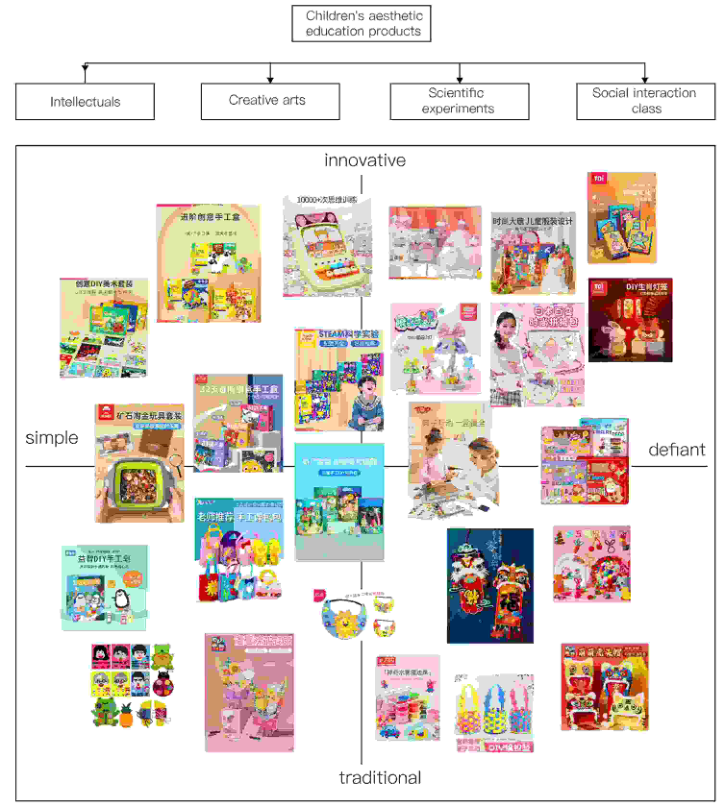
The current research on aesthetic education focuses on the shape and style of products and the design of traditional manual stitching. It directly graf- ted cultural elements with products, but ignores children’s experience design and cognitive ability. As a result, users can only produce some shallow cogni- tion and despise children’s experience. At the IXDA Education Summit, Xin Xiangyang put forward the academic views of “experience as a design object” and “from user experience to experience design”, and shifted the focus of design from the design principles of products and services to the experience itself, starting from the whole experience process, including the environ- ment, products and users. Through market research, children’s products are divided into four categories, including x puzzle, building blocks, and intelli- gence games; y creative art toys, such as painting tools, handicrafts, musical instruments; z Scientific experiment toys, such as chemical experiment box, astronomical telescopes, ecological observation tools; { social interactive toys, such as chess, ball, board games. For the specific product classification, see the visual analysis diagram in Figure 1.
Experience design has gradually become the mainstream of design rese- arch, which has changed from the simple form of design to the attention to users’ feelings and emotions, and attaches importance to the significance
584 Luo and Zhang
Figure 1: Product classification.
of design to life. The research significance of children’s aesthetic education experience design lies in order to provide better learning, games and explora- tion experience, promote children’s comprehensive development and growth, and at the same time, cultivate social skills and emotional intelligence, and promote the development of physical and mental health. This is very worth the energy and resources, because it is about the growth and development of children, but also about the future of society. Zhang Fan (2022) discusses the necessity of introducing multi-sensory experience design based on the phy- sical and mental change law of children’s behavior development. Children’s cognition and experience mode are different from those of adults. Therefore, multisensory experience should be considered in the design, so as to improve their reading interest and understanding ability, and enrich the parent-child reading experience Zhang Fan. Design of multisensory experiences in paper
Children’s Experiential Product Design From the Perspective of Aesthetic Education 585
children’s picture books based on behavioral development [J]. Packaging Engineering, 2022,43 (02): 179–185.; Xu Yanchang (2017) discusses and analyzes the innovative design strategy of smartphone video APP interactive experience design from the perspective of traditional culture, user cogni- tion and behavior, user experience elements, on the basis of respecting user cognition and behavior rules, grasp the elements of user experience design, and realize design innovation and breakthrough Xu Yanchang. Convergence analysis of interactive experience design of smartphone video APP.
DEVELOPMENT STATUS OF CHILDREN’S AESTHETIC EDUCATION PRODUCTS With the popularization of children’s aesthetic education, people pay more attention to the research of product design with educational function. Chil- dren’s products in the market are counted and divided into four categories: picture books, toys, teaching AIDS, and education APP. These educatio- nal products can promote the development of children’s language, com- munication, learning, physical skills, and help cultivate habits and shape personality.
Picture Book In the information society, the aesthetic education of picture books, by com- bining augmented reality technology, shapes the traditional static text and pictures through natural interaction, so as to make the information more vivid and visual. The study by Li Xiangyuan et al. (2010) discussed the influence of the interactive design of books on children’s reading. The expe- rimental results found that the olfactory interaction, folding interaction and pulling interaction related to physical activity are more popular with children and affect children’s reading behavior. This interactive design makes reading picture books more interesting and fascinating, stimulates children’s interest and imagination, enriches their reading experience, and thus promotes the innovation and development of aesthetic education of picture books in the information society.
Toys Children’s toys can be combined with educational content, educational meth- ods, and scientific and technological means, so as to achieve the purpose of education. x The combination of educational content: combine chil- dren’s toys with educational content, such as science, art, history and other knowledge into toys; y Based on the combination of educational meth- ods: combine children’s toys with educational methods, such as role playing, gamification learning and other ways, to guide children to participate in inte- raction, cooperation and exploration, so as to cultivate their cognitive, social and emotional control ability, such as role-playing toys, puzzle games. z Based on the combination of scientific and technological means: the com- bination of children’s toys and scientific and technological means, such as augmented reality, virtual reality, programming and other technologies, so
586 Luo and Zhang
that children can experience novel technology applications in play, such as augmented reality toys, programming education toys, etc.
Teaching AIDS Children’s teaching AIDS products are educational AIDS or learning materi- als specially designed and manufactured specifically for children, which are designed to promote the development of children’s cognitive, language, social, sports and creativity. These products are usually child-friendly designs and materials, including picture books, mental puzzles, building blocks, Musical Instruments, scientific experiment equipment, handicrafts, graffiti tools, lear- ning cards, pinyin cards, digital cards, etc. The diversity and playability of teaching AIDS can meet the needs of different children and promote them to have a richer artistic experience. In addition, market demand, social and cultural environment and educational policies also have an impact on the production and application of children’s teaching AIDS products, helping children to cultivate their artistic interest, aesthetic concepts and creati- vity, and promoting the development of their comprehensive quality-oriented education.
Educational APP By integrating rich educational content and interactive gamification design, the APP provides a new learning method for children, covering a wealth of educational content, including language, mathematics, science, art and other disciplines. Through rich interactive educational resources, children can carry out interesting learning activities in the APP, so as to stimulate their inte- rest and enthusiasm in learning. Children’s education APP also focuses on personalized and adaptive learning. APP can provide different levels of lear- ning content and learning path according to children’s age, learning level and subject needs, so that children can make independent choices and learning arrangements according to their own conditions, so as to meet the learning needs of different children.
EXPERIENCE DESIGN METHOD OF CHILDREN’S AESTHETIC EDUCATION PRODUCTS Graduate students from the School of Engineering and Design of Hunan Normal University conducted an experience design experiment on tiger hat products in the clothing building, and invited 6 children to experience it in the classroom. In children’s aesthetic education product design strategy, to the user, environment and products on the basis of interaction, this is a common way of strategy, through the situation, artistic conception and environment analyzed the relationship between the user and the product, this is an impor- tant link in the product development process, situation experience design by creating a specific situation to describe the relationship between the user and the product.
Children’s Experiential Product Design From the Perspective of Aesthetic Education 587
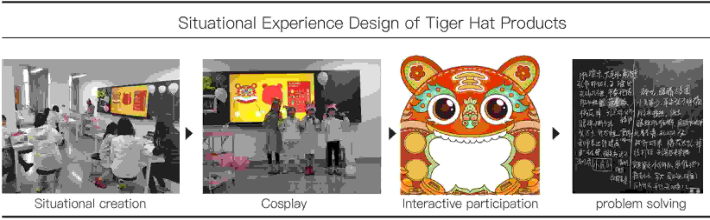
Situational Experience-Emotion Children’s situational experience design is a child-centered design method. By simulating real situations or situations, children can experience and learn in the interaction. This design method enables children to explore the environ- ments, situations or activities in the context and promote the comprehensive development of cognition, emotion, social and motor. As shown in Figure 2: Take the tiger hat product experience as an example, the following steps were taken in the experiment: x Situation creation: create the situation by integrating the warm tiger background music, arranging the site in adva- nce, and playing the tiger hat story film; y Role play: children can tiger role play and participate; z interactive participation: divide six children into two groups to encourage children to have interactive participation; { problem solution: after the end, the experience can put forward their own suggestions and opinions, and get effective feedback mechanism.
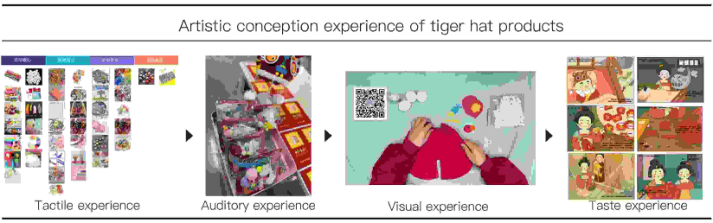
Artistic Experience-Educational Children’s artistic conception experience design is a design method that allows children to explore and learn creativity, art and aesthetics in emotional experience by creating an artistic and emotional resonance environment. As shown in Figure 3: x Touch: through rich texture materials, such as cotton, bells, etc.; y Smell: designed with fragrant sachets as materials; (3) Hearing: in the process of tiger hat experience, the unique situation and atmosphere are created by making picture book sound effects, making tiger sounds, leaves sounds and raining sounds; { Vision: Through exquisite painting, illustra- tion, graphics and color matching, it creates visual pleasure and attraction, thus guiding the experiencer into a specific situation and atmosphere. This design method focuses on perception, experience and expression.
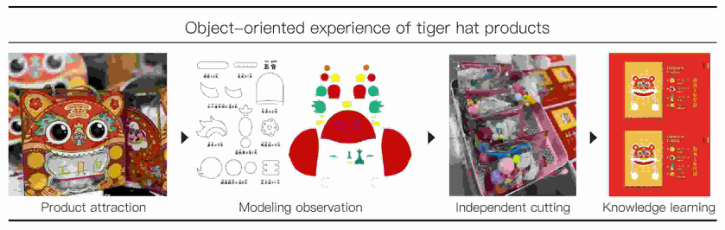
Physical Experience-Fun The ential design of children’s environment is a design method that encoura- ges children to explore, interact, learn and create independently by creating rich material environment and situational background. As shown in the figure: in the process of tiger hat product experience, the sensory interaction, product material, form, color, shape, decoration and other links have been
Figure 2: Situational experiential design.
588 Luo and Zhang
Figure 3: Artistic conception experience design.
carefully designed. x When children get the product, they attract the atten- tion of users through bright colors and packaging. y Children expand the imagination space. z uses the specific cultural symbols, traditional elements or regional characteristics to combine the situation with the specific cultural connotation to create a unique cultural atmosphere, so that the experiencer can deeply understand and experience the emotional connotation of the spe- cific culture. As an intangible cultural heritage, the five poison culture of tiger hat should be carried forward. The experiential design of children’s physical environment focuses on providing children with rich, diverse and inspiring materials and situations, stimulating their interest, imagination and creati- vity, and promoting their active participation and all-round development. As shown in Figure 4.
The user experience map shows the individual experience of users in stages in a visual way, and excavates the internal needs of users through the analysis of each node. Taking the experience of Tiger Hat products as an example, based on the investigation and analysis of children’s personal situation, this paper analyzes and combs children’s main behaviors and emotions by using the experience map to find out the pain points and user needs of rural children in the process of using existing educational products, as shown in the figure.
On the activity line of “before production-during production-after produ- ction”, there are key behavior points that warrant closer examination. These points can be classified into positive and negative categories. The positive points can be referred to as excitement points, which can stimulate children’s spontaneous activities. Children’s emotions reach the first high point when
Figure 4: Physical experience design.
Children’s Experiential Product Design From the Perspective of Aesthetic Education 589
they open the material package, expressing their enthusiasm after observing the product and touching the material. Upon realizing that they can obtain a hat of their own upon completion, they become even more excited. The hairball represents another emotional high point, where children will cheer, dance, and observe the progress of other children nearby after completing this step and receiving a tiger hat as a reward. The sticking decoration phase represents an emotional demand point, which is particularly significant for rural children who lack emotional interaction. Overcoming obstacles and completing the activity with the encouragement of others is a satisfying expe- rience that forms the climax of the entire activity. During this time, children will actively engage with their surroundings and form the optimal state for creation, communication, and learning.
Conversely, negative points can reduce children’s satisfaction and the ove- rall value of the product. The presence of obstacles, such as a lack of tools, sticky hands, an inability to find the corresponding holes in time, or poor needle and thread operation can cause children to give up and ultimately result in a negative experience. This can undermine the educational function of the product. As demonstrated in the picture on the right, the overall experience of the tiger hat activity was positive. It is evident that targe- ted educational product design can guide children’s physical behavior, foster emotional interaction, and improve their abilities.
CLOUDE In contemporary education, aesthetic education has become an indispensa- ble means of cultivating children’s creativity and imagination. Since children represent the future and hope, aesthetic education plays a vital role in their overall development. To facilitate the advancement of aesthetic education, an increasing number of educational products adopt an experiential approach to cater to children’s learning and growth needs. In the process of situational
590 Luo and Zhang
experience, artistic conception experience, and physical environment experi- ence design, designers must gain a deep understanding of children’s cognitive and perceptual mechanisms to create educational products that are better ali- gned with their cognitive patterns. Only through such an approach can we effectively promote the development of aesthetic education and maximize its benefits for children’s growth.
The practice of aesthetic education has demonstrated the immense poten- tial of art in fostering children’s boundless imagination and creativity. Through the creation of experiential education products, designers can create an environment in which children can learn while playing and enhance their artistic abilities and creative expression. To ensure that children truly enjoy the learning process, such products must prioritize the emotional experiences of children from a child’s perspective. Thus, the design of children’s experien- tial education products must focus on cultivating children’s aesthetic ability and artistic accomplishments, and ensure that children’s emotional experi- ences are adequately considered. By adopting such a design approach, we can effectively promote the development of aesthetic education and provide a better foundation for the growth and future of our children.
REFERENCES
Gao Liyan, Fang Shu. Research on Children’s Product Packaging Based on Emotional Design [J]. Packaging Engineering, 2020, 41 (02): 104–108. DOI: 10.19554/j.cnki.1001–3563.2020.02.015. He Guozhen, Ding Shiyao. Research on the innovation of aesthetic edu- cation teaching mode under the thinking of double-drilling model design [J]. Packaging Engineering, 2022, 43 (S1): 348–353+361. doi: 10.19554/j.cnki.1001–3563.2022.s1.059. Li Fangyu, Zhou Le. Research on the design of rural children’s educational products
from the perspective of embodied cognition [J]. Packaging Engineering, 2020, 41 (16): 154–163. DOI: 10.19554/j.cnki.1001–3563.2020.16.023. Shi Dandan. Research on the Inheritance Path of Chinese Excellent Traditional Aesthetic Education Culture [J]. Chinese Character Culture, 2022 (23): 172–174. DOI: 10.14014/j.cnki.cn11-2597/g 2.2022.23.043. Wang Yanqun, Zhang Bingchen, Song Lishu, Xie Shuxin. Research on the pro-
duct design of interactive children’s playing teaching AIDS based on inte- rest guidance [J]. Packaging Engineering, 2018, 39 (02): 119–123. DOI: 10.19554/j.cnki.1001–351. Xia Bing, Guo Yantong. Research on the Aesthetic Value of Contemporary Gaming Packaging [J]. Packaging Engineering, 2020, 41 (22): 207–210+257. DOI: 10.19554/j.cnki.1001–3563.2020.22.033. Xu Yanzhang. Analysis on the Convergence of Interactive Experience Design
of Smart Phone Video APP [J]. Packaging Engineering, 2017, 38(10): 128–132. DOI:10.19554/j.cnki.1001–3563.2017.10.029. Yang Yixue, Cao Jujiang. Analysis of design elements of children’s electronic products under experience design [J]. Packaging Engineering, 2012, 33 (02): 86–88+115. doi: 10.19554/j.cnki.1001–3563.2012.02. Zhang Fan. Multi-sensory experience design of paper children’s picture books based
Read this individual research paper free through the original publisher, or explore the full digital proceedings book.
ISBN 978-1-958651-86-5
Explore this ISBN in the AHFE Bookstore ↗Listed in the July 2026 bookstore catalogue; search by ISBN to confirm current availability · Digital book purchase optional