Xin Tian, Shijian Luo, Zhengtang Tan, Huixiang Zhang, Hui Cheng, Chunxiao Zhu, Yao wang, Huan Lin, Fang Cong (2023). From Concept to Framework: Construction of Evaluation Index Framework for Intelligent Home Appliance Design under the Context of AIGC. In: Human-Centered Design and User Experience. AHFE Open Access, vol. 114, pp. 211–221. https://doi.org/10.54941/ahfe1004238
1 Department of Industrial Design, College of Computer Science and Technology Zhejiang University, Hangzhou 310027, China; College of Management, Guizhou University, Guiyang 550025, China ↗
2 Department of Industrial Design, College of Computer Science and Technology, Zhejiang University, Hangzhou 310027, China ↗
3 College of Engineering and Design, Hunan Normal University, Changsha, 410081, China ↗
4 School of Business, University of Nottingham Ningbo China, Ningbo 315000, China ↗
5 College of Mechanical Engineering, Quzhou University, Quzhou 324000, China ↗
With the development of artificial intelligence, the production method of automatically generating content using AI technology has been continuously evolving. AI-generated content (AIGC) has rapidly emerged and plays a significant role in the design and development of smart home appliances. However, there hasn't been a systematic discussion on the evaluation index framework for smart home appliance design under the influence of AIGC. In this study, based on the popularity and essentiality of home appliance categories, we selected washing machines as the research object. With a research time span from 1980 to 2023, we conducted a systematic review of 427 publications and analyzed 52 core articles. Through the extraction of high-frequency vocabulary related to design evaluation in the literature, we obtained multiple key evaluation index keywords. By combining user interviews, expert interviews, and focus group experiments, we summarized the key evaluation index keywords and found that the design evaluation can be conducted from three dimensions: form, function, and experience. Based on this framework, we further categorized and classified the involved indicator items into hierarchies and categories, forming a design evaluation index framework to guide designers in their work.
generate a large number of design images provides designers with more choices and enhances creativity (Goodfellow et al., 2014). However, it has also created a dilemma for designers in terms of decision-making and choice. Thus, it becomes crucial to effectively evaluate designs generated with the assistance of AIGC.
In addition to aiding in the intelligent generation of product designs, AIGC can also provide personalized services based on user usage habits, potentially transforming home appliances from passive to proactive. This shift in trend also affects the evaluation criteria for smart home appliances, moving away from performance and quality towards aspects such as CMF (Color, Mate- rial, and Finish) and user experience. There is an increasing emphasis on the experiential requirements of products that offer intelligent and precise ser- vices. Understanding these evaluation criteria can assist designers in aligning their designs with the new demands brought about by emerging technologies.
However, there is a relative lack of systematic research on the evaluation index framework for smart home appliance design in the context of AIGC. In this study, we focus on washing machines as a representative research object due to their popularity and essentiality among home appliances. Our objective is to construct a comprehensive evaluation index framework for intelligent washing machine design and provide designers with a practical and instructive design evaluation guide.
A REVIEW OF DESIGN EVALUATION CRITERIA RESEARCH Designing the Collection and Analysis of Evaluation Indicators
The relationship between home appliance design and evaluation criteria has been extensively explored and published in various journals, conference papers, and books. To conduct a literature review, we employed a system- atic review approach proposed by Tranfield, Denyer, and Smart (2003). The search was conducted using specific keywords and keyword combinations, as shown in Table 1 (Tranfield et al., 2003).
Table 1. Keywords for literature search.
Table available in the original PDF paper.
Search topics Product design Evaluation indicators Examples of search terms
Indicators, evaluation indicators, aesthetic indicators, washer,washing machine, kansei theory
Designing an Evaluation AND Indicators,Design Evaluation AND Evaluation Indicators OR aesthetic indicators AND design guidelines, AND washer,washing machine, kansei theory
A preliminary search through databases such as Web of Science, Google Scholar, and CNKI initially yielded a total of 683 English and Chinese lit- erature sources. After manual deduplication and the exclusion of irrelevant articles, we obtained 427 foundational articles. To ensure the relevance of
From Concept to Framework: Construction of Evaluation Index Framework 213
the literature, we reviewed abstracts and figures (Blizzard & Klotz, 2012; Easterby-Smith et al., 2018), narrowing down the selection to 213 items. Through a thorough reading of the full texts, we identified the evaluation dimensions, attributes, and indicators of design evaluation, resulting in a final selection of 52 core papers (Delaney et al., 2022).
Figure 1: Literature screening process.
Review of Evaluation Indicators Based on the core literature review, the evaluation dimensions of the “wash- ing machine” can be categorized into three aspects: product functionality, product form, and product experience (Table 2), in line with the evolution of product features and attributes.
Table 2. Summary table of evaluation indicators.
Table available in the original PDF paper.
Evaluation attributes Evaluation indicators Evaluation dimensions Product Features Product Forms Product Experience Function, Structure, efficiency Personalized design eco-design Sensory Experience, Emotional Experience Interaction Design Strategies Humanization Design Performance parameters, utility, functional structure optimization, etc. Overall form (form, shape, color, etc.), visual attributes, user scenarios, ecology, sensory characteristics, environmental suitability, etc. Differences in subjective needs: safety, practicality, effectiveness, emotionality durability and information service support, comfort of use, etc. Micro-interaction, humanization (ageing), intelligent manufacturing [home integration, simplicity, humanization, as well as high adaptability, customer satisfaction intelligent, compatible, etc.]
Evaluation Indicators for Product Functionality The washing machine was initially designed as a traditional household appliance with the primary functions of “laundry washing” and “simpli- fying housework.” The evaluation of washing machines primarily focuses on indicators related to product functionality, performance, and efficiency.
Jiahua Yang (1982) and Aizhen Wang (1983) summarized the design require- ments and principles of washing machines, including safety, washability, fabric damage rate, rinsing performance, dehydration rate, ease of operation, environmental adaptability, economy, functional diversity, standardization, serialization, and generalization (in the industrial era). Additionally, they emphasized the simplicity of structure, attractiveness of appearance, and con- sistency of key component lifespan. Wu Kun (2017) applied the theory of functional aesthetics, emphasizing the functional aesthetic characteristics of product form, such as safety, usability, rationality, workmanship, and econ- omy. Xu Yanyan (2016), Song Guanyi (2017), and others proposed indicators to measure the cleaning effectiveness of washing machines and the degree of clothing damage, including clean ratio, evenness of cleaning, and rinsing effi- ciency. Yuan Quan et al. (2019) determined noise indicators, including sound intensity, loudness level, sharpness, roughness, and judder intensity. Zhang Jun et al. (2020) evaluated the durability of washing machines based on indi- cators such as repairability, design reliability, lifespan, vibration intensity, and noise level. Rainer Stamminger et al. (2020) selected total energy con- sumption, total water consumption, washing time, pumping performance, and washing results as evaluation factors for durability. Ye Rui, Liu Lei, and others (2021) evaluated the dynamic performance of washing machines based on indicators such as vibration amplitude, abnormal vibration, delay, dehydration completion rate, and average rotational speed. The aforemen- tioned studies primarily focus on evaluating the functionality and efficiency optimization of the “washing machine” and similar household appliances. The indicators mainly concentrate on cleanliness, structural optimization, energy consumption, and environmental protection. These studies provide important references for determining the functional indicators of washing machines.
Focus on Evaluation Metrics in the Form of Products With the increasing demand for product personalization and environmen- tal adaptability from consumers, design patterns such as personalized design and ecological design have emerged. In this stage, the evaluation indicators for washing machine products mainly focus on three dimensions of aesthetic design ontology: artifact, visual attributes, and aesthetic design principles. Huicong Hu et al. (2022) proposed these dimensions and emphasized the development trend of sensory attributes and the importance of their rela- tionship. He Huang et al. (2018) focused on the product’s form attributes, specifically the body and styling elements. Zhang Wensheng (2007) and Han Chun-ming (2018) found that appearance factors, such as proportion, color, material, and decoration, can elicit different psychological responses from users.
Additionally, research on washing machine design is increasingly focus- ing on the ecological aspects of the product in relation to the environ- ment. This includes considering indicators related to resources, energy, environment, and technology. Li Jing-li (2016) proposed a green compre- hensive evaluation model based on FRT/Fuzzy. Chen Deqing and other scholars constructed a comprehensive evaluation index system and model
From Concept to Framework: Construction of Evaluation Index Framework 215
for greenness. Lu Jianguo proposed ecological design assessment indi- cators for smart washing machines. Li Wang xi and Zhang Ling hao (2011) identified usability, economy, rationality, and purposefulness as the design elements of washing machines for low-end users in small space scenarios.
Therefore, in addition to meeting functional utility and commercial attributes, home appliance products should also consider the sensory reac- tions brought about by the appearance form and the ecological and adaptive properties to the scene and environment. This is important to ensure market acceptance of the products.
Evaluation Indicators for Focusing on Product Interaction Experience With the continuous development of artificial intelligence technology, wash- ing machines have transformed into electronic devices that provide intel- ligent, convenient, and efficient solutions for home life. The content of design evaluation indicators has gradually shifted towards factors such as product interaction, experience, and emotion. WU (2016) and others have developed multiple aesthetic indicators for the micro-interaction inter- face of washing machines. They propose aesthetic indicators for interface layout, color, and interface consistency. Huang Sheng, Zhang Linghao, and others (2015) have put forward effectiveness and experiential indica- tors, summarizing the design principles of visual user experience for hard interfaces. These principles include user-centeredness, user behavior flow, user importance and probability, hierarchy principle, experiential principle, brand principle, and human-computer interaction index. Interaction design (Liu, Z. 2016) emphasizes the efficiency and satisfaction indicators of the product.
Furthermore, humanized design and user satisfaction are also empha- sized. This includes considering visual, auditory, and tactile factors, as well as indicators of product safety, practicality, effectiveness, and emo- tion. Research by Kleiss, James A. (2008) found that providing a light and smooth tactile experience can increase user pleasure. Hak-Seon Kim and oth- ers (2019) emphasized the impact of cleaning quality, service failures, cyclic operation issues, product faults, musty odor, detergent issues, and various functions on customer satisfaction. Kim et al. (2019) listed these factors as satisfaction-related evaluation indicators. Liu Zhi-qiang (2020) proposed that convenience can enhance user satisfaction. Cao Zhi (2012) evaluated modern smart home appliances based on indicators such as network func- tionization, intelligence, compatibility, green environmental protection, and ease of use. They believe that future smart home appliances will develop towards multiple intelligence, interactive intelligent control, openness, and energy efficiency.
It can be observed that the evaluation of washing machine design has evolved from emphasizing functionality and structural optimization to enhancing emotional and sensory experiences. It then shifted towards focus- ing on service experience, scene segmentation, and intelligent interaction experience. Ultimately, the evaluation has moved towards achieving harmony and symbiosis with individuals, the environment, and society. This shift has
resulted in a transition from single usability evaluation to multidimensional evaluation, with a focus on user needs, social concerns, experience, and intelligent interaction.
In the context of Artificial Intelligence in Generalized Computing (AIGC), smart home appliances are transitioning from passive tools to active ser- vices. Therefore, design should place greater emphasis on user person- ality, interests, and usage habits. It should satisfy comprehensive eval- uations of aesthetics, functionality, emotional needs, and interaction experience.
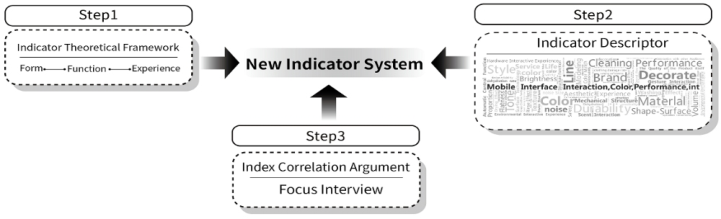
DESIGN EVALUATION INDEX FRAMEWORK CONSTRUCTION The process of constructing the index framework involves three steps:
Step 1: Establish the theoretical framework for indicators based on the analysis of core literature. This framework should encompass form, func- tionality, and experience.
Step 2: Extract 93 indicator descriptors from the literature as candidates for secondary and tertiary indicators.
Step 3: Establish a connection between the indicator descriptors and the theoretical framework to facilitate the design evaluation application. This step entails revising and supplementing the indicator descriptors through interviews with experts and users. Subsequently, construct the second-level and third-level indicators associated with the theoretical framework through focused interviews.
Figure 2: Indicator framework construction process.
Explanation of the Indicator Theoretical Framework The essence of design is to create artifacts according to aesthetic prin- ciples (Gan and Xu, 2010). Based on the functional-formal coordinate system as a theoretical foundation (Vogel and Cagan, 2008), combined with new user demands driven by AI and IoT technology transitioning from passive response to proactive precision service, the design evaluation theo- retical framework for intelligent home appliances, exemplified by washing machines, can be summarized as functional beauty, formal beauty, and experiential beauty. These three aspects are considered primary evaluation indicators.
From Concept to Framework: Construction of Evaluation Index Framework 217
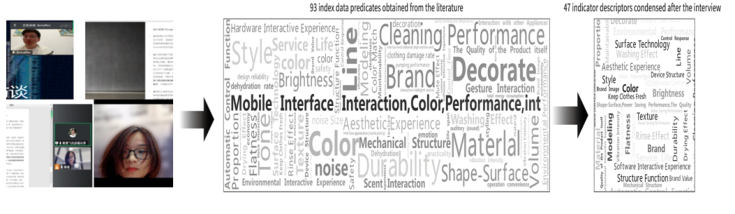
Optimization of Indicator Frequency Items Using word cloud software, 93 indicator descriptors were extracted from the core literature. Through expert and user interviews, duplicate synonyms were eliminated, and the necessity of each descriptor was prioritized. Eventually, 49 indicator descriptors were chosen. The expert interviews involved a total of 12 experts, consisting of 4 senior designers with 10 years of experience from mainstream Chinese home appliance brands such as Midea, Panasonic, Whirlpool, and TCL, as well as 8 experts from universities and research institutions with over 10 years of experience in industrial design and management. Among them, 20% held senior professional titles, while 80% held intermediate professional titles.
User interviews were conducted with 10 randomly selected individuals who had purchased washing machines from shopping malls. The intervie- wees represented different age groups, including the elderly, middle-aged, and young generations. Through these user interviews, the indicators selected from the expert interviews were further validated. As a result, the initial 93 indicator descriptors were narrowed down to 49.
Figure 3: Indicator framework construction process.
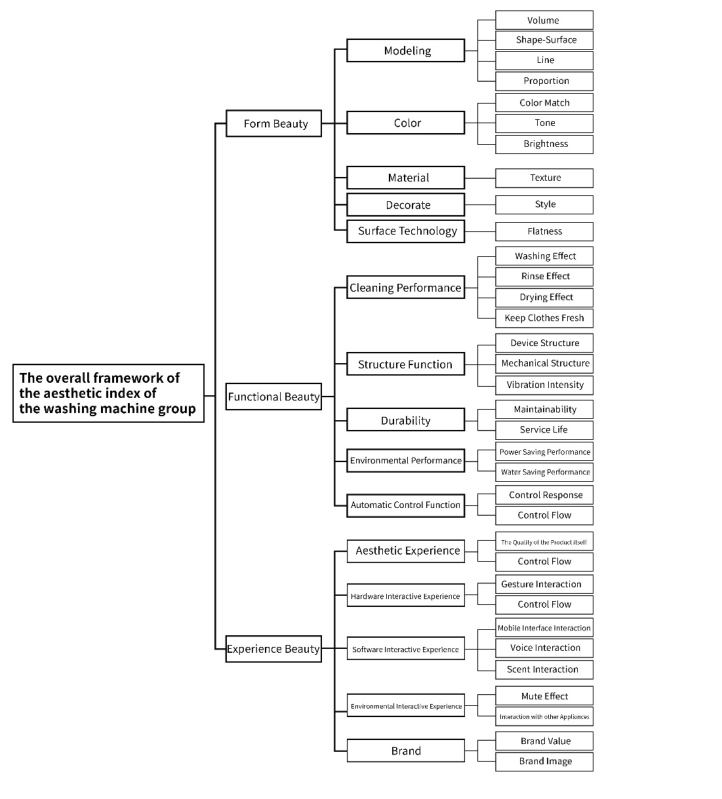
Association and Categorization of Indicator Levels To establish the association between indicator descriptors and the theo- retical framework, focused interviews were conducted with 8 user expe- rience designers who had more than 5 years of design experience. The eight professional designers were randomly divided into four groups, and through focus group interviews, the indicators provided by the experts were further classified and ranked. The necessity and importance of each level of evaluation indicators for washing machines were thor- oughly discussed. After two rounds of integration and summarization, a total of 3 primary evaluation indicators, 15 secondary evaluation indica- tors, and 34 tertiary evaluation indicators were obtained. The indicators were then categorized accordingly. Please refer to Figure 4 for detailed information.
Figure 4: General framework diagram of the washing machine design evaluation indicator framework.
CONCLUSION
This study conducted a comprehensive evaluation of smart home appli- ance design, using washing machines as a representative example, through three aspects of innovation: perspective innovation, content innovation, and evaluation innovation. It has constructed a comprehensive and practical eval- uation indicator framework that provides valuable guidance for smart home appliance design.
In terms of perspective innovation, we have taken into account the views and needs of participants in the AIGC era of smart home appliance design, integrating the opinions of users, designers, engineers, and other stakehold- ers to form a comprehensive and inclusive evaluation perspective. This helps ensure the comprehensiveness and objectivity of design evaluation, better meeting the expectations of all parties involved.
From Concept to Framework: Construction of Evaluation Index Framework 219
In terms of content innovation, we have built a multi-level indicator framework to meet the requirements of smart home appliance design in the AIGC era. The framework includes three primary indicators: aesthetic form, functional beauty, and experiential beauty, which are further divided into secondary and tertiary indicators to provide more specific and systematic design evaluation methods. Through this hierarchical indicator system, we can more accurately evaluate various aspects of design, thereby promoting improvement and innovation in design.
In terms of evaluation innovation, we pay special attention to the usage scenarios and detailed demands of products. We extend the evaluation indi- cators to the level of detail to make the evaluation results more accurate and refined, and to provide more practical guidance for designers. By focusing on details, we can better grasp the needs and preferences of users, thereby improving the quality and practicality of design.
However, this study also has some limitations. We need further verification and optimization of the framework to adapt to the product characteristics and usage requirements of different categories of smart home appliances. Only in this way can we ensure the applicability and effectiveness of the evaluation framework.
In summary, this study provides a comprehensive and practical indicator framework for the design evaluation of washing machine products in the AIGC era of smart home appliances. This framework helps meet the needs of different stakeholders and guides the development of smart home appli- ance design towards a closer alignment with user needs and market trends. By considering various perspectives, focusing on details, and using a hierar- chical evaluation approach, we can promote innovation and improvement in smart home appliance design, enhance user experience, and drive industry development. In the future, we will further refine this framework to adapt to the ever-changing technological and market requirements, providing better guidance and support for smart home appliance design.
ACKNOWLEDGMENT
The work was supported by the Zhejiang Social Science Foundation, research on the realization path of creative design integrating intelligent technology to enhance new economic dynamics (No. 21XXJC01ZD).
REFERENCES
Blizzard, J. L. & Klotz, L. E. 2012. A framework for sustainable whole systems design.
Design Studies 33, 456–479. Cao, Z. (2012). Research on interactive design of smart home appliances, Doctoral dissertation, Shenyang Aerospace University. Cagan, J., & Vogel, C. (2018). Creating Breakthrough Products: Revealing the
Secrets that Drive Global Innovation, Beijing: Machinery Industry Press No. 2. Delaney, E., Liu, W., Zhu, Z., Xu, Y., & Dai, J. S. (2022). The investigation of environmental sustainability within product design: a critical review. Design Science, 8, e15.
Easterby-Smith, M., Thorpe, R., Jackson, P. R. & Jaspersen, L. J. 2018. Management and Business Research. Sage. Hu, H., Liu, Y., Lu, W. F., & Guo, X. (2022). A quantitative aesthetic measurement
method for product appearance design. Advanced Engineering Informatics, 53, 101644. Huang, H., Yang, M., & Lv, T. (2018). Ergonomic analysis of washing machines for elderly people: A focus group-based study. International Journal of Industrial Ergonomics, 68, 211–221. Han, C., Li, Y., Zhu, Y., & Zhang, B. (2000). New features of product styling design
from the perspective of washing machine modification design. Journal of Hefei University of Technology: Natural Science Edition, (z1), 866–868. Huang, S., Zhang, L., & Cao, M. (2015). Research on hard interface design of pulsator washing machine based on information visual logic. Decoration, (3), 94–95. Huang, S., & Zhang, L. (2015). Research on VUX (Visual User Experience) sys-
tem design for hard interface of drum washing machine. Packaging Engineering, 36(20), 79–83. Goodfellow, I., Pouget-Abadie, J., Mirza, M., Xu, B., Warde-Farley, D., Ozair, S.,...
& Bengio, Y. (2014). Generative adversarial nets. Advances in neural information processing systems, 27. Gan, Q., & Xu, R. (2010). Aesthetic evaluation of product design. Journal of Shandong University of Art and Design, (2), 75–78. Kleiss, J. A. (2008, September). Sensory quality evaluation of clothes washing
machine selector knobs. In Proceedings of the Human Factors and Ergonomics Society Annual Meeting (Vol. 52, No. 20, pp. 1687–1691). Sage CA: Los Angeles, CA: SAGE Publications. Kim, H. S., & Noh, Y. (2019). Elicitation of design factors through big data analysis of online customer reviews for washing machines. Journal of Mechanical Science and Technology, 33, 2785–2795. Li, J. (2016). Research on green product innovation design based on TRIZ/FRT/-
Fuzzy (Doctoral dissertation). Shandong University. Li, W., & Zhang, L. (2011). Exploration of washing machine design under the research of residents’ living patterns in affordable housing. Packaging Engineering, 32(18), 58–61. Liu, Z. (2016). Research on information visualization design method from the
perspective of user needs. Packaging Engineering, 37(16), 1–5. Liu, Z. (2020). Optimization design of washing machine interactive panel based on user research. Packaging Engineering and Design, 41(16), 111–115. Song, G. (2017). Selection of laundry performance indicators based on Analytic
Hierarchy Process. Science and Technology Innovation Herald, 14(16), 135–136. Stamminger, R., Bues, A., Alfieri, F., & Cordella, M. (2020). Durability of washing machines under real life conditions: Definition and application of a testing procedure. Journal of cleaner production, 261, 121222. Tranfield, D., Denyer, D., & Smart, P. (2003). Towards a methodology for developing
evidence-informed management knowledge by means of systematic review. British journal of management, 14(3), 207–222. Wang, A. (1983). On the design and calculation of washing machines. Household Appliance Technology, 1983(6), 13–15. Wu, K. (2016). Design research on electric heating tables based on emotional design
and functional aesthetics. Furniture and Interior Decoration, (1), 66–68.
From Concept to Framework: Construction of Evaluation Index Framework 221
Wu, D. (2016, September). Research on the micro-interactive interface design of intelligent washing machines in IOT environment. In 2016 22nd International Conference on Automation and Computing (ICAC) (pp. 479–487). IEEE. Xu, Y., Xue, Y., & Gao, X. (2016). Research on washing performance of washing
machines based on AHP. Petrochemical Technology, 23(7), 147–148 Yuan, Q., Hu, Y., Cui, X., & Wu, Y. (2019). A brief discussion on the durability performance design and evaluation of drum washing machines. Proceedings of the 2019 China Household Appliance Technology Conference. Yang, J. (1982). Performance characteristics and basic design requirements of
washing machines. Household Appliance Technology, 1982(2), 7–12+45. Ye, R., Liu, L., Li, X., Liu, J., & Wen, J. (2021). Research and application of dynamic performance design and evaluation method for drum washing machines. In Proceedings of the 2021 China Household Appliance Technology Conference (pp. 988–991). Zhong, A., Zhang, M., Li, Y., Zhang, J., et al. (2019). A brief discussion on the dura-
bility performance design and evaluation of drum washing machines. Proceedings of the 2019 China Household Appliance Technology Conference. Zhang, W. (2007). Study on the design elements of drum washing machine styling (Doctoral dissertation). Hefei University of Technology.
LISTED IN THE AHFE DIGITAL BOOKSTORE CATALOGUE
Explore the complete digital volume
Human-Centered Design and User Experience
Read this individual research paper free through the original publisher, or explore the full digital proceedings book.
ISBN 978-1-958651-90-2
Explore this ISBN in the AHFE Bookstore ↗Listed in the July 2026 bookstore catalogue; search by ISBN to confirm current availability · Digital book purchase optional