Zhengtang Tan, Yufan Zhou, Shuang Lin, Meizhen Den, Zhuyun Yuan, Shunshun Tang (2024). Types of children's cultural and creative products based on card sorting method. In: Ergonomics In Design. AHFE Open Access, vol. 129, pp. 163–172. https://doi.org/10.54941/ahfe1004821
1 College of Engineering and Design, Hunan Normal University, Changsha, China; Institute of Interdisciplinary Studies, Hunan Normal University, Changsha, China ↗
2 College of Engineering and Design, Hunan Normal University, Changsha, China ↗
3 School of Art & Design, Taizhou University, Taizhou, China ↗
Children's cultural and creative products, designed specifically for the child demographic, aim to subtly influence children by integrating high-quality cultural resources through diverse design techniques. These products help children understand cultural content such as history, geography, local customs, and artistic aesthetics, thereby fostering cultural confidence. Despite the wide range of children's cultural and creative products, including educational toys and cultural heritage tools, there is a lack of a scientific and systematic method for classifying these products. This gap affects the accuracy of product design and market positioning, as well as limits the potential for product innovation. To address this issue, this study introduces an innovative card classification method aimed at establishing a scientific framework for classifying children's cultural and creative products, thereby enhancing the precision and innovation of product design.In this study, we first collected and created 20 cards representing different children's cultural and creative products. Subsequently, we invited nine scholars and experts from the fields of design and vocational education to conduct experiments on the Optimal Workshop, an online card classification analysis platform. The results from the 3D cluster analysis categorized these 20 cards into four major groups: interactive educational products, technology-integrated products, cultural and scientific products, and aesthetically practical products. We conducted a thorough analysis of these four categories of children's cultural and creative product cards and their grouping labels, finding that the interactive educational products category had the most products, while the technology-integrated products category had the fewest. The study further conducted case analyses and feature descriptions for each category.The experimental results demonstrate that the card classification method can effectively classify children's cultural and creative products, providing a reliable and reusable method for categorizing these products. This classification not only helps designers accurately position products and foster innovation but also meets the diverse needs of children. Additionally, this scientific classification method provides solid support for the marketing and sales of products.
Children’s cultural and creative products are cultural and creative products for children’s groups. Product design integrates excellent cultural resources into it through a variety of design methods, subtly affect children’s groups, and help children understand historical geography, local customs, art aesthet- ics and other cultural content. Cultivate children’s cultural self -confidence. In the selection of classification methods, due to the lack of official classifica- tion of children’s cultural and creative products, it has affected the accuracy of children’s cultural and creative design and market positioning, as well as
the realization of product innovation and educational value. In response to this issue, this article will explore the classification methods of children’s cul- tural and creative products and lay the foundation for the development of the cultural and creative industry of the children.
OVERVIEW Current Status of Research on Foreign Children’s Cultural and Creative Products
Children’s cultural and creative products refer to cultural and creative products aimed at children. Product design incorporates excellent cultural resources into them through various design techniques, subtly influenc- ing children, and helping children understand history, geography, customs, art aesthetics and other cultures. content to cultivate children’s cultural confidence (Wang Yingman, 2021).
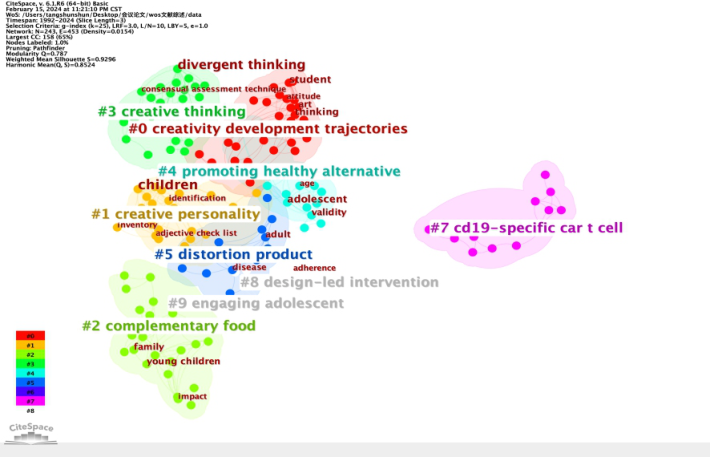
This article first uses bibliometric methods to analyze cultural and creative products. Judging from the number of literature, there are limited papers focusing on the research direction of children’s cultural and creative prod- ucts. The study searched the Web of Science database for documents with “Cultural and creative products” as the first keyword and “Children” and “Toy” as the second keyword. and documents with “Creative” as the first keyword and “Playing with teaching aids” and “Children products” as the second keyword. As shown in Table 1, a total of 350 relevant documents were retrieved, ranging from 1992 to 2024. Bibliometric analysis software CiteSpace and bibliometrix were used to conduct quantitative analysis and visual presentation of the literature.Cluster analysis was conducted on the keywords of foreign literature on children’s cultural and creative products, As shown in Figure 1, current foreign research mainly focuses on the follow- ing three aspects: (1) The inherent impact of cultural and creative products on the applicable population. Including #0 creativity development trajec- tory, #1 creative personality, #3 creative thinking. The research content involves increasing creativity, and specific keywords include art, students, ideas, attitudes, divergent thinking, and identification. and the importance and methods of stimulating creativity of different ages and groups, such as On the edge between the digital and the physical: materials that enhance children’s creativity, etc. (Michela Ponticorvo et al., 2020) (2) Ways of involving children in the design process. Includes #8 Design-Led Interven- tion, #9 Engaging Teens. Specific keywords include feedback and perception. Involves integrating children’s expertise and perspectives into design, empha- sizing the usability of children’s products, allowing children to be highly involved and tailoring products to their preferences and needs (Martina Galler, 2022). (3) Medicine and food. This theme is more about consid- ering issues related to child-oriented products and stimulating the interest and creativity of special children. Includes #2 complementary foods, #4 health-promoting alternatives, #5 aberration products, #7 CD19-specific CAR T cells. Specific keywords include nutrition, food labeling, or standards.
Types of Children’s Cultural and Creative Products Based on Card Sorting Method 165
Figure 1: Keyword clustering.
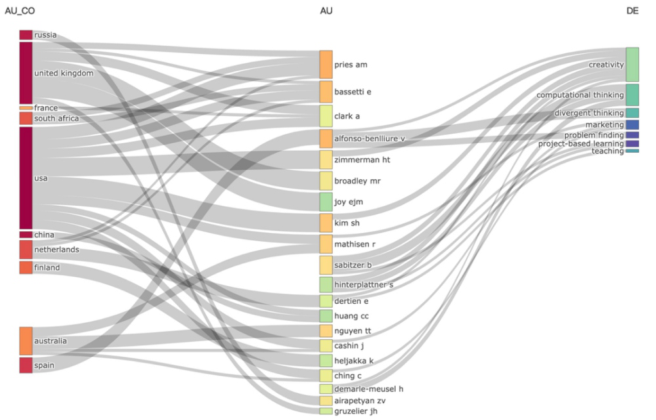
As shown in Figure 2, the country is on the left, the author is in the mid- dle, and the keywords are on the right. The United Kingdom and the United States publish the most articles, while China publishes less. It mainly focuses on creativity, computational thinking, divergent thinking, etc. Based on the clustering results in Figure 1, the research on children’s cultural and creative products mainly focuses on cultivating the creativity of adolescent groups.
Figure 2: Sankey diagram.
In summary, research on children’s cultural and creative products mainly focuses on stimulating children’s creativity, such as seeking new methods to promote flexible thinking and creativity in the collaborative process. It is worth noting that in the quantitative research, it was found that this con- tent lacks the dissemination and research of traditional culture. Although the search keywords include the word “culture”, most of the overall literature focuses on the stimulation of children’s creativity by child-oriented prod- ucts. and cultivation, there are fewer acting skills involving the extraction and innovative application of cultural genes.
Research on Card Sorting Method Card classification originated from George Kelly’s personal construct theory. Personal construct theory is based on the belief that “different people cat- egorize the world differently, but there are enough commonalities for us to understand each other, but also enough differences to make us individuals.” Card sorting involves using a single criterion to classify a group of Pictures, objects or marker cards are sorted into different groups. The advantage is the simplicity of managing scale and its applicability to all domain expertise (Finche, 2005). Card sorting can provide insight into participants’ mental models, providing a way to create an information architecture that meets user needs (Wentzel et al., 2016). Card sorting first appeared in the 1980s. Card sorting is a method of studying user experience in the field of interac- tion design, and can be used to analyze users’ cognition of interactive tasks. It is a technology for classifying information blocks and is often used in the planning and design of information architecture for software products or Internet products. Card sorting is divided into closed card-sorting and open card-sorting. Nowadays, card sorting can not only be performed face-to-face using real cards, and then analyzed through software such as EZSort, Card- sort, SPSS, etc.; online card sorting analysis can also be performed using the Internet, such as tools such as Web-sort and optimal workshop (Zhihui et al., 2020).
CURRENT STATUS OF RESEARCH ON CLASSIFICATION OF CHILDREN’S CULTURAL AND CREATIVE PRODUCTS Current Status of Research on Classification of Children’s Cultural and Creative Products
There are currently different opinions on the classification of cultural and creative products. Zhang Jian classified cultural products into content-based cultural and creative products, creative-type cultural and creative products and extended-type cultural and creative products. Yang Huizi believes that there are roughly three categories of cultural and creative products, namely arts and crafts, cultural and creative products and art derivatives, and film and television and animation cultural and creative products (Yang Huizi, 2017). At present, there is no clear definition of the classification of chil- dren’s cultural and creative products, so this study uses card sorting method to conduct classification research on children’s cultural and creative products.
Types of Children’s Cultural and Creative Products Based on Card Sorting Method 167
Research Process The process of the card sorting experiment of children’s cultural and cre- ative products is roughly as follows. First, collect relevant data and generate children’s cultural and creative product cards; second, select the card sorting method; then invite participants to perform card sorting; and finally analyze the results of the card sorting.
CHILDREN’S CULTURAL AND CREATIVE PRODUCT CLASSIFICATION EXPERIMENT Information Collection and Card Generation
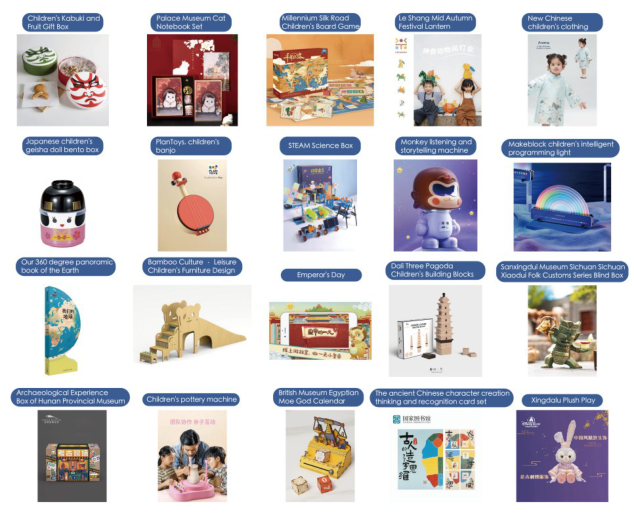
This study collected and summarized popular and common children’s cultural and creative products on the market, and selected relatively typical children’s cultural and creative products to generate card content. Scholars Rosendield and Morville proposed that the number of 20 to 25 cards is sufficient to represent the overall content (Courage, 2004). Based on this, the number of cards was chosen to be 20, and the content of the 20 cards is as follows (Figure 3):
Figure 3: Children’s cultural and creative product card.
Card Sorting Method Selection In terms of classification methods, card sorting is divided into two types, open card sorting and closed card sorting. According to scholar Donna Spencer, open card sorting refers to participants creating their own card groups and
naming labels for the groups; closed card sorting is when the researcher pro- vides a set of categories and then asks participants to put the content into categories. Within these categories (Spencer, 2009). According to the cate- gories of participants, the card sorting method is divided into group card sorting and individual sorting. As the name suggests, group card sorting invites groups as participants; individual card sorting invites individuals as participants. According to different classification scenarios, card sorting is divided into offline card sorting and online card sorting.
In the choice of classification method, due to the lack of official classi- fication of children’s cultural and creative products, this experiment chose open card sorting to obtain participants’ classification labels for children’s cultural and creative products. When choosing between offline card sorting and online card sorting, this study chose to use the online card sorting anal- ysis website Optimal Workshop as the online card sorting method due to the flexible activity time and the convenience of participants from other places to participate in the experiment. platform. Based on the factors of online card sorting, all invited participants participated in the sorting experiment on an individual basis.
Implementation of Card Sorting Card sorting experimental operations are mainly conducted through the online card sorting platform Optimal Workshop. The researchers established a children’s cultural and creative product classification experimental project through the Optimal Workshop platform, input the proposed 20 card data into it, and wrote a preface for the experiment to help participants understand the purpose of the experiment. At the same time, they collected partici- pants’ information through questionnaires before sorting the cards. Basic Information.
A total of 9 participants were invited to this card sorting, and the 9 partic- ipants were scholars and experts from the fields of art design and vocational education. The participant information is as follows. Nine participants par- ticipated in the online card sorting by clicking on the experimental link shared by the researcher, and followed the guidance prompts on the interface to sort the cards for children’s cultural and creative products.
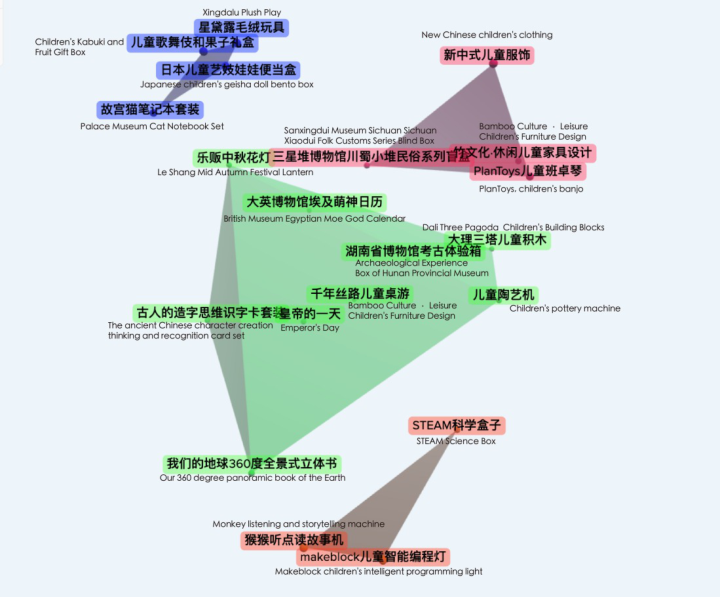
Card Sorting Results Analysis As an online card sorting analysis website, Optimal Workshop not only has a card sorting project, but also can conduct real-time analysis of card sorting result data and generate corresponding similarity matrices, clustering den- drograms, and 3D clustering renderings. Based on the 3D cluster diagram formed by the optional workshop, the study further analyzes and summa- rizes the classification of children’s cultural and creative products. According to statistics, the number of groups of participants are 10, 3, 5, 4, 4, 3, 4, 6, and 5. The average number of groups of participants was calculated to be approximately 4.89. Therefore, it was decided to divide the number of groups of children’s cultural and creative products into roughly Set as 4 or 5 groups (Figure 4).
Types of Children’s Cultural and Creative Products Based on Card Sorting Method 169
Figure 4: 3D clustering diagram.
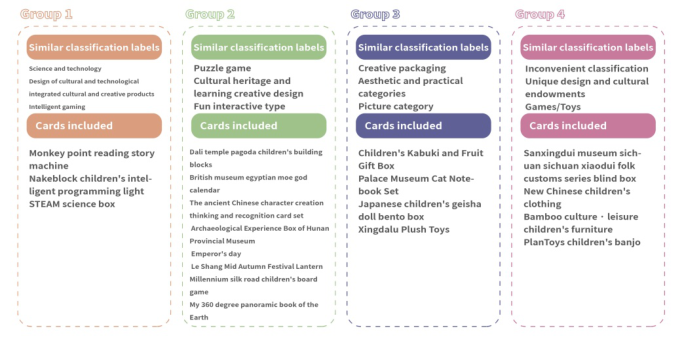
According to the 3D clustering diagram, 20 children’s cultural and cre- ative product cards were clustered into four major categories. The researchers sorted out four groups of clustered children’s cultural and creative cards and their corresponding grouping labels, as shown in the figure below.
Figure 5: Clustering grouping labels and card summary diagram.
Based on the cluster grouping and label and card summary tables, the researchers named the four clusters after discussion and analysis, and finally determined that the categories of children’s cultural and creative products are educational and interactive cultural and creative products, and technology- integrated cultural and creative products. Creative products, beautiful and practical cultural and creative products, cultural and science popularization cultural and creative products.
DISCUSSION BASED ON THE CLASSIFICATION OF CHILDREN’S CULTURAL AND CREATIVE PRODUCTS Puzzle Interactive Cultural and Creative Products
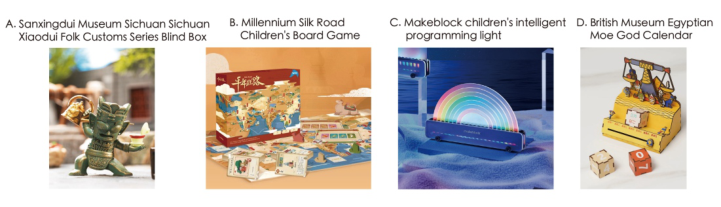
As the name suggests, educational interactive cultural and creative products are cultural products that can promote children’s intellectual development and improve their intelligence. This type of cultural and creative products can not only help children gradually develop a basic and concrete under- standing of their own cultural background, but also gradually develop their hands-on ability and logical thinking ability in the process of using them. This type of cultural and creative forms include pictures, building blocks, board games and other educational toys, etc. For example, the yaofish Millennium Silk Road children’s board game integrates Silk Road cultural content into the board game, allowing children to experience the Silk Road business jour- ney in the form of a board game, and cultivating children’s knowledge of equivalent substitutions and path planning abilities (Figure 6-A).
Technology Integration Cultural and Creative Products Technology-integrated cultural and creative products refer to products that use intelligent technology product media for cultural communication. Due to the technological nature of such cultural and creative products, the culture carried by technology-integrated cultural and creative products is often chil- dren’s enlightenment knowledge of science and technology. Common types of such products include smart electronic products, Internet APPs, etc. The makeblock (Figure 6-B) children’s smart programming lamp is a typical cul- tural and creative product that integrates technology. It helps children get started with programming through simple graphical building blocks and leads them to explore the world of lighting games and design.
Cultural and Popular Science Cultural and Creative Products Cultural and science-based cultural creations are products that can educate cultural knowledge. Such products generally take the form of picture books, arts and crafts reproductions, DIY handmade bags, creative figures, etc. For example, the Sanxingdui Museum launched the Sichuan-Sichuan Xiao- dui Folk Custom Series blind box. The figure’s shape is extracted from the Sanxingdui bronze mask. It is also matched with folk costumes and move- ments with local cultural characteristics of Sichuan and Sichuan, reflecting the characteristics of Sichuan culture in terms of shape and movement artistic conception (Figure 6-C).
Types of Children’s Cultural and Creative Products Based on Card Sorting Method 171
Beautiful and Practical Cultural and Creative Products Beautiful and practical cultural creations refer to products that have both dec- orative appearance and practical functions. It is often used as daily necessities in daily life, such as water cups, stationery, doll backpacks, etc. The Egyptian Cute God Calendar produced by the British Museum is a typical beautiful and practical cultural and creative product. The Egyptian Cute God on the calendar is vivid and cute. The user displays the month and date through three square dice, and slides the roller to set the day of the week as a daily reminder. At the same time as a date tool, the calendar also brings a certain degree of interactive fun to users. The freely adjustable months and dates also make the calendar suitable for any year and can be used for a long time (Figure 6-D).
Figure 6: Classification cases of cultural and creative products.
CONCLUSION
This study focuses on the classification of children’s cultural and creative products, uses bibliometric methods to sort out existing research fields, and combines card sorting to explore the scientific classification system of children’s cultural and creative products.
This study first used bibliometric methods to conduct a comprehensive analysis of the field of children’s cultural and creative products, thereby identifying three core research directions. First, the research focuses on the impact of cultural and creative products on group innovation capabilities; second, explores the participation model of children in design activities; third, research on medical and food children’s products. The research uncovers an analysis of current trends focusing on in-depth exploration of children’s education and creative thinking. However, the analysis shows that there are relatively few studies on the design process of extracting and trans- forming cultural and aesthetic genes, which reflects that there is still room for further development in the field of assistive children’s product design. This article uses card sorting as a method of classifying children’s cultural and creative products. Four major categories of children’s cultural and cre- ative products have been identified: educational and interactive cultural and creative products, technology-integrated cultural and creative products, beautiful and practical cultural and creative products, and cultural and
science-popularizing cultural and creative products. These categories can serve as a basis for further exploration and development of children’s cul- ture and creative product design. Overall, the findings provide insights into the classification, design, and future directions of children’s cultural and cre- ative products, informing future research and design practice in the field of children’s cultural and creative products.
ACKNOWLEDGMENT
We would like to thank the support of Hunan Province Social Science Foun- dation, Project: “Social Aesthetic Education Design of Huxiang Handicrafts Based on Children’s Embodied Cognition Perspective”, Project number: 21YBQ036.
REFERENCES
C. Courage, K. Baxter. (2004). Understanding Your Users: A practical guide to user requirements. Morgan Kaufmann. Jiang Zhihui, Wang Jiongxian, Chen Yan. (202). Application of card sorting in the
study of visual symbols on university campuses. Tomorrow Fashion, pp. 180–182. Jobke Wentzel, Nienke Beerlage de Jong, and Thea van der Geest. (2016). Redesign Based on Card Sorting: How Universally Applicable are Card Sort Results?. Digital Human Modeling: Applications in Health, Safety, Ergonomics and Risk Management, pp. 381–388. Martina Galler, Kristine S. Myhrer, Gast’on Ares, Paula Varela. (2022). Listening to
children voices in early stages of new product development through co-creation– Creative focus group and online platform. Food Research International. Michela Ponticorvo, Luigia Simona Sica, Angelo Rega, and Orazio Miglino. (2020) On the Edge Between Digital and Physical: Materials to Enhance Creativity in Children. An Application to Atypical Development. Frontiers in Psychology, Volume 11, p. 755. Sally Fincher and JoshTenenberg. (2005). Making sense of cardsorting data. Guest
Editorial, July, Volume 22, No. 3, pp. 89–93. Spencer, D. (2009). Card sorting: Designing Usable Categories. Rosenfeld Media. Wang Yingman. (2021). Research and practice on Song Ling cultural and creative product design based on the cognitive characteristics of school-age children. HunanUniversity. Yang Huizi. (2017). Intangible cultural heritage and cultural creative product design.
Chinese Academy of Arts.
LISTED IN THE AHFE DIGITAL BOOKSTORE CATALOGUE
Explore the complete digital volume
Ergonomics In Design
Read this individual research paper free through the original publisher, or explore the full digital proceedings book.
ISBN 978-1-964867-05-2
Explore this ISBN in the AHFE Bookstore ↗Listed in the July 2026 bookstore catalogue; search by ISBN to confirm current availability · Digital book purchase optional