Michael Baldauf, Momoko Kitada, Lisa Loloma Froholdt (2023). The role of VTS operators in new maritime safety situations: when conventional and autonomous ships meet. In: Application of Emerging Technologies. AHFE Open Access, vol. 115, pp. 413–423. https://doi.org/10.54941/ahfe1004339
Ensuring safe maritime traffic in coastal areas is important work. For this purpose, Coastal States establish Vessel Traffic Services (VTS) along coasts worldwide. Their primary role is to monitor and to organize safe and efficient vessel traffic flow and protect the marine environment. For example, VTS monitors ship-to-ship communication while providing useful information and instructions to ships. In recent years, the introduction of Maritime Autonomous Surface Ships (MASS) has been discussed in the maritime industry and several trials were made as part of research and development (R&D). Although potential benefits of MASS are acknowledged, there are a number of challenges anticipated, including the role of VTSs. The composition of maritime traffic was always a mixture of ships equipped according to the requirements with either conventional, modern or high sophisticated, partly- or fully automated systems. The future of maritime traffic will continue monitoring and managing mixed traffic scenarios at least for a longer period, if not forever. VTS must integrate and absorb the handling of new and complex traffic situations. There will be unstaffed fully autonomously ships or remote controlled by a shore control centre (SCC). This requires the development of appropriate operational procedures to ensure the safe and efficient traffic flow.This paper will present results from experimental trials using full-mission VTS simulation of future scenarios with mixed maritime traffic from the perspective of experienced VTS operators. While current research very much focusses on technical aspects of automation and digitalization and the feasibility and reliability of MASS, the focus of this research is based on aspects of operational integration and the handling of mixed traffic situations in the coastal areas. The systematic development and implementation of mixed traffic scenarios in simulated real world environment will be presented. Ongoing pilot studies using series of experimental simulation trials, entry questionnaires and follow-up focus group discussions after simulation runs will be introduced. Outcomes and first results in terms of the identification of administrative and organizational needs as well as related future requirements for training and for technical support systems will be presented and discussed. An outlook will provide a strategy for the further research work to be done.
Ensuring safe maritime traffic in coastal areas is an important yet complex work to be mindful of various human factors and vessel types and condi- tions. For this purpose, Coastal States establish Vessel Traffic Services (VTS) along coasts worldwide. Their primary role is to monitor and organize safe and efficient vessel traffic flow and protect the marine environment. For example, VTS monitors ship-to-ship communication while providing useful information and instructions to ships.
In recent years, the introduction of Maritime Autonomous Surface Ships (MASS) has been discussed in the maritime industry and several trials were made as part of research and development (R&D) projects. Although poten- tial benefits of MASS are acknowledged, there are several challenges antic- ipated, including the role of VTS. The composition of maritime traffic was always a mixture of ships equipped according to the requirements with either
conventional, modern or highly sophisticated, partly or fully automated sys- tems. The future of VTS will be to continue monitoring and managing mixed traffic scenarios at least for a longer period, if not forever. However, VTS must integrate and absorb the handling of new and complex traffic situa- tions. There will be unstaffed fully autonomous ships or remote controlled by a shore control centre (SCC) (WMU, 2023) and (Baldauf et al., 2019). This requires the development of appropriate operational procedures to ensure the safe and efficient traffic flow.
This paper will present results from experimental trials using full-mission VTS simulation of future scenarios with mixed maritime traffic from the per- spective of experienced VTS operators. While current research largely focuses on technical aspects of automation and digitalization as well as the feasi- bility and reliability of MASS i.a. (Guo et al., 2022; Aylward et al., 2020; Hauge, 2020; Chong, 2018; Ang, Go & Li, 2016; Baldauf et al., 2014) or discussed impact of MASS on socio-technical aspects (e.g. Relling, Praetorius & Hareide,2019; Kitada et al., 2019) and studied training and education issues (Boguslawski et al., 2022; Narayanan, Emad & Fei, (2019 or Baldauf et al., 2018), the focus of this research is based on aspects of operational integration and the handling of mixed traffic situations in the coastal areas. The systematic development and implementation of mixed traffic scenarios in simulated real-world environment will be presented. Ongoing pilot stud- ies using series of experimental simulation trials, entry questionnaires and follow-up focus group discussions after simulation runs will be introduced. This paper presents spotlight results and first conclusions will be presented and discussed.
FROM TRAFFIC MONITORING TO TRAFFIC MANAGEMENT – VTS TODAY AND IN THE FUTURE The International Convention for the Safety of Life at Sea 74/78 (SOLAS) provides the legal frame for VTS all over the world. Chapter V, Regulation 12 defines the purpose of VTS, the main prerequisites for establishing VTS. Furthermore, it contains the obligation for contracting governments to ensure the participation of vessels sailing under their flag. The overall goal of VTS is to ensure safe and efficient navigation of vessels, to protect the maritime environment, adjacent shore areas, work sites and offshore installations from threats originating from shipping, and to contribute to the safety of life at sea in general (SOLAS, 2014, chapter V, regulation 12). Contracting governments are encouraged to establish a VTS within their territorial waters based on a risk analysis which among others include factors like the quantity and density of vessel traffic as well as the level of accident risks.
After more than 20 years, IMO has revised the guidelines on VTS and set into force a revised version. The new principles and general provisions for operating a VTS and for participating vessels1 are described in the IMO Res- olution A.1158(32) Guidelines for Vessel Traffic Services (2022). VTS shall
1According to Paragraph 2.7, Annex of A 32/Res.1158, Participating ship means a ship required to participate with vessel traffic services.
The Role of VTS Operators in New Maritime Safety Situations 415
identify and monitor vessels and interact with the traffic when deemed neces- sary in order to provide information and assistance to vessels and to perform a vessel traffic management to strategically plan the movements of vessels (IMO, 2022). Further issues addressed in the IMO’s new VTS guidelines are, e.g., the regulatory and legal framework, VTS responsibilities, general prin- ciples as well as qualification and training requirements. Specific reference is made to standards and guidelines elaborated and provided by the Interna- tional Association of Marine Aids to Navigation and Lighthouse Authorities (IALA).
To achieve the stated goals VTS actively provides timely and relevant infor- mation to the Captain of a vessel and the bridge team and therefore assist the decision-making process on board. The final decision making remains with the crew on board. However, VTS operators also monitor and manage the vessel traffic in order to contribute to safety and efficiency of shipping by responding to developing unsafe situations (IALA, 2021). In the old and revoked resolution A.857(20) these VTS-actions were described as measures of information service, navigational assistance service, and traffic organiza- tion service (IMO, 1997). In this respect, the new resolution is more straight forward and clearly focusing on the aimed objectives.
While VTS monitors all vessel traffic in its monitored area including all ships of certain sizes (usually defined by a certain length, e.g. 30 or 50 m), the operators are to ensure compliance with overall and individual rules and regulations that specifically apply to each vessel. Besides, from the very beginning of the development of VTS there were also other public or private services to support shipping from ashore. Especially with the development and implementation of the IMO’s e-Navigation initiative, more innovative and new shore-based services have been created.
Among those new services, other functions similar to VTS are Fleet Oper- ations Centre (FOC) of cruise ship and big container companies. Contrary to VTS, FOC operators only monitor ships of the own company. On the other hand, using most modern information and communication technolo- gies, FOCs monitor the company-owned fleets on their voyages worldwide and are able to contact the Captain or even the responsible officer of the watch, whenever deemed necessary, as e.g. the ship is unusually wide off track. Meanwhile, apart from VTS and FOC, so-called vessel coordination centre (VCC) appear as another institution supporting smooth terminal oper- ation by coordinating the in-time departures and arrivals of large container vessels. Such VCCs are either independent from VTS (as e.g. in Hamburg and Bremen) or integrated part of VTS (like e.g. in Antwerp) and are usually operated by port terminals operators.
Moreover, with the further technological developments in relation to autonomous shipping another category of shore-based services will be estab- lished, namely Remote or Ship Control Centre (RCC or SCC) for partly or completely unstaffed ships (Veitch, Hynnekleiv & Lützhöft, 2020). Accord- ing to IMO’s standards and terminology, there will be four types of MASS with different level of autonomy and crewing. The MASS level 3 will be unstaffed but controlled by operators from RCC. The developments of the mentioned shore centres firstly are independent from one another and so are
their operations. Although there seem to be obvious relations there are seem- ingly no connections e.g. between a VTS and a VCC or between a VTS and a RCC as of yet. The development of autonomous shipping is very much focusing on the technological feasibility and reliability of sensors and control systems on board the ships. Less is done in regard to the operational inte- gration of MASS into the patterns of existing regular traffic, see e.g. (Janßen et al., 2021; Zijan et al., 2019; Tagaki et al., 2016).
DESIGN AND CONDUCTION OF A PILOT STUDY A first pilot study was designed to collect basic data about opinions and, views from VTS operators on the potential consequences of the introduction of remotely controlled MASS into the existing traffic where conventional crewed ships operate. The study aimed at gathering basic data to identify and assess potential impacts of new traffic compositions in regards to how and in what way VTS operations and the behaviour of VTS operators may change. In other words: What potential effects may occur when integrating MASS level 3 into the existing traffic system? The initial hypothesis for the study was set to be that there will be a change in the behaviour of VTS- operators while monitoring and organizing the vessel traffic. Specific focus is handling of collision avoidance situations with involved MASS Level 3 from the shore-based perspective.
Mixed research methods were used for this pilot study, including a pre-trial questionnaire, simulation experiment, debriefing session and a concluding focus group discussion with semi-structured interviews. Fourteen partici- pants were randomly selected without prior contact or consultation among active VTS operators who were undertaking their regular refresher training courses in the Maritime Simulation Centre Warnemünde in 2021 and 2022. Their participation was voluntary outside their working hours to complete the questionnaires as well as the interview.
The simulation scenario was designed on the basis of several real traf- fic recordings. The number and type of objects and events implemented in the scenario were according to original recordings. Initial times and con- tent of VHF communication from traffic were implemented in the scenario scripts. However, the final real course of scenario depends very much on VHF communication between VTS operator and the contacted vessels including among others the ways of how officers of the watch (OOW) onboard reply and take or not take actions according to information or warnings given by VTS operators. The action of vessels in the simulation scenario as e.g. course or speed alteration was controlled by the instructors accordingly. One exer- cise run was designed for a running time of 30 minutes and implemented to a full-mission VTS-simulator providing an exact copy of the workstation equipment and infrastructure as in real VTS centres. In VTS training ses- sions experienced instructors took over the role of officers onboard to reply to VTS contacts with pre-defined VHF communication. For the scenario it was assumed, that the MASS is operated from a RCC located in Indonesia. Detailed scenario scripts and storyboards were drafted for scenario control including phrases and hints for the content and for the way of ship officers’
The Role of VTS Operators in New Maritime Safety Situations 417
responses. For the VTS interaction with MASS through RCC communication content was drafted and an intended standard delay for the communication reply from RCC to VTS of 15 to 20 seconds were integrated into the sce- nario script. The role of the RCC operator was assigned to an Asian research assistant familiar with VTS communication from series of VTS field studies. This was especially done to also address specific communication issues and to support realistic course of the scenario.
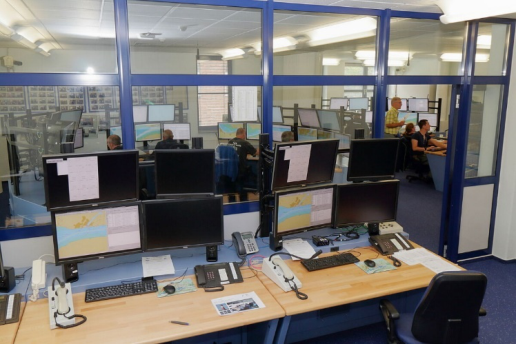
Figure 1: Instructor area of VTS-Simulator in the Maritime Simulation Centre Warnemünde (MSCW) – separate room with communication means, 5 monitors to follow and control the scenario.
The first scenario for the pilot study was planned for an open sea area with traffic separation schemes. The applied area was designed as copy of real world (German Bight and approaches to Wilhelmshaven, Bremen, Ham- burg, Kiel Canal) and include i.a. the reporting points, deep water routes, anchorage areas, pilot embarkation stations, fairways of different categories etc. The initial situation was created by combining events requiring action from VTS operators (e.g. approaching a reporting line, leaving anchorage, typical encounter situations (meeting, overtaking and crossing courses). The traffic density was set to medium compared to real traffic courses in the area.
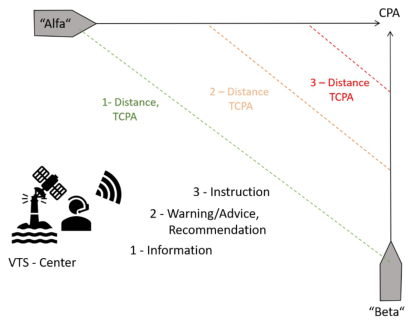
To focus on VTS operators’ behaviour when handling situations with MASS and with risk of collision an encounter situation on crossing courses (as sketched in Fig. 2) were taken from original recordings and included in the experiment by using the original moving parameter but changing char- acteristics of the ships into those available in the simulator’s database. The experiment consists of two runs: one where the two involved targets were conventionally crewed and a second run were the westbound vessel was set to “remote controlled” mode.
Visibility conditions for both the simulations runs were set to more than10 nm (good visibility). According to IMO’s convention on international reg- ulations for preventing collisions at sea then “Alfa” is required “so far as possible, take early and substantial action to keep well clear” of “Beta”. VTS shall ensure safety and efficiency of vessel traffic flow and shall interact
with the traffic by sending out information, warning, advice or instruction to vessel.
Figure 2: Sketch of encounter situation with developing risk of collision between vessel “Alfa” and “Beta” (in first run booth conventionally staffed, in second run “Beta”.Table 1. Comparison of action taken by VTS operators during two different simulation trials containing similar situation of an encounter on crossing courses, one without and the second with involvement of “remote controlled” MASS.
Table available in the original PDF paper.
1st contact 2nd contact 3rd contact
both vessels crewed
Equation reproduced from the original PDF.Equation reproduced from the original PDF.
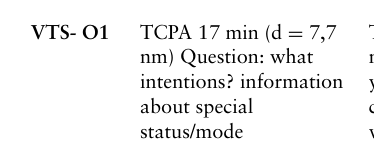
VTS- O1 TCPA 12 min (d= 3,25 nm) Info about approaching vessel, clarify situation and get in contact VTS- O2 TCPA 12 min (d = 3,25 nm) Information about the approaching vessel and awareness
Equation reproduced from the original PDF.
TCPA 4 min (d = 1,3.. 1,5 nm) Instruction to give-way vessel alter course to starboard (repeated due to missing action) MASS involved
Equation reproduced from the original PDF.
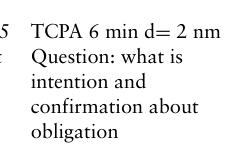
TCPA 13 min d= 5,7 nm Question: what is your intention and contact of the stand-on vessel for confirmation
TCPA 8 min (d = 3,7 nm) Instruction to alter course to starboard (4th) contact: TCPA 6 min (d = 2,7 nm) instruction to follow original course VTS- O2 TCPA 12 min (d= 5,3 nm) Question: what intentions? Request to increase CPA and contact of the stand-on vessel to inform
TCPA 8 min (d = 3,7 nm) Instruction to alter course to starboard (4th) contact: TCPA 6 min (d= 2,7 nm) instruction to keep course
According to the operational procedures of VTS in the simulated area, operators shall apply the measures basing on their assessment considering, especially, the prevailing circumstances of the situation. The above table
The Role of VTS Operators in New Maritime Safety Situations 419
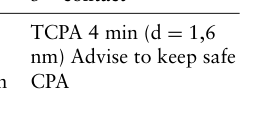
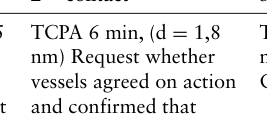
presents the results of VTS operators’ action taken during the first simula- tion runs of the pilot study in regards to measures and times, distances of the vessels for the same type of encounter situation with the difference of involvement of a remote-controlled vessel.
It is obvious, that the operators took earlier action when the remote- controlled vessel was involved in the risky situation. Moreover, in the situation with the remote-controlled vessel the operators were stricter and applied the stronger measure “warning” and even “instruction”.
OUTCOME FROM INTERVIEWS AND FOCUS GROUP DISCUSSION The simulation runs were concluded by debriefing sessions with all par- ticipants together to have an open discussion on prepared questions for semi-structured interviewing. The aim was to get a deeper insight in the behavioural patterns of the VTS operators by open-ended questions, to obtain explanations and detailed information about their decisions in the simulation runs as well as in general, and to know the independent opinions and thoughts of the individual members of the group (Adams, 2015; God- dard III, & Villanova, 2006). The duration of the session was planned for approximately one hour. The interviews were conducted in German language to avoid language barriers and later translated by the researcher in English language. In the beginning the groups were asked for consent to record the interview. All participants agreed to that approach and the interview was recorded on a standard smartphone and subscripted. The following results are extracted from (Eckardt, 2022).
Several VTS operators felt difference in their situational awareness when uncrewed ships were present. However, the situational awareness of the VTS operators was appropriate in the trials and portrayed a perception of the situation as a novel and unknown situation with an unpredictable future, which resulted in a changed behaviour in the form of an earlier reaction time and increased vigilance. This can be seen in the following quotes:
“I contacted the vessel significantly earlier because I did not trust the vessel and the operator’s behaviour in the RCC compared to a manned vessel. My focus was on this traffic situation, and not on the one in the approach of river Weser. I was not sure how “uncrewed” would alter course. If she would follow her westbound course the situation would be fine, but I expected that she alters course. And this situation I tried to avoid. I understood it that way that we agreed on it, but probably the order to alter course was already sent to the vessel.”
“It was an unusual situation, and it was something different to the situation when the bridge is crewed.”
Some operators contributed with other reflections, that show there are still questions to be researched in more detail and that need to be solved in relation to which rules are to be followed, such as:
“I was quite happy that stand-on turned to port, despite it was not according to the rules, but it cleared the situation!”
“The problem for the VTS in case of a remotely operated vessel is, which criteria are used in the RCC to make a decision. Is there something like a watch standing order, for example keep a CPA of not less than one nauti- cal mile? What about the five cables like in the exercise? Is this enough? Maybe it is enough for the uncrewed give-way, but what about the stand- on vessel then? For the stand-on it’s not enough. Then, the give-way has to alter course.”
These quotes show that the experienced VTS operators were more vigilant than usual. More studies would need to be done in order to analyse the extent of this, especially whether it is more about the novelty of the situation, as this will decrease over time and allow the operators to focus on other tasks. The following quotes demonstrate this:
(VTS operator 1) I would say, the situation with the remotely operated vessel had about 80% of my attendance. All the time I asked myself what is she doing? Lost signal, lost communication link between vessel and RCC?
(VTS operator 2) I had a look on the other traffic situation, but the CPA was always around 0.9 nautical miles and one vessel significantly reduced speed. My main attention was on the traffic situation with the remotely operated vessel.
Another VTS operator expressed frustration in communicating with uncrewed vessels due to a longer response time than usual with usual crewed ships and explained that:
I recognized one more aspect. The communication takes a longer time and the VHF channel is in use for a longer period. And sometimes the time span between question and answer was quite long. There is the problem, if there is no immediate answer, i.e., other vessels will use this gap for their communication attempts.
This reflection points to another potential challenge that could be looked into further, as to whether communication can be optimised. This, again, would need more studies to ascertain if the challenge is something that will create a problem.
SUMMARY AND CONCLUSION A first experimental study was planned to gain basic data about opinions, and views of VTS operators about their role in handling new situations and the potential consequences of the introduction of remotely controlled MASS.
Based on the exploratory analysis from the collected data, our preliminary assessment of the initial hypothesis for the study - there will be a change in the behaviour of VTS operators while monitoring and organizing the vessel traffic with a specific focus on handling of collision avoidance situations from the shore-based perspective – was both accepted and nuanced. VTS operators showed changed behaviour in decision-making when encountering uncrewed vessels in the form of a higher vigilance and their situation awareness was
The Role of VTS Operators in New Maritime Safety Situations 421
affected. Under such uncertain circumstances, VTS operators effectively com- municate with vessels, however their communication took longer than usual, which made them frustrated and could pose a potential challenge that needs to be further researched. Further studies could also shed light on whether the vigilance is predominantly due to the novelty of uncrewed ships and something that would decrease over time.
This exploratory study provided evidence that more research is needed in order to further understand the complexity of traffic monitoring and manage- ment in VTS when MASS is introduced. The study tested particular scenarios and German participants, which may limit the application of the result to wider and different maritime traffic contexts. Nevertheless, the study shed lights on the importance of maritime human factors research on MASS in order to reap the benefits of the technology development.
ACKNOWLEDGMENT
The authors wish to thank those VTS operators, pilots and navigators who shared their opinions in interviews and questionnaires. They also thank for the opportunities to join watches for participant observations in the VTS Centers.
Investigations and preliminary results presented in this paper were partly carried out and achieved in the national research project “Shore-side decision support for traffic situations with highly automated or autonomous vessels using Artificial Intelligence (LEAS)” funded by the German Federal Ministry of Education and Research (BMBF). It is supervised and surveyed by VDI Technologiezentrum Düsseldorf.
Moreover, part of the materials presented in this paper were obtained from the Polish-German RTD project CADMUSS - Collision Avoidance Domain- Method Used by Ships and Ashore. This project belongs to the MARTERA program supported by the European Commission. It is funded by the German Federal Ministry of Economics and Technology (BMWi), and supervised by the German Research Centre Jülich (PTJ).
REFERENCES
Adams, W. (2015). Conducting semi-structured interviews. Handbook of practical program evaluation (Fourth Edition) by Newcomer, K., Hatry, H., Wholey, J., https://doi.org/10.1002/9781119171386.ch19 Ang, J. H., Goh C. and Li. Y. (2016) “Smart design for ships in a smart product
through-life and industry 4.0 environment.” 2016 IEEE Congress on Evolution- ary Computation (CEC), 5301–5308. Aylward, K., Johannesson, A., Weber, R., MacKinnon, S. N., & Lundh, M. (2020).
An evaluation of low-level automation navigation functions upon vessel traffic services work practices. WMU J Marit Affairs 19, 313–335. https://doi.org/10. 1007/s13437-020-00206-y Baldauf M., Benedict K., Krüger C. (2014) Potentials of e-Navigation - Enhanced Support for Collision Avoidance. TransNav, Int. J. Mar. Navig. Safety Sea Trans- port, Vol. 8, No. 4„ pp. 613–617, http://dx.doi.org/10.12716/1001.08.04.18 Baldauf, M., Fischer, S., Kitada, M., Mehdi, R. A., Al-Quhali, M. A., Fiorini, M.
(2019). Merging conventionally navigating ships and MASS – merging VTS, FOC
and SCC? TransNav Int. J. Mar. Navig. Safety Sea Transport. 13(3), 495–501 (2019). https://doi.org/10.12716/1001.13.03.02 Baldauf, M., Kitada, M., Mehdi, R. A., Dalaklis, D. (2018). E-Navigation, Digitalization and Unmanned Ships: challenges for Future Maritime Education and Training. In: 12th Annual International Technology, Education and Devel- opment Conference (INTED), Barcelona, Spain. https://doi.org/10.21125/inted. 2018.2374 (2018). Bogusławski, K., Gil, M., Nasur, J. Wrobel, K., (2022). Implications of autonomous
shipping for maritime education and training: the cadet’s perspective. Marit Econ Logist 24, 327–343. https://doi.org/10.1057/s41278-022-00217-x Chong, J. C. (2018). Impact of maritime autonomous surface ships (MASS) on VTS operations. World Maritime University Dissertations. 647. https://commons.wm u.se/all_dissertations/647/ Eckhardt, Ch. (2022). Pilot Study on the Operational Integration of Remote-
Controlled Vessels in the Existing Vessel Traffic from the Perspective of VTS. Master Thesis, Jade University of Applied Sciences, Wilhelmshaven, Oldenburg, Elsfleth, Campus Elsfleth May 2022. Goddard III, R., Villanova, P. (2006). Designing surveys and questionnaires for research. The Psychology Research Handbook. A Guide for Graduate Stu- dents and Research Assistants (Second Edition) by Leong, F., Austin, J., ISBN 0-7619-3022-1 (pbk.) Guo, W., Zhang, X., Wang, J., Feng, H., & Tengecha, N. A. (2022). Traffic Orga-
nization Service for Maritime Autonomous Surface Ships (MASS) with Different Degrees of Autonomy. Journal of Marine Science and Engineering, 10(12), 1889. MDPI AG. https://www.mdpi.com/2077-1312/10/12/1889 Hauge, J. (2020). STM BALT SAFE – Automatic Ship Reporting -pre-study and concepts document including Use Cases. Sea Traffic Management. Heffner, K. & Rødseth, Ø. J., 2019, Enabling Technologies for Maritime Autonomous Surface Ships J. Phys.: Conf. Ser. 1357 012021, DOI 10.1088/1742- 6596/1357/1/012021 IALA. (2016). Vessel Traffic Service Manual (6 b.). Saint Germain en Laye, France:
International Association of Marine Aids to Navigation and Lighthouse Author- ities. IMO. (1997). Resolution A.857(20): Guidelines for Vessel Traffic Services. London. IMO. (2001). IMO Standard Marine Communication Phrases. Resolution A.918(22). London, United Kingdom: International Mari-time Organization. IMO. (2014). The e-navigation strategy implementation plan (SIP) MSC 94. London: International Maritime Organization. IMO. (2022). Resolution A.1158(32): Guidelines for Vessel Traffic Services. London. Janßen, T., Baldauf, M., Müller-Plath, G., Kitada, M. (2021) The Future of Shipping –
A Shore-Based Experience? In: Bauk S., Ilˇcev S. D. (eds) The 1st International Conference on Maritime Education and Development. Springer, Cham. https://do i.org/10.1007/978-3-030-64088-0_5 Janssen T., Baldauf M., Claresta G. (2023) From Ship to Shore – Studies Into Potential Practical Consequences of Autonomous Shipping on VTS Operation and Training. TransNav Int. J. Mar. Navig. Safety Sea Transport., Vol. 17, No. 2, http://dx.doi.org/10.12716/1001.17.02.15 Johns, M. (2018). Seafarers and Digital Disruption. Hamburg/London: Hamburg
School of Business Administration for the International Chamber of Shipping. Kitada M, Baldauf M, Mannov A, et al. (2019) Command of vessels in the era of digitalization. In: Kantola J, Nazir S, Barath T (eds.) Advances in human factors,
The Role of VTS Operators in New Maritime Safety Situations 423
business management and society. AHFE 2018, Advances in Intelligent Systems and Computing, vol. 783. Springer, Cham. DOI: 10.1007/978-3-319-94709-9_32. Narayanan, S. C., Emad, G. R. & Fei, J. (2023). Theorizing seafarers’ participation and learning in an evolving maritime workplace: an activity theory perspective. WMU J Marit Affairs. https://doi.org/10.1007/s13437-023-00311-8 Relling, T., Lützhöft, M., Ostnes, R., & Hildre, H. P. (2021). The contribution of Ves-
sel Traffic Services to safe coexistence between automated and conventional ves- sels. Maritime Policy & Management, https://doi.org/10.1080/03088839.2021. 1937739 Relling, T., Praetorius, G., & Hareide, O. (2019). A socio-technical perspec-tive on the future Vessel Traffic Services. Southall, (2019) Revision of IMO Resolution A.857(20) Guidelines for Vessel Traffic
Services. IALA Seminar Report … Takagi, N., John, P., Noble, A., Björkroth, P., Brooks, B. (2016). VTS-Bot: Using ChatBots in SMCP-based Maritime Communication. Japan Institute of Navigation Conference 2016. Tijan, E., Agatic, A., Jovic, M., & Aksentijevic, S. (2019). Maritime National Sin-
gle Window - A Prerequisite for Sustainable Seaport Business. Rijeka: MDPI. doi:10.3390/su11174570 UNCTAD. (2020). Executive Summary - Review of Maritime Transport 2020. New York: United Nations Publications. Veitch, E., Hynnekleiv, A., & Lützhöft, M. (2020). The Operator’s stake in Shore
Control Centre Design: A stakeholder analysis for autonomous Ships. Human Factors. London: The Royal In-stitution of Naval Architects. WMU. (2023). Transport 2040: Impact of Technology on Seafarers - The Future of Work. World Maritime University, https://dx.doi.org/10.21677/itf.230613
LISTED IN THE AHFE DIGITAL BOOKSTORE CATALOGUE
Explore the complete digital volume
Application of Emerging Technologies
Read this individual research paper free through the original publisher, or explore the full digital proceedings book.
ISBN 978-1-958651-91-9
Explore this ISBN in the AHFE Bookstore ↗Listed in the July 2026 bookstore catalogue; search by ISBN to confirm current availability · Digital book purchase optional