Brian Sylcottt, Rui Wu, Shanyue Guan, Chia-Cheng Lin (2023). Comparing Brain Activity Between Sitting and Standing Positions during Optic Flow with Coinciding Auditory Cognitive Tasks. In: Emerging Technologies in Healthcare and Medicine. AHFE Open Access, vol. 116, pp. 165–173. https://doi.org/10.54941/ahfe1004368
1 Department of Computer Science, East Carolina University, Greenville, NC, USA ↗
2 Department of Engineering, East Carolina University, Greenville, NC, USA; Department of Construction Management Technology, Purdue University West Lafayette, IN, USA ↗
3 Department of Physical Therapy, East Carolina University, Greenville, NC, USA ↗
Physical therapy intervention for people with vestibular disorders often includes optic flow stimulation. Such interventions can be performed with patients in either sitting or standing positions. Yet, little is known about how these positions affect brain activation during treatment. In this study, functional near-infrared spectroscopy (fNIRS) was used to investigate the reaction time and activation patterns of the prefrontal cortex (PFC) and temporoparietal junction VEST between sitting and standing conditions in the presence of both visual (optic flow) and cognitive (reaction time tasks) stimulation. 33 healthy adults participated in this two-visit study. In the first visit, participants were instructed to perform a series of reaction time tasks while sitting and experiencing optic flow at varying speeds through the HTC ViveTM virtual reality headset. In the second visit, participants performed the same tasks while standing. When compared with sitting, increased activation was observed in the left and right VEST for some of the standing trials. However, no statistical difference was found in the right or left PFC activation between sitting and standing positions when performing the reaction time tasks. These results suggest that, when compared to a sitting position, tasks performed in a standing position with optic flow stimulation will elicit greater VEST cortex activation, allow for multisensory integration training, and enhance positive outcomes after vestibular rehabilitation.
Human postural control is a complex dynamic sensory integration process that involves processing large amounts of visual, somatosensory, and vestibu- lar information (Manchester et al., 1989; Nashner & Berthoz, 1978). In order to better understand how the brain processes this information, researchers have employed neuroimaging technologies. These technologies have proven to be valuable tools capable of yielding important information about the neu- rological activity associated with a person completing a task. Studying the
underlying neurological mechanisms at play when completing tasks can grant valuable insights that help to develop strategies to improve performance on those tasks. Such strategies could be relevant during the initial learning of a task, rehabilitation after an injury, or compensation for a health disorder. In many cases, a person’s approach to task completion will be influenced by both internal and external factors such as arousal state and environmental conditions respectively. However, it is not always immediately apparent how such factors impact task performance. This is especially true when consid- ering completing multiple tasks concurrently. In this work, neuroimaging is used to investigate how a seated versus standing position affects the brain’s ability to complete cognitive tasks while simultaneously processing visual information.
OPTIC FLOW In day-to-day life humans often find themselves multitasking. Whether it’s walking down the street, talking to a co-worker, while looking for a new place to have lunch or driving down the road, listening to music, while fol- lowing directions from a GPS app, multiple neurological systems are being engaged simultaneously. In both of these scenarios the person is in motion and relies on their vestibular system to maintain their postural control. Research has shown that visual information is important throughout this process (Hinderaker et al., 2020; Persiani et al., 2015; Schmuckler, 2017). One way to approximate a person being in motion is to artificially provide the stream of visual information received while in motion, optic flow (OF). OF stimuli can induce an illusion of self-motion in a stationary person, called vection (Brandt et al., 1973). As a result, OF is commonly used in research studies to provide visual stimulation. One challenge when delivering OF stimuli is that standard monitors do not block out other visual stimuli. As such, study par- ticipants may gain external visual references that can interfere with the effect of the OF. To overcome this limitation head mounted virtual reality (VR) displays can be used to present OF stimuli across a full visual field while isolating subjects from external visual stimuli. There are several examples in the literature of immersive VR being used to present OF stimuli (Hinderaker et al., 2020; Lubetzky et al., 2019; Lubetzky & Hujsak, 2019). In this work the HTC ViveTM was used to present a full visual field OF stimuli to study participants as they completed cognitive tasks.
FUNCTIONAL NEAR-INFRARED SPECTROSCOPY Neuroimaging provides a means of monitoring neurological activity as a per- son completes a task. For example, in prior work, the cognitive demands of postural control have been evaluated as subjects perform postural tasks. One such study found that aging populations and people with fall risks have increased attention-demand during postural tasks (Lin et al., 2015). There are several technology options for use in neuroimaging studies. Several of these technologies measure brain activity indirectly through the blood oxy- gen level dependent (BOLD) response. The BOLD response operates on the
Comparing Brain Activity Between Sitting and Standing Positions 167
principle that active areas of the brain consume oxygen. This differentiates them from inactive, oxygen rich areas. Over the last decade, functional mag- netic resonance imaging (fMRI) has seen a rise in popularity. fMRI analysis uses a strong magnetic field to measure changes in the BOLD response. The images produced are high in temporal resolution and give an indication of blood flow in the brain. Although fMRI is a powerful tool that has been used in a variety of different neurological studies, including some investiga- tions of visual conditions during dynamic balance tasks (Noohi et al., 2019; Scarapicchia et al., 2017), it has some critical limitations. Most pertinent to this work is the requirement that subjects remain still and stay in a supine position to be imaged. The restricted motion conditions make fMRI unsuit- able for many vestibular research studies. Recently, a novel neuroimaging technology called functional near-infrared spectroscopy (fNIRS) has been used to measure brain activity during upright seated or standing conditions (Karim et al., 2012, 2013; Lin et al., 2017). fNIRS uses near-infrared light (650-900 nm) to measure blood flow and oxygenation changes, similar to fMRI, on the surface of the scalp to provide spatial localization of brain activ- ity. Previous work has identified the temporal-parietal junction and superior temporal gyrus as being active during vestibular and multi-sensory infor- mation processing (Rosso et al., 2017). The location of the expected brain activity, as well as the ability to scan in standing positions, make fNIRS suitable for this application.
STUDY METHODOLOGY Participants
In this study, we aimed to recruit healthy younger adults aged 25–45 years with right-hand dominance. Subjects with any vestibular, orthopedic, or neu- rological disorder, knee or hip replacement, reports of dizziness, low visual acuity (corrective vision less than 20/40), or use of an assistive device for ambulation were excluded from this study. Moreover, to be considered in the healthy group, participants had to demonstrate good clinical gait and balance scores, including a Dynamic Gait Index score > 19/24 (Shumway-Cook et al., 1997), a Functional Gait Assessment score > 21/30 (Wrisley & Kumar, 2010) and an Activities-Specific Balance Confidence (ABC) scale > 67% (Lajoie & Gallagher, 2004).
Experimental Design Auditory Cognitive Reaction Time Tasks Participants in this study completed two auditory cognitive tasks. The simple auditory reaction time tasks (SRT) and the choice reaction time tasks (CRT) were used to investigate the attention demand in sitting and standing posi- tions. SRT required the subject to push a button held in their right hand as soon as possible after hearing a pure tone at 1000 Hz, while CRT added a 500 Hz pure tone to the SRT and the subject had to press the button held in the right hand when hearing high pitch tones (1000 Hz) or the button held in
the left hand when hearing low pitch of tones (500 Hz). Each SRT and CRT trial lasted for 30 seconds.
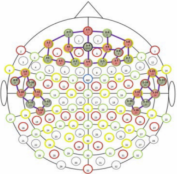
Figure 1: Probe setting.
fNIRS Two sets of continuous wave fNIRS devices, containing a total of 16 sources and 16 detectors, (NIRSport, NIRx, Berlin, Germany) were used in this study. The prefrontal cortex (PFC) and temporal-parietal areas (VEST) were mea- sured in both hemispheres, using a 10–20 system cap for source and detector array arrangement as shown in Figure 1. The NIRS Brain AnalyzIR toolbox (Santosa et al., 2018) was used to process the raw data. Briefly, all data was processed with a pre-whitened autoregressive (AR-IRLS model) coherence statistical model with and without vestibular cortex activation adjustment in the subject-level analysis. The group level used the mixed model with random-effect analysis.
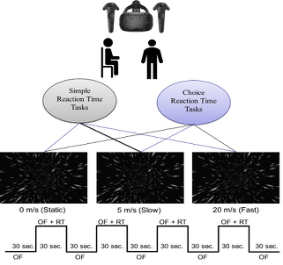
Study Protocol The participants were required to complete the study protocol in two visits. Before the fNIRS set-up, the participants practiced SRT and CRT each for five 30-second trials to get familiarized with the auditory cognitive task and reduce the learning effect in both visits. After fNIRS set-up, a virtual real- ity headset (HTC ViveTM) was used to display the optic flow stimulation at speeds of 0 m/s, 5 m/s, and 20 m/s. A block design (A-B-A-B-A-B-A-B-A) was used to examine the effect of the concurrent cognitive and OF stimulation in sitting (Visit 1) and standing (Visit 2) as illustrated in Figure 2. A total of six trials were performed by the combined SRT/CRT and OF stimulation speed tasks (2x3).
Figure 2: A block design was used to examine the effect of concurrent cognitive and optic flow stimulation in sitting and standing positions.
Comparing Brain Activity Between Sitting and Standing Positions 169
RESULTS
A total of 35 healthy younger adults completed the study protocol (mean age: 34 ± 5 years old; Height: 167.6 ± 10.7 cm; Weight: 88.1 ± 22.6 Kg; 18 female and 23 male).
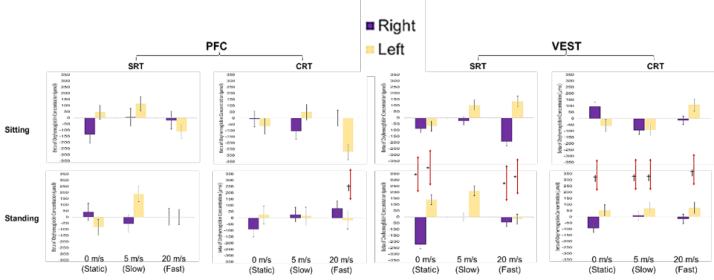
Neurological Activation The activation results are summarized in Figure 3. These results show the left PFC had significant activation difference in the 20 m/s OF speed on the CRT (p < 0.001). For this condition standing had more activation compared with sitting. There was no significant difference in PFC activation in other conditions.
When comparing the standing position vs the seated position, the results also indicated increased left VEST activation in the 0 m/s OF speed on the SRT (p < 0.05) and 5 m/s OF speed on the CRT (p < 0.001) but had decreased activation in the 20 m/s OF speed on both the SRT and CRT. The right VEST increased activation in the 20 m/s OF speed on the SRT (p < 0.05) and 5 m/s OF speed on the CRT (all p < 0.001) but decreased in the 0 m/s OF speed (p < 0.05) on the SRT and 0 m/s OF speed on the CRT (p < 0.001).
Figure 3: Prefrontal and VEST cortex activation during test conditions. SRT = simple reaction time; CRT = choice reaction time; red arrow- significant difference between sitting and standing positions (p < 0.001; † p < 0.05).
Auditory Cognitive Tasks
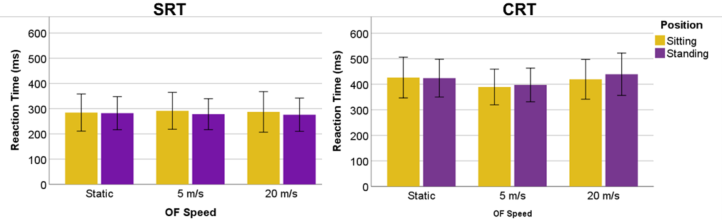
Figure 4 shows a summary of the reaction time data for both the SRT and CRT. Overall, the CRT had slower reaction time compared to the SRT (F1, 32 = 277.09, p < 0.001) indicating increased cognitive load. The CRT was 132 milliseconds slower than the SRT. The overall RT in the slow OF condition was about 15 milliseconds faster than the static and fast OF. There was an RT x OF interaction (F1, 66, 53.07 = 17.75, p < 0.001), in which there was no difference between SRT among the three OF conditions while the CRT in the slow OF condition was shorter than the RT in static and fast OF conditions. However, there was no significant difference among the OF speed and positions.
Figure 4: Summary of reaction time.
DISCUSSION
The first area of interest for this work was the PFC. This area is respon- sible for a variety of executive functions (Koechlin & Summerfield, 2007) and attention allocation (Rossi et al., 2009). When comparing the activa- tion observed in the sitting vs standing positions, no significant difference was observed in the 0 m/s and 5 m/s OF conditions. However, at the highest rate of OF speed tested, 20 m/s, increased activation was observed in the left PFC. Left prefrontal activation has been shown to be present during divided attention tasks leading to the belief that the area may be important in exe- cuting controlled processing when attention is divided between two sources of information (Loose et al., 2003). The activation pattern observed in this work indicates that the combination of higher speed OF and a standing posi- tion caused a higher cognitive load than sitting. This may be the result of an added cognitive expense associated with processing sensory information while standing.
The second area of interest, the temporoparietal junction, is associated with sensory information processing. Its involvement has been shown rele- vant when integrating input of multiple types such as visual, auditory, and somatosensory (Nieuwenhuys et al., 2007). In particular, the temporoparietal junction has been implicated in a range of cognitive functions such as mem- ory, attention, and theory of mind. Here, increased activation was observed in several of the standing trials as compared to seated trials. It has been pro- posed that left temporoparietal junction codes both matches and mismatches between expected and actual sensory, motor, or cognitive events. Alterna- tively, the right temporoparietal junction only codes mismatches (Doricchi et al., 2022). It is possible that this is why, during the SRT trials, the 0 m/s OF speed saw increased activation in the left VEST while the 20 m/s OF speed saw increased activation in the right VEST. As the speed increased there may have been a greater mismatch between the actual and expected sensory events. There is also evidence that the right temporoparietal junction is involved in the reorientation of attention (Corbetta et al., 2008). Taking into account the difference in left PFC activation at the 20 m/s speed during the CRT condi- tion, it is possible that the overall processing requirements made less resources available to switch attention to the cognitive task.
The reaction time results did not show a significant difference between sit- ting and standing during OF stimulation. Previous studies comparing sitting
Comparing Brain Activity Between Sitting and Standing Positions 171
and standing have found similar results (Gaule & Bhattad, 2020; Redfern et al., 2002). However, OF stimulation was not presented in the previ- ous studies. Our results further confirmed that auditory attention was not affected by OF stimulation.
The study’s limitations included uncertainty about how well the subjects focused on the OF stimulation. Some subjects reported not focusing on OF stimulation due to a sense of being overwhelmed when looking at the OF stimulation. Future studies should consider using an eye-tracking system to record the percentage of time that the participants focus on the OF stimu- lation. Moreover, our small sample size may affect the generalization to a larger group.
CONCLUSION
In this work the brain activity of younger healthy adults was monitored as they completed cognitive tasks while experiencing optic flow stimuli. The results of their tasks were compared in seated and standing positions. Although the results vary with the speed of the OF and the complexity of the task, in general, greater activation was observed when participants were in the standing vs seated position. Additionally, results showed a shift from the left to the right VEST as the speed of the OF stimuli increased during the sim- ple reaction task. The higher speed OF potentially led to a greater mismatch between the actual and expected sensory inputs. Considering these findings, it is suggested that, when compared to a seated position, tasks performed in a standing position with optic flow stimulation will elicit greater VEST cortex activation, allow for multisensory integration training, and enhance positive outcomes after vestibular rehabilitation.
ACKNOWLEDGMENT
The authors would like to acknowledge the North Carolina Space Grant program for helping to support this work.
REFERENCES
Brandt, T., Dichgans, J., & Koenig, E. (1973). Differential effects of central versus peripheral vision on egocentric and exocentric motion perception. Experimental Brain Research, 16(5). Corbetta, M., Patel, G., & Shulman, G. L. (2008). The Reorienting System of the
Human Brain: From Environment to Theory of Mind. In Neuron (Vol. 58, Issue 3). Doricchi, F., Lasaponara, S., Pazzaglia, M., & Silvetti, M. (2022). Left and right temporal-parietal junctions (TPJs) as “match/mismatch” hedonic machines: A unifying account of TPJ function. In Physics of Life Reviews (Vol. 42). Gaule, A., & Bhattad, G. (2020). Effect of posture on reaction time: Impact of gender.
National Journal of Physiology, Pharmacy and Pharmacology, 0. Hinderaker, M., Sylcott, B., Williams, K., & Lin, C. C. (2020). Aging Affects the Ability to Process the Optic Flow Stimulations: A Functional Near-Infrared Spectrometry Study. Journal of Motor Behavior, 52(4), 466–473. Karim, H., Fuhrman, S. I., Sparto, P., Furman, J., & Huppert, T. (2013). Func-
tional brain imaging of multi-sensory vestibular processing during computer- ized dynamic posturography using near-infrared spectroscopy. NeuroImage, 74, 318–325.
Karim, H., Schmidt, B., Dart, D., Beluk, N., & Huppert, T. (2012). Functional nearinfrared spectroscopy (fNIRS) of brain function during active balancing using a video game system. Gait and Posture, 35(3). Koechlin, E., & Summerfield, C. (2007). An information theoretical approach to
prefrontal executive function. Trends in Cognitive Sciences, 11(6). Lajoie, Y., & Gallagher, S. P. (2004). Predicting falls within the elderly community: Comparison of postural sway, reaction time, the Berg balance scale and the Activities-specific Balance Confidence (ABC) scale for comparing fallers and non-fallers. Archives of Gerontology and Geriatrics, 38(1). Lin, C. C., Barker, J. W., Sparto, P. J., Furman, J. M., & Huppert, T. J. (2017).
Functional near-infrared spectroscopy (fNIRS) brain imaging of multi-sensory integration during computerized dynamic posturography in middle-aged and older adults. Experimental Brain Research, 235(4), 1247–1256. Lin, C. C., Whitney, S. L., Loughlin, P. J., Furman, J. M., Redfern, M. S., Sienko, K. H., & Sparto, P.J.(2015). The effect of age on postural and cognitive task performance while using vibrotactile feedback. Journal of Neurophysiology, 113(7). Loose, R., Kaufmann, C., Auer, D. P., & Lange, K. W. (2003). Human prefrontal and
sensory cortical activity during divided attention tasks. Human Brain Mapping, 18(4). Lubetzky, A. V., & Hujsak, B. D. (2019). A virtual reality head stability test for patients with vestibular dysfunction. Journal of Vestibular Research: Equilibrium and Orientation, 28(5–6). Lubetzky, A. V., Wang, Z., & Krasovsky, T. (2019). Head mounted displays for
capturing head kinematics in postural tasks. Journal of Biomechanics, 86. Manchester, D., Woollacott, M., Zederbauer-Hylton, N., & Marin, O. (1989). Visual, vestibular and somatosensory contributions to balance control in the older adult. Journals of Gerontology, 44(4). Nashner, L., & Berthoz, A. (1978). Visual contribution to rapid motor responses
during postural control. Brain Research, 150(2). Nieuwenhuys, R., Voogd, J., & Van Huijzen, C. (2007). The human central nervous system: a synopsis and atlas. Springer Science & Business Media. Noohi, F., Kinnaird, C., De Dios, Y., Kofman, I., Wood, S. J., Bloomberg, J. J.,
Mulavara, A. P., Sienko, K. H., Polk, T. A., & Seidler, R. D. (2019). Deactivation of somatosensory and visual cortices during vestibular stimulation is associated with older age and poorer balance. PLoS ONE, 14(9). Persiani, M., Piras, A., Squatrito, S., & Raffi, M. (2015). Laterality of Stance during Optic Flow Stimulation in Male and Female Young Adults. BioMed Research International, 2015. Redfern, M. S., Müller, M. L. T. M., Jennings, J. R., & Furman, J. M. (2002).
Attentional dynamics in postural control during perturbations in young and older adults. Journals of Gerontology - Series A Biological Sciences and Medical Sciences, 57(8). Rossi, A. F., Pessoa, L., Desimone, R., & Ungerleider, L. G. (2009). The prefrontal cortex and the executive control of attention. Experimental Brain Research, 192(3). Rosso, A. L., Cenciarini, M., Sparto, P. J., Loughlin, P. J., Furman, J. M., & Huppert,
T. J. (2017). Neuroimaging of an attention demanding dual-task during dynamic postural control. Gait and Posture, 57. Santosa, H., Zhai, X., Fishburn, F., & Huppert, T. (2018). The NIRS Brain AnalyzIR toolbox. Algorithms, 11(5).
Comparing Brain Activity Between Sitting and Standing Positions 173
Scarapicchia, V., Brown, C., Mayo, C., & Gawryluk, J. R. (2017). Functional magnetic resonance imaging and functional near-infrared spectroscopy: Insights from combined recording studies. In Frontiers in Human Neuroscience (Vol. 11). Schmuckler, M. A. (2017). Postural response to predictable and nonpredictable visual
flow in children and adults. Journal of Experimental Child Psychology, 163. Shumway-Cook, A., Baldwin, M., Polissar, N. L., & Gruber, W. (1997). Predicting the probability for falls in community-dwelling older adults. Physical Therapy, 77(8), 812–819. Wrisley, D. M., & Kumar, N. A. (2010). Functional gait assessment: Concurrent, dis-
criminative, and predictive validity in community-dwelling older adults. Physical Therapy, 90(5).
LISTED IN THE AHFE DIGITAL BOOKSTORE CATALOGUE
Explore the complete digital volume
Emerging Technologies in Healthcare and Medicine
Read this individual research paper free through the original publisher, or explore the full digital proceedings book.
ISBN 978-1-958651-92-6
Explore this ISBN in the AHFE Bookstore ↗Listed in the July 2026 bookstore catalogue; search by ISBN to confirm current availability · Digital book purchase optional