Allison Bayro, Noelle Brown, Shannon Mcgarry, Joseph Coyne, Kaylin Strong, Mikaela Aiken, Rebecca Nesmith, Ciara Sibley, Cyrus Foroughi (2023). Bridging the Gap: Investigating the Role of Physiological Indicators in Capturing Cognitive State Changes among Naval Personnel. In: Emerging Technologies in Healthcare and Medicine. AHFE Open Access, vol. 116, pp. 404–410. https://doi.org/10.54941/ahfe1004395
This study supplements findings from traditional cognitive assessments using physiological markers—Heart Rate Variability (HRV) and Galvanic Skin Response (GSR)—in conjunction with self-report psychological measures to better understand changes in cognitive state. Forty-nine sailors and marines completed pre-experiment surveys, including the Stanford Sleepiness Scale, the Short Stress State Questionnaire (SSSQ), and a Cognitive State Survey. These assessed various psychological parameters, including arousal, distress, engagement, and sleep quality. Resting GSR and HRV data were collected using Gazepoint Biometric sensors before and after participants completed a set of cognitive tasks. BIOPAC and Kubios software analyses revealed significant changes in several psychophysiological parameters from baseline to post-task, including average skin conductance level (SCL), minimum SCL, and maximum heart rate. Notably, a strong correlation emerged between the low-frequency power feature of HRV and the task-oriented thought score from the SSSQ and between the maximum heart rate and the distress score from the SSSQ. Despite data quality challenges that reduced the sample size, the study uncovers valuable insights into the use of physiological markers in detecting cognitive state changes. These findings highlight the potential of such an approach and underscore the need for further research.
From 2013 to 2020, the U.S. military aviation sector experienced over 6,000 mishaps during routine training exercises and operations (National Com- mission on Military Aviation Safety, 2020). Significantly, 43% of Class A incidents—events causing damages exceeding $2 million—were attributed to human errors (National Commission on Military Aviation Safety, 2020). A thorough probe identified various culprits, including elevated fatigue,
Bridging the Gap: Investigating the Role of Physiological Indicators 405
dwindling morale, a demanding operational pace, and continuous distrac- tions faced by overburdened maintainers.
Fatigue stands out as a primary contributor to human error in mili- tary operations, diminishing cognitive abilities like attention, memory, and decision-making. This often leads to a propensity for higher-risk actions. Lieberman et al. (2005) demonstrated these consequences, examining the cognitive and mood impacts of conditions such as sleep deprivation, heat, dehydration, and undernutrition within a simulated combat environment. Their conclusions pointed to fatigued individuals being more error-prone and likely to undertake riskier behaviors, emphasizing the substantial influence on military task performance.
Stress is another formidable player in this domain. It not only affects cog- nitive functions, like attention and memory, but also results in heightened emotional arousal, clouding clear thought processes. Morgan et al. (2006) explored this dynamic, revealing how stress adversely impacts decision- making and increases error tendencies during simulated military activities. With today’s ‘digital battlefield’ inundating soldiers with data from equip- ment like head mounted displays, distractions further complicate operations. Morelli & Burton’s 2004 research echoed this sentiment, focusing on the effects of induced stress on multitasking abilities, thus endorsing the cognitive readiness initiative.
According to Grier (2012), cognitive readiness encapsulates one’s capac- ity to anticipate and optimize cognitive functions amidst the unpredictable, demanding, and stress-laden military terrains. It is a pivotal trait for military operatives frequently required to make timely and precise decisions under pressure. The assessment of cognitive readiness can be intricate and multi- pronged. Of particular significance in this spectrum of methodologies is the use of psychophysiological measures. Physiological indicators, such as heart rate variability (HRV) and galvanic skin response (GSR) sensors, are at the crux of these measures. HRV, for instance, is an indicator of the autonomic nervous system’s activity, reflecting an individual’s stress response and emo- tional regulation. Changes in HRV can indicate a shift from a restful, attentive state to a stressed or over-aroused one, making it invaluable in assessing readiness for demanding tasks (Shaffer & Ginsberg, 2017). Similarly, the GSR sensors, which measure the electrical conductance of the skin, provide insights into the sympathetic nervous system’s activity. A spike in skin con- ductance, as detected by GSR, can often point towards heightened arousal or an intense emotional reaction—factors that can directly impede cognitive performance (Boucsein, 2012). Lohani et al. (2019) underscores the utility of these physiological measures, highlighting their capability to offer real-time insights into shifts in arousal, attention, and overall cognitive state.
Furthermore, complementary to these physiological metrics are detailed surveys. These questionnaires meticulously capture an individual’s sleep pat- terns, perceived levels of stress, and the burdens of their workloads—each of which can substantially influence cognitive agility. Moreover, performance- based tasks, ranging from simulations to real-world scenarios, present a tangible way to gauge a variety of cognitive capabilities, providing a rounded assessment of an individual’s preparedness in mission-critical situations.
To enhance the efficacy and safety of military operations, a structured methodology to pinpoint and address factors leading to human errors is imperative (Crameri et al., 2019). This study aims to capture changes in cog- nitive state that impact cognitive performance through psychophysiological measures such as HRV and GSR. Additionally, we compared sleep quality, self-reported measures of stress and engagement, and recent consumption of caffeine, alcohol, and medication—all known influencers of cognitive per- formance. Through this approach, we aim to advance our understanding of cognitive effectiveness in military operations and to discern when individuals might be at a cognitive disadvantage, predisposing them to errors.
METHODS
The study adopted a mixed-method approach, which incorporated both psychophysiological measures and psychological self-report assessments.
Participants The study included 49 sailors and marines training at Naval Air Station Pensacola. However, due to data loss issues, only 18 participants’ data were found to be viable for final analysis. The study was approved by the Institutional Review Board at the US Naval Research Laboratory and all participants gave their informed consent prior to their inclusion in the study.
Procedure The experimental procedure began with a battery of pre-experiment surveys. These included the Stanford Sleepiness Scale (Hoddes et al., 1973), the Short Stress State Questionnaire (SSSQ) (Helton et al. 2015 & Helton 2004), and a survey to assess other factors known to affect psychophysiological measures. The surveys were designed to assess various psychological parameters such as arousal, engagement, distress, worry, task-unrelated and task-oriented thought, sleep quality (Buysse, 2014), and recent caffeine, alcohol, and medication use.
Following these initial surveys, participants’ baseline physiological data were collected. HRV and GSR data were recorded over a five-minute interval using Gazepoint Biometric sensors. Following the baseline measures, partic- ipants completed a series of cognitive tests, including versions of the Flanker Task (Eriksen & Eriksen, 1974), Stroop Task (Stroop, 1935), Brief Psy- chomotor Vigilance Task (PVT) (Basner et al., 2011), and Rapid Serial Visual Presentation (RSVP) (e.g., Martens & Johnson, 2009; Nieuwenhuis et al., 2005) for approximately 60 minutes. These tests were specifically designed to progressively challenge their mental capacities and place increasing demands on cognitive resources. Once the cognitive tests were completed, HRV and GSR data were recorded again to assess post-task physiological responses. Additionally, participants completed the SSSQ for a second time and Grit survey (Duckworth et al., 2007), to assess psychological states post-task.
The GSR and HRV data collected from participants were analyzed using BIOPAC software and Kubios software, respectively. Psychophysiological data captured in the final minute of the baseline period and the first minute following the experimental task were extracted and compared. Significant
Bridging the Gap: Investigating the Role of Physiological Indicators 407
differences in several psychophysiological measures were identified using paired samples t-test. Further, correlations were computed between specific physiological features (Table I) and self-reported psychological measures.
Table 1. Extracted physiological and psychological features. The standard deviation of the differences between successive normal-to-normal (NN) intervals (SDNN), heart rate (HR), root mean square of successive differences (RMSSD), the proportion of adjacent R-R intervals differing by more than 50 ms (pNN50), triangular interpolation of NN, skin conductance level (SCL), and number of non-specific skin conductance responses (NS-SCR).
Table available in the original PDF paper.
HRV Features GSR Features Psychological Features Mean R-R (ms) Max SCL (uS) GRIT score (Grit survey) SDNN (ms) Min SCL (uS) Distress score (SSSQ) Average HR (bpm) Avg. SCL (uS) Engagement score (SSSQ) Std. HR (bpm) NS-SCRs (peaks) Task-related thought score (SSSQ) Min HR (bpm) Mean amplitude of NS-SCRs (uS)
Task-unrelated thought score (SSSQ) Max HR (bpm) Worry score RMSSD (ms) Time performance (e.g., morningness) score (State survey) pNN50 (%) Sleep score (Stanford Sleepiness Scale) HRV triangular index TINN (ms) Stress index Very low frequency peak (Hz) Very low frequency power (ms2) Very low frequency power (log) Very low frequency power (%) Low frequency peak (Hz) Low frequency power (ms2) Low frequency power (log) Low frequency power (%) High frequency peak (Hz) High frequency power (ms2) High frequency power (log) High frequency power (%) Low power/high power ratio Poincare plot (SD1) (ms) Poincare plot (SD2) (ms) Poincare plot (SD2/SD1)
RESULTS
The analysis of psychophysiological and self-reported psychological mea- sures revealed significant insights into changes in cognitive states across the experimental session.
Psychophysiological Measures Paired samples t-tests were conducted on the GSR and HRV data to com- pare changes in these measures across the session. In general, an increase
in the GSR measures indicates an increase in arousal (Boucsein, 2012). The HRV measures are separated into spectral analyses and frequency measures. With regard to the spectral analyses, the low-frequency (LF) band measures sympathetic activity and the high-frequency (HF) band measures parasym- pathetic activity. LF and HF increase with increased sympathetic and vagal tone (e.g., Lean & Shan, 2012). In other words, increases in LF are indicative of increased engagement and arousal while an increase in HF is indicative of decreased arousal associated with a more relaxed state. Several signifi- cant differences were observed between the baseline and post-task measures. Notably, the average skin conductance level (SCL), minimum SCL, and min- imum HR demonstrated statistically significant changes from baseline to post-task (p < 0.001). Other significant changes observed from baseline to post-task included the average non-specific skin conductance responses amplitude, mean R-R interval, mean heart rate, low-frequency power, and high-frequency power (p < 0.05).
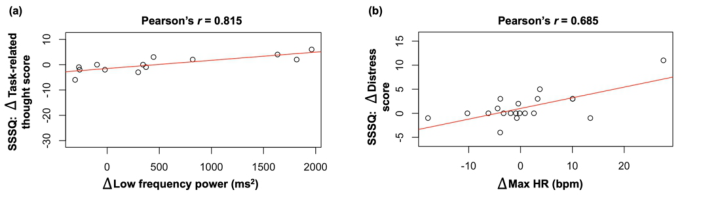
Correlation Between Psychophysiological and Psychological Measures A correlation analysis was performed to determine relationships between psy- chophysiological measures and self-reported psychological states. The results revealed a robust correlation between the change in low-frequency power feature of HRV and change in task-oriented thought score from the SSSQ (r = 0.815, p < 0.001) (Figure 1a), indicating those who ended the experi- mental session with higher levels of arousal also reported more task-related thoughts at the end compared to how they began. Additionally, a significant correlation was found between the max HR and the distress score from the SSSQ (r = 0.685, p < 0.01) (Figure 1b). This suggests that increases in distress were associated with increased heart rate during the cognitive tasks.
Figure 1: Correlation analysis between (a) the change (post-task to baseline) in low frequency power and change in task-related thought score, and (b) the change in maximum HR and change in distress score.
CONCLUSION
The present study offers an initial exploration into the potential of physio- logical markers, particularly HRV and GSR, in indicating shifts in cognitive states. We noted some compelling associations, such as the correlation between low-frequency power (an HRV measure) and task-oriented thought,
Bridging the Gap: Investigating the Role of Physiological Indicators 409
and between mean heart rate and distress score. These connections, as posited by the Task Force of the European Society of Cardiology and The North American Society of Pacing and Electrophysiology (1996), hint at the poten- tial for physiological measures to reflect changes in cognitive states. For the domain of Naval missions, understanding these connections—even at this ini- tial stage—can potentially guide the creation of cognitive interventions and training strategies (Salas, Driskell, & Hughes, 1996).
One clear limitation of our study was the restricted sample size owing to data quality issues, which may affect the wider applicability of our observa- tions. Future studies should continue to explore the potential of HRV and GSR as markers of cognitive state changes, with the objective of developing a real-time assessment tool that can effectively capture transient changes in cognitive states. Additionally, research could investigate the use of interven- tions aimed at optimizing these physiological markers to enhance cognitive readiness. Overall, this research signifies a crucial first step towards lever- aging physiological measures to measure cognitive effectiveness in military operations (Grier, 2012).
ACKNOWLEDGMENT
We express our deepest gratitude to the Naval Aerospace Medical Institute, our study participants, and Dr. Thomas McKenna at the Office of Naval Research who has partially funded this work. All of whom have been instru- mental in the successful completion of this research. The student research was sponsored by the Office of Naval Research NREIP Program.
REFERENCES
Basner, M., Mollicone, D., & Dinges, D. F. (2011). Validity and sensitivity of a brief psychomotor vigilance test (PVT-B) to total and partial sleep deprivation. Acta Astronautica, 69(11-12), 949–959. doi:10.1016/j.actaastro.2011.07.015 Boucsein, W. (2012). Electrodermal activity (2nd ed.). Cambridge, UK: Cambridge
University Press. Buysse, D. J. (2014). Sleep health: Can we define it? Does it matter? Sleep, 37(1), 9–17. Crameri, L., Hettiarachchi, I., & Hanoun, S. (2021). A Review of Individual Opera-
tional Cognitive Readiness: Theory Development and Future Directions. Human Factors, 63(1), 66–87. Duckworth, A. L., Peterson, C., Matthews, M. D., & Kelly, D. R. (2007). Grit: Perseverance and passion for long-term goals. Journal of Personality and Social Psychology, 92(6), 1087–1101. Eriksen, C. W., & Eriksen, B. A. (1974). Effects of noise letters on the speed and
accuracy of a simple visual detection task. Perception & Psychophysics, 16(1), 54–62. Grier, R. A. (2012). Military cognitive readiness at the operational and strategic levels: A theoretical model for measurement development. Journal of Cognitive Engineering and Decision Making, 6(4), 358–392. Helton, W. S. (2004). Validation of a short stress state questionnaire. Proceedings of
the Human Factors and Ergonomics Society Annual Meeting, 48(11), 1238–1242. https://doi.org/10.1177/154193120404801107
Helton, W. S. & Naswall, K. (2015). Short Stress State Questionnaire: Factor structure and state change assessment. European Journal of Psychological Assessment, 31(1), 20–30. https://doi.org/10.1027/1015-5759/a000200 Hoddes, E., Zarcone, V., Smythe, H., Phillips, R., & Dement, W. C. (1973). Quan-
tification of sleepiness: A new approach. Psychophysiology, 10(4), 431–436. https://doi.org/10.1111/j.1469-8986.1973.tb00801.x Lean, Y., & Shan, F. (2012). Brief review on physiological and biochemical evaluations of human mental workload. Human Factors and Ergonomics in Manufacturing & Service Industries, 22(3), 177–187. Lieberman, H. R., Bathalon, G. P., Falco, C. M., Kramer, F. M., Morgan, C. A.,
& Niro, P. (2005). Severe decrements in cognition function and mood induced by sleep loss, heat, dehydration, and undernutrition during simulated combat. Biological psychiatry, 57(4), 422–429 Lohani, M., Payne, B. R., & Strayer, D. L. (2019). A review of psychophysiological measures to assess cognitive states in real-world driving. Frontiers in human neuroscience, 13, 57. Martens, S. & Johnson, A. (2009). Working memory capacity, intelligence and the
magnitude of the attentional blink revisited. Exp Brain Res, 192, 43–52. Morelli, F., & Burton, P. A. (2004). The impact of induced stress upon multipleobject tracking: Research in support of the cognitive readiness initiative. Human Research & Engineering Directorate. Morgan III, C. A., Doran, A., Steffian, G., Hazlett, G., & Southwick, S. M. (2006).
Stress-induced deficits in working memory and visuo-constructive abilities in Special Operations soldiers. Biological psychiatry, 60(7), 722–729. National Commission on Military Aviation Safety (2020) Report to the president and the Congress of the United States December 1, 2020. https://www.militaryav iationsafety.gov/report/NCMAS_Final_Report.pdf Nieuwenhuis, S., Gilzenrat, M. S., Holmes, B. D., Cohen, J. D. (2005). The role of the
locus coeruleus in mediating the attentional blink: A neurocomputational Theory. Journal of Experimental Psychology: General, 134(3), 291–307. Salas, E., Driskell, J. E., & Hughes, S. (1996). Introduction: The study of stress and human performance. In J. E. Driskell & E. Salas (Eds.), Stress and human performance (p. 1–45). Lawrence Erlbaum Associates Publishers. Shaffer, F., & Ginsberg, J. P. (2017). An Overview of Heart Rate Variability Met-
rics and Norms. Frontiers in public health, 5, 258. https://doi.org/10.3389/fpubh. 2017.00258 Stroop, J. R. (1935). Studies of interference in serial verbal reactions. Journal of Experimental Psychology, 18(6), 643–662. Task Force of the European Society of Cardiology and The North American Society
of Pacing and Electrophysiology. (1996). Heart rate variability. Standards of mea- surement, physiological interpretation, and clinical use. European Heart Journal, 17(3), 354–381.
LISTED IN THE AHFE DIGITAL BOOKSTORE CATALOGUE
Explore the complete digital volume
Emerging Technologies in Healthcare and Medicine
Read this individual research paper free through the original publisher, or explore the full digital proceedings book.
ISBN 978-1-958651-92-6
Explore this ISBN in the AHFE Bookstore ↗Listed in the July 2026 bookstore catalogue; search by ISBN to confirm current availability · Digital book purchase optional