Zhenyu Ma, Xiaotong Wang (2024). Facilitating Stakeholder Consensus in Geothermal Development: Developing an AIGC-Integrated 3D Visual-Tactile Opinion Communication System. In: Human Factors in Communication of Design. AHFE Open Access, vol. 136, pp. 166–177. https://doi.org/10.54941/ahfe1004979
Effective stakeholder communication is crucial for successful geothermal development projects. This research proposes integrating co-sketching methods into the Persuasion Game (SNG) framework to enhance mutual understanding and consensus among diverse stakeholders. Empirical experiments validate the improved communication effectiveness of the sketching-integrated SNG compared to traditional verbal exchanges. To address practical implementation challenges, an AIGC-Integrated 3D Visual-Tactile Opinion Communication System is designed, leveraging AI-generated visuals iteratively refined through intuitive tactile inputs. Prototypes for key system components are developed and tested, demonstrating feasibility. Future work involves large-scale prototyping, system integration, and field trials with actual stakeholders to validate the holistic system's usability and capability in fostering stable geothermal project consensus formation.
Japan possesses the world’s third-largest geothermal resources, but its geothermal utilization rate ranks outside the top ten globally due to (1) low public acceptance, (2) technical challenges, and (3) complex factors hindering consensus among stakeholders, resulting in relatively slow development.
Currently, non-technical research on geothermal development primarily focuses on three interrelated aspects: (1) public acceptance, (2) understanding and attitudes of potential stakeholders, and (3) acceptance and consensus among actual stakeholders. Regarding the first two aspects, the “Persuasion Game”(abbreviated in Japanese as ‘SNG’) developed by Professor Sugiura of Keio University (Sugiura, 2003) is considered an effective tool for enhancing public awareness and understanding of relevant knowledge.
While SNG has shown positive effects in promoting participants’ knowl- edge acquisition (Sugiura, 2007; Ando et al., 2019), attitude changes (Hirose, 2007; Onuma et al., 2019), and mutual communication (Ando et al., 2019),
Facilitating Stakeholder Consensus in Geothermal Development 167
in the third aspect, which directly influences the success or failure of geother- mal development projects, relying solely on verbal communication may be insufficient for achieving a consensus satisfactory to multiple stakeholders due to differences in cognition, backgrounds, and behavioral motivations. Particularly during the introduction and negotiation stages of geothermal projects in rural Japanese villages, opposition from a single stakeholder can lead to project abandonment. Even if the project proceeds forcibly, its uncer- tainty and risks may result in challenges or opposition from stakeholders, causing the ongoing project to fail. Although risks and unexpected situations before and during a project (including operation) can significantly influence its progress and maintenance, a reasonable design for stakeholder commu- nication could ensure effective communication in the event of unexpected circumstances, reducing the likelihood of project disruption or failure.
To find an effective method for promoting communication among stake- holders with different discourses, the use of sketches and visual commu- nication techniques in the design field has been proven to better facilitate communication and consensus-building. If stakeholders could utilize sketches as a medium for visualizing their intangible ideas, they might achieve a more effective communication form than the current protocol meeting format.
Therefore, after conducting interviews and opinion exchange sessions with stakeholders involved in a geothermal project in Iwate Prefecture, north- eastern Japan, this research summarizes the challenges faced by traditional stakeholder communication methods in incorporating sketching and other visual communication techniques and proposes designs to address these pain points.
Consequently, this research contributes to solving existing pain points by assuming and developing an intuitive and engaging sketching and commu- nication method for local geothermal stakeholders (residents, environmental groups, local government officials, etc.) who are generally older and lack drawing skills or motivation for sketching. This is an AI-assisted “image communication system” that utilizes tactile and visual feedback, which may positively impact effective sketching, communication, and consensus- building. To support the communication process, this research developed an interactive system assisted by AI-generated images. Considering the diffi- culties and resistance faced by elderly rural Japanese residents when using artificial intelligence, as well as the challenges in aligning text-generated vision sketches with mental conceptions, the system incorporates intuitive tactile behaviors as instructions for fine-tuning the AIGC tools within the communication system.
Due to various limitations and reasons, this research did not test or use the entire “communication system” prototype with actual stakeholders. Instead, a non-AIGC version of the SNG was conducted with university students interested in geothermal energy as a preliminary test of the educational tool. This initial validation showed that the improved SNG version incorporating co-sketching and other visual methods was more effective in promoting opin- ion communication and understanding different stakeholder roles compared to the traditional SNG version relying solely on verbal explanations. Sub- sequently, the aforementioned communication system was designed around
168 Ma and Wang
sketching as a communication medium. Through prototype testing, the feasi- bility of the three main components of the target communication system – the tactile component, the visual component, and the AIGC image generation, iteration, and integration module – was preliminarily validated.
RESEARCH OBJECTIVES AND METHODOLOGY Research Objectives
This research endeavors to achieve two primary objectives. The first aim is to theoretically analyze and substantiate the superior effectiveness of utilizing sketching as a communication tool, in contrast to traditional unidirectional or bidirectional protocol-based dialogues. This hypothesis will be qualita- tively validated through empirical experiments conducted with students as subjects.
The second objective is to develop a system that integrates large language models (LLMs) for text-to-image generation and facilitates iterative vision sketches through intuitive (tactile) operations. This system is designed to assess the acceptance and effective utilization of co-sketching methodologies in practical geothermal development projects. Prototyping and unit testing will be carried out to evaluate the components’ performance.
Research Methodology Considering the multidisciplinary nature of this research, encompassing design, social psychology in the context of renewable energy promotion, and human-computer interaction, a systems theory approach is deemed most suit- able. Consequently, a mixed methods approach will be employed throughout the design, iteration, and validation processes. The mixed methods will include:
1) Field interviews, surveys, and analyses; 2) 7-point likert scale questionnaire; 3) Prototype testing (including unit testing).
Adopting a systems theory perspective and a mixed methods approach, this research aims to further the theoretical understanding of sketching as a communication tool. Concurrently, it seeks to develop and evaluate an interactive system that integrates AI-generated vision sketches with intuitive tactile feedback, reflected in the elevation differences between pixels com- posing the composite visuals, to facilitate enhanced communication quality within geothermal development projects.
ISSUES IDENTIFIED FROM INTERVIEWS ABOUT GEOTHERMAL PROMOTION To effectively integrate the proposed method into the mainstream con- sultation and protocol environments of current geothermal projects, field interviews were conducted with various stakeholders in Japan. The objective was to identify potential issues that may impact the progress of geothermal
Facilitating Stakeholder Consensus in Geothermal Development 169
projects in the current reality, potential barriers to implementing the new method, and challenges stakeholders may face when adopting it.
Introduction of Selected Stakeholders for Interviews This research conducted field or online interviews and consultations with stakeholders representing three distinct roles, as well as professors and experts in geothermal energy research or the social promotion of new energy sources. The specific geothermal project associated with the selected stake- holders is located in the “Southern Oidematsukurayama Area”of Shizukuishi Town, Iwate Prefecture, currently in the investigation phase. The research ini- tially interviewed the 16 stakeholders listed in Table 1, whose social identities and roles as stakeholders are recorded.
Table 1. List of interviewed individuals with real geothermal stakeholders.
Table available in the original PDF paper.
Affiliations Titles
SHs First Names
Affiliations Titles SHs First Names Academic Experts Ohnuma Hokkaido University Professor Public Officials
Environment and Energy
Yamanaka Hokkaido Prefectural Government Shiratsuchi Akita Prefecture
Suzuki Tohoku University
Associate professor
Yuzawa City Hall
Community Vitality Promotion Group Baba Tokyo City University
Professor Kikuchi Iwate Prefectural Government
Environmental Life Hunting Office Shirai Musashino University
Professor Nakamura Shizuokishi Town Hall,
Environmental Affairs Hondo Yokohama National University
Professor Hori Beppu City Public Welfare Department
Living Environment Division
Sugiura Keio University
Professor Hot Spring Iwaoka Tokyo-koho Hot Spring -
(Representative Director) Igarashi The University of Tokyo
Research Staff
Tajita Geothermal Tourism Lab Enma
Fukuda Sapporo City University
Lecturer Geothermal Developer
Kajiwara Geothermal Engineering Co.
General Manager of Business Headquarters
Analysis and Conclusions From Interview Results After conducting interviews and consultations with the aforementioned subjects, the collected data was organized and analyzed. The key points raised by stakeholders with different roles and the areas of consensus were summarized, leading to the following interim conclusions:
1) Unexpected challenges from NGOs can hinder overall project progress (e.g., environmental groups). 2) Traditional “protocol meetings” have room for improvement in problem- solving and communication effectiveness (e.g., question-and-answer for- mat).
170 Ma and Wang
3) Geothermal development itself faces inherent challenges, such as long timelines, substantial investment, high risks, and technical issues that need to be addressed. 4) Communication between stakeholders with different backgrounds and motivations lacks substantial effectiveness and mutual understanding. Currently, there is a lack of mature systems and communication support measures to address emerging issues. 5) Even without reaching a consensus, geothermal projects can proceed, but unforeseen or unpredictable situations may lead to project disruptions, resulting in wasted time and investment.
Therefore, it can be concluded that promoting effective communication and more reasonable and stable shared understanding in the early stages of geothermal projects can positively contribute to the stable progress of these projects. Even in the face of unexpected risks, this approach can help maintain the stakeholder network from collapsing and provide a platform and methods for effective communication and jointly exploring consensus solutions when addressing internal disharmony and external crises.
INTEGRATING SKETCHING INTO SNG AS A COLLABORATIVE VISUALIZATION METHOD The implicit function of sketching includes offloading working memory dur- ing complex cognitive tasks. Empirical studies on visual-spatial working memory suggest that “the capacity of visual-spatial working memory is lim- ited when performing visual-spatial tasks using images” (Bilda and Gero, 2005). Therefore, introducing sketching into the communication process can effectively facilitate the exchange of complex information and enhance communication quality.
Purpose of Employing SNG and Design of SNG With Sketching In geothermal development projects, reaching consensus among stakehold- ers with different standpoints is crucial, but the existing SNG relying solely on verbal explanations and communication may struggle to fully under- stand each other’s issues, behavioral principles, and influencing factors. Therefore, based on existing research, this study proposes leveraging the “rough and speedy” visualization method of sketching to visually represent problems through storyboarding and facilitate mutual understanding of con- flicting issues by visually referencing and persuading each other’s envisioned geothermal development sketches during gameplay.
Furthermore, the process of collaboratively sketching to reach a mutu- ally acceptable vision deepens the understanding of others’ standpoints and behavioral principles. Additionally, by experiencing the collaborative sketch- ing process, participants naturally become aware of various factors influ- encing behavioral change beyond economic interests, such as environmental and cultural awareness, enabling them to find compromises while considering each other’s influencing factors, thereby enhancing learning effectiveness.
Facilitating Stakeholder Consensus in Geothermal Development 171
Validating the Communication Effects of SNG With Sketching To validate the hypothesized superiority of the sketching integrated SNG over the traditional SNG, we designed the “SNG with Sketching” refer to specific SNG procedures in Sugiura (2003). The main change was the introduction of referencing sketches during the mutual explanation and persuasion process, where players could directly annotate each other’s sketches. After each expla- nation and persuasion round, the persuadee would annotate the persuader’s sketch, eventually forming a collaborative sketch encompassing perspectives from various roles. This aided the persuaders in better understanding dif- ferent stakeholders’ viewpoints and provided a reference for exploring more consensual geothermal development proposals.
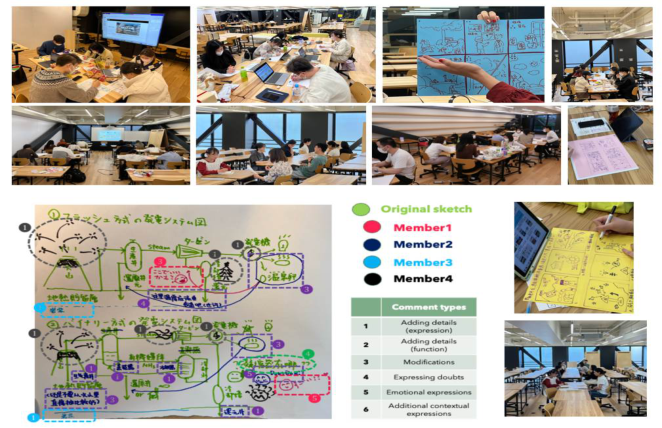
The study conducted an SNG experiment with a total of 73 university stu- dents concerned about geothermal energy. Forty-five participants used “SNG with Sketching,”while 28 participants formed a control group using the exist- ing SNG for role-playing persuasion. Figure 1 shows photographs from the experiment and the resulting sketches.
Experimental Results and Discussion In the experiment, we conducted a 7-point likert scale questionnaire before (after the lecture) and after the SNG to assess:
[Q1&2] Your understanding of the standpoint (issues considered) of the stakeholder you portrayed, after the Lecture/SNG.
[Q3&4] Your understanding of the reasons why the stakeholder you portrayed found it difficult to compromise on certain issues, after the Lecture/SNG.
Figure 1: Field photographs and sketch samples of experiments conducted on university students while using SNG.
172 Ma and Wang
The quantitative survey results are summarized in Table 2.
Table 2. Statistical results of controlled experiments on SNG with sketching and SNG.
Table available in the original PDF paper.
SHs Local Officials Geothermal
Hot spring hosts Pro-environment developers group Before After △ Before After △ Before After △ Before After △
Understanding of the issues SHs are considering (Reasons why it’s difficult for them to agree on certain topics)
As shown in Table 2, four stakeholder roles were portrayed: Local Offi- cials, Geothermal Developers, Hot Spring Hosts, and Pro-Environment Groups. The average understanding scores for all roles improved signifi- cantly after the SNG compared to before. Moreover, the pre-post difference was notably larger for “SNG with Sketching” than for “SNG,” with all statistical tests yielding P-values well below 5%. The experimental results preliminarily demonstrated the superiority of “SNG with Sketching” in help- ing participants better understand the perspectives and rationales of different stakeholders.
Besides the quantitative analysis confirming the effectiveness of sketching in promoting communication and mutual understanding among stakehold- ers, some challenges were observed regarding the introduction and usage of the method. Although sketching is considered an effective communication tool, its successful integration and effective utilization remain challenging for individuals lacking drawing skills or averse to sketching.
Therefore, this study aims to leverage AIGC tools to enable more conve- nient, rapid, and precise visual sketch communication. However, considering that the actual target users may be older individuals with lower technologi- cal sensitivity, effectively utilizing AI support tools to generate vision sketches could increase the implementation difficulty of the AIGC-sketching method.
In summary, the following issues need further improvement and research to leverage the effects of visual communication through sketching:
1) Mitigating the aversion of actual stakeholders to introducing sketching as a communication medium during discussions and persuading them to proactively use it. 2) Developing a user-friendly method for individuals unfamiliar with sketch- ing and AI technologies to effectively utilize text-to-image generation and make adjustments and iterations.
To address these issues, we have developed the “AIGC-Integrated 3D Visual-Tactile Opinion Communication System,” which will be elaborated in Session 5.
Facilitating Stakeholder Consensus in Geothermal Development 173
AIGC-INTEGRATED VISUAL-TACTILE OPINION COMMUNICATION SYSTEM After preliminarily validating the effectiveness of sketching in facilitating communication and understanding among stakeholders, while also recogniz- ing the challenges and resistance in introducing such methods into traditional consensus systems, we developed the following system to better leverage our research findings through improved generation and interaction meth- ods, maintaining positive relationships and stability among stakeholders in geothermal development projects. The following section introduces the system’s components and prototype.
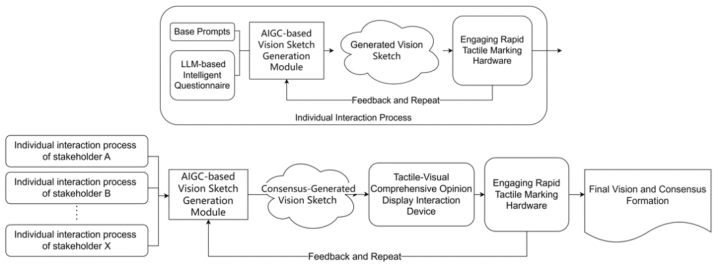
Overall Construction of the Consensus System This section describes the components and interaction flow of the proposed AIGC-Integrated 3D Visual-Tactile Opinion Communication System. The interaction between stakeholders and the system is divided into two parts: an individual interaction process for each stakeholder, and a multi-person interaction process integrating the outputs from the individual processes. Through these two stages, the system consolidates stakeholders’ opinions and optimizes the generation of vision sketches. In the individual interaction stage, participants provide feedback through an LLM-based intelligent ques- tionnaire and evaluate the generated vision sketches using a gamified rapid tactile marking hardware until satisfaction or reaching the iteration limit. The multi-person interaction stage re-generates vision sketches based on the consolidated individual data, reflecting them in real-time on the tactile-visual integrated opinion display interactive device, allowing all participants to col- lectively evaluate and ensure the final image reflects the collective opinion (see Figure 2).
Figure 2: Structural framework of AlGC-integrated 3D visual-tactile opinion communi- cation system.
Interaction Flow of the AIGC-Integrated 3D Visual-Tactile Opinion Communication System In the individual interaction process, each stakeholder will answer an LLM- based intelligent questionnaire. The LLM-based intelligent questionnaire is
174 Ma and Wang
designed and developed as follows: First, the questionnaire designer inputs predetermined prompt words into the LLM and designs and formulates the questions with LLM assistance. The questionnaire includes traditional Lik- ert scales and some open-ended short-answer questions. The questionnaire designer, with LLM assistance, will also draft three to five possible answers for the short-answer questions.
When answering the questionnaire, stakeholders can use the gamified rapid tactile marking hardware to quickly select their choices or preferred pre-set short-answer responses. If none of the pre-set short answers satisfies the stakeholder, they can directly record their answer through voice input, with relevant staff present to ensure accurate recording.
After completing the intelligent questionnaire, the LLM will analyze the stakeholder’s responses and generate a series of vision sketches based on predetermined themes. In each stakeholder’s individual interaction process, the number, sequence, and themes of the generated vision sketches are the same. Stakeholders will sequentially browse, mark, and evaluate each gen- erated vision sketches as follows: Stakeholders use the gamified rapid tactile marking hardware to mark the satisfactory and unsatisfactory parts of each vision sketches and record their reasons through voice input. The LLM will regenerate each vision sketches based on the marked locations and evalu- ations, repeating the process until the stakeholder is satisfied or reaches a predetermined iteration limit. This concludes the individual process for each stakeholder.
In the multi-person interaction process, the system consolidates and inte- grates the user responses, markings, evaluations, and feedback collected from the individual processes. After consolidation and weighting, these serve as the prompt words for the multi-person interaction process and are re-input into the system to generate a set of vision sketches that reconcile everyone’s inten- tions. These vision sketches are simultaneously displayed to all participating stakeholders, who use the gamified rapid tactile marking hardware to quickly mark the satisfactory or unsatisfactory parts of the currently displayed vision sketch. The overlaid markings are displayed in real-time on the tactile-visual integrated opinion display interactive device, allowing all present stakehold- ers to clearly observe the collective opinion distribution on the current vision sketch, quickly identifying areas of consensus and disagreement.
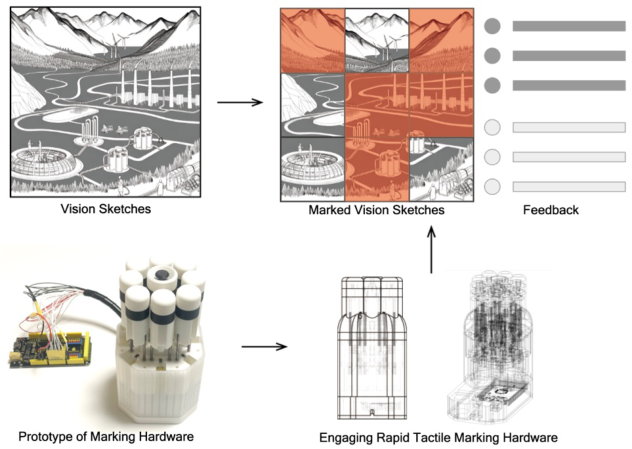
Design and Prototype Development of the Gamified Rapid Tactile Marking Hardware The gamified rapid tactile marking hardware is designed to complete this interaction process as follows: The hardware itself consists of a 3x3 matrix of nine pressure columns. The currently displayed vision sketch is also divided into nine sections using a 3x3 matrix grid. Each section of the vision sketch corresponds to the same position pressure column on the hardware. When a pressure column is pressed, the micro-switch underneath is triggered, and the microprocessor in the hardware communicates with the computer’s upper computer, completing the marking of the corresponding vision sketch section.
Facilitating Stakeholder Consensus in Geothermal Development 175
We developed a prototype of the gamified rapid tactile marking hardware based on the Arduino Mega2560 microcontroller. As described earlier, the prototype adopts a 3x3 matrix arrangement of nine pressure columns. Each pressure column is spring-reset, with a magnet-hall sensor combination at the bottom to detect the degree of pressure, allowing for setting a threshold to trigger the pressure signal (see Figure 3).
Figure 3: Development of engaging rapid tactile marking hardware.
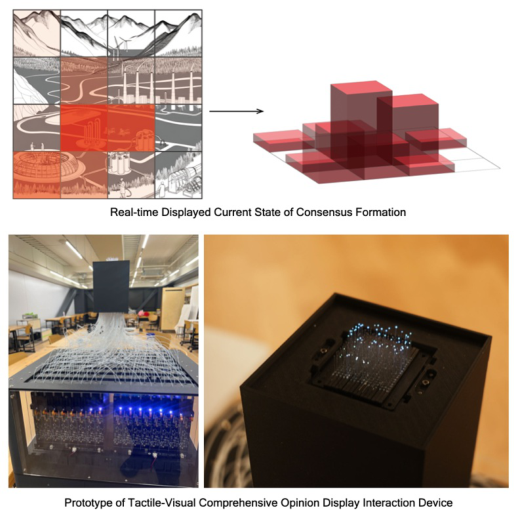
Design and Prototype Development of the Tactile-Visual Integrated Opinion Display Interactive Device For each vision sketch displayed, the marking results for its various sections are displayed in real-time on the tactile-visual integrated opinion display interactive device. This device consists of several vertically movable units arranged in a matrix. Each unit can move up and down within a certain range driven by a micro-motor, with an LED installed at the end. The matrix of vertically movable units corresponds to the currently displayed vision sketch divided into multiple sections and the gamified rapid tactile marking hard- ware held by each stakeholder. When more stakeholders simultaneously mark a particular section of the vision sketche as satisfactory/unsatisfactory, the corresponding vertically movable unit matrix will rise/descend more promi- nently, and the corresponding LED will become brighter. In this way, all present stakeholders can intuitively observe the collective satisfaction level for different regions of the currently displayed vision sketch, reflected in real-time on the tactile-visual integrated opinion display interactive device, presenting the current consensus formation situation like a sand table.
We developed a prototype of the tactile-visual integrated opinion display interactive device based on the STM32 microcontroller. Using micro-stepper
176 Ma and Wang
motors to drive optical fibers to move up and down within PTFE tubes, the optical fibers can transmit light from internal LEDs to the ends. In this way, we created compact vertically movable units. During the prototype develop- ment, we arranged 16x16 (256) vertically movable units, achieving a highly detailed visual-tactile display effect (see Figure 4).
Figure 4: Development of tactile-visual comprehensive opinion display interaction device.
CONCLUSION AND FUTURE WORKS This study validates the superiority of introducing sketching methods into the SNG framework for facilitating effective communication and consensus- building among geothermal development stakeholders. Empirical experi- ments demonstrate improved mutual understanding when incorporating visual techniques compared to traditional verbal exchanges. To address chal- lenges in integrating sketching for stakeholders averse to or unfamiliar with it, an AIGC-Integrated 3D Visual-Tactile Opinion Communication System is proposed, leveraging AI-generated visuals iteratively refined through intuitive tactile inputs. Prototypes for key system components - the gamified rapid tac- tile marking hardware and the tactile-visual integrated opinion display device - are developed and preliminarily tested.
Future works include fabricating higher-fidelity and larger-scale proto- types of these components for comprehensive system integration testing. This holistic system will then undergo field trials with actual geothermal stake- holders to validate its feasibility, usability, and effectiveness in fostering stable
Facilitating Stakeholder Consensus in Geothermal Development 177
consensus formation. Insights from these practical deployments will further refine the system’s design and identify areas for enhancement, advancing the goal of facilitating harmonious geothermal development through improved stakeholder communication methodologies.
REFERENCES
Ando, K., Sugiura, J., Ohnuma, S., Tam, K.-P., Hübner, G. and Adachi, N. (2019).
Persuasion Game: Cross-Cultural Comparison’, Simulation & Gaming, 50(5), pp. 532–555. Bilda, Z. and Gero, J. S. (2005) ‘Does Sketching Off-Load Visuo-Spatial Working Memory’, in Studying Designers. Sydney, Australia, pp. 145–160. Hirose, Y. (2007). A normative and empirical research on procedural jus- tice of
citizen participation in environmental management planning. In K. Ohbuchi (Eds.) Social Justice in Japan: Concepts, Theories and Paradigms. Melbourne: Trans Pacific Press, pp. 264–290. Onuma, S., Hirose, Y. and Sugiura, J. (2019). Acceptance of Compromise Solutions Beyond Dichotomous Support or Opposition and Procedural Justice as a Deter- mining Factor: A Case Study of Tram Projects in Noise City, Journal of Social Safety Studies, 9, pp. 89–101. Sugiura, J. (2003). The Persuasion Game as an Environmental Education Tool:
Examining the Development, Implementation, and Improvement Processes, Sim- ulation & Gaming, 13(1), pp. 3–13. Sugiura, J. (2007). Development of Learning Materials on Fraudulent Business Practices Using the Persuasion Game, Consumer Education, 27, pp. 113–122.
LISTED IN THE AHFE DIGITAL BOOKSTORE CATALOGUE
Explore the complete digital volume
Human Factors in Communication of Design
Read this individual research paper free through the original publisher, or explore the full digital proceedings book.
ISBN 978-1-964867-12-0
Explore this ISBN in the AHFE Bookstore ↗Listed in the July 2026 bookstore catalogue; search by ISBN to confirm current availability · Digital book purchase optional