Gaelic Jara-reinhold, Ina Jovicic, Akash Nandi, Evangelos Markopoulos (2024). Analysis of Personal Safety Walking Alone at Night and an Innovative Wearable Solution. In: Human Factors and Wearable Technologies. AHFE Open Access, vol. 141, pp. 70–80. https://doi.org/10.54941/ahfe1005056
This study explores the acute problem of personal safety, particularly when walking alone at night, a concern that resonates globally across various demographics. The core of this issue lies in the alarming statistics indicating that in the UK, every second woman and every seventh man do not feel safe in such circumstances, with two out of three women experiencing public sexual harassment annually (Office for National Statistics, 2022). This widespread fear not only impacts mental and physical well-being but also the fundamental freedom of movement, contributing to broader societal and gender inequalities. In this paper, a smart wearable badge is presented to be worn by users walking at night, but more specifically women, children, students, and late-night workers. Unlike conventional safety gadgets, the badge operates on the principles of 'Prevent, Protect, and Provide' with a particular emphasis on prevention.The technology is not merely a reactive tool but a proactive deterrent, visibly indicating protection and thus potentially preventing incidents. Furthermore, its integration with cloud technology for evidence storage and its capacity to trigger an immediate response in crisis situations set it apart from existing solutions.This paper aims to dissect the effectiveness of such a badge in mitigating the fear and reality of walking alone at night. By examining its technological framework, user needs, and real-world applicability, the badge stands as a significant advancement in personal safety technology and clearly shows a positive potential impact on societal norms and individual well-being.
According to Maslow’s Hierarchy of Needs, safety is the second most important basic human need, and its insufficiency can negatively impact an individual’s overall well-being (Pichere & Cadiat, 2015). Consequently,
Analysis of Personal Safety Walking Alone at Night and an Innovative Wearable Solution 71
human evolution has equipped us with survival mechanisms for enhanced survival odds (Mobbs et al., 2015), (Isaacs, 1975). Many technological advancements of the modern era have been developed in response to this innate quest for safety. Some innovations include seatbelts, vaccinations, and cybersecurity measures. However, one major problem persists: the lack of safety when walking alone at night. Although various safety measures have been implemented, their effectiveness in deterring criminal behaviour remains inadequate. Consequently, there is a pressing need for innovative solutions to address this pervasive issue effectively.
PUBLIC PERCEPTION OF SAFETY Before introducing a solution, a deep analysis of the problem is required to signify its importance. This paper begins with a global overview, yet swiftly narrows its focus to the United Kingdom, aiming to shed light on the specific context within this region.
The Problem A significant portion of the population continues to feel unsafe walking alone at night, a concern largely attributed to persistent criminal activity. This issue disproportionately affects women, who report feeling less secure than their male counterparts (Office for National Statistics, 2022). The problem spans across both developed and developing countries, indicating its global nature (Crabtree and Nsubuga, 2012).
Global Overview The issue of feeling unsafe while walking alone at night transcends geographic and economic boundaries, with minimal variation across different regions and levels of wealth. One particularly extensive dataset on this global mat- ter is provided by Gallup (Crabtree and Nsubuga, 2012). More specifically, Gallup asks respondents across 143 countries the following survey question: “In the city or area where you live, do you feel safe walking alone at night, or not?” The findings reveal a weak association between a nation’s wealth and its citizens’ sense of security during solo nocturnal walks (Crabtree and Nsubuga, 2012). Gallup’s survey unveils nuanced insights:
59% of women from low-income countries feel safe,
70% of women from lower-middle-income countries feel safe,
40% of women in upper-middle-income countries feel safe,
59% of women in high-income countries feel safe.
Additionally, from the survey, women’s perception of safety, when analysing specific instances such as the United Kingdom in 2012, only 62% of British women feel safe at night, a stark contrast to the 90% in Georgia. Despite the UK’s superior GDP per capita, such findings hint at the profound impact of cultural values, norms, and societal practices on shaping safety per- ceptions, challenging the assumption that wealth equates to a universal sense of security.
This influence of cultural and societal factors is further highlighted by the notable variations in women’s feelings of safety across different continents, where each exhibits distinct cultural norms. For example, in Europe, 55% of women feel safe walking alone at night, compared to 50% in the Americas, and a higher 70% in Asia (Crabtree and Nsubuga, 2012). These statistics not only reflect diverse cultural contexts but also emphasize the complexity of factors that contribute to women’s sense of safety, beyond simple economic development or national wealth.
This discrepancy suggests that, regardless of economic status, women consistently perceive a vulnerability in isolation.
Perception of Safety in the United Kingdom Delving deeper into the United Kingdom, the latest Opinions and Lifestyle Survey by the Office for National Statistics revealed significant gen- der disparities in perceptions of safety (Office for National Statistics, 2022):
quiet streets: 50% of the female and 83% of male’s respondents feel safe,
busy public space: 55% of female and 82% of male’s respondents feel safe,
park/open space: 18% of female and 58% of male’s respondents feel safe,
public transport: 52% of female and 81% of male’s respondents feel safe.
These concerns are more acute among younger women, aged between 16 to 34.
Moreover, the lack of safety directly affects 25% of women and 11% of men’s lifestyles as they are reported to cease from leaving their homes alone at night and engaging in activities (Office for National Statistics, 2022). The situation underscores a pressing issue: feeling unsafe not only subjects’ women to immediate emotional distress but also restricts their personal free- doms and narrows their range of experiences, a concern that also affects men, although to a smaller extent.
This pronounced impact on women highlights the urgent need to address safety concerns to ensure that all individuals, especially women, can fully engage in societal activities without fear.
THEORETICAL APPROACHES ON UNDERSTAND CRIMES Understanding crime dynamics is equally important to best tackle the problem. Situational crime prevention and routine activity theory are two concepts used to understand the requirements for personal safety devices.
Situational Crime Prevention Theory Situational crime prevention focuses on altering the physical or social envi- ronment to make criminal activity less conducive. It aims to reduce opportu- nities for crime by making it more challenging, riskier, or less rewarding for potential offenders.
Analysis of Personal Safety Walking Alone at Night and an Innovative Wearable Solution 73
This approach emphasizes the importance of targeting specific situations or settings where crimes are likely to occur and implementing measures to deter or prevent them (Clarke, 1983). Situational crime prevention can guide the design and features of personal safety devices by understanding the risk-laden scenarios. For example, devices can incorporate features like GPS tracking, panic buttons, loud alarms, or discreet signalling options to enhance personal safety in different situations.
The Routine Activity Theory The routine activity theory suggests that for a crime to occur, three ele- ments must converge: a motivated offender, a suitable target, and the absence of capable guardians. It emphasizes the importance of understand- ing the everyday routines and activities of potential victims, offenders, and guardians (e.g., law enforcement, security, or personal safety devices) to assess the risk of criminal events (Cohen & Felson, 1979). Routine activ- ity theory highlights the significance of capable guardians in preventing crime.
Personal safety devices can serve as effective guardians by empow- ering individuals with tools to protect themselves but also by provid- ing the possibility to rapidly call for help. By considering the rou- tines and activities of potential victims, safety devices can be designed to be easily accessible, portable, and noticeable, ensuring they can act as efficient guardians and provide protection in various routine situations.
UNDERSTANDING USER REQUIREMENTS FOR SAFETY PRODUCTS AND CURRENT AVAILABLE SOLUTIONS To assess the potential market for a novel protective product, it’s essential to analyse the landscape of existing products, their usage among women, their impact on perceptions of safety, and the user requirements to feel safe. A sur- vey was conducted to delve into these critical questions, aiming to understand the current options for means of protection and the willingness of women to embrace new technologies for their safety.
In conducting this survey, emphasis was placed on a demographic that typically leads to a more socially active nightlife, specifically women aged 18 to 30. As such, out of 136 participants, 98.0% of the survey respondents were female, with 59.7% falling within the 18 to 24 age range, and 29.5% aged between 25 and 30 years old. This focus was instrumental in gathering relevant insights from the target audience most likely to benefit from a new solution.
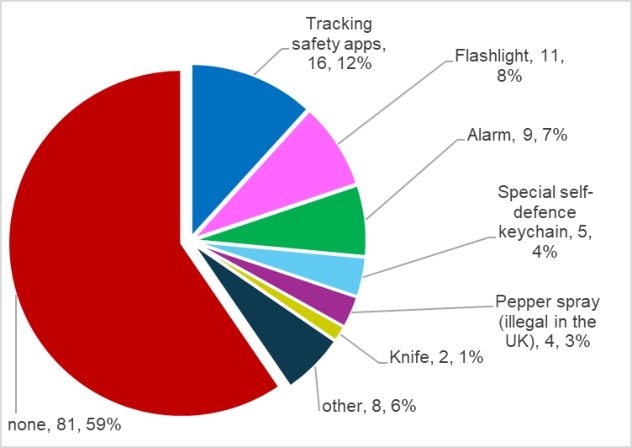
Results and Discussion From the Conducted Survey The initial inquiry of the survey was to determine the usage of self-defence tools among women, specifically which tools, if any, were being utilized. The findings are presented in Figure 1.
Figure 1: Types of self-defence tools used by women.
Among the women who did not use any means of protection, 32% were unsure which product to choose, 17.5% doubted the effectiveness of such products in ensuring their safety, while only a small fraction, 4.4%, cited cost as a deterrent, and 3.5% expressed embarrassment as their reason. These findings indicate a significant willingness among women to adopt protective measures, suggesting that the challenge lies not in the lack of desire for safety but in finding a suitable product that meets their needs and expectations.
Concerning the preferences for the nature of safety tools, whether hard- ware or software. Table 1 showcases that a hardware product is preferred.
Table 1. Preferred nature of protective tool.
Table available in the original PDF paper.
Should the tool signal its presence Choice count Hardware (eg: key-chain alarm) 54.4% - 74 votes Software (eg: app) 15.4% - 21 votes No preference 30.1% - 41 votes
More interestingly, Table 2 displays results outlying that women prefer a product to visibly indicate that the user is under protection.
Table 2. Preference of the protective tool being informed that the user is protected.
Table available in the original PDF paper.
Should the tool signal its presence Choice count Yes (eg: wearable visible badge) 43.9% - 61 votes No: (eg: hidden key-chain) 28.1% - 39 votes No preference 28.1% - 39 votes
Analysis of Personal Safety Walking Alone at Night and an Innovative Wearable Solution 75
In the survey’s conclusion, participants were queried on their willingness to adopt a new wearable device designed to visibly enhance their prospects of receiving assistance in times of need. A significant majority, 78.9%, responded affirmatively, indicating their readiness to embrace such a solution.
Conversely, 16.4% expressed reluctance, while 4.7% remained undecided on the matter. These responses collectively affirm a crucial insight: women are generally receptive to embracing novel products that promise increased safety during solitary nighttime activities, thereby potentially expanding their liberty to move freely and securely at any hour.
The Market Landscape and Current Solutions Upon examining the array of solutions accessible to consumers, a significant gap becomes apparent: the lack of preventive measures. The current market offerings do not prioritize averting incidents before their inception; rather, they focus on safeguarding the user post the initiation of criminal activity.
According to our survey data, a mere 28.1% of female respondents express a preference for “invisible” safety products. This preference underscores a critical flaw in the existing solutions— their inconspicuous nature does not visibly deter potential offenders. Often, these protective measures are concealed within a purse or manifest merely as applications, leaving the perpetrator oblivious to the user’s protected status.
Table 3 delves into an analysis of various products currently available in the market, highlighting this pervasive issue.
Product Name Reference Description SHIFT (Springwise, 2024) Jewellery - Alert button EPOWER (Epowar, 2024), App - Detecting if distress, calls for help NOVO GO (NovoGo, 2024) Jewellery - Connects with help services SHE’S BIRDIE (Shesbirdie, 2024) Keychain alarm INVISAWEAR (InvisaWear, 2024) Scrunchie - Alert button + GPS tracking FLARE (Flare, 2024) Bracelet - Alert button, calls user for safety check BASU (Basu, 2024) Keychain alarm ONE SCREAM (OneScream, 2024) App - Reacts when user screams BSAFE (BSafe, 2024) App -GPS tracking, fake call, alerts contacts SAFELET (SafeLet, 2024) Armband - Alert button
It is significant to acknowledge that the company “ONE SCREAM” has ceased operations, highlighting the challenge that reliance on a phone appli- cation does not suffice in providing safety for users. The discontinuation is speculated to stem from the impracticality of needing to access one’s phone during an attack to activate an alert, which paradoxically may endanger the device itself to theft.
THE ENOUGH BADGE Enough Safety Ltd. is a company dedicated to enhancing personal safety, with a special focus on empowering women to feel safe while walking alone
at night, initially targeting the United Kingdom market. To fulfil its mission, the company is poised to launch the eNOugh badge, a smart wearable device that magnetically clips to a jacket or coat the moment the user starts a journey.
The Badge and Its Features The design and functionality of the badge have been informed by extensive research, including the survey and consultations with self-defence and crim- inal experts. Key insights from these engagements highlight the importance of a personal safety device being instantly accessible, still offering protec- tion even if the wearer is incapacitated by shock, and highly visible to show potential criminals that the user is being protected.
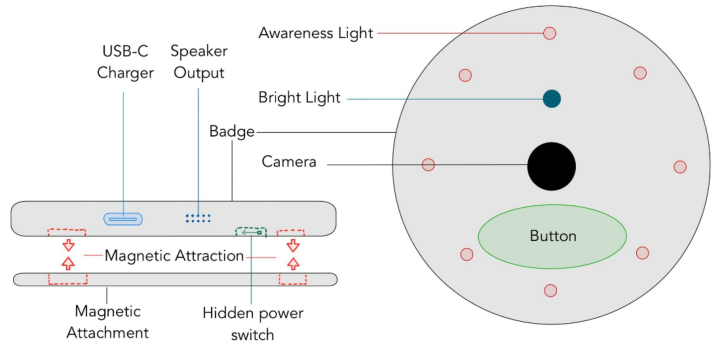
To fulfil these requirements and ensure optimum protection, the company has divided the badge’s features into three core objectives, also called the 3P’s: Prevent, Protect, and Provide. An accompanying app also supports the product. Figure 2 presents a visual insight into the badge and its features.
Figure 2: Overview of the badge’s hardware features.
Prevent Under Prevent falls two features: the red awareness lights, and an embedded camera live streaming the walk. Along a unique design, the awareness lights ensure the visibility of the product and clearly indicate that the person is being protected.
The camera livestreaming is another important deterring factor, reducing risks of aggression. The Hawthorne effect indicates that individuals modify their behaviour in response to being filmed or observed (Mayo, 1933). It increases the criminals’ perceived risk of being caught, leading to a decrease in criminal behaviour (Lindegaard, 2018). Additionally, the footage, can help authorities in investigations and legal processes. This can potentially lead to successful convictions and therefore transforming the award aspect of taking criminal actions into punishment. The use of a camera is also supported by
Analysis of Personal Safety Walking Alone at Night and an Innovative Wearable Solution 77
crime prevention strategies such as CCTV cameras in public spaces and body- warn-cameras used by police officers (Welsh & Farrington, 2009).
Protect Under Protect falls two features: a loud alarm and a bright light, to be acti- vated upon a shout or if the badge’s main button is pressed. These aim to protect the user in case of an attack without harming the criminal.
The loud, piercing alarm intends to attract immediate attention to the user and thus surprise potential attackers, disrupting their focus and potentially causing them to reconsider their actions (TBOTECH, 2023).
On the other hand, the LED lights produce bright, flashing patterns that can be visually disorienting and momentarily blind the offender. When acti- vated in conjunction with a personal alarm, they create a multi-sensory deterrent, adding to the overall impact of the alarm. This provides an oppor- tunity for the user to escape to a safe location (Personal Defense World, 2022).
Provide When the alert remains active past a set timeframe (eg: organised and graver crimes), the system engages its Provide mechanism, utilizing GPS location, live video, and audio to evaluate the situation. It then proceeds to notify either emergency contacts or local authorities, based on the assessed needs, ensuring timely assistance is dispatched.
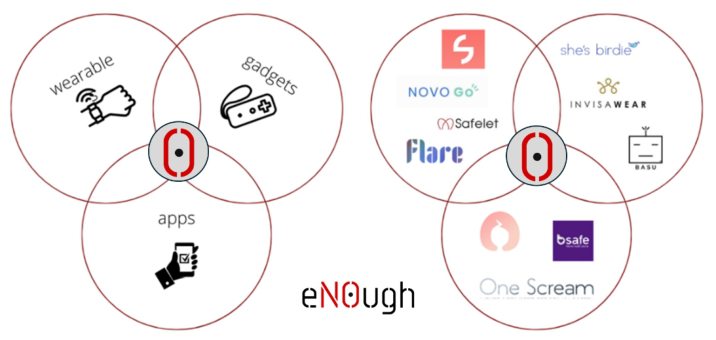
ENOUGH Versus the Competition Compared to the solutions mentioned in Table 4, ENOUGH combines the three different types of solutions into a single one as shown in Figure 3.
Figure 3: Allocation of ENOUGH and competition between three sectors.
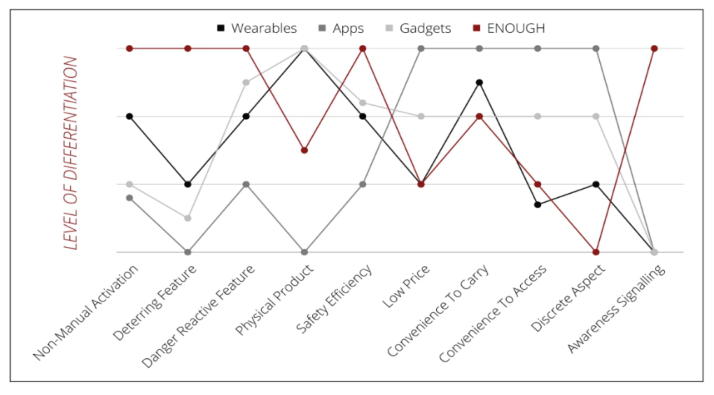
To further compare how ENOUGH distinguishes itself from the 3 groups of competitors, a framework was applied inspired by the Strategy Can- vas framework from the Blue Ocean Theory (Kim and Mauborgne, 2015).
ENOUGH was evaluated against each group on multiple categories and ranked whether it increased, decreased, maintained, or eliminated an aspect of the safety product in comparison to other safety prevention products (see Figure 4).
Figure 4: Comparison of different types of solutions and ENOUGH.
The distinctiveness of ENOUGH in the realm of safety lies in its threefold functionality: prevention, protection, and providing. Its uniqueness stems from its visibility and ability to deter threats through visible features and a camera that not only acts as a deterrent but also captures evidence, making the user a less appealing target for potential offenders. This multifunctional design sets ENOUGH apart from its competitors, offering a comprehensive safety solution.
LIMITATIONS RESEARCH The limitations of this study include reliance on data primarily from two sources and a survey with a limited number of participants, which may affect the accuracy of the safety perception analysis to some extent. Furthermore, the effectiveness of the safety badge has not been tested in public street envi- ronments, highlighting a gap in empirical validation of the proposed solution in real-world settings.
AREAS OF FURTHER RESEACH Future investigations should prioritize testing the product in public environ- ments to assess its viability for commercial use among the general populace. Additionally, exploring how the product performs across various geogra- phies would provide valuable insights into its effectiveness and adaptability in different cultural and environmental contexts.
Analysis of Personal Safety Walking Alone at Night and an Innovative Wearable Solution 79
CONCLUSION
In conclusion, this paper addresses the critical need for enhanced safety mea- sures for individuals, particularly women, walking alone at night. Rooted in Maslow’s Hierarchy of Needs, it highlights the innate human quest for safety and the inadequacy of current solutions in mitigating the risk of noctur- nal criminal activity. Through a comprehensive analysis, including a survey within the United Kingdom, we identified a significant demand for preventive safety solutions that are visible and capable of deterring potential threats.
The introduction of the eNOugh badge by Enough Safety Ltd. represents an innovative response to this demand, offering a multifaceted approach to personal safety through prevention, protection, and provision. Featuring visibility through red awareness lights, a deterrent effect via live-streaming capabilities, and immediate protection through alarms and bright lights, the eNOugh badge sets a new standard in personal safety devices. This research underscores the importance of developing solutions that address the nuanced and complex nature of feeling safe in public spaces, urging further innovation and exploration in the field of personal safety technology.
The downstream effects of allowing women to feel safer may potentially have a wide variety of positive impacts. By mitigating the anxieties associ- ated with walking alone at night, innovations can substantially contribute to women’s autonomy, confidence, and participation in societal activities. Ultimately, the widespread adoption of visible and effective personal safety devices can transform public spaces into arenas of freedom and security, enabling women to fully exercise their right to personal and communal engagement without the shadow of vulnerability.
REFERENCES
Basu, A. (2024). My eAlarm. https://myealarm.com/collections/self-defense-alarm BSafe. (2024). Get Bsafe. https://www.getbsafe.com/ Chapanis, A. (1996). Human factors in systems engineering. Wiley Series in Systems Engineering and Management. Andrew Sage, series editor. Hoboken, NJ: Wiley. Clarke, R. V. (1983). Situational Crime Prevention. Crime and Justice, 19, 91–150. Cohen, L. E., & Felson, M. (1979). Social Change and Crime Rate Trends: A Routine
Activity Approach. American Sociological Review, 44, 588–608. Crabtree, S., & Nsubuga, H. (2012). Women feel less safe than men in many developed countries. Gallup. https://news.gallup.com/poll/155402/women-feel-less-sa fe-men-developed-countries.aspx Epowar. (2024). Revolutionising Women’s Safety. https://epowar.com/ Flare. (2024). Flare. https://getflare.com/ InvisaWear. (2024). InvisaWear. https://www.invisawear.com/ Isaacs, H. R. (1975). Idols of the tribe: Group identity and political change. Harvard
University Press. Kim W. C. and Mauborgne R. (2015). Blue Ocean Strategy. Boston: Harvard Business Press. Lindegaard, M. R., & Bernasco, W. (2018). Lessons Learned from Crime Caught on
Camera. The Journal of Research in Crime and Delinquency, 55, 155–186. Mayo, E. (1933). The Human Problems of an Industrial Civilization. New York: Macmillan.
trends/#/observation/1134203?fromSearch=%3Ffreetext%3Dsafety%2520women Mobbs, D., Hagan, C. C., Dalgleish, T., Silston, B., & Prévost, C. (2015). The ecology of human fear: Survival optimization and the nervous system. Frontiers in Neuroscience, 9, 55. https://doi.org/10.3389/fnins.2015.00055 NovoGo. (2022). The Next Generation of Technology Enabled Care. Legrand. https:
//www.legrand.com/legrandcare/novogo.html Office for National Statistics. (2022). Perceptions of personal safety and experiences of harassment, Great Britain. OneScream. (2024). One Scream. https://www.onescream.com/ Personal Defense World. (2022). Flashlight Self-Defense Tactics to Show Your
Attacker the Light. Athlon Outdoors. https://www.athlonoutdoors.com/article/f lashlight-self-defense/ Pichère, P., & Cadiat, A.-C. (2015). Maslow’s hierarchy of needs. Lemaitre. SafeLet. (2024). SafeLet. https://safelet.com/ Springwise. (2024). Connected jewellery doubles as a personal safety device.
https://www.springwise.com/innovation/fashion-beauty/jewellery-that-doubles- as-a-safety-device Shesbirdie. (2024). She’s a birdie. https://www.shesbirdie.com/ TBOTECH. (2023). Personal Alarms for Women: A Comprehensive Guide. https: //www.tbotech.com/personal-alarms-for-women.htm Welsh, B. C., & Farrington, D. P. (2009). Public Area CCTV and Crime Prevention:
An Updated Systematic Review and Meta-Analysis. Justice Quarterly, 26(4), 716– 745. https://doi.org/10.1080/07418820902873852
LISTED IN THE AHFE DIGITAL BOOKSTORE CATALOGUE
Explore the complete digital volume
Human Factors and Wearable Technologies
Read this individual research paper free through the original publisher, or explore the full digital proceedings book.
ISBN 978-1-964867-17-5
Explore this ISBN in the AHFE Bookstore ↗Listed in the July 2026 bookstore catalogue; search by ISBN to confirm current availability · Digital book purchase optional