Yongkyun Lee, Hyesu Park, Sitai Kim, Younggun Lee, Seunghoon Yoo, Sungho Kim, Choongsik Oh, Hyesik Yun, Joonghoon Ko, Jongwoo Ha, Dongsoo Kim (2024). Daily Multidimensional Fatigue Scale and Physiological Indicators to minimize Subjective Bias in assessing Fatigue Levels. In: Physical Ergonomics and Human Factors. AHFE Open Access, vol. 147, pp. 35–43. https://doi.org/10.54941/ahfe1005175
Fatigue is a human factor that can diminish task efficiency and serve as a potential cause of safety incidents. The specific aim is to investigate the removal of subjective bias in fatigue assessment with the daily multidimensional fatigue inventory (DMFI), covering acute, cumulative, physical, and mental fatigue. Additionally, the goal is to investigate the elimination of residual subjective bias after DMFI using physiological indicators, the Psychomotor Cognition Test (PCT), salivary CRP, blood lactate, and salivary cortisol, related to each type of fatigue. The DMFI significantly classified daily fatigue into 5 levels (p<0.001). As the level of fatigue increased, the reaction time of PCT slows down, and the success rate decreased. PCT alone was not sufficient for classifying fatigue levels. However, PCT could possibly serve as a tool for data refinement, eliminating some subjective bias in self-reported fatigue levels. The levels of blood lactate showed a positive correlation with the increase in fatigue levels. Especially in groups with high levels of physical activity, the concentration of blood lactate can be utilized as a tool to eliminate subjective bias, and it was found to be useful in classifying fatigue into binary or 3 levels. Salivary CRP, representing cumulative fatigue, had some utility as a tool to track subjective bias in participants, specifically in office work where cumulative fatigue levels were relatively low. Salivary cortisol, representing mental fatigue, was found to be unsuitable as an indicator for tracking fatigue levels in mentally healthy participants. The accumulated data here will be utilized for the training of a deep learning-based fatigue level classifier.
Fatigue is a human factor that can diminish task efficiency and serve as a potential cause of safety incidents (Williamson et al., 2011). However, fatigue is a concept that cannot be clearly defined and relies on individual subjec- tive assessments. Hence, the assessment of fatigue levels predominantly relies on individual judgment, and systematic intervention is generally infrequent. However, there are instances where a precise evaluation of fatigue becomes imperative. Firstly, measurements of fatigue levels are conducted when assess- ing disease levels requiring treatment, such as in the case of chronic fatigue syndrome (Montoya et al., 2013). Secondly, evaluations of fatigue levels are implemented for high-risk occupations, like pilots and drivers, with the aim of promoting qualitative improvements in task performance or for risk management purposes (Aghdam et al., 2019). While measuring physiological indicators, such as cortisol levels, can assist in gauging disease-level fatigue (Nijhof et al., 2014), the exclusion of subjective bias in real-time assessments of a worker’s fatigue level in the field may prove challenging. A method to partially exclude subjective bias in self-reported fatigue assessments involves utilizing a multidimensional fatigue scale that surveys the detailed causes of fatigue through a questionnaire. In this study, we developed the “Daily Mul- tidimensional Fatigue Inventory (DMFI),” a fatigue scale for daily repeated measurements, by integrating and modifying such a multidimensional fatigue scale and a fatigue risk management checklist. In this scale, multidimensional fatigue encompasses mental fatigue, physical fatigue, cumulative fatigue, and acute fatigue. The comprehensive fatigue scale, consisting of a total of 13 items, allowed us to classify fatigue into five levels. Notably, we utilized scores from six items with excellent resolution in fatigue level classification for this purpose (see Table 1).
1. The accumulated fatigue affected my work today.
2. I think I’m exhausted.
3. My workload has been heavy on me in the last 24 hrs.
4. I need a break now.
5. My concentration has decreased compared to usual.
6. I don’t have much motivation for my work.
Each specific type of fatigue is associated with physiological indicators that fluctuate in response to changes in fatigue levels. Blood lactate concentration is linked to physical fatigue (Nozaki et al., 2009), cortisol concentration, a stress hormone, is associated with mental fatigue (Koo et al., 2018), and cumulative fatigue shows partial correlation with the concentration of the
Daily Multidimensional Fatigue Scale and Physiological Indicators 37
inflammatory marker C-reactive protein (CRP) (Strawbridge et al., 2019). Acute task-related fatigue can be tracked through vigilance tests (Lee et al., 2023). These physiological indicators can be additionally utilized to track and exclude subjective bias. The specific aims of this study are to investi- gate the level of removal of subjective bias in fatigue assessment through a multidimensional fatigue assessment scale consisting of acute fatigue, cumu- lative fatigue, physical fatigue, and mental fatigue, and to elucidate whether remaining subjective bias can be eliminated through physiological indicators associated with each type of fatigue. The fatigue level classification data with removed subjective bias will be cumulatively stored in the database along with simultaneously collected thermal, visual, and vocal data. This dataset will be utilized as training data for developing a deep learning-based fatigue level classifier that classifies fatigue levels solely based on biological information.
SUBJECT AND METHODS Subjects: The participants consisted of 170 individuals, including high-risk fatigue groups such as firefighters and nurses, as well as a control group of office workers. Among the 170 participants, there were 72 males and 98 females. The average age of the participants was 40.9 years. All experimen- tal procedures involving human subjects were approved by the Institutional Review Board at Republic of Korea Air Force Aerospace Medical Center (ASMC-21-IRB-005).
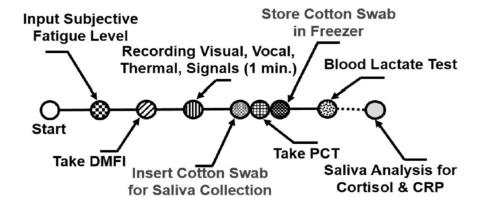
Data Acquisition Procedure: All fatigue data were obtained through the specially designed Bio Signals Collecting System for Fatigue Level Classifica- tion (Lee et al., 2023). Fatigue levels were assessed once to twice a day per person, with a total of 40 to 50 repetitions. Summarizing the procedure for a single data acquisition, participants logged into the system, entered subjective fatigue level as per instructions, and performed the DMFI. Subsequently, they underwent the PCT, read a script on the screen, and during this time, vocal, visual and thermal signals were recorded for one minute. Following that, a lactate test was conducted, and saliva was collected into a container. Saliva was utilized for cortisol and CRP analyses. The data acquisition procedure is illustrated in Figure 1.
Figure 1: Data acquisition procedure.
Physiological Indicator Analysis: The vigilance test is conducted using the Psychomotor Cognition Test (PCT) (Lee et al., 2023). The level of vigilance is determined through the reaction time and success rate obtained from the PCT. Blood lactate levels were measured using the Lactate Pro-2, a blood lactate test meter from Arkray Inc (Japan). Salivary cortisol and CRP level tests utilized Enzyme-Linked Immunosorbent Assay (ELISA) kits from Sali- metrics (USA), and were performed according to the protocol provided by Salimetrics.
RESULTS
Fatigue assessments were conducted a total of 7,023 times, resulting in an average fatigue level of 2.67 on a scale of 1 to 5 (see Table 2). The DMFI significantly categorized daily fatigue into 5 levels (p<0.001). Fatigue levels determined by DMFI were statistically significantly lower than those sub- jectively reported. Notably, firefighters and nurses engaged in shift work exhibited a more pronounced difference compared to office workers. Dis- crepancies between subjective fatigue level assessments and DMFI fatigue level assessments were primarily observed at the extremes of fatigue levels, specifically, at level 1 and level 5 (see Table 2). Participants were instructed that level 1 represents a state where they can concentrate on work without significant fatigue for more than 2 hours without rest, while level 5 indi- cates a very tired state requiring a substantial rest. Interestingly, participants tended to avoid selecting the extremes and instead chose fatigue levels closer to the middle, even when being assessed as level 1 or level 5 in the multidi- mensional evaluation. This suggests a subjective tendency to avoid extreme choices in self-reported surveys, which was partially corrected through the multidimensional assessment.
Table 2. Fatigue assessment results.
Table available in the original PDF paper.
Mean Fatigue Level Difference in freq., % Subjective DMFI L-1 L-2 L-3 L-4 L-5
However, there may be fatigue that DMFI cannot detect. In the process of performing tasks while ignoring the circadian rhythm for an extended period, participants, who consider shift work as part of their daily routine and may perceive themselves as already adapted, could be physiologically unadapted and vulnerable to external stressors (Shen et al., 2006). This is evident because the fatigue levels of firefighters and nurses working in shift schedules, when self-reported, appear similar to those of the control group, office workers, but the DMFI results show lower levels. Ultimately, physiological adaptation to fatigue should be tracked through physiological indicators related to specific types of fatigue.
Daily Multidimensional Fatigue Scale and Physiological Indicators 39
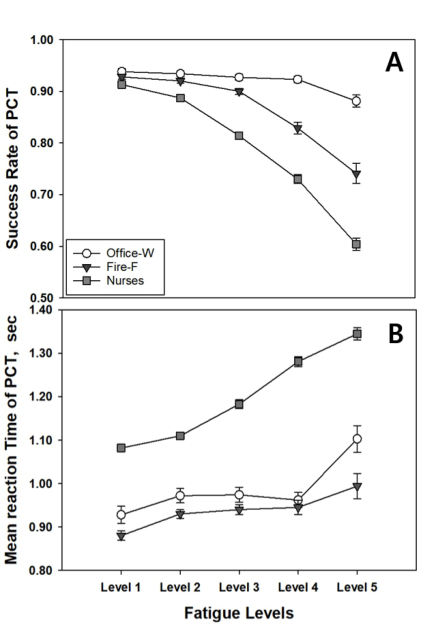
The acute fatigue level directly influencing task performance was tracked through vigilance tests. The Psychomotor Cognition Test (PCT) measured the speed and sustained concentration during task execution. PCT’s reaction time, indicative of task performance quantity, was evaluated based on the average speed of motor responses to visual stimuli. The assessment of task performance quality relied on the success rate derived from response errors to visual stimuli. As fatigue levels increased, mean reaction times slowed, and success rates decreased (see Figure 2). While PCT alone may not suffice for classifying fatigue levels, it serves as a tool to refine data by mitigating respondent bias. Nurses had significantly lower success rates in PCT and longer reaction times in PCT compared to firefighters and office workers. These indicators were significantly differentiated by fatigue levels only in nurses. Furthermore, this study suggests that PCT could be utilized in clas- sifying fatigue levels for individuals in occupations with a high proportion of women, such as nursing, or for participants with low levels of physical activity.
Figure 2: Differential (A) success rate and (B) reaction time of PCT based on fatigue levels.
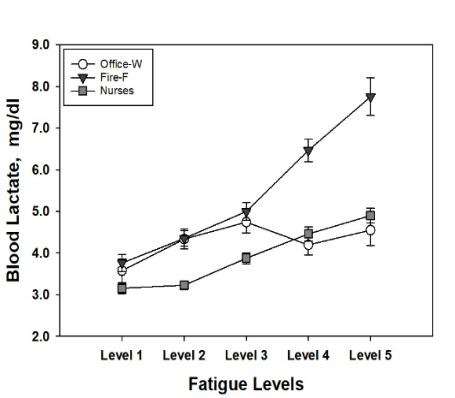
Firefighters showed higher levels of blood lactate associated with physical fatigue compared to office workers and nurses (p<0.01). Firefighters with high levels of physical fatigue were able to classify fatigue levels solely based
on blood lactate (see Figure 3). Firefighters and nurses, who engage in high levels of physical activity, exhibited that physical fatigue has a significant impact on fatigue level classification compared to office workers. Particularly, the blood lactate levels of firefighters and nurses at fatigue level 1 and level 2 showed a significant difference compared to those at fatigue level 4 and level 5 (p<0.01, all). The high blood lactate levels observed at low subjective fatigue levels suggest the potential use of this physiological indicator as a tool for removing subjective bias. However, it is noteworthy that this finding is limited to occupations with high physical activity, such as firefighters and nurses.
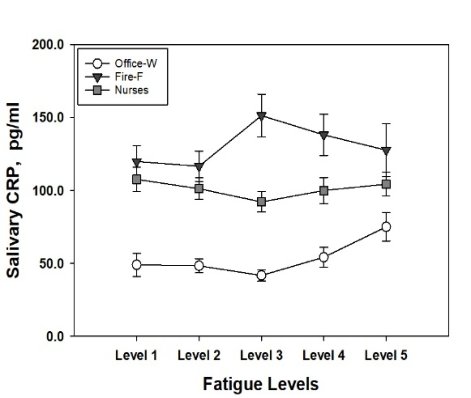
Figure 3: Differential blood lactate concentrations based on fatigue levels.Figure 4: Differential salivary CRP concentrations based on fatigue levels.
The salivary CRP levels of firefighters and nurses, whose fatigue levels were lower according to DMFI compared to office workers, were significantly higher (p<0.001, all). Although there was no significant correlation between
Daily Multidimensional Fatigue Scale and Physiological Indicators 41
fatigue levels and salivary CRP, relatively higher salivary CRP levels were observed when fatigue levels were elevated (see Figure 4). Indirectly, it can be inferred that firefighters and nurses working in shifts experience higher cumulative fatigue compared to office workers. However, it was revealed that this factor did not significantly contribute to the classification of fatigue levels. Nonetheless, CRP associated with cumulative fatigue may result from repeated exposure to fatigue or stress, which could potentially lead to vulner- ability in future disease resistance (Gouin et al., 2012). On the other hand, for office workers not engaged in shift work, the rise in fatigue was correlated with an increase in CRP. In professions where fatigue levels are not typically high, such as office work, CRP may serve as a tool for classifying elevated levels of fatigue.
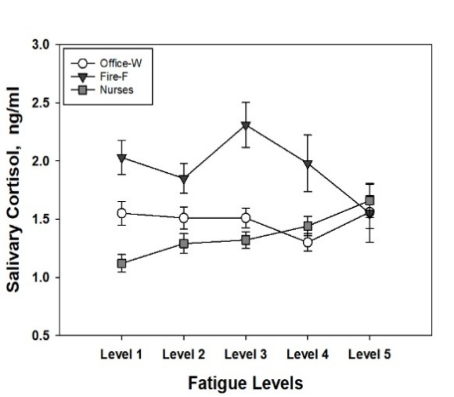
Figure 5: Differential salivary cortisol concentrations based on fatigue levels.
Firefighters exhibited higher levels of salivary cortisol associated with mental fatigue compared to office workers and nurses (p<0.01, all). Addi- tionally, firefighters maintained elevated salivary cortisol levels from waking up throughout the diurnal period compared to other occupational groups (data not shown). It is hypothesized that firefighters and nurses engaged in shift work must maintain consistent alertness. As fatigue levels increase in this process, stress is added, leading to an elevation in cortisol levels. However, the burden of tasks brought on by fatigue can increase mental stress. Conversely, reduced alertness may result in lowering cortisol levels. It is considered that the competitive relationship between these two factors determines cortisol levels.
CONCLUSION
This study investigated the categorization of daily fatigue using the Daily Multidimensional Fatigue Inventory (DMFI), highlighting differences between subjective and DMFI-classified fatigue levels. The DMFI effectively
classified fatigue into five levels, showing statistically lower levels compared to self-reported fatigue, particularly pronounced in occupations with high cumulative fatigue, such as firefighters and nurses. The multidimensional assessment aimed to address the gap in perceiving cumulative fatigue, often present but not fully understood in self-report evaluations. Additionally, the study revealed a tendency to avoid extreme choices in self-report surveys, impacting fatigue level reporting. The DMFI partially alleviated this bias, resulting in an increased frequency of level 1 fatigue reports. In conclusion, the study suggests that DMFI contributes to mitigating subjective biases in fatigue assessment. Furthermore, the investigation explored the potential of utilizing physiological indicators related to fatigue. While overall perceived fatigue indicators exist (Michael et al., 2012), this study validated specific fatigue aspects using the DMFI and distinct indicators. The reaction time of the Psychomotor Cognition Test (PCT) increased with rising fatigue lev- els, demonstrating its potential use, especially in occupations with a high proportion of females or low physical activity, to refine data and elimi- nate respondent bias. Blood lactate levels showed a positive correlation with increasing fatigue levels, particularly associated with physical fatigue percep- tion. In groups with high physical activity, blood lactate concentration proved useful for eliminating subjective bias and classifying fatigue levels. Salivary C- reactive protein (CRP), indicating cumulative fatigue, tracked subjective bias, especially in office work with lower cumulative fatigue levels. Salivary corti- sol, reflecting mental fatigue, exhibited significant circadian fluctuations and arousal associations, making it unsuitable for mentally healthy participants’ fatigue level measurement. This research also contributes to the development of an artificial intelligence-based fatigue classifier using visual, thermal, and audio signals, contributing to the construction of training data for future applications.
ACKNOWLEDGMENT
This research was supported by Civil Military Technology Cooperation Cen- ter, Republic of Korea (project code: 20-CM-BD-18). We would like to present our appreciation to the Netherlands Aerospace Centre for being with us in the consortium.
REFERENCES
Aghdam, S. R. Alizadeh, S. S. Rasoulzadeh, Y. and Safaiyan, A. (2019). Fatigue Assessment Scales: A Comprehensive Literature Review, Archives of Hygiene Sciences, Volume 8, No. 3. Gouin, J. P. Glaser, R. Malarkey, W. B. Beversdorf, D. and Kiecolt-Glaser, J. (2012).
Chronic stress, daily stressors, and circulating inflammatory markers, Health Psychology, Volume 31, No. 2, p. 264. Koo, H. Kim, C. Y. Kim, Y. Sin, S. J. Cheon, K. and Kim, D. (2018). Biomarkers for Combat-Related Stress and Fatigue-Mitigating Drugs Discovery. Journal of The Korea Institute of Mliltary Science and Thchnology, Volume 21, No. 2, pp. 246–254.
Daily Multidimensional Fatigue Scale and Physiological Indicators 43
Lee, Y. Lee, Y. Yoo, S. Shin, S. Park, H. and Kim, D. (2023). The Psychomotor Cognition Test for Measurement of Sleepiness/Fatigue on a Touch Screen. In 2023 45th Annual International Conference of the IEEE Engineering in Medicine & Biol- ogy Society (EMBC). IEEE Open Access, pp. 1–4. IEEE Conference Publication, Australia. https://ieeexplore.ieee.org/document/10340988. Lee, Y. Lee, Y. and Kim, D. (2023). Bio-signals Collecting System for Fatigue
Level Classification. In 2023 45th Annual International Conference of the IEEE Engineering in Medicine & Biology Society (EMBC). IEEE Open Access, pp. 1–5. IEEE Conference Publication, Australia. https://ieeexplore.ieee.org/docu ment/10340350 Michael, D. J. Daugherty, S. Santos, A. Ruby, B. C. and Kalns, J. E. (2012). Fatigue biomarker index: An objective salivary measure of fatigue level. Accident Analysis & Prevention, Volume 45, pp. 68–73. Montoya, J. G. Kogelnik, A. M. Bhangoo, M. Lunn, M. R. Flamand, L. Merrihew,
L. E. Watt, T. Kubo, J. T. Paik, J. and Desai, M. (2013). Randomized clinical trial to evaluate the efficacy and safety of valganciclovir in a subset of patients with chronic fatigue syndrome. Journal of medical virology, Volume 85, No. 12, pp. 2101–2109. Nijhof, S. L. Rutten, J. M. Uiterwaal, C. S. Bleijenberg, G. Kimpen, J. L. and van de Putte, E. M. (2014). The role of hypocortisolism in chronic fatigue syndrome. Psychoneuroendocrinology, Volume 42, pp. 199–206. Nozaki, S. Tanaka, M. Mizuno, K. Ataka, S. Mizuma, H. Tahara, T. Sugino, T. Shirai,
T. Eguchi, A. Okuyama, K. Yoshida, K. Kajimoto, Y. Kuratsune, H. Kajimoto, O. and Watanabe, Y. (2009). Mental and physical fatigue-related biochemical alterations. Nutrition, Volume 25, No. 1, pp. 51–57. Shen, J. Botly, L. C. Chung, S. A. Gibbs, A. L. Sabanadzovic, S. and Shapiro, C.
M. (2006). Fatigue and shift work. Journal of sleep research, Volume 15, No. 1, pp. 1–5. Strawbridge, R. Sartor, M. L. Scott, F. and Cleare, A. J. (2019). Inflammatory proteins are altered in chronic fatigue syndrome—A systematic review and meta-analysis. Neuroscience & Biobehavioral Reviews, Volume 107, pp. 69–83. Williamson, A. Lombardi, D. A. Folkard, S. Stutts, J. Courtney, T. K. and
Connor, J. L. (2011). The link between fatigue and safety. Accident Analysis & Prevention, Volume 43, No. 2, pp. 498–515.
LISTED IN THE AHFE DIGITAL BOOKSTORE CATALOGUE
Explore the complete digital volume
Physical Ergonomics and Human Factors
Read this individual research paper free through the original publisher, or explore the full digital proceedings book.
ISBN 978-1-964867-23-6
Explore this ISBN in the AHFE Bookstore ↗Listed in the July 2026 bookstore catalogue; search by ISBN to confirm current availability · Digital book purchase optional