Megan Parisi, Kaitlin Mctigue, Shu-Chieh Wu, John Karasinski, Tina Panontin, Lauren Landon, Alonso Vera (2024). The Impact of Delayed Communication on NASA’s Human-Systems Operations: Preliminary Results of a Systematic Review. In: Advances in Human Factors of Transportation. AHFE Open Access, vol. 148, pp. 49–57. https://doi.org/10.54941/ahfe1005194
Throughout the history of human spaceflight, NASA has relied on a team of ground-based experts on Earth to manage its missions, vehicles, and crews to ensure crew safety and mission success. However, as missions progress beyond low-Earth orbit (LEO), this paradigm of dependence on ground must evolve. Beyond LEO, in missions to the moon and Mars, crews will confront new challenges: limited evacuation options, reduced resupply capabilities, and significant communication delays that impede real-time support from experts on the ground. This reduction in ground support amplifies the likelihood that crews will be unable to adequately respond to unanticipated, safety-critical events. Understanding the scope of these risks and identifying effective countermeasures hinges on understanding the impact of communication delays on complex operations, especially in urgent, unforeseen events. Real-time communication currently provides the crew with continuous access to a large, extensively resourced ground team skilled in anomaly resolution. However, as communication delays grow, the need to transfer some responsibilities from ground experts to onboard crew becomes evident. NASA has been exploring this shift in operational responsibilities and its effectiveness in managing complex operations for decades. Nevertheless, a comprehensive understanding of the specific challenges posed by communication delays and the necessary countermeasures to mitigate them remains a gap. In this paper, we present an update on our systematic review of the literature on communication delays, the first in-depth review since 2013 (Rader et al.). We introduce a coding taxonomy to capture key constructs from papers of interest and discuss preliminary findings. These preliminary results suggest two significant research gaps: limited studies have been conducted 1) with lunar-like latencies and 2) on problem-solving strategies for the maximum latencies expected in Mars missions. We outline plans and propose recommendations to address these gaps through ongoing and future research.
Throughout the history of human spaceflight, NASA has relied on a team of ground-based experts on Earth to manage its missions, vehicles, and crews to ensure crew safety and mission success. During current missions, a team of 15–20 system experts in the Mission Control Center (MCC) front room monitors data, commands the vehicle, oversees onboard operations, and
coordinates closely with the spaceflight crew to execute tasks. These MCC front room experts receive support from other experts in their back rooms (Multi-Purpose Support Rooms) and the Mission Evaluation Room. Dur- ing daytime operations, this network comprises over 80 individuals ready to detect off-nominal events and participate in real-time operational decision making (Valinia et al., 2022). When an unanticipated event occurs, these ground-based experts undertake the problem solving necessary to diagnose and resolve the issue using their systems expertise and extensive resources, including ground-exclusive datasets.
As missions extend beyond low-Earth orbit, a variety of constraints (e.g., limited resupply, decreased evacuation opportunities, and extended com- munication delays) reduce the efficacy of this ground-dependent paradigm (Panontin et al., 2021). The NASA Human System Risk Board has identified a risk that the crew will be unable to effectively respond to unantici- pated anomalies and execute complex procedures with diminished ground support under the Risk of Adverse Outcomes due to Earth Independent Human-Systems Operations (EIHSO Risk), previously known as the Risk of Adverse Outcomes due to Inadequate Human Systems Integration Archi- tecture (Buckland et al., 2022).
Upcoming Artemis missions will experience new challenges that impact this risk profile, including harsh lighting conditions (Petro et al., 2020), greater maintenance demands (Lynch et al., 2022; McTigue et al., 2023), and prolonged communication delays. Space-to-ground communications during Artemis are anticipated to experience a round-trip delay of 4 to 14 sec- onds, compared to the approximately 3-second delay experienced during the Apollo missions.
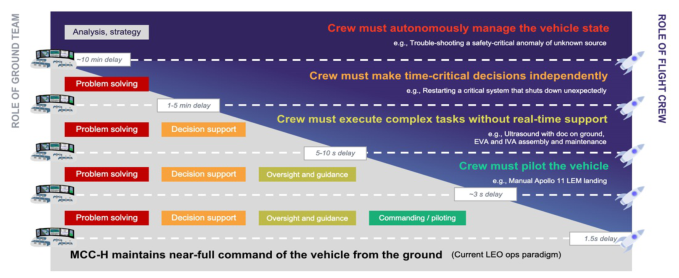
Our prior analyses of anomalies in ISS and Apollo missions suggest that delays within this range could hinder the ground team’s ability to effectively oversee crew task execution (see Figure 1) (Parisi et al., 2023). Currently, ground controllers can correct crew actions in real-time to prevent unin- tended outcomes. This real-time oversight is especially important during the execution of complex, time-critical, and highly interactive procedures like those undertaken during the Apollo 13 anomaly (Apollo Flight Journal, 2019).
Figure 1: Ground-to-onboard shift of safety-critical operations with increasing round- trip communication delays. Time delays are notional (Parisi et al., 2023).
The Impact of Delayed Communication on NASA’s Human-Systems Operations 51
As communication delays further increase, more capabilities currently per- formed by MCC will need to shift to the onboard human-system team. For Mars missions, where the delay can reach up to 24 minutes each way, crews will need to independently respond to unanticipated, safety-critical anoma- lies without real-time ground support (Valinia et al., 2022). The responsibility for creative problem-solving, a function that presently lies almost exclusively with MCC, will need to transfer to the crew. This is a critical change in responsibility, essential for crew safety during solar conjunctions which will completely block communications for nearly two weeks.
This shift in responsibilities will necessarily affect team cooperation, coor- dination, and communication. At the team and multi-team levels, previous research suggests that space-to-ground shared understanding, team coordi- nation, team performance, and team cohesion decline under communication delay (Landon et al., 2018). The risk associated with inadequate function- ing within a team is captured under the Risk of Performance and Behavioral Health Decrements Due to Inadequate Cooperation, Coordination, Commu- nication, and Psychosocial Adaptation within a Team (i.e., the Team Risk) (Landon, 2022).
NASA has been studying the nature of this shift in responsibilities and its impact on complex operations since the early 2000s, but the last comprehen- sive assessment of the state of communication delay literature took place in 2013 (Rader et al.). To begin developing communication delay countermea- sures, an updated overview of the research landscape is needed. The purpose of this work is to examine the evidence generated through 20 years of com- munication delay research as an integrated set across these relevant risks. Our systematic literature review focuses on how existing research aligns with known areas of concern (e.g., complex procedure execution during lunar delays and problem-solving during Mars-like delays). This paper presents preliminary findings, highlighting significant research gaps in the field.
METHOD
We used research databases to gather 117 papers related to communication delay. Search terms included “communication delay” and “communication latency.” Although we were interested in analogous domains, we conducted targeted, supplemental searches that added the term “spaceflight.” As our current effort focuses on collaborative, crew-ground task performance, we excluded papers that did not involve collaboration between two groups and/or individuals (e.g., telerobotic operations over time delay) from the results.
We developed inclusion and exclusion criteria to evaluate the remain- ing papers. As we are interested in reviewing experimentally derived results on communication delay risk characterization and mitigation, we included research papers with an outlined study design. Papers that did not have an experimental design (e.g., thought papers, technology demonstrations) or that did not provide sufficient information for review of the methods (e.g., conference abstracts, posters) were also excluded. This selection pro- cess led to the preliminary inclusion of 24 research papers (denoted by * in the References section).
To evaluate the 24 selected papers, we developed a taxonomy tailored to the key constructs of interest for the EIHSO and Team Risks; we devel- oped operational definitions for each construct and created examples to anchor construct ratings. We thoroughly reviewed and coded papers using this taxonomy. During our review, we excluded two additional papers as their experimental protocols did not require collaboration between two groups; in both studies, the crew-like participants completed tasks independently, without input from the simulated MCC.
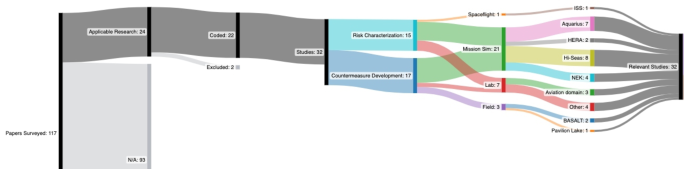
For papers reporting multiple experimental instances (e.g., a protocol was executed in two distinct analog missions reported in the same publication), we coded each instance separately. This process yielded 32 coded results from 22 papers (see Figure 2).
Figure 2: Diagram depicting the paper inclusion and review process.
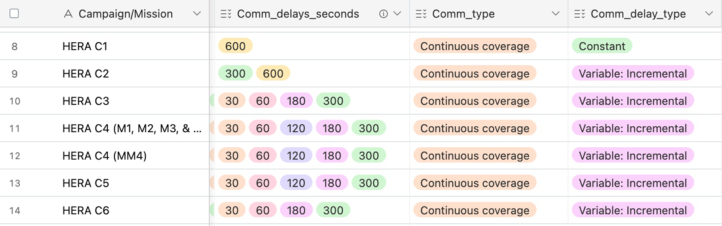
Concurrently to this effort, our team began compiling a database of ana- log missions, detailing associated characteristics (e.g., communication delay studied, crew size, etc.; see Figure 3). We collected data from publicly avail- able resources (e.g., news articles). Ninety-two missions have been identified as of this writing, but data gathering is still ongoing, focusing on studies less representative of high-fidelity spaceflight.
Figure 3: Set of example data gathered for the analog mission database.
PRELIMINARY RESULTS The risk construct data captured during the coding process is currently under review. Here, we present preliminary findings related to communication delay characteristics and task types.
The Impact of Delayed Communication on NASA’s Human-Systems Operations 53
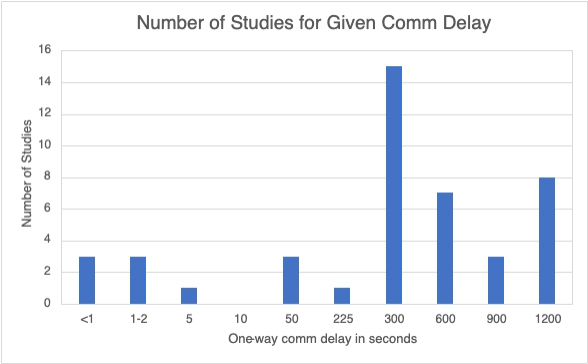
Figure 4 displays the communication delays studied in the 22 papers. Among the 32 instances coded from our analysis of papers, 28 focused on the extended delays anticipated in Mars missions (i.e., 30 seconds to 22 minutes one-way). Three instances examined delays like those experienced in low- Earth orbit, under two seconds one-way. Notably, only one coded instance (Vu et al., 2014) explored an experimental task with a communication delay falling within the lunar range (five seconds one-way).
Figure 4: Number of studies for a given one-way communication delay. Coding results may be counted in more than one comm delay category if the reported study had multiple communication delay conditions.
Vu et al. studied the impact of “short” (one second) and “long” (five sec- onds) communication delays on interactions between Unmanned Aircraft Systems (UAS) pilots and Air Traffic Control (ATC). They found that a five- second verbal delay, akin to lunar-like conditions, resulted in lower mean acceptability ratings from ATC compared to the short delay condition. This study offers preliminary evidence that Artemis-like delays could significantly differ in impact from Apollo-like delays. Participants included experienced air traffic controllers acting as ATC and experimental confederate “pseu- dopilots” acting as the UAS pilots. Because the study did not intend to replicate spaceflight operations, participants were not screened for astronaut- like qualities (e.g., advanced STEM degree) and were therefore rated as lacking generalizability to the astronaut population during the coding pro- cess. Additionally, experimental tasks were rated as somewhat low fidelity relative to spaceflight-like tasks; ATC issued clearances to UAS pilots and responded to requests using simulated aircraft control and UAS systems. The tasks were specific to aeronautics, limiting their generalizability to spaceflight tasks.
Among the 92 analog missions we surveyed, only one included any com- munication delay within the lunar range. The Mars-500 Stage 3 mission, which took place in 2010, implemented a variable communication delay
simulating distance from Earth during Mars transit, ranging from 8 to 736 seconds (European Space Agency, n.d.). While the lower end of this range does align with expected lunar latencies for Artemis, specific findings related to this delay range have not been published.
Another research gap we identified relates to communication delays in the Mars-like range. Four of the 22 final papers (Fischer, Mosier, & Orasnu, 2013; Fischer & Mosier, 2014; Fischer & Mosier, 2020; Mosier & Fischer 2023), explored problem-solving under a Mars-like delay, but each of these experiments used a five-minute one-way delay. Notably, no studies meeting our inclusion criteria investigated problem-solving under the maximum Mars delay (i.e., 24 minutes one-way). Our analyses of past anomalies suggest this capability will need to be led by the onboard human-system team when delays reach this duration.
FUTURE WORK
While we are still analyzing the data from this systematic review, our pre- liminary results highlight a substantial need for research to characterize the impacts of expected lunar latencies on crew task execution and the impacts of maximum Mars communication delays on problem-solving.
Our team’s portfolio of ongoing and future work is attempting to fill these research gaps. We have developed a protocol that utilizes Microsoft Teams to simulate lunar-like delays. This protocol involves one participant acting as a spaceflight crewmember that will collaborate with another participant acting as MCC under multiple delay conditions (i.e., 0, 2, 4, 6, 8, and 10 seconds). We plan to use this simulation capability to conduct laboratory studies that examine collaborative task execution under lunar-like latencies between the spaceflight crew and MCC. In these studies, we will measure key constructs of interest, including performance, frustration and stress, and team cohesion. Additionally, we will focus on teamwork processes such as commu- nication and coordination. This approach aims to provide an understanding of the dynamics involved in spaceflight operations under lunar-appropriate communication delays.
Simultaneously, we continue to use anomaly reconstruction and analy- sis to characterize onboard needs for crew-led problem solving (e.g., Wu, 2021; Parisi, 2023). Our team is actively examining processes for organizing and integrating information in spaceflight and analogous domains. We are also mapping anomaly resolution processes onto established problem-solving frameworks. This method is aimed at developing onboard information and decision support systems.
Outside of our team’s specific contributions, NASA’s Human Research Pro- gram at large is recognizing the gap in lunar latency research ahead of the upcoming crewed Artemis missions. The Human Exploration Research Ana- log (HERA) is planning on conducting missions during its Campaigns 7 and 8 that simulate lunar latencies (Loggins, 2024). During these missions, crew performance on crew coordination and space-to-ground collaborative tasks will be evaluated.
The Impact of Delayed Communication on NASA’s Human-Systems Operations 55
CONCLUSION
As missions move beyond low-Earth orbit, first to the Moon and then to Mars, NASA needs to develop new mission operations paradigms that increase the crew’s capability to execute time-critical procedures and respond to safety-critical events without immediate support from the ground. This shift requires extensive research on team performance under expected laten- cies, and there is currently a gap in the research literature that addresses lunar communication delays. Research and countermeasure development is urgently needed as NASA prepares to return to lunar orbit in 2025 and to the surface of the moon in 2026.
ACKNOWLEDGMENT
The authors would like to acknowledge NASA’s Human Research Program for funding this work.
REFERENCES
Anderson, A. P., Fellows, A. M., Binsted, K. A., Hegel, M. T., Buckey, J. C. (2016).
Autonomous, computer-based behavioral health countermeasure evaluation at HI-SEAS Mars analog. Aerosp Med Hum Perform.* Anglin, K. M. & Kring, J. P. (2016). Lessons from a space analog on adaptation for long-duration exploration missions. Aerosp Med Hum Perform. 87(4): 406–410.* “Apollo Flight Journal,” (W. D. Woods, Ed.). Last revised November 11, 2019. URL:
https://history.nasa.gov/afj/, last accessed on February 13, 2022. Beaton, K. H., et al. (2019). Using Science-Driven Analog Research to Investigate Extravehicular Activity Science Operations Concepts and Capabilities for Human Planetary Exploration. Astrobiology. 19(3). 10.1089/ast.2018.1861.* Beaton, K. H., et al. (2017). “Extravehicular Activity Operations Concepts under
Communication Latency and Bandwidth Constraints,” 2017 IEEE Aerospace Conference, Big Sky, MT, pp. 1–20, 10.1109/AERO.2017.7943570.* Buckland, D. M., Parisi, M. E., McTigue, K. R., Wu, S., Panontin, T. L., Vos, G., Petersen, D., & Vera, A. H. (2022). “NASA’s Identified Risk of Adverse Outcomes due to Inadequate Human-System Integration Architecture,” Human Centered Aerospace Systems and Sustainability Applications. AHFE International, 2022. https://doi.org/10.54941/ahfe1001427 Chappell, S. P., Graff, T. G., Beaton, K. H., Abercromby, A. F. J., Halcon, C.,
Miller, M. J., & Gernhardt, M. L. (2016). NEEMO 18–20: Analog testing for mitigation of communication latency during human space exploration. 2016 IEEE Aerospace Conference, 1–12. https://doi.org/10.1109/AERO.2016.7500717* Chappell, S. P. & Abercromby, A. F. (2013). NEEMO 16: Evaluation of Systems for Human Exploration of Near-Earth Asteroids. American Institute of Aeronautics and Astronautics.* DeChurch, L. A., Gokhman, I. A., Plummer, G., Vazquez, M., Bell, S., & Contractor, N. S. (2019). Deciding on Mars: The Effects of Isolation on Autonomous Team Decision-Making. Proceedings of the International Astro- nautical Congress, IAC-19. 70th International Astronautical Congress, IAC 2019, Washington, D. C. https://iafastro.directory/iac/archive/browse/IAC-19/A1/ 1/51272/*
European Space Agency. Mars500 Quick Facts. https://www.esa.int/Science_Explor ation/Human_and_Robotic_Exploration/Mars500/Mars500_quick_facts Fischer, U., Mosier, K. & Orasnu, J. (2013). The Impact of Transmission Delay on
Mission Control-Space Crew Communications.* Fischer, U. & Mosier, K. (2014). The Impact of Communication Delay and Medium on Team Performance and Communication in Distributed Teams. Human Factors and Ergonomics Society Annual Meeting.* Fischer, U. & Mosier, K. (2020). Examining Teamwork of Space Crewmembers
and Mission Control Personnel Under Crew Autonomy: A Multiteam Sys- tem Perspective. Human Factors and Ergonomics Society International Annual Meeting.* Fischer, U., Mosier, K., Schmid, J., Smithsimmons, A., & Brougham, R. (2023).
Braiding–A novel approach to supporting space/ground communication under signal latency. Acta Astronautica, 207, 411–424.* Goemaere, S., Van Caelenberg, T., Beyers, W., Binsted, K., & Vansteenkiste, M.
(2019). Life on mars from a Self-Determination Theory perspective: How astro- nauts’ needs for autonomy, competence and relatedness go hand in hand with crew health and mission success - Results from HI-SEAS IV. Acta Astronautica, 159, 273–285. https://doi.org/10.1016/j.actaastro.2019.03.059* Heinicke, C., Poulet, L., Dunn, J., & Meier, A. (2021). Crew self- organization and group-living habits during three autonomous, long-duration Mars analog missions. Acta Astronautica 182, 160–178. http://dx.doi.org/10.1016/j.actaastro.2016.09.018. Received 26 July 2016; Accepted 15 September 2016.* Krausman, A. S. (2017). Understanding audio communication delay in distributed team interaction: Impact on trust, shared understanding, and workload. 2017 IEEE Conference on Cognitive and Computational Aspects of Situation Manage- ment (CogSIMA), 1–3. https://doi.org/10.1109/COGSIMA.2017.7929609* Landon, L. B. (2022). Risk of Performance and Behavioral Health Decrements Due
to Inadequate Cooperation, Coordination, and Psychosocial Adaptions within a Team. https://ntrs.nasa.gov/citations/20220007465 Landon, L. B., Slack, K. J., & Barrett, J. D. (2018). Teamwork and collaboration in long-duration space missions: Going to extremes. American Psychologist, 73(4), 563. Loggins, S. (2024, January 22). “HERA Campaign 7 Mission 1 Crew Sets Course for
Ingress, Astronaut Health and Safety Research Ahead.” Roundup Reads Johnson Space Center. https://roundupreads.jsc.nasa.gov/roundup/2292 Lynch, C., Stromgren, C., Cirillo, W., Owens, A. C., Drake, B. G., & Beaton, K. H.
(2022). “Early Assessments of Crew Timelines for Lunar Surface Habitat,” AIAA ASCEND, Las Vegas, NV. https://doi.org/10.2514/6.2022-4236 Lyons KD, Slaughenhaupt RM, Mupparaju SH, Lim JS, Anderson AA, Stankovic AS, Cowan DR, Fellows AM, Binsted KA, Buckey JC. Autonomous psycholog- ical support for isolation and confinement. Aerosp Med Hum Perform. 2020; 91(11):876–885.* McTigue, K. R., Parisi, M. E., Panontin, T. L., Wu., S., Vera, A. H. (2023). “How
to keep Your Space Vehicle Alive: Maintainability Principles for Deep-Space Missions.” SpaceCHI, Cambridge, MA. Miller, M. J. et al. (2016). PLRP-3: Operational perspectives conduct- ing science-driven extravehicular activity with communications latency. 10.1109/AERO.2016.7500643.*
The Impact of Delayed Communication on NASA’s Human-Systems Operations 57
Mosier, K. L., & Fischer, U. M. (2023). Meeting the Challenge of Transmission Delay: Communication Protocols for Space Operations. Human Factors, 65(6), 1235–1250. https://doi.org/10.1177/00187208211047085* Nadler, E., Mengert, P., DiSario, R., Sussman, E. D., Grossberg, M. & Spanier, G.
(1993) Effects of Satellite- and Voice- Switching -Equipment Transmission Delays on Air Traffic Control Communications, The International Journal of Aviation Psychology, 3:4, 315–325, doi: 10.1207/s15327108ijap0304_5.* Panontin, T. L., Wu, S., Parisi, M. E., McTigue, K. R., and Vera, A. H. (2021).
“Human-Systems Integration Architecture Needs Analysis: On-board Anomaly Resolution During Autonomous Operations,” Human Research Program Techni- cal Report. Parisi, M. E., Panontin, T. L., Wu, S., McTigue, K. R., Vera, A. H. (2023). “Effects of Communication Delay on Human Spaceflight Missions,” AHFE International, San Francisco, CA. Petro, N. E., Mazarico, E. M., Kendall, J. D., Wright, E. T., Schmitt, H. H., Feist, B. F.,
& Eppler, D. B. (2020). “Blinded by the Light: Illumination Considerations for Artemis Site Selection, Traverse Planning, and Instrument Operations,” Lunar Surface Science Workshop. Rader, S. N., Reagan, M. L., Barbara Janoiko, & Johnson, J. E. (2013). Human-in-the-Loop Operations over Time Delay: Lessons Learned. Proceed- ings of the 43rd International Conference on Environmental Systems (ICES). The 43rd International Conference on Environmental Systems (ICES), Vail, CO. https://doi.org/10.2514/6.2013–3520 Rantanen, E. M., McCarley, J. S., & Xu, X. (2004). Time Delays in Air Traffic Control Communication Loop: Effect on Controller Performance and Workload. International Journal of Aviation Psychology, 14(4), 269–394.* Sandal, G. M., Bye, H. H., & van de Vijver, F. J. R., (2011). Personal val-
ues and crew compatibility: Results from a 105 days simulated space mission. https://doi.org/10.1016/j.actaastro.2011.02.007* Supolkina, N., Yusupova, A, Shved, D., Gushin, V., Savinkina, A., Lebedeva, S. A., Chekalina, A., Kuznetsova, P. (2021). External Communi- cation of Autonomous Crews Under Simulation of Interplanetary Missions. https://doi.org/10.3389/fphys.2021.751170* Valinia, et. al., (2022). Safe Human Expeditions Beyond Low Earth Orbit (LEO), NASA/TM-20220002905. Vu, K.-P. L., Chiappe, D., Morales, G., Strybel, T. Z., Battiste, V., Shively, J., &
Buker, T. J. (2014). Impact of UAS Pilot Communication and Execution Latencies on Air Traffic Controllers’ Acceptance of UAS Operations. Air Traffic Control Quarterly, 22(1), 49–80. https://doi.org/10.2514/atcq.22.1.49* Wu, S. C-., Parisi, M. E., McTigue, K. R., Panontin, T. P., Vera, A. V. (2021). “Toward enabling safe Earth-independent mission operations,” International Association for the Advancement of Space Science Managing Risk in Space.
LISTED IN THE AHFE DIGITAL BOOKSTORE CATALOGUE
Explore the complete digital volume
Advances in Human Factors of Transportation
Read this individual research paper free through the original publisher, or explore the full digital proceedings book.
ISBN 978-1-964867-24-3
Explore this ISBN in the AHFE Bookstore ↗Listed in the July 2026 bookstore catalogue; search by ISBN to confirm current availability · Digital book purchase optional