Michal Grzeskowiak, Alicja Maciejko (2024). The impact of the natural environment on the design of infrastructure in national parks in terms of ergonomics, safety and accessibility. In: Human Factors in Architecture, Sustainable Urban Planning and Infrastructure. AHFE Open Access, vol. 153, pp. 1–6. https://doi.org/10.54941/ahfe1005332
National parks are located in naturally attractive areas. In practice, this means that these are the areas that are less accessible, legally protected, or where intense, violent, or even extreme climatic conditions occur. These problems significantly affect the design solutions of tourist infrastructure facilities such as pedestrian and access roads, parking lots, ticket offices, sanitary buildings, camping sites; elements of small architecture such as handrails, stairs, bridges, huts, and places to relax, information signs as well as extensive architectural facilities such as shelters and catering facilities. The article presents the problems of designing tourist infrastructure for tourists and disabled people in protected landscape areas with difficult environmental conditions, such as intense rain and snowfall, high humidity, violent wind, low or high temperatures, dangerous rock formations, wetlands or deserts, high mountain areas, wild animals, assuming that both the safety and comfort of users as well as maximum protection of nature are important. These factors are largely mutually exclusive, which is why the quality of the proposed architectural solutions and materials used is so important, so as not to have a destructive impact on the existing natural conditions with optimal accessibility. Design problems were discussed based on the analysis of existing solutions and divided into groups of factors affecting access, safety, comfort, design and implementation possibilities, and use.
natural environment. Because the protected area is rarely of the same geol- ogy and landforms, it can be divided into accessible parts for all people and their cars, and an area that will remain remote and fully protected, accessible only to the fit. The area of interest for creating an infrastructure of any sort is most likely to be flat. And no matter how inaccessible the terrain seems – flat is always found in nature. Limiting the infrastructure to the few places accessible is good. Most of the park will be saved from the artificial features such as asphalted roads, parking lots filled with cars, buildings and many more. The developed area, however, will serve as the most accessible part for everyone – no matter the age or fitness level. It will also be an access point to the rest of the national park.
National Parks in the United States are the key examples of how both can work together and provide for a protection of an environment but also for an enjoyment of the public.
Accessibility in Tourism The basic documents regulating the rights of disabled people are the Con- vention on the Rights of Persons with Disabilities drawn up in New York on December 13, 2006, Act of December 3, 2010 on the implementation of certain European Union provisions in the field of equal treatment. There are also many studies and documents that do not have legal force, but constitute a set of good principles that influence the shaping of the situation of peo- ple with disabilities. An important element that influences the shaping of the human material environment and making design decisions is architectural accessibility, which refers to elements such as driveways, stair platforms, spa- tial markings for the blind and visually impaired, the layout and equipment of rooms, corridors, toilets, the width of passages and height of work sur- faces and reach for people in wheelchairs. Most studies discuss the problems of disabled people in apartments, public spaces, and buildings. Currently, these issues are expanding to open landscape areas, tourist trails and areas of legal nature protection, but these issues have not yet been fully researched and described. The implementation of full accessibility and making the pro- tected landscape available for tourism is subject to many restrictions and is extremely difficult, almost impossible, to achieve in high mountain areas. However, there are many examples, including in the most attractive places in the world, where, despite the lack of a legal obligation to provide access for people with disabilities, accessibility is partially or fully implemented. To achieve this, an individual nature analysis of the accessible areas is necessary, as well as consultations with the disabled community, whether the proposed solutions contribute to the comfort of using the areas and the quality of life.
METHODS, SELECTED NATIONAL PARKS – CASE STUDIES For the analysis the authors chose three national parks located in the United States:
(1) Yosemite National Park, (2) Zion National Park, (3) Grand Canyon National Park.
The Impact of the Natural Environment on the Design of Infrastructure 3
They differ in terms of geomorphology, location, climate, and other factors but they all have the same approach for designing the public infrastructure and protecting the natural environment. Choosing these three parks is based on author’s own observations backed up by photographic documentation. The purpose of the analysis is to present factual state of tourist infrastructure in these parks that can serve as a model for creating sustainable approach for development of the area that serves both the public and nature.
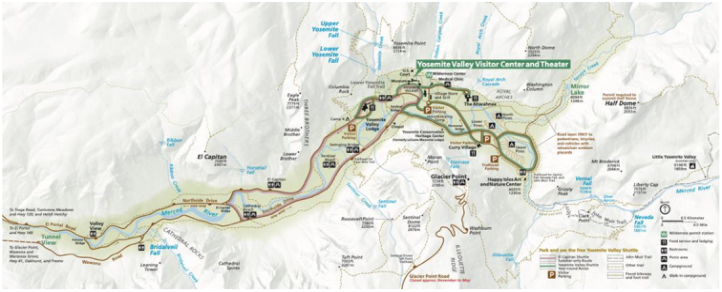
(1) Yosemite National Park is located in California, United States. The most geomorphologically accessible part of the park is Yosemite Valley – flat, U-shaped valley floor carved out by the glaciers in Pleistocene. The most developed part of the park is composed of the main road that leads to the val- ley and then splits into a loop. This is the crucial access point to the park. The infrastructure is mainly located by the road or in close proximity. There are 4 main parking lots and the sides of the road serve as an additional space for the cars. There is a shuttle bus service going year-round, all buses are accessi- ble with wheelchair lifts and tie-downs. This allows for leaving a car parked and getting around the park easily. Yosemite Village has everything a tourist would need. The Visitor Center offers necessary tourist information. Four campgrounds and lodges make up for accommodation. Several restaurants and a grocery store provide food and all the necessary supplies. Within the valley are multiple trails accessible to the disabled – flat, paved tracks with minimal denivelation. If this option is still not accessible – sightseeing by car is also possible. Even though the park is not entirely wheelchair-accessible, it has a complete guide called “Yosemite Accessibility Guide” on its website. Besides Yosemite Valley, another access point to the park is Tioga Road open in summer only. It is a scenic drive itself but on its way there are multiple trail- heads – places for leaving a car and access points to the less accessible part of the park with a lot of denivelation and difficult terrain features. By the road are other amenities, such as a campground, a lodge and visitor center. As we can see, the area of the park is on one hand composed of infrastructure for all public that highly interferes with nature. On the other hand, the greater remainder of the park is changed in minor ways (such as bridges, campsites with food lockers, trail signs).
Figure 1: Map of the shuttle stops and the trails in Yosemite National Park; nps.gov.
4 Grzeskowiak and Maciejko
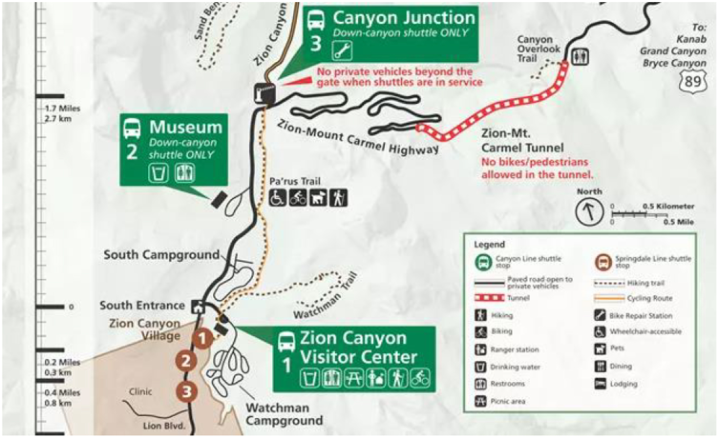
(2) Zion National Park in Utah, United States is of different physical fea- tures than the former example but the placement of the infrastructure is also in the flat-bottomed valley. In this case, however, the valley is narrower and does not allow for the infrastructure of an extent of the former. That’s why some things are different.
Figure 2: Map of the shuttle stops and the trails in Zion National Park; nps.gov.
The main and most popular access point to the park is through the State Highway 9 that enters the park through the South Entrance in Springdale and leaves it through the East Entrance. The visitors have to leave the car near the entrance, in close proximity to the Visitor Center, because the rest of the most scenic and developed area is only accessible by shuttle bus in high season (decision made in 2000 to avoid crowds and pollution). The majority of this part is accessible with designated trails, handrails and infrastructure adapted for the disabled.
(3) Grand Canyon National Park is located in Arizona, United States. It protects Colorado River with landforms surrounding it. The main infras- tructure is built on the North and South Rim of the canyon. South Rim is the most popular place in the park. It is accessible with Arizona State Route 64, which enters the park through the South Entrance near Tusayan and leaves the park through the East Entrance. The center of activity is Grand Canyon Village, reachable by the State Route as mentioned, but the railway as well. The village consists of two Visitor Centers, a campground and a trailer village, multiple lodges, restaurants, and shops. All of the infrastructure is connected via road accessible to the public. The visitors, however, are encouraged to leave the car on the parking lots available throughout the village and then to ride free shuttle buses (all wheelchair-accessible), or to follow the trails Another road stretches westwards out of the village but as well as in Zion
The Impact of the Natural Environment on the Design of Infrastructure 5
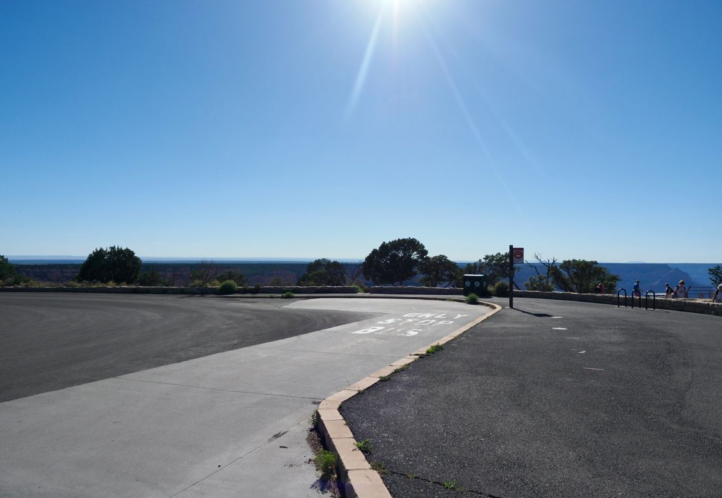
NP, in high season only the shuttle bus can operate. There are many bus stops with accessible viewpoints and there is an option to follow easy, flat and paved trails. As described, the part of the park located on the plateau is highly developed and accessible to anyone. This can cause crowds but most of the remaining area remains undeveloped and is still open for tourists with greater experience.
Figure 3: Bus stop next to the viewpoint in grand Canyon National Park; M. Grzeskowiak.
It is worth mentioning that in all three examples some roads normally reserved only to the authorized vehicles are accessible to the disabled who cannot get around by any other means provided.
CONCLUSION
When developing a national park, it is always necessary to analyze where to set the limits of interference in the area. How to regulate accessibility, what amenities are possible, and how to control tourist traffic without irreversibly damaging the natural landscape. The area that involves the least interference in nature, running through mountain ranges and forested areas, is usually a part of the park requiring specific equipment, experience, fitness level and ter- rain preparation. This is due to the large differences in terrain levels, uneven surfaces, obstacles, and narrow or low passages. Difficult accessibility means minimal infrastructure – lack of amenities, often even lack of information on the trail, the need to use a map and the required ability to orient well in the field. These are things that allow for leaving the natural environment almost
6 Grzeskowiak and Maciejko
untouched and at the same time make it inaccessible to many, including disabled people.
To assess the placement of the most accessible tourist infrastructure, there should be taken a global look at the geographical features of an area of inter- est. Generally, the flatter the area the better and easier it is for creating a safe and an accessible space. Although many national parks do not have the easy terrain, every one of them has a part which is flat and accessible and a part with a lot of denivelation which is only accessible to some. That division is good for sustainability and for protecting the protected area. National Parks in the United States are the key examples of how both can work together and provide for a protection of an environment but also for an enjoyment of the public.
After analyzing the terrain and environmental conditions occurring locally in 3 examples (flat-bottomed valleys, plateaus), there can be some conclu- sions drawn. Walking sections can be designed, accessible from access roads, equipped with parking lots and places for the disabled, which lead to the most attractive places or viewpoints. Such sections require smooth, non-slip surface, roads, and accesses with small slopes, These are areas in which interference with nature is high, but many parks decide on such a solution because of the enormous social benefits.
REFERENCES
Helios program [in: ] HELIOS Commission of the European Community. Actions for Disabled People. Brussels, 1993. Maciejko, A., Czajka, R. (2019). Public Space Projects in the Open Areas. W:
J. Charytonowicz, C. Falcão, Advances in Human Factors, Sustainable Urban Planning and Infrastructure. AHFE 2018. Cham: Springer. Maciejko, A., Strzelecki, M. (2016). Ład natury i architektury. Projekt małej infrastruktury technicznej na obszarze parku narodowego gór stołowych. Wrocław: Wydawnictwo Polskiego Towarzystwa Ergonomicznego PTErg. Maciejko, A., Strzelecki, M. (2022). Projekt małej infrastruktury technicznej Parku
Narodowego Gór Stołowych. Wrocław: Strzelecki Biuro Architektoniczne. Maciejko, A., Wojtyszyn, B. (2019). Tourism Infrastructure Providing Access to Areas of Protected Landscape and Nature in Poland. Selected Examples. IOP Conference Series Materials Science and Engineering, 603(4), 042049. https: //doi.org/10.1088/1757- 899X/603/4/042049 1 Zob. https://legislacja.rcl.gov.pl/ projekt/12356100 (dostep: 10.2023). Maciejko, A., Wojtyszyn, B., Skrzypczak, A. (2019). Design Problems of Tourism
Infrastructure for People with Disabilities in Protected Landscape Areas in Poland. IOP Conference Series Materials Science and Engineering, 603(4), 042048. Rozporza˛dzenie ministra ´srodowiska z dnia 12 maja 2005 r. w sprawie sporza˛dzania projektu planu ochrony dla parku narodowego, rezerwatu przyrody i parku kra- jobrazowego, dokonywania zmian w tym planie oraz ochrony zasobów, tworów i składników przyrody. Turystyka dostepna dla wszystkich, (Novenber 07, 2023) Polish Goverment Web-
site: Turystyka dostepna dla wszystkich - Ministerstwo Sportu i Turystyki - Portal Gov.pl (www.gov.pl). Ustawa z dnia 16 kwietnia 2004 r. o ochronie przyrody. Wijk Ed. M. (1990) European Manual for an Accessible Built Environment. Publisher PMC Waddinxveen, ISBN 9052650217,
LISTED IN THE AHFE DIGITAL BOOKSTORE CATALOGUE
Explore the complete digital volume
Human Factors in Architecture, Sustainable Urban Planning and Infrastructure
Read this individual research paper free through the original publisher, or explore the full digital proceedings book.
ISBN 978-1-964867-29-8
Explore this ISBN in the AHFE Bookstore ↗Listed in the July 2026 bookstore catalogue; search by ISBN to confirm current availability · Digital book purchase optional