Seunghun Yoo, Hahyun Kang, Chanjong Kim, Junhong Park, Ken Nah (2024). A Human Factors Study on the Interface Structure Design of AR-HUD for Small Vessel. In: Usability and User Experience. AHFE Open Access, vol. 156, pp. 280–290. https://doi.org/10.54941/ahfe1005439
Maritime collisions involving small vessels are common due to failures in recognizing other vessels, posing safety risks and economic losses. This study proposes a human factors- based augmented reality head-up display (AR-HUD) interface design tailored for enhancing small vessel navigation and situation awareness. Unlike existing auditory solutions, the AR- HUD integrates real and virtual navigational information through graphics prioritizing rapid recognition, color-coding following ISO safety guidelines, and a layout utilizing horizon- based zoning with a central field-of-view focused on essential user vessel and other vessel data. Developed by reviewing prior AR and HUD research and analyzing navigation software products, this intuitive, prioritized information presentation aims to minimize cognitive errors for operators, enhance operational safety, reduce collisions and pollution, while providing a foundation for further maritime AR-HUD research.
With the advancement of technology, the volume of maritime trade has increased, leading to the development of larger, more advanced, faster, and automated vessels. This increase in traffic has complicated the maritime traf- fic environment, doubling the risk of maritime accidents (Ministry of Oceans and Fisheries, 2022). Maritime accidents are particularly dangerous due to the isolation at sea, which shortens response times and makes rescue and acci- dent management difficult, leading to the potential for major disasters (Kim, 2010). They also result in human casualties and property damage, as well as causing marine pollution and environmental and economic losses (Jung, 2023). Maritime accidents such as engine damage and entanglement with float- ing objects occur continuously, and excluding minor incidents, collisions are
A Human Factors Study on the Interface Structure Design of AR-HUD for Small Vessel 281
the most common type of accident (Kang, 2020). In particular, collisions involving vessels under 20 tons account for 52% of all collisions (Ministry of Oceans and Fisheries, 2022), with most of these incidents occurring due to a failure to recognize other vessels (Kim, 2018). For this reason, collision warnings that can visually and audibly alert operators to the risk of collision are essential for enhancing vigilance (Park, 2021). However, previous studies aimed at enhancing the safety of small vessel operators have tended to focus only on auditory solutions, and research on visual collision warning devices is needed.
Therefore, this study aims to provide a visual interface structure utilizing augmented reality (AR) technology in a head-up display (HUD) device to pre- vent collisions of small vessels caused by a failure to recognize other vessels. This is expected to reduce collisions of small vessels and enhance the safety of small vessel operators.
RELATIONSHIP BETWEEN AR-HUD AND SAFE NAVIGATION Augmented reality (AR) is a technology that integrates text, graphics, audio, and other virtual forms with real objects, adding value to the user interface by integrating the real world (Gartner, 2019). Therefore, AR provides a virtual information experience through real-time interactive feedback and immersive interaction via displays, which can improve the safety and convenience of vessel operators (Woo, 2022).
A HUD (Head-Up Display) is a technology that directly displays infor- mation such as speed on the front windshield, allowing the user to check it while continuing to look ahead, minimizing eye movement (Oh, 2013). Addi- tionally, HUDs were originally developed in the aviation industry to project information onto fighter jet windshields to minimize pilot eye movement (Kim, 2015). In the automotive industry, GM first introduced HUD technol- ogy in 1988, and it has been developed to display vehicle speed and objects detected by collision avoidance systems (Kim, 2016). Recently, AR technol- ogy has been integrated into HUDs, enabling the development of display technologies that can convey more information in a shorter time, referred to as AR-HUDs (Jang, 2023). This integrated technology can present infor- mation more intuitively and minimize user eye strain in terms of safety and convenience compared to conventional HUDs (Han, 2021; Giordano, 2021).
In the shipbuilding market, there have also been increasing attempts to introduce AR-HUDs as maritime trade volumes increase (Laera, 2021). This is because vessel operators are frequently provided with complex and excessive information, hindering decision-making (Oh, 2016). AR-HUD technology can be an important tool for preventing information overload and promoting safe navigation by focusing the user’s gaze and providing neces- sary information intuitively, enhancing the safety and convenience of vessel operation.
COMPONENTS OF THE AR-HUD INTERFACE To extract the components of the AR-HUD interface, previous studies related to AR and HUD technologies were collected and analyzed, and the results
can be summarized as shown in Table 1. Hwang classified displays into visual flow, color, and font for presenting integrated guidelines for vessels (2011). Oh presented an AR display for vessels considering the location, color, symbol shape, and units of information display (2017). Son proposed the components of vehicle HUDs as information composition, content form, color, and layout (2020). Na analyzed vehicle HUDs by categorizing them into color, layout, logotype, graphics, and icons, and summarized the core ele- ments through a case study analysis (2022). Jang considered content form, color, and content arrangement as important components when designing vehicle AR-HUD interfaces (2021).
Table 1. Prior studies on visual interface properties.
Table available in the original PDF paper.
Category Researcher Research Area Interface Element Form Color Layout Text
Vessel Hwang (2011) Display ⃝ ⃝ ⃝ Oh (2017) AR ⃝ ⃝ ⃝ ⃝ Vehicle Son (2020) HUD ⃝ ⃝ ⃝ Na (2022) HUD ⃝ ⃝ ⃝ Jang (2021) AR-HUD ⃝ ⃝ ⃝ ⃝
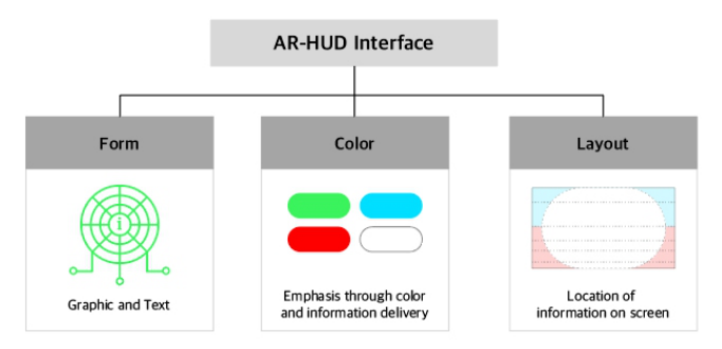
Through the review of previous studies, it was confirmed that although the terms used for visual interfaces vary by category, they convey the same mean- ing. Based on this, the core components of the visual interface were divided into graphics, color, text, and layout. Figure 1 shows the core components of the visual AR-HUD interface discussed above.
Figure 1: Components of AR-HUD interface.
The form of the AR-HUD interface was defined as expressions using shapes, icons, specific graphics, and text. Simple forms aid in easy and
A Human Factors Study on the Interface Structure Design of AR-HUD for Small Vessel 283
quick understanding of information, so basic shapes such as circles, rect- angles, triangles, and diamonds were used whenever possible for the expressed forms (Kim, 2013).
Color was defined as a visual element that leads fast information recogni- tion (Park, 2012), Green, yellow, and red enhance the visibility of graphics, while white improves the readability of text (Moffitt, 2019). Addition- ally, the ISO guide for maritime safety signage designates green as ‘safe condition’, yellow as ‘warning’, and red as ‘prohibition’ (2020). These conventions help correctly recognize situations in changing environments. Summarizing various previous studies and guides, representative colors can be organized as shown in Table 2.
Table 2. The meaning of color for AR-HUD.
Table available in the original PDF paper.
Color Meaning (Moffitt, 2019) Safety Guide (ISO, 2020) Green Visibility is good. Safe Condition Yellow Visibility is excellent Warning Red Visibility is fair Prohibition White Highly visible. Recommend for text. -
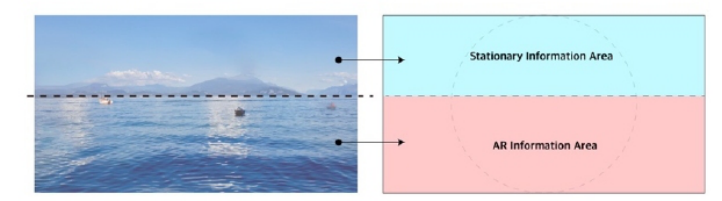
Layout was defined as a framework that can arrange information such as graphics and text in appropriate positions (Lee, 2015). Various AR studies apply the concept of field of view (FOV), which considers the char- acteristics of human vision, to place text and graphics in the center of the visual field (Zimmermann, 2022). Additionally, layouts are often defined based on environmental characteristics. In the maritime environment, the basic layout is reported to be divided into upper and lower sections based on the horizon. Laera reported that in the maritime environment, fixed information such as speed and RPM tended to locate in the upper section, while non-fixed information such as navigation routes is in the lower sec- tion (2021). According to various studies, most maritime AR layouts are divided into upper and lower sections, which can be visually represented as shown in Figure 2.
Figure 2: Interface layout divided by areas.
Through the analysis of previous studies, it was confirmed that the AR- HUD interface can be composed of forms for information recognition, colors for visibility enhancement, and layouts for human factors approaches such as FOV.
Therefore, the information displayed in the framework should be expressed in simple graphic and icon forms for quick information delivery to the operator. Additionally, the colors specified in the ISO safety guide should be used to enhance visibility and readability. Furthermore, the layout should utilize FOV and horizon-based designs to be properly applied in the maritime environment.
PROPOSED AR-HUD INTERFACE Essential Navigation Information for Small Vessel AR-HUD
To concretize the core elements of form, color, and layout into actual designs for the AR-HUD interface, the specific information for each element was identified. For this purpose, six representative companies providing naviga- tion information software utilizing AR and HUD for small and large vessels, respectively, were selected and comparatively analyzed.
All navigation information software is based on the Automatic Identifi- cation System (AIS), which allows vessels to provide their own information to the AIS, which then transmits it to other vessels to avoid dangerous situ- ations. Therefore, almost all information can be interpreted as information about one’s user vessel or other vessels.
Based on this information, the information occupying the largest area on the software screen was ranked first, followed by the information occupying the smallest area. Through this analysis, the four most important pieces of information were identified from the various information provided by each company. Organizing the extracted information by company ranking yields Table 3.
Table 3. Marine vessel AR company case composition.
Table available in the original PDF paper.
Ship size Company name Display Type Order of Information Size on Display
1 2 3 4
Large Vessel Furuno AR-HUD UV H OV L Map OV S Groke AR-Display Map OV L UV H UV S Orca.ai AR-Display UV H Camera UV S OV S Small Vessel Avikus AR-Display UV H OV L UV S OV S Lookout AR-Display UV H OV L UV S OV S Sea-ai AR-Display OV L UV H UV S OV S *User Vessel (UV), Other Vessel (OV), Heading (H), Location (L), Speed (S)
The top-ranked collected information elements were mostly related to location and speed. In particular, the information was divided into two types: user vessel and other vessel information. From this, it can be inferred that operators desire to prioritize information about their own vessel’s direction and speed, as well as the location and speed of other vessels.
A Human Factors Study on the Interface Structure Design of AR-HUD for Small Vessel 285
Therefore, considering the AIS-based information provided, the navigation information for a small vessel AR-HUD interface can be organized as follows:
1. User Vessel Heading: Indicates the direction the vessel’s bow is point- ing, which is crucial information for the operator to know the correct direction. 2. User Vessel Speed: Indicates the current speed of the user vessel in knots. 3. Other Vessel Location: Indicates the location of other vessels in the vicinity of the user vessel. The more congested, the more likely the operator is to become confused, so this information must be provided accurately. 4. Other Vessel Speed: Indicates the moving speed of other vessels in the vicinity of the user vessel. Since each vessel has a different speed, failure to pay attention can lead to collisions. Therefore, the speed of other vessels must be presented in an easily recognizable manner.
The four prioritized pieces of information can be considered as the detailed elements required for the form, color, and layout of the AR-HUD interface. Therefore, a specific design is needed to realize an AR-HUD interface for small vessels that clearly presents the location of this information.
Proposed AR-HUD Interface for Small Vessels The small vessel AR-HUD interface provides information through its com- position of form, color, and layout. The presentation of each piece of information is combined with the essential navigation information derived earlier, and the specific expression format can be systematized as shown in Table 4 in visual form.
Table 4. Arrangement of information.
Table available in the original PDF paper.
Navigation Information Form Example of Design User Vessel Heading Graphic/Text
User Vessel Speed Text Other Vessel Location Graphic
Other Vessel Speed Text
Form: Refers to the shape in which information is expressed and is com- posed of user vessel and other vessel information. The user vessel’s heading is indicated by a reference marker shifting left or right on a horizontal line, allowing the user to recognize the direction. A compass also uses a similar representation. The user vessel’s speed and the other vessel’s speed are dis- played in text form, using knots (kn) as the unit for navigation speed. The other vessel’s location is represented in a map-like form, with the center indi- cating the user vessel’s position and the distance from the center representing the other vessel’s location, displayed as points for visual recognition by the operator.
Color: The color display utilizes the green, yellow, and red colors from the ISO safety guide, with white used for displaying numerical text infor- mation such as speed and units. Green, yellow, and red indicate different levels of danger for the user vessel or other vessels, while white is used to display speed, direction, and other numerical values. Additionally, the area and opacity of colors for objects are used to ensure consistent recognition of environmental and vessel information by the operator. Table 5 summarizes the color regulations, definitions, and examples.
Table 5. Color system for AR-HUD interface.
Table available in the original PDF paper.
Color Color Code Definition Example Image Green #2DF78C Expressed during normal status Yellow #00DAFF Expressed when warning information appears Red #FF0000 Expressed when emergency information appears White #FFFFFF Text of User Vessel speed, Other Vessel speed information
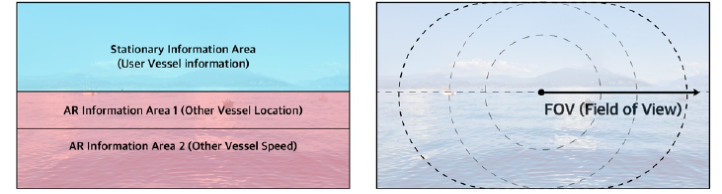
Layout: The layout is based on the division into upper and lower areas and the field of view (FOV) expanding from the center. The upper and lower division consists of the user vessel information display area at the top and the other vessel information display area at the bottom. The bottom area is fur- ther divided into two sub-stages: information displaying the movement and location of other vessels, and information displaying the speed and direction of moving other vessels. The FOV-based composition prioritizes informa- tion that the operator needs to recognize quickly in the center, with stages extending outward from the center to properly position various pieces of information based on priority. Figure 3 visually represents the areas divided into upper and lower sections and based on the FOV.
Through the above discussions, the AR-HUD interface structure and basic concepts have been established to enable the operator to recognize informa- tion without errors and quickly and easily for safe navigation. Therefore, based on these concepts, the AR-HUD interface structure was concretized into an actual design by systematically composing the form, color, and layout.
Figure 3: AR-HUD interface structure.
A Human Factors Study on the Interface Structure Design of AR-HUD for Small Vessel 287
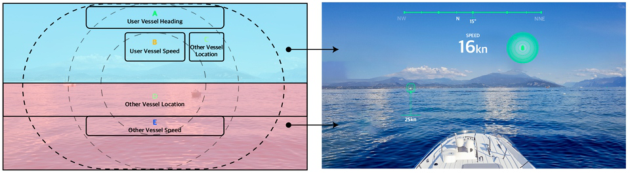
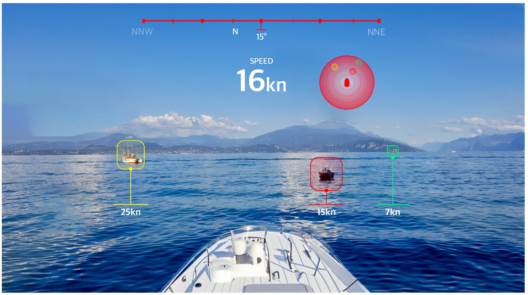
Designed AR-HUD Interface for Small Vessels For safe navigation of small vessels, essential navigation information about the user vessel and other vessels must be properly conveyed to the operator using form, color, and layout. Comprehensively expressing the visual formats and rules discussed above into a specific design yields Figure 4.
Figure 4: AR-HUD interface structure design.
The presented AR-HUD Interface Structure Design displays the heading direction, current user vessel speed, and other vessel locations in the upper section of the frame for the operator. In particular, by utilizing the FOV criteria, important information is prioritized, guiding the user sequentially through speed, other vessel location, and heading direction. Additionally, in the lower section, the other vessels appearing in front of the user vessel are color-coded to indicate danger levels, clearly distinguishing the distance from the user vessel and the other vessel’s speed to enable safe navigation for the operator.
Figure 5 is the completed result, integrating all the information required for the composition of the AR-HUD interface discussed above. The form of the information is differentiated to provide proper expression, color is used to distinguish danger levels, and the optimal layout is configured to mini- mize cognitive errors. Furthermore, the navigation information is interpreted from a human factors perspective, with priorities established to provide the operator with safe and comfortable visual information.
Figure 5: Prototype of AR-HUD interface structure design.
CONCLUSION
Vessel navigation is always exposed to the risk of accidents due to the confined maritime environment. In particular, the operator’s correct decision- making based on the interpretation of information can prevent fatal accidents such as collisions. Therefore, providing accurate information to the operator and quickly distinguishing and presenting necessary information can further enhance navigation safety compared to existing methods.
This study aimed to propose a new AR-HUD interface structure design by deriving components through comparative analysis of necessary navigation information and then organizing the extracted navigation information from a human factors perspective. To achieve this, the preceding study examined the meaning and terminological definitions of AR-HUD, as well as its rela- tionship with safe navigation. Additionally, the forms utilized for AR-HUD in safe navigation were analyzed to identify the components of form, color, and layout. Furthermore, six navigation information software companies uti- lizing AIS-based data were analyzed, and navigation safety elements were derived by distinguishing between user vessel and other vessel information. The results confirmed the core elements required for the design composi- tion of the AR-HUD interface, and based on these findings, a new AR-HUD interface structure design was proposed for presenting information.
Summarizing the details of the proposed AR-HUD interface structure design for small vessels along with the navigation information, the following three conclusions can be drawn:
1. Form: Simple graphic forms should be used for important visibility, while text forms should be used for readability. 2. Color: A color scheme using green for safety, yellow for warning, red for emergency, and white for text information should be implemented. 3. Layout: User vessel and other vessel information should be clearly distin- guished, and information should be arranged centered around the field of view (FOV).
The three presented elements and the AR-HUD interface structure design for small vessels are based on a prototype design grounded in the analysis of various previous studies and a comparison of software companies uti- lizing AIS technology. However, there is a limitation due to the absence of a maritime experiments. Therefore, future research requires usability test- ing based on maritime activities. The value of this research lies in proposing an AR-HUD interface structure design as a prototype by applying a human factors-based information classification and interpretation based on the col- lection of various information. Additionally, this study has significance in proposing an AR-HUD interface structure design for the small vessel domain, incorporating detailed navigation information, which has previously been utilized mainly in vehicles. Through the results of this study, it is expected that deeper discussions on the safety of small vessel operators will be facili- tated, and this research will aid future researchers in conducting studies for the safe navigation of all operators.
A Human Factors Study on the Interface Structure Design of AR-HUD for Small Vessel 289
ACKNOWLEDGMENT
This paper was supported by Korea Institute for Advancement of Tech- nology(KIAT) grant funded by the Korea Government(MOTIE) (P0012725, HRD Program for Industrial Innovation).
REFERENCES
Gartner, Information Technology Glossary. (2019). Augmented Reality (AR). https: //www.gartner.com/en/information-technology/glossary/augmented-reality-ar Giordano, C. (2021). Keep Your Eyes on The Road: AR HUDs for Automotive: AR
HUD. https://www.autoelectronics.co.kr/article/articleView.asp?idx=4113 Han, S. M. (2021). The Past, Present and Future of Head Up Display. https://www.autoelectronics.co.kr/article/articleView.asp?idx=3877 Hwang, H. G., Kim, T. J., Park, H. C., Lee, J. S. and Lee, S. J. (2011). A User Interface Designing Guideline for Shipboard Integration Monitoring. Journal of Digital Contents Society Volume 12, No. 3. International Standard ISO, 2nd edition. (2020). Ships and marine technology -
Design, location and use of shipboard safety signs, fire control plan signs, safety notices and safety markings. Jang, G. H. (2023). The Effect of Arrow Spacing and Blinking Speed Difference on Driver’s Visual Perception and Cognitive Functioning in Augmented Reality (AR) Information Delivery Method of Head Up Display (HUD). Unpublished master’s thesis. Hongik University. Jang, J. H. (2021). AR-HUD Interface Design Based on Driving Contextual Informa-
tion. Unpublished master’s thesis. Yonsei University. Jeong, W. S. (2023). The vulnerability assessment of marine ship accident. Unpublished master’s thesis. Sungkyunkwan University. Kang, W. S. (2020). A Study on the Development of the Collision Avoidance System
for Small Vessels Based on Wireless Access in Vehicular Environment. Unpublished doctoral dissertation. Korea Maritime & Ocean University. Kim, G. T. (2018). A Study on the Evaluation of Ship Collision by Human Error.
Unpublished master’s thesis. Korea Maritime & Ocean University. Kim, K., Jeong, J., Kim, C. and Park, G. (2010). A Study on the Selection of the risks of the vessel. The Korean Society Of Marine Environment & Safety Annual Conference Proceedings. Kim, K. H. (2015). Trends of See-Through Display Applied to the Car HUD.
Electronics and telecommunications trends Volume 30, No. 3. Kim, M. J. (2015). A Study on the relationship between cognitive level and size according to the importance of vehicle Head-Up Display channeled information. Korea Design Knowledge Society Volume 33. Kim, Y. S. (2013). Effects of Components of GUI Design on User’s Satisfaction -
Focused on a Vehicle Navigation Product. A Journal of Brand Design Association of Korea Volume 11, No. 5. Laera, F., Fiorentino, M., Evangelista, A., Boccaccio, A., Manghisi, V. M., Gabbard, J., Gattullo, M., Uva, A. E. and Foglia, M. M. (2021). Augmented reality for mar- itime navigation data visualization: A systematic review, issues and perspectives. The Journal of Navigation Volume 74, Issue 5. Lee, M. H. & Park, I. K. (2015). A Study on How the Functional Difference of User
Interface Design Layout Affects User Experience-Focusing on the F-layout and Z-layout. Design convergence study Volume 14, No. 4.
Ministry of Oceans and Fisheries in Korea. (2022). Marine Accident Statistics Report
2022. Ministry of Oceans and Fisheries in Korea. (2022). Plan for National Maritime Safety Report 2022∼2026. Moffitta, K. & Browne, M. P. (2018). Visibility of color symbology in head-up and
head-mounted displays in daylight environments. Proceeding SPIE Volume 10642, 1064209–1. Na, K. H. (2023). The moderating effect of involvement in the effect of perceived value of head-up display design on brand attachment. Korea Institute of Design Research Volume 8, No. 3. Oh, H. J. (2013). A study on driving performance and glance behavior using head-up
display for the elderly. Unpublished master’s thesis. Yonsei University. Oh, J. Y. (2017). Development of Augmented Reality System for Navigation Support in Ships. Unpublished doctoral dissertation. Chungnam National University. Oh, J. Y. & Kwon, O. S. (2016). Research on Advanced Navigation Aids System
based on Augmented Reality. Korean Institute of Navigation and Port Research Volume 40, No. 4. Park, M. J., Park, Y. S., Lee, M. K., Kim, D. W. and Kim, N. E. (2021). A study on the improvement of Collision Prevention Algorithm for small Vessel Based on User Opinion. Journal of the Korean Society of Marine Environment & Safety Volume 27, No. 2. Park, S. R., Kyung, G. H. (2012). Improving the integrated bridge system (IBS) user
interface based on human factors guidelines. Journal of the Ergonomics Society of Korea Volume 2012, No. 5. Son, M. J. (2020). Research on the Configuration of Head-up Display Interfaces for Autonomous Vehicles to Reduce Cognitive Load. Unpublished master’s thesis. Seoul University. Woo, H. H. (2022). A study on the Intention of Co-creation through AR Technology.
Unpublished master’s thesis. Chungbuk National University. Zimmermann, J., Bredenkamp, K., Hwong, J. and Jadhav, K. (2022). Human Interface Guidelines for Interaction Zones in AR. Human Interaction and Emerging Technologies Volume 68.
LISTED IN THE AHFE DIGITAL BOOKSTORE CATALOGUE
Explore the complete digital volume
Usability and User Experience
Read this individual research paper free through the original publisher, or explore the full digital proceedings book.
ISBN 978-1-964867-32-8
Explore this ISBN in the AHFE Bookstore ↗Listed in the July 2026 bookstore catalogue; search by ISBN to confirm current availability · Digital book purchase optional