Gyuhee Park, Yu Hwa Hong, Suhwan Jung, Yong Gu Ji (2024). Light-based external Human-Machine Interfaces: The effect of animation. In: Usability and User Experience. AHFE Open Access, vol. 156, pp. 303–312. https://doi.org/10.54941/ahfe1005441
As the development of autonomous driving vehicle technology accelerates, the necessity for effective communication between autonomous vehicles and other road users is increasingly emphasized. To this end, usability research using various design factors of the proposed external Human-Machine Interfaces (eHMIs) is progressing rapidly. This study specifically focuses on Light-based eHMIs which have fewer cultural/environmental constraints and allow for faster information transmission. As well as we aim to investigate the effects of various animation types applied to Light-based eHMIs. Conducted with a total of 40 participants, we employed survey and interview methods to understand the impact between Light-based eHMIs and pedestrian behavior. The study utilized four types of animations (i.e., Sweeping (Dual), Scale Up-down (Dual), Flickering, Pulsing), along with two AV-First messages (i.e., Walk, Braking), and two Pedestrian-First messages (i.e., Don’t Walk, Driving). Participants evaluated the animations subjectively on aspects of Intuitiveness, Distraction, Variance, Perceived Safety, Trust, Satisfaction, and Preference. Additionally, the interview was conducted regarding the preference evaluation results. The analysis methods included ANOVA for survey results and Semantic Network Analysis (SNA) of affective vocabulary in interview transcripts. The findings indicated that the Flickering animation was significantly higher in Perceived Safety, Trust, and Satisfaction, and to some extent, the Sweeping Animation also showed positive outcomes from pedestrians. Through network analysis, positive/negative vocabulary for each animation was visualized and the eHMIs design direction was explored accordingly. The outcomes of this study could serve as foundational data contributing to the establishment of a safer and more efficient road traffic environment in the era of autonomous driving.
As the commercialization of autonomous driving technology accelerates, considering a mixed traffic environment where conventional vehicles and autonomous vehicles(AV) share the road has become crucial. This signifies a change in the way pedestrians interact with the road when using it (Hubner et al., 2022; He et al., 2021). The traditional interaction between pedestrians and vehicles involved understanding the vehicle’s intentions by observing the direction indicators for turning or obtaining clues about vehicle actions (e.g. driving and stopping) based on the distance and speed (e.g. deceleration) from
the vehicle (Moore et al., 2019). However, these methods had limitations in conveying the vehicle’s intentions in all situations. Therefore, in cases where the distance between the vehicle and pedestrians was close, the driver’s gaze, gestures, and facial expressions played a role in clear communication.
With the absence of a driver in AV, there arose a need for means to replace the traditional methods of interaction typically managed by drivers. This background led to the emergence of eHMIs (external Human-Machine Inter- faces) (Hensch et al., 2019). The eHMI is considered a useful technology for providing active and immediate information thereby increasing communica- tion efficiency and ensuring safety in interactions between pedestrians and AV interact (Clercq et al., 2019).
Light-Based eHMIs Animation The movement of light can convey intention based on its dynamics, serving as a form of communicative signal to pedestrians about the vehicle’s intentions (Dey et al., 2020). This mode of communication could serve as a means for AV without drivers to provide clear information. Existing research on eHMIs has predominantly unfolded with a focus on usability evaluations based on the type of eHMIs and its approach to message representation (e.g., Display, Light band, Load projection) (Ackermann et al., 2019; Eisma et al., 2019; Guo et al., 2022). Among these, studies on Light band eHMIs have primarily revolved around validating the necessity and effectiveness of eHMIs through the presence or absence of light (Sorokin et al., 2019; Singer et al., 2020; Ferenchak et al., 2023). Despite the high potential for the motion effects of light to support effective communication between AV and pedestrians, research in this area has been lacked. Therefore, this study defines the motion of light in eHMIs as animation, with a specific emphasis on the animation effects of Light-based eHMIs. The objective of this study is to investigate how pedestrians interpret the movement of each animation and the experi- ences during usage. The study not only seeked to explore the usability of Light-based eHMIs animations as a novel traffic signal but also anticipates going further by providing a foundational basis for rules governing eHMIs message delivery methods.
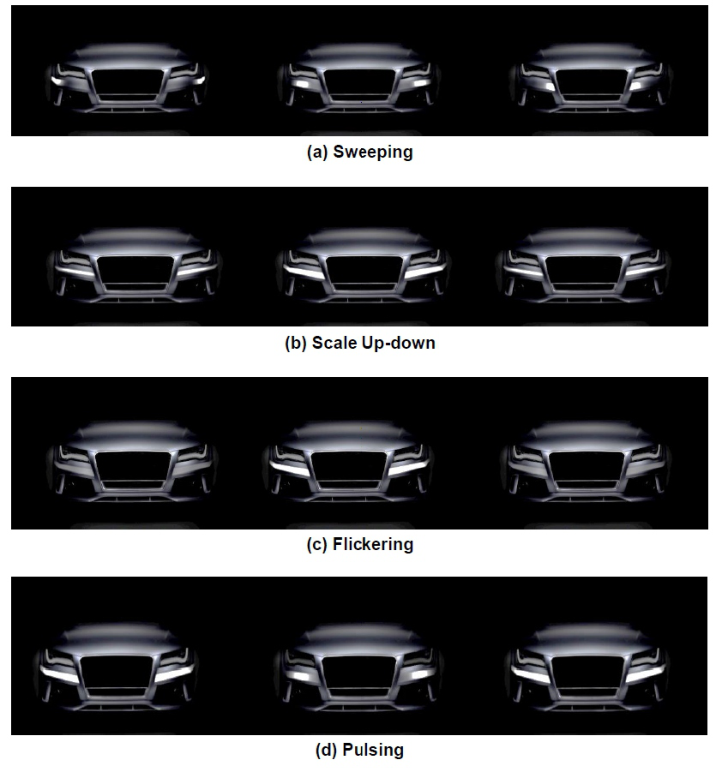
STUDY DESIGN This study conducted an experiment with a total of 40 participants (M = 24.9 years old, SD = 2.55). To understand the perception and experience of eHMIs animation from a pedestrian’s perspective, a within-subject research design of 4 (Animation Type) x 4 (Message Type) was conducted. Four types of animation were used in this study, and they were designed in a way that a specific change method of light is repeated (Figure 1). Sweeping is an ani- mation in which an element or object moves horizontally across the screen. “DualSweep” means that this animation repeats and makes two sweeping movements in opposite directions. Scale Up-down is an animation in which the size of an object or element changes. “Scale Up” refers to the effect of enlarging the object, and “Scale Down” refers to the effect of reducing the object. In this study, like DualSweep, the animation in which the ramp shrinks
Light-Based External Human-Machine Interfaces: The Effect of Animation 305
and expands from its original range is repeated. Flickering is a visual anima- tion that provides a blinking effect by quickly alternating the appearance and disappearance of objects or elements. The lamp turns on and off repeat- edly at a certain frequency. Pulsing is an animation in which the size of an object or element periodically expands and contracts. This can be called Fade in/Out and provides the visual effect of making the lamp appear larger and smaller periodically by adjusting its size at regular intervals. It is designed to be located in the lower area of the headlamp of AV in all conditions. To minimize the influence of color and focus on the pure animation, achromatic colors were used for both the vehicle color and eHMI color in the study. Ani- mated stimuli do not consist of separate scenarios, but only provide simple dynamic/static animation screens.
Figure 1: eHMIs animation types according to change pattern.
A total of four messages used in this study were organized according to the meaning (pedestrian first, AV first) and perspective (egocentric, allocen- tric) that can convey the intention of the AV in a situation where the AV and pedestrians face each other. Participants watched the eHMIs animation video and the survey evaluated the intuitiveness items about how well the animation felt the presented message. According to the experimental design variables, the participants performed a total of 16 trials. After the evalua- tion of the intuitiveness items, usability testing for each animation type was conducted. Participants responded to a total of five items (Distraction, Vari- ance, Perceived Safety, Trust, and Satisfaction) on a 7-point Likert scale for each animation. After all the surveys were completed, participants ranked preference of animations, and then, their opinions were collected through interviews.
Table 1. eHMIs message types according to meaning and perspective.
Table available in the original PDF paper.
Meaning/Perspective Egocentric (=Pedestrian) Allocentric (=AV) Pedestrian-First Walk Braking AV-First Don’t walk Driving
In this study, we used ANOVA analysis to evaluate differences among quantitative evaluation indicators such as intuitiveness, Distraction, Vari- ance, Perceived Safety, Trust, and Preference based on experimental condi- tions. Student Newman Keuls (SNK) was used as a post hoc test. Additionally, network analysis was utilized to analyse interview utterances based on the ranking of animation preferences. We used the Gephi-0.9.1 program to quan- tify and visualize the utterance data regarding animations. The utterances were translated into English consistently by four Human Factor experts. Sub- sequently, an analysis based on Degree Centrality, a commonly used measure in Network analysis, was conducted to examine the correlation between the terms (Jung et al., 2019; Kim et al., 2021).
RESULTS
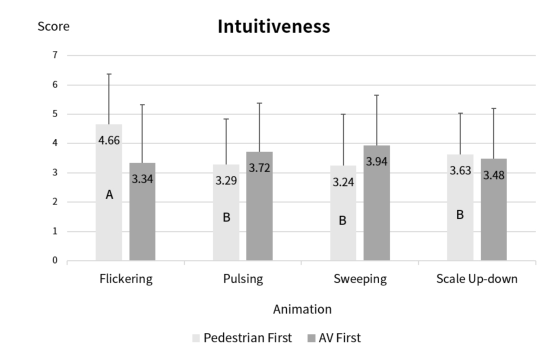
Animation Intuitiveness In order to determine how well the animation represents the message con- veyed by the AV, the intuitiveness scores by the participants were analysed (Figure 2). When a AV wants to convey a pedestrian priority message, the Flickering was found to have the highest intuitiveness (M = 4.66). The participant responded that it was intuitive in the following order: Scale Up- down, Pulsing, and Sweeping. For the AV priority message, Sweeping had the highest intuitiveness score (M = 3.94), and Flickering had the lowest (M = 3.34).
Light-Based External Human-Machine Interfaces: The Effect of Animation 307
Figure 2: Intuitiveness evaluation results for message meaning (bars indicated with different letters are significantly different at p < 0.05).
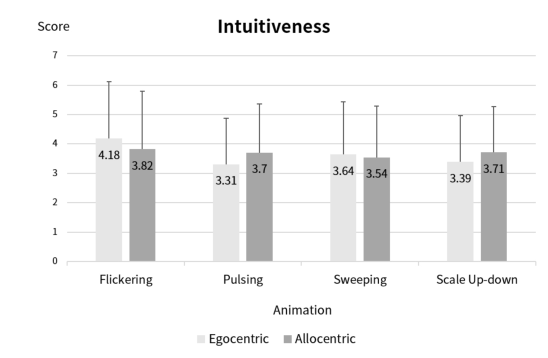
Figure 3 shows the results of animation intuitiveness for message mean- ing. The intuitiveness of animation was analysed according to the perspective of the message presented. For messages from an egocentric perspective, the Flickering (M = 4.18) and Sweeping (M = 3.64) showed high intuitiveness. On the contrary, the message delivered from an allocentric perspective was intuitive in Scale up-down (M = 3.71) and Pulsing (M = 3.7).
Figure 3: Intuitiveness evaluation results for message perspective.
Animation Usability
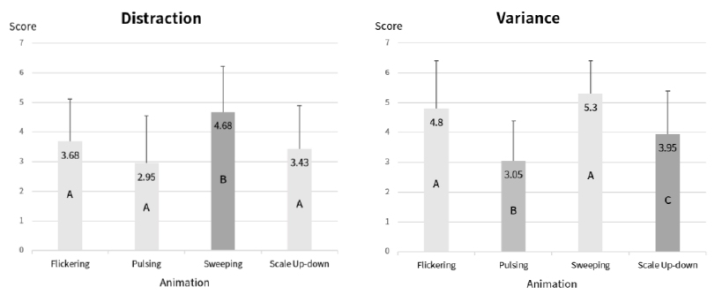
Figure 4 shows the results of animation distraction and variance. Distraction was significantly higher for the Sweeping (M = 4.68). In terms of variance, Sweeping (M = 5.3) and Flickering (M = 4.8) were significantly higher.
Figure 4: Pedestrian distraction, variance evaluation results for animations (bars indicated with different letters are significantly different at p < 0.05).
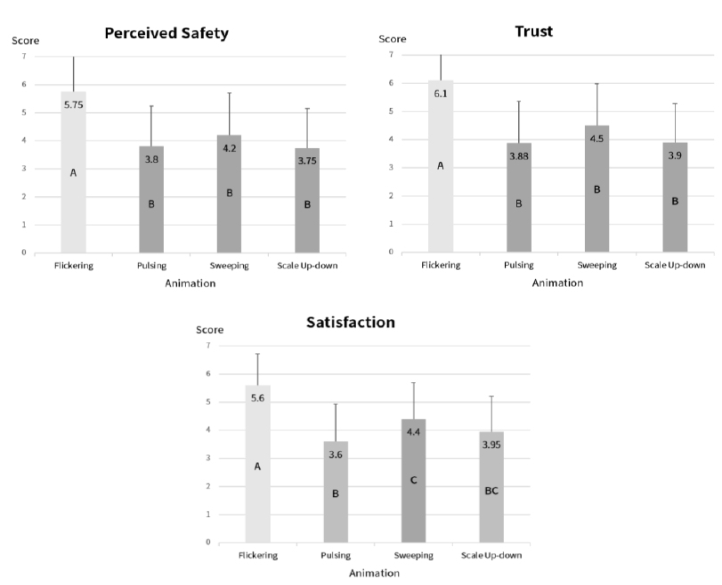
Figure 5 shows the results of animation perceived safety, trust, and satis- faction. Flickering had the highest level of perceived safety (M = 5.75), trust (M = 6.1), and overall satisfaction (M = 5.6). Satisfaction was confirmed that Sweeping was significantly higher in the next order (M = 4.4). Pulsing showed the most lowest score (M = 3.6).
Figure 5: Pedestrian perceived safety, trust, and satisfaction evaluation results for animations (bars indicated with different letters are significantly different at p < 0.05).
Light-Based External Human-Machine Interfaces: The Effect of Animation 309
Semantic Network Analysis
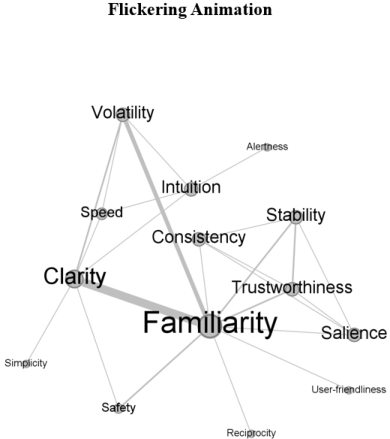
Figure 6 is a network visualization of the selection reason for the animation ranked first in the preference result ranking. The animations that ranked first were Flickering (32), Sweeping (6), and Pulsing (1), and network analysis was conducted targeting Flickering, which was believed to form a network cluster. As a result, degree centrality for ‘Familiarity’ was the largest, and ‘Clarity’, ‘Volatility’, ‘Consistency’, and ‘Stability’ also showed large degree centrality within the network group. ‘Familiarity/Clarity’ and ‘Familiarity/Volatility’ were prominent examples of correlation between two words.
Figure 6: SNA analysis results for the animation selected as 1st priority.
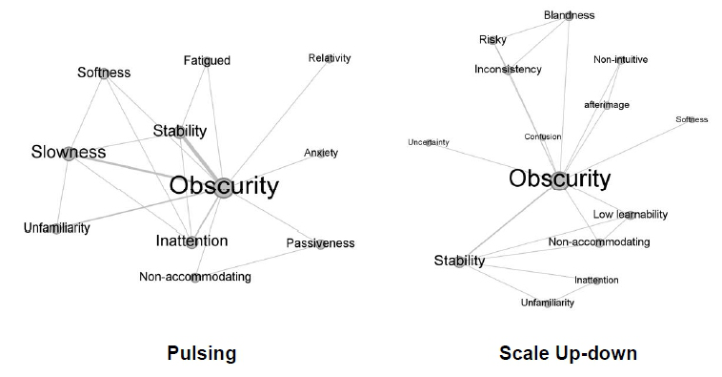
Figure 7 is a network visualization of the selection reason for the animation ranked fourth in the preference ranking. The animations that ranked fourth were Pulsing (22), Scale Up-down (11), Sweeping (6), and Flickering (1). Puls- ing and Scale Up-down, which are believed to be likely to form network clusters, were selected. Network analysis was conducted on the target. First, in the case of Pulsing, the Degree Centrality for ‘Obscurity’ was the largest, and ‘Slowness’, ‘Stability’, and ‘Inattention’ also had the largest Degree Centrality within the network group. ‘Obscurity/Stability’ and ‘Obscurity/S- lowness’ were prominent examples of correlation between two words. Next, in the case of Scale Up-down, Degree Centrality for ‘Obscurity’ appeared the largest, and Degree Centrality within the network group for ‘Stability’, ‘Inconsistency’, and Blandness also appeared large. ‘Obscurity/Stability’ and ‘Obscurity/Inconsistency’ were prominent examples of correlation between two words.
Figure 7: SNA analysis results for the animation selected as 4th priority.
DISCUSSION
When looking at the meaning of each message and the matching animation according to the AV’s yielding behavior, Flickering and Scale up-down are used when trying to give crossing priority to pedestrians, and AV will pass first without giving way to pedestrians. Sweeping and pulsing were confirmed to be appropriate when it comes to meaning. The Flickering was rated as variable as the Sweeping but felt less distracting. Through this, it was found that there was enough variation to be noticeable to pedestrians, but there was little possibility of causing confusion due to distraction.
As a result of semantic network analysis, it was confirmed that high famil- iarity with Flickering had a positive impact. In addition, it was confirmed that the consistency shown in Flickering provides safety and high intuitiveness to subjects. This suggests the possibility of introducing and expanding eHMIs for Flickering. Next, in the case of Pulsing, negative effects appeared due to ambiguity. This is believed to be because Pulsing itself causes a slowdown in the subject’s speed, negatively affecting stability and attention. Lastly, in the case of Scale Up-down, negative effects due to ambiguity also appeared. It is believed that the Scale up-down itself was unfamiliar to the subjects and had a negative impact in terms of stability, learnability, and acceptability. Accordingly, this suggests that additional research on the speed and wave- length of animation is needed to resolve the ambiguity between Pulsing and Scale Up-down.
CONCLUSION
This study investigated pedestrians’ perception and experience of various animation effects of light-based eHMIs. In situations where AV-pedestrian interaction is required, the meaning of animation effects was identified and an animation suitable for conveying the AV’s intent was discovered. This contributes to the commercialization of AV and eHMIs and can be used as
Light-Based External Human-Machine Interfaces: The Effect of Animation 311
basic data for light-based eHMIs design. Because we wanted to look at pedes- trian recognition based on animated movements, factors other than the visual aspect were tightly controlled. Therefore, we can expect future expansion into multimodal research that examines the influence of complex variables.
ACKNOWLEDGMENT
This work was supported by Korea Evaluation Institute of Industrial Tech- nology (KEIT) grant funded by the Korea government (MOTIE) (No. 20024368, Development of Integrated Control System for Multi-mobility and Autonomous Delivery Service Demonstration).
REFERENCES
Ackermann, C., Beggiato, M., Schubert, S., & Krems, J. F. (2019). An experimental study to investigate design and assessment criteria: What is important for commu- nication between pedestrians and automated vehicles?. Applied ergonomics, 75, 272–282. De Clercq, K., Dietrich, A., Núñez Velasco, J. P., De Winter, J., & Happee, R. (2019).
External human-machine interfaces on automated vehicles: Effects on pedestrian crossing decisions. Human factors, 61(8), 1353–1370. Dey, D., Habibovic, A., Pfleging, B., Martens, M., & Terken, J. (2020, April). Color and animation preferences for a light band eHMI in interactions between auto- mated vehicles and pedestrians. In Proceedings of the 2020 CHI conference on human factors in computing systems (pp. 1–13). Eisma, Y. B., van Bergen, S., Ter Brake, S. M., Hensen, M. T. T., Tempelaar, W. J., &
de Winter, J. C. (2019). External human–machine interfaces: The effect of display location on crossing intentions and eye movements. Information, 11(1), 13. Ferenchak, N. N. (2023). Longitudinal bicyclist, driver, and pedestrian perceptions of autonomous vehicle communication strategies. Journal of traffic and transportation engineering (English edition), 10(1), 31–44. Guo, J., Yuan, Q., Yu, J., Chen, X., Yu, W., Cheng, Q.,... & Jiang, X. (2022). External
human–machine interfaces for autonomous vehicles from pedestrians’ perspective: A survey study. Sensors, 22(9), 3339. He, Z., Tan, Z., Zhang, R., Li, Y., & Liu, B. (2021). How pedestrian-AV interaction is affected by the eHMI: A virtual reality experiment. In Advances in Usability, User Experience, Wearable and Assistive Technology: Proceedings of the AHFE 2021 Virtual Conferences on Usability and User Experience, Human Factors and Wear- able Technologies, Human Factors in Virtual Environments and Game Design, and Human Factors and Assistive Technology, July 25–29, 2021, USA (pp. 707–714). Springer International Publishing. Hensch, A. C., Neumann, I., Beggiato, M., Halama, J., & Krems, J. F. (2019). Effects
of a light-based communication approach as an external HMI for Automated Vehicles–a Wizard-of-Oz Study. Transactions on Transport Sciences, 10(2). Hübner, M., Feierle, A., Rettenmaier, M., & Bengler, K. (2022). External communication of automated vehicles in mixed traffic: Addressing the right human interaction partner in multi-agent simulation. Transportation research part F: Traffic psychology and behaviour, 87, 365–378. Jung, S., Park, J., Wang, L., & Widyanti, A. (2019). Comparison of affective
perception of bitcoin between Korea and China. ICIC Int, 13, 231–237.
Kim, H. K., Jung, S., Park, J., & Widyanti, A. (2021). Comparison of affective perception by country for emerging IT products and services. International Journal of Mobile Communications, 19(3), 387–411. Moore, D., Currano, R., Strack, G. E., & Sirkin, D. (2019, September). The case
for implicit external human-machine interfaces for autonomous vehicles. In Pro- ceedings of the 11th international conference on automotive user interfaces and interactive vehicular applications (pp. 295–307). Singer, T., Kobbert, J., Zandi, B., & Khanh, T. Q. (2020). Displaying the driving state of automated vehicles to other road users: An international, virtual reality-based study as a first step for the harmonized regulations of novel signaling devices. IEEE transactions on intelligent transportation systems, 23(4), 2904–2918. Sorokin, L., Chadowitz, R., & Kauffmann, N. (2019, May). A change of perspec-
tive: Designing the automated vehicle as a new social actor in a public space. In Extended Abstracts of the 2019 CHI Conference on Human Factors in Computing Systems (pp. 1–8).
LISTED IN THE AHFE DIGITAL BOOKSTORE CATALOGUE
Explore the complete digital volume
Usability and User Experience
Read this individual research paper free through the original publisher, or explore the full digital proceedings book.
ISBN 978-1-964867-32-8
Explore this ISBN in the AHFE Bookstore ↗Listed in the July 2026 bookstore catalogue; search by ISBN to confirm current availability · Digital book purchase optional