Ji Man Kim, hyungjun Oh, Hwan Hwangbo, Yong Gu Ji (2021). Effect of Age on Superimposition of Head-Up Display. In: Advances in Affective and Pleasurable Design. AHFE Open Access, vol. 14. https://doi.org/10.54941/ahfe100549
In this paper, we investigate the effect on superimposition of the HUD (Head-Up Display) in a driving environment. The semi-transparent properties of HUD lead to the superimposition which means the overlap between HUD’s graphics and an environmental object. Especially, the elderly may have difficulties with driving in a HUD environment because of their loss of cognitive and physical capability. Therefore, we performed the experiment to investigate the effect of age on superimposition in a HUD environment. Participants (elderly, non-elderly) performed the driving task in high and low superimposition level (two simulated road conditions). The result showed that each group’s glance duration was significantly increased in a HUD environment. Moreover, the elderly’s glance duration showed more increasing in a HUD environment than the non-elderly.
During driving, driver should constantly check the variable information such as driving-related information and environment information in order to avoid risk and drive safely. Thus, as driving assistance system, information system in vehicle is variously developed to provide the safety and convenience for driver. Especially, head up display (HUD) is gradually applied to new cars as a typical technology of IVIS in accordance with the design guidelines. The HUD is a transparent display and windshield is used as HUD’s display area. The HUD projected information on a front windshield in driver’s field of view.
Several literature studies have been found on the benefits of the HUD. Liu & Wen (2004) studied the effect of the usage on information displays (HUD, HDD) for driver in two road condition (low, high driving load road). The results showed that drivers in a HUD condition were quicker to respond to road information from display, had less mental stress and had better performance than in a HDD condition. In Gish et al. (1999) study, subjects performed the three tasks (speed monitoring task, navigation task and warning detection task) on information display (HUD, HDD). The author found that drivers in a HUD condition reacted quickly to road events in a HDD condition. Sojourner and Antin (1990) found that Driver in a HUD condition is quicker in responding to the information for salient cues of driving scene than in a HDD condition. Also, several studies (Briziarelli & Allan, 1989; Kato et al., 1992; Sprenger, 1993) found that driver showed the reduction of checking time in a HUD condition.
However, semi-transparent properties of HUD raise a doubt about the positive effects. The semi-transparent properties of HUD lead to the superimposition that is overlapped between HUD's graphics and environmental object (Tangmanee & Teeravarunyou, 2012). This properties may influence the driver distraction, visibility of the display interface, etc., which lead to an increase in glance duration and greatly influence the driver safety.
Especially, Elderly may be vulnerable to a HUD environment because of the loss of physical and cognitive capability. These drivers showed the rapidly growing group in terms of “a driving population” and “a total driving distance” (ball et al., 1993). Generally, elderly experience the loss of eyesight with the increasing age (Rubin et al., 1997; Vitale et al., 2006 and Owsley, 2011). Elderly showed the decrease of the amount of information that human can be processed in given time with the increasing age (Pauzie et al., 1989). These loss leads to the difficulties in driving, as well as using an in-vehicle information system (Dingus et al., 1997; Kirasic, 2000). For example, elderly have difficulties in using the information system such as navigation (Dingus et al., 1997; Kirasic, 2000). These difficulties greatly influence driver’s mobility (McCarthy, 2005). Moreover, Merat et al. (2005) referred that the IVIS is designed without careful consideration for the difficulties of elderly. Thus, considering the capability of elderly is required to design the HUD.
Human acquire the information through variable sensory organ. The most of environment information is received from the vision that is general sense to get the information (Jung & Kee, 1996, Masih-Tehrani &Janabi-Sharifi, 2008). The loss of vision can be applied to driver utilizing IVIS. Because driving is the representative task of vision (Owsley et al., 2013), information design in terms of visual characteristics is essential and should be considered.
Shaheen & Niemeier (2001) studied five kinds of physical disability for elderly. In the research, the older drivers experience the problem of not selecting important information from unnecessary information in terms of selective attention. The author referred that the reduction of attention leads to the difficulties of visual search. Parasuraman & Nestor (1991) found that the decline of selective attention is shown to be highly correlated with the rate of driving accidents. Pauzie(1989) mentioned the following two driving behavior on the visual display in terms of age. First, elderly showed the increase of glance duration and fixation time. This means the decrease of forward-looking time when elderly used the information display. Next, elderly showed the decrease of the amount of information that can be processed in given time. These visual defects of elderly raise some doubt about the positive effects on superimposition in a HUD environment.
Through previous research, we found the various merits and demerits of HUD. Especially, the effect of HUD didn’t be confirmed for elderly. Therefore, this study investigates the effects of age on superimposition of the HUD in a driving environment.
METHOD
Participants In this experiment, subjects are screened for information processing ability through pre-test and a total of 25 subjects participated (12 elderly: the 65-year-old or older, 13 non-elderly). The mean age of elderly is 69.5 years old (SD = 3.5). The mean visual acuity of elderly is in the left eye 0.97 (SD = 0.24) and the right eye 0.95 (SD = 0.28). The elderly are two of the past experience of cataract surgery. The mean age of non-elderly is 28.2 years old (SD = 2.7). The mean visual acuity of non-elderly is in the left eye 0.89 (SD = 0.38) and the right eye 1.00 (SD = 0.37). The non-elderly didn’t have eye disease.
Apparatus The experiment environment is set up considering usage environments of the HUD. We utilized a HUD that is full color head-up display. The model provide a virtual image of 4.5 inch (9.9 x 5.5cm), 400x240 resolution and a 3,100~26000ch/m brightness. The steering wheel is Logitech driving force GT model that include the button at either side. The task is present to 50 inches HD TV in front of subject. To measure glance behavior, SMI mobile eye tracking Glasses 2.0 were used. We set up the basic environment of experiment based on following study. Freeman (2011) designed the usage environment of HUD. The distance between the subject and the HUD image is 1.5m and the HUD is located under the 4~12 degree from the eye position of the driver.
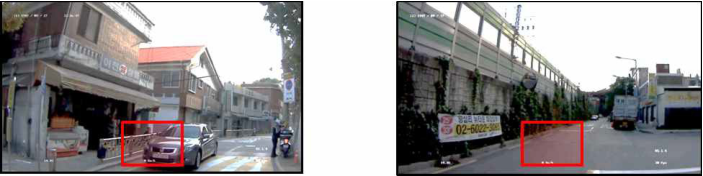
Stimuli The superimposition phenomenon of HUD occurs through overlapping between HUD’s graphics and environment object such as vehicle, road marking and pedestrian. Thus, we controlled the driving scenes by modifying the stimuli level of environment object in the projected area of HUD’s graphics. The stimuli levels depend upon the number of objects of projected area and the degree of frequency of overlapping between HUD’s graphics and environment object. For example, figure 1(left) is high stimuli level that presents the high frequency of overlapping between HUD’s graphics and environment object. Figure 1(right) is the condition of low stimuli that presents the low frequency.
Figure 1. Stimuli level: high (left), low (right)
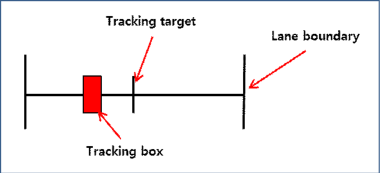
Task In this study, we used the dual-task methodology to investigate the efficiency for HUD. Subjects performed the primary driving task and simultaneously secondary task. In general, the primary task is made up of the operation of the steering wheel, acceleration and brake pedal in viewing the front. The selected primary task is the tracking task that George et al. (1999) used. We transformed the task that driver consistently control the tracking box from particular location of line to tracking target by using the steering wheel. Tracking target is located in the center of display and tracking box move from side to side randomly.
Figure 2. The example of tracking task
Several researchers used a method of evaluating secondary task performance between HUD and HDD (Gish et al., 1999; Wittmann et al., 2006). The method is that subjects respond to whether or not the information of display is correct by using the button of steering wheel at either side. For reference, the selected secondary task is the speed monitoring task that drivers check the current speed (figure 3, right) of vehicle and speed limit (figure 3, left), and respond to a condition by using the button of steering wheel at either side. Subject press the corresponding side button for bigger value. For example, subject press the right side button if the number of figure 3 (right) is bigger than figure 3 (left).
The HUD interface of most vehicle manufacturers is perpendicularly arranged for current speed and speed limit. In this study, the steering wheel button is horizontally arranged. Thus, the speed information is horizontally arranged because we thought that elderly may be difficulty to respond to perpendicular arranged information than horizontal.
Figure 3. The example of speed monitoring task
Figure available in the original PDF paper.
Procedure Subjects (non-elderly, elderly) conducted speed monitoring task in two road conditions (high and low superimposition level) based on tracking task. Each participant is allocated randomly to each of the experimental conditions. The display area is classified as primary task and stimuli area. The figure 2 is located in the center area of display. The other area is stimuli area and the secondary task is presented in the red area of figure 1 with the warning sound. Before experiment, subjects were allowed to interact with simulation for 20 minutes in order to avoid the case that subjects don’t know what to do.
Subjects fixed their eye on the center area of front to perform the primary task and continuously control the location of tracking box by using the steering wheel. And, when a controlled situation is presented with beeps via speakers, participants conducted secondary task during the primary task. The warning sounds occur randomly 10 times at intervals from 20s to 40s in each condition (high and low superimposition level). A total experiment time is about 1 hour. Each condition takes about 6-minute and the time interval between each condition takes about 5minute.
Measurement The measurement of primary task is tracking error that is the gap between the tracking target and tracking box. The outcome is standard deviation of distance from tracking target to tracking box. In the experiment, we assumed that primary task didn’t influence as a solo task and the values of tracking error are not different from any experiment condition because drivers performed the secondary task in a moment. Thus, we focused on the situation of dual task that subject conducted the secondary task during the primary task.
In the research, the dependent variables are secondary task performance and gaze behaviors. The measurements of secondary task are response time and accuracy. The response time is defined as the time from presenting the warning sound to pressing the button of steering wheel. The accuracy is defined as the correct ratio of answer for secondary task. The measurement concerning the visual distraction is selected as glance duration that was utilized at the several studies (Green, 1999, May et al., 2005; Zwahlen et al., 1988;). Zhang et al. (2006) found the reliability of the glance duration as the index measuring the visual distraction. Chiang et al. (2004) measured the glance duration as method to observe the driver behavior When driver performed the input task by using navigation system in road condition. The research defined the glance duration that is the total time of the fixation time which gaze the display, and the transition time that move between the display and road. Also, ISO (15007-1) is presented for glance duration as quantitative measurement for visual demand Caused by secondary task. In this study, Glance duration is defined as the total time from taking eye off the center area of display during tracking task to taking eye on the center area after checking the speed information.
RESULT
We performed t-test to examine the difference between superimposition level in a HUD environment and conducted univariate analysis to examine the interaction effect between age and superimposition level. As expected, the values of tracking error are not different from any experiment condition. Thus, the result analysis of primary task is not included.
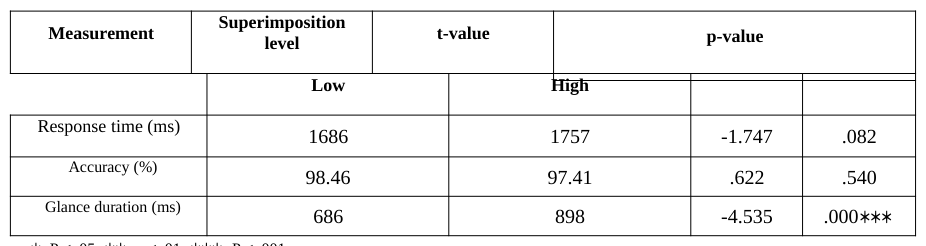
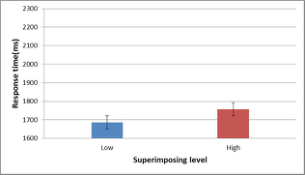
Comparison of the HUD under the different stimuli The results of superimposition level for non-elderly are summarized in Table 1. The glance duration was found to be significant with p=.000. The glance duration of high superimposition level was taken more 252ms than low level. The response time and accuracy did not show a significant effect (α= 0.05).
Table 1. Results of superimposition level for non-elderlyFigure4. Results of superimposition level for non-elderly
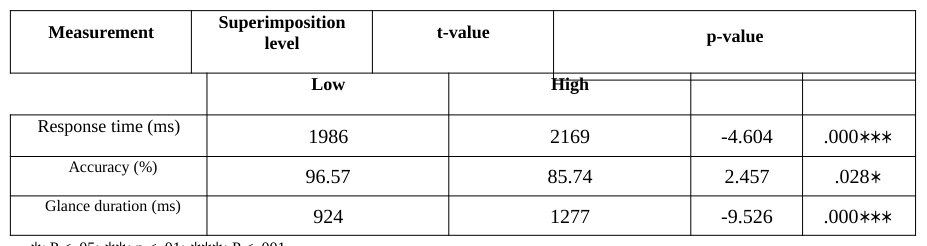
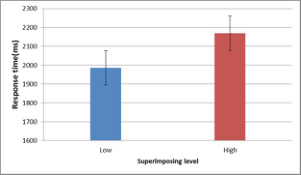
The results of superimposition level for elderly are summarized in Table 2. All measurement were found to be significant (α= 0.05). The response time of high superimposition level was taken more 183ms than low level (p=.000). The accuracy of high superimposition level was decreased more 10.83% than low level (p=.028). The glance duration of high superimposition level was taken more 353ms than low level (p=.000).
Table 2. Results of superimposition level for elderlyFigure5. Results of superimposition level for elderly
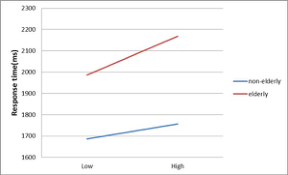
Difference between the effects of stimuli The results of interaction effect between age and superimposition level are summarized in Table 3. The effect of elderly on the superimposition level is significant than non-elderly in terms of response time (F=4.727, p=.030) and accuracy (F=4.420, p=.041). The glance duration did not show a significant effect at α= 0.05 (F=2.518, p=.114).
Table 3. Results of interaction effect between age and superimposition level MeasurementFigure6. Results of interaction effect between age and superimposition level
CONCLUSIONS
We found that high superimposition level have a negative effect on the glance duration in a HUD environment. As the superimposition level increase, all age group showed the increase of glance duration. The increase of glance duration means the increase of the demanded time responding to the projected information in a HUD environment. Especially, elderly is more sensitive to superimposition than non-elderly in terms of response time and accuracy.
Several studies have found the benefits of the HUD in terms of response time. But, we found the negative aspects on the superimposition of HUD. The HUD will be carefully designed on problem of superimposition by text information because of the elderly’s loss of physical and cognitive capability. However, if the defects of HUD are compensated, the HUD is expected to be significant benefit for elderly (Dingus et al., 1997; Kirasic, 2000).
The vehicle manufacturers suggest the full windshield HUD as the future technology. They try to design for the graphic types and the location of HUD. The provided information of HUD includes simple sign, text, warning information, etc. This interface have relevance to superimposition because of the information is required for visibility. Therefore, The HUD should be designed by considering the negative effects on superimposition of the projected information in a HUD environment.
In this study, we have the limitation that didn’t suggest the design method for HUD. Also, the text information of HUD influences superimposition, but we didn’t verify the effect of graphic types on superimposition level. Further study is minimizing the superimposition of HUD, optimizing the location of HUD and verifying the effect of graphic types on superimposition.
REFERENCES
Ball, K., Owsley, C., Sloane, M. E., Roenker, D. L., & Bruni, J. R. (1993). Visual attention problems as a predictor of vehicle crashes in older drivers. Investigative Ophthalmology & Visual Science, 34(11), 3110-3123. Briziarelli, G., & Allan, R. W. (1989). The effect of a head-up speedometer on speeding behavior. Perceptual and
Motor Skills, 69(3f), 1171-1176. Chiang, D. P., Brooks, A. M., & Weir, D. H. (2004). On the highway measures of driver glance behavior with an example automobile navigation system. Applied ergonomics, 35(3), 215-223. Dingus, T. A., Hulse, M. C., Mollenhauer, M. A., Fleischman, R. N., Mcgehee, D. V., & Manakkal, N. (1997).
Effects of age, system experience, and navigation technique on driving with an advanced traveler information system. Human Factors: The Journal of the Human Factors and Ergonomics Society, 39(2), 177-199. Freeman, M. O. (2011, February). MEMS scanned laser head-up display. In SPIE MOEMS-MEMS (pp. 79300G- 79300G). International Society for Optics and Photonics. George, C. F., Boudreau, A. C., & Smiley, A. (1997). Effects of nasal CPAP on simulated driving performance in
patients with obstructive sleep apnoea. Thorax, 52(7), 648-653. Gish, K. W., Staplin, L., Stewart, J., & Perel, M. (1999). Sensory and cognitive factors affecting automotive head-up display effectiveness. Transportation Research Record: Journal of the Transportation Research Board, 1694(1), 10-19. Green, P. (1999, April). The 15-second rule for driver information systems. In Proceedings of the ITS America
Ninth Annual Meeting. ISO, E. (2002). 15007-1: 2002. Road vehicles–Measurement of driver visual behaviour with respect to transport information and control systems–Part 1: Definitions and parameters. Jung, E. S., & Kee, D. (1996). A man-machine interface model with improved visibility and reach functions.
Computers & industrial engineering, 30(3), 475-486. Kato, H., Ito, H., Shima, J., Imaizumi, M., & Shibata, H. (1992). Development of hologram head-up display (No.
SAE Paper 920600). Kirasic, K. C. (2000). 10 Ageing and spatial behaviour in the elderly adult. Cognitive mapping: Past, present, and future, 4, 166. Liu, Y. C., & Wen, M. H. (2004). Comparison of head-up display (HUD) vs. head-down display (HDD): driving
performance of commercial vehicle operators in Taiwan. International Journal of Human-Computer Studies, 61(5), 679-697. May, A., Ross, T., & Osman, Z. (2005). The design of next generation in-vehicle navigation systems for the older driver. Interacting with computers, 17(6), 643-659. Masih-Tehrani, B., & Janabi-Sharifi, F. (2008). Kinematic modeling and analysis of the human workspace for visual
perceptibility. International Journal of Industrial Ergonomics, 38(1), 73-89. McCarthy, D. P. (2005). Elder drivers and technology. Smart Technology for Aging, Disability, and Independence: The State of the Science, 247-283. Merat, N., Anttila, V., & Luoma, J. (2005). Comparing the driving performance of average and older drivers: The
effect of surrogate in-vehicle information systems. Transportation Research Part F: Traffic Psychology and Behaviour, 8(2), 147-166. Owsley, C. (2011). Aging and vision. Vision research, 51(13), 1610-1622. Owsley, C., McGwin, G., & Searcey, K. (2013). A population-based examination of the visual and ophthalmological characteristics of licensed drivers aged 70 and older. The Journals of Gerontology Series A: Biological Sciences and Medical Sciences, 68(5), 567-573. Pauzie, A., & Marin-Lamellet, C. (1989, September). Analysis of aging drivers' behaviors navigating with in-vehicle
visual display systems. In Vehicle Navigation and Information Systems Conference, 1989. Conference Record (pp. 61-67). IEEE. Parasuraman, R., & Nestor, P. G. (1991). Attention and driving skills in aging and Alzheimer's disease. Human Factors: The Journal of the Human Factors and Ergonomics Society, 33(5), 539-557. Rubin, G. S., West, S. K., Munoz, B., Bandeen-Roche, K., Zeger, S., Schein, O., & Fried, L. P. (1997). A
comprehensive assessment of visual impairment in a population of older Americans. The SEE Study. Salisbury Eye Evaluation Project. Investigative ophthalmology & visual science, 38(3), 557-568. Shaheen, S. A., & Niemeier, D. A. (2001). Integrating vehicle design and human factors: minimizing elderly driving constraints. Transportation Research Part C: Emerging Technologies, 9(3), 155-174. Sojourner, R. J., & Antin, J. F. (1990). The effects of a simulated head-up display speedometer on perceptual task
performance. Human Factors: The Journal of the Human Factors and Ergonomics Society, 32(3), 329-339. Sprenger, A. (1993). In-vehicle displays: head-up display field tests. In VISION IN VEHICLES IV.
PROCEEDINGS OF THE FOURTH INTERNATIONAL CONFERENCE ON VISION IN VEHICLES, UNIVERSITY OF LEIDEN, THE NETHERLANDS, 27-29 AUGUST, 1991. Tangmanee, K., & Teeravarunyou, S. (2012, July). Effects of guided arrows on head-up display towards the vehicle windshield. In Network of Ergonomics Societies Conference (SEANES), 2012 Southeast Asian (pp. 1-6). IEEE. Vitale, S., Cotch, M. F., & Sperduto, R. D. (2006). Prevalence of visual impairment in the United States. JAMA: the
journal of the American Medical Association, 295(18), 2158-2163. Wittmann, M., Kiss, M., Gugg, P., Steffen, A., Fink, M., Pöppel, E., & Kamiya, H. (2006). Effects of display position of a visual in-vehicle task on simulated driving. Applied Ergonomics, 37(2), 187-199. Zhang, H., Smith, M. R., & Witt, G. J. (2006). Identification of real-time diagnostic measures of visual distraction
with an automatic eye-tracking system. Human Factors: The Journal of the Human Factors and Ergonomics Society, 48(4), 805-821. Zwahlen, H. T., Adams, C. C., & DeBals, D. P. (1988). Safety aspects of CRT touch panel controls in automobiles.
In Vision in Vehicles II. Second International Conference on Vision in Vehicles.
LISTED IN THE AHFE DIGITAL BOOKSTORE CATALOGUE
Explore the complete digital volume
Advances in Affective and Pleasurable Design
Read this individual research paper free through the original publisher, or explore the full digital proceedings book.
ISBN 978-1-4951-2109-8
Explore this ISBN in the AHFE Bookstore ↗Listed in the July 2026 bookstore catalogue; search by ISBN to confirm current availability · Digital book purchase optional