Hyo Chang Kim, Sang Min Ko, Yong Gu Ji (2021). A Study on the Behavioral Characteristics of the Elderly Living in a Smart Home. In: Advances in Affective and Pleasurable Design. AHFE Open Access, vol. 14. https://doi.org/10.54941/ahfe100586
The purpose of this study is to investigate behavioral of the elderly living in smart home using the diary study method and to analyze the characteristic required according to behavior and smart home service. For the research of the characteristics of service-use, the seven types of main smart home services were chosen by analyzing previous research. We carried out a diary study with ten elderly people over the age of 65 in smart home environment. They recorded their every behavior for one week by themselves. Diary study items consist of four parts: 1) time, 2) activity, 3) device, 4) place. The result of this study, findings of behavioral characteristics of the elderly reveal that most of them spend their time on personal care, socializing and leisure activities. While elderly generally did not fully utilize smart home functions, there was high usage frequency and preference for automatic intelligence service compared to manual. Therefore, smart home services related to these characteristics should be considered as a top priority.
The most comfortable environment in which people live is home environment. Recently, with the rapid progress of technology, the importance of intelligent residential service to improve the quality of life has increased. As rapid growth of global population of elderly people over the age of 65, developed countries has already entered into aging society in the 1990s and Korea has also entered in 2000. (Mariel et al., 2008) Countries which experienced aging society earlier consider residential issue to be the most important concern. Since scope of activity for elderly is limited to their physical ability, the overall living space environment to support their lives is crucial, and studies related to this are in progress.
In the case of United States, supply of elderly-assisting living spaces, which provides various functions and features to aid independent living of elderly, are increasing through projects such as the aware home to study and solve possible problems which could arise. Other projects in foreign countries like Mav Home Project, Neural Network House and etc. also precede various studies of home environment for the elderly. However, in Korea, which is experiencing rapid increase in aging population, is yet to develop suitable policies for elderly and the elderly- friendly residential area. 59% of the residential type of Korea is an apartment, which is the most common type of housing in Korea, and the proportion is expected to continue to grow. Newly built apartments are providing improved quality of life through smart home functions.
Smart Home, called intelligent residential services, home automation system, and digital home, is an IT-based resident of the convenience, safety and other housing support services that enhance the quality of life. The introduction of new technologies will affect many residents, especially the socially disadvantaged elderly (Chappll, 1998). The currently available smart home services are designed and provided depending on the developers' idea without considering the user's physical and psychological characteristics. Although various services are provided, lack of this consideration causes low utilization of smart home Services and inability to provide the intended convenience. To increase the satisfaction of the residents, the intelligent services should be designed and provided taking nature of the residents into account (Mori et al., 2000).
Renaud & Van Biljon (2008) analyzed the factors which affects the elderly’s adoption of mobile phone. They integrated the technology adoption model and domestication of technology approach and suggested the Senior Technology Acceptance & adoption Model (STAM). According to STAM, key factor which affect the elderly’s real usage of mobile phone was ‘Learning & Ease of Use’, and factor which affect the ‘Learning & Ease of Use’ was ‘Experiment and Exploration’. Giving consideration to user’s technology adoption ability could be seen crucial in smart home which is built with different intelligence technology and smart devices. Especially, elderly usually have very low acceptance tendency for new technologies and will require more attention, comparatively (Beamish and Johnson, 1994).
This study elderly living in smart home in Korea with the objective of studying their perception, activity characteristics, and service-use characteristics to escape the current technology-oriented smart home and enable application of user characteristics.
METHOD
Christoffer Bjorkskog (2009) performed assessment of user interface in ubiquitous equipment which are developed to create smart home, and in Martin Krafft (2009), interview with technological solution background took place to find out elderly’s though of health smart home, and design trend of health smart home for elderly was suggested. Also, studies of George Demiris (2008) carried out interviews of elderly living in independent institutions for elderly to assess and measure smart home equipment. Other prior studies which incorporate smart home are continuously being performed.
However, general trend of related research is limited to presenting technology-focused one-dimensional utilization plan, and lacks the studies of resident’s environment and behavior characteristics. Researches involving the development of a smart home are mainly technology oriented, focusing on the protocol and the sensor network design to build smart home environment, and studies in human centered perspective including the interaction with the user, including the elderly, are relatively insufficient. (Michael C. Mozer 1998). Therefore, to collect information on the users' behavioral and emotional characteristics, the research selects the methodology of diary study, in which the users write their own behavior in person.
Diary Study, which is used by various areas of research centered on psychology, is a method of leaving records of one's own way for a certain period of time. The first diary study was conducted in Darwin's language study in 1887 as a record of children's language acquisition process, and since then, diary study has been developed and settled through a lot of research. The results obtained through diary study can be summarized in following three points (Bolger et al., 2003).
1) Detailed information about individuals
2) Difference in individual changes with time
3) Individual changes in a specified period of time and analysis on the casual relationship between the individual differences Diary study is divided into two types, based on the method of recording; 1) time-centric approach (the author records events and behaviors by time) and 2) event-centric approach (the author records when particular events happen) (Palen et al., 2002). In the case of user interview and observation methodology, the subject is affected by the presence of the observer, and emotional information of the user is impossible to obtain. On the other hand, diary study can collect a large amount of data on user behavior characteristics, habits, and feelings without direct observation. Also, as they are the records of actual events from the users, this research method can obtain more detailed information than other methods. Diary study was applied in the research by M. Musil (1998) to identify the elderly health problem and characteristics and the research by Victoria Haines (2007) on the general users’ need of smart home. Diary Study is also conducted for the many other researches to observe user behavioral characteristics and ways of product usage (Brown et al., 2000; Forlizzi, 2007; Lewis et al., 2005).
However, diary study has some limit as the user may feel difficult to record all details for one day or more than a week, and they may write exaggerated information after presuming the intention of the investigators. Also, since the method is based on analysis of record in a certain period of time, the user's emotional state and experience can affect Affective and Pleasurable Design (2021) the results (Reiman, J. 1993).
Recent research has addressed the importance of long period observation to measure the change in a user's experience. Compared to other research methods, ability of diary study to collect information of the real user's behavior qualifies suitably to the object of this research to understand behavioral characteristics of the elderly (Karapanos et al., 2009; von Wilamowitz-Moellendorff et al., 2006). Accordingly, diary study is used in this study to investigate behavioral and service-use characteristics of the elderly living in smart home.
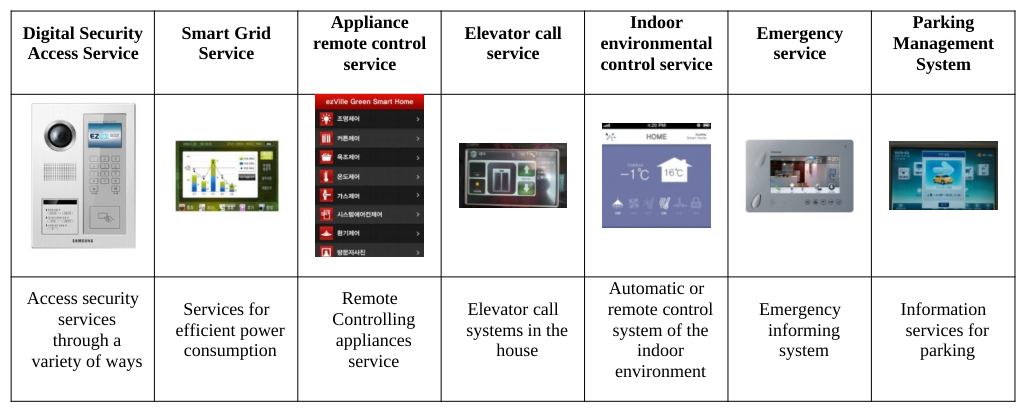
Before selecting the research subjects, the study first examined smart home services provided in current apartments in Korea, and chose seven kinds of services which are most commonly used. Selected services are as follows (See Table 1).
Table 1: Main smart home services
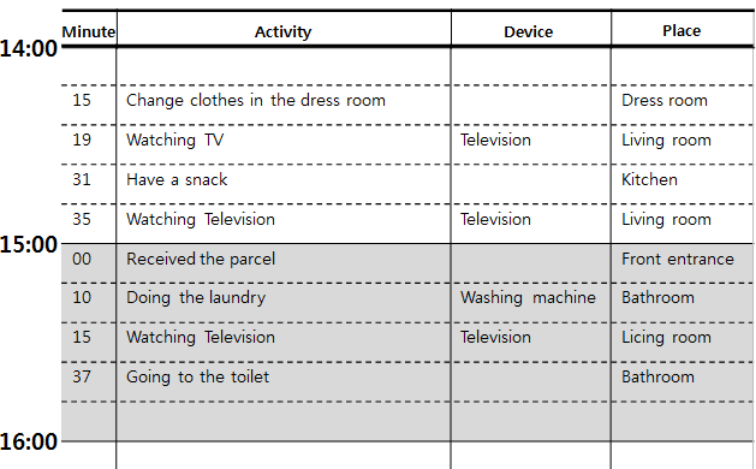
The study selected ten elderly men and women over the age of 65 living in the apartment equipped with all seven kinds of smart home service functions. All participants are living in a smart home and most of their work and activities were at the residential district. Participants were given record forms of the diary study, and they self- recorded their behavior of 24 hours in minutes for one week. This was intended to extract the elderly's main repeated behavioral characteristics, service-use characteristics and spatial characteristics through a week observation (see Figure 1).
Figure 1. Diary study form
The research by Kahneman (2004) conducted survey on 'when', 'what', and 'how do you feel' about the events of the day. This study used the same structured survey with additional items of 'used equipment' and 'place' to analyze behavioral characteristics of the elderly.
Also, taking into consideration that this is a diary study for the elderly, without full explanation of how to record, it is difficult to obtain valid data (Bolger et al., 2003). The guideline of diary study was made for the elderly to help them understand the method, and a full description and practice session were conducted to create one full day recording, which was used to judge the go-ahead of the study. In each day of the diary study, daily home visit was done to encourage the periodical recording and short interview enabled the study to supplement shortcomings of the diary study.
RESULT
Behavioral Characteristics The data collected through the diary study of the elderly are analyzed focusing on behavior to identify behavioral characteristics. Before analyzing the collected data focusing on behavior, the study used classification standards for behavior based on report of elderly lifestyle classification of time by the Korea National Statistical Office and other existing relevant research (See Table 2). Utilizing the following behavior classification standard, all activities of the elderly collected from the diary study were matched, and through the rearrangement, the final behavior classification sheet was designed for the research analysis.
Using the behavior classification sheet, behaviors and time are entered on the sheet. Type of behavior on which the participants spend most time in smart home environment is analyzed examining the time share of each type of behavior. Also, this paper provides additional analysis on their main behavior at home. Through the behavior classification sheet, the result of comprehensive analysis on behavior of the elderly shows that the type of behavior that they spend most time is personal care, socializing and leisure activity, and housekeeping in the order named.
Table 2 : Classification of behavior type of the elderly Item Note
In the case of personal care on which the elderly put most of their time, it is mainly consumed by sleeping activity. Other than sleeping, other activities like eating, washing, and toileting, which are critical life activities, take high proportion (see Table 3). Most of these activities can be seen as physiological necessities. Therefore, smart home Services which can be provided in spaces where those activities are performed should be considered. Observing activities of personal care through spatial separation, living room and bedroom had environment control system which controls the air quality and temperature, and bathroom and bedroom had emergency measure system to monitor accidental fall and account for emergency situation, to be considered. Frequent use of cooking fire in the kitchen needed the support of environment regulating system which prevents fire and gas leak.
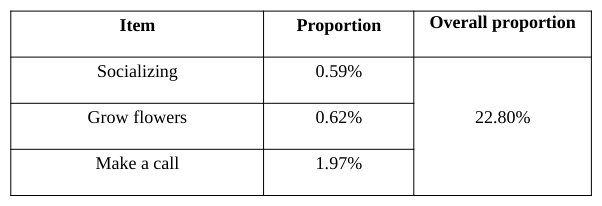
Socializing and leisure activity take up 22.8%, the second highest percentage. Watching TV accounts for most of these behaviors, and aside from sleeping, it takes up most of the time for activity of the elderly (see Table 4). Meanwhile, preparation time for going out had lowest proportion, and diary study showed elderly to be spending more time in the house compared to going out. This is considered to be the result of physical aging to create difficulties for elderly to enjoy outdoor leisure. However, indoor leisure activities of elderly was limited and showed high reliance on TV. There was need to support various indoor leisure activities for elderly.
Table 3 : Personal care Behavior Proportion Overall proportion
Table 4: Socializing and leisure activity Item Proportion Overall proportion
In the case of housekeeping, meal preparation, dish-washing, cleaning and organizing showed even proportion to some extent. Checking indoor power, gas, and heat is 2.13%, but this shows relatively large difference in time among the participants compared to other classification. On the other hand, health management and family care take up less time than other activities, but the elderly people who participated in the diary Study regularly spend their time on sports activities in common. Another common denominator of elderly’s activity was taking medicine, which can be closely related with elderly characteristic of physical aging. To fulfill physical capacity based basic needs of Elderly, indoor space to perform indoor exercise will be required, and there was essential need to offer health support system which notifies medicine taking times.
Use of services To identify smart home service-use characteristics of the elderly, collected data from the diary Study are analyzed focusing on the seven types of smart home services selected before. While elderly generally did not fully utilize smart home Functions, there was high usage frequency and preference for automatic intelligence service like indoor environmental control service, compared to manual services like appliance remote control service, smart greed service. Automatic intelligence service can automatically recognize household condition and control operations while manual service needs to be operated by the user. Manual service is mostly controlled by integrated controllers installed in most home. The following <Table 5> is the result of classification of seven services of smart home by automatic intelligent service and manual service (see Table 5).
Table 5 : The type of smart home services Type Function Note
Indoor environmental control services detect household situation and presence of the residents, to control the indoor environment automatically. It is easy to use this service without lot of effort, thus, the very high use frequency by the elderly compared to other smart home services. The interview with the elderly indicates that the majority of the elderly had a low recognition of smart home services, and indeed, the indoor environmental control services is considered simply as a convenient feature rather than a smart home service. Considering the fading ability in memorizing and physical movement which elderly experience, automatic intelligence service would be the suiting path for smart home service to progress.
Digital security access services provide security for each householder by using a variety of methods (card, fingerprint, and password), and most of the elderly are indicated to use a card for access services. Even the elderly who feel difficult to use manual services shows their voluntary utilization of the service since this service is necessary for the residence. If they do not recognize Smart Grid services, they do not use it. However, a lot of needs in term of power management are observed as they check the monthly amount of electricity through the electricity bill, and turn the light off before they go out. Appliance remote control, elevator calls, emergency calls, and parking management services are controlled by the integrated controller installed at home. However, the elderly do not fully understand each function of the service and some of them give up using it as they feel high difficulty in operating the integrated controller. Therefore, Lack of accessibility and experience to use each service are the factors which rise above simple lack of elderly’s needs. Most of the smart home Service currently uses integrated controller which is constructed with touch interface. But most elderly are not skillful with the touch interface and supplemented control method which can be skillfully operated by elderly is required
CONCLUSIONS
Currently a great number of smart home services have been developed and provided unilaterally without considering the characteristics of the occupants. This study is designed to analyze behavioral characteristic and smart home service-use characteristics of the elderly living in smart home, using the research method of diary study beyond the existing technology centered researches on smart home.
The findings of behavioral characteristics of the elderly reveal that most of them spend their time on personal care, socializing and leisure activities, which are essential activities in life. Therefore, smart home services related to these activities should be considered as a top priority, and although "sports activities" do not take up a lot of time share, those are in the same vein as health management, the main interest of the elderly. Indeed, this was the common characteristic of all the elderly participants verified by the interview. Additionally, after excluding sleeping which is basic physiological phenomenon, watching TV takes up most of the time share. Therefore, suggestions for smart home service configuration which consider both TV watching Activity, as well as ‘health management’, which is another big interest of the elderly, would provide suitable functions for the elderly. Current smart home services are mainly the manual operation type. The analysis results from service-use characteristics of the elderly demonstrate that they can make use of automatic intelligent services, with some help, without struggling in usage. However, they feel great difficulty with the manual operation type of services, and thus show less frequency of use. Therefore, the support of automatic intelligent services which help the elderly to take advantage of natural and intuitive services should be extended, and in the case of manual type of services, additional research is needed for the controller in which the elderly can better accommodate and make better use of the manual type of smart home services.
This study indicates that most of the elderly living in smart home has low level of awareness about smart home, and are not able to utilize the smart home services effectively in their daily lives. The observation results on behavioral characteristics and service-use characteristics of the elderly will contribute to improving convenience and satisfaction of the elderly by making practical use of their behavioral characteristics in their daily residential environment.
ACKNOWLEDGEMENTS
This work was supported by Basic Science Research Program through the National Research Foundation of Korea (NRF) funded by the Ministry of Education, Science and Technology (MEST) (2012R1A1A2006949).
REFERENCES
Beamish, J. and Johnson, M. (1994), “Acceptance of Housing Alternatives for the Elderly: Consumer Perspectives”, Housing and
Society, volume 21 No.3, pp. 17-26 Bolger, N., Davis, A., Rafaeli, E. (2003), "Diary methods: Capturing life as it is lived," Angelina Daviis, and Eshkol Refaeli,Annual Review of Phychology, pp.579-616 Brown, Barry A.T, Abigail J. Sellen, and Kenton P. O'hara (2000), “A Diary Study of Information Capture in Working Life",
Proceedings of the SIGCHI conference on Human factors in computing systems Carol M. Musil, Sukhee Ahn, Marie Haug, Camille Warner, Diana Morris, and Evelyn Duffy (1998), “Health Problems and Health Actions Among Community-Dwelling Older Adults: Results of a Health Diary Study”, Applied Nursing Research, volume 11, No. 3, pp. 138-147 Chappell (1998), “Aging: Canadian perspectives” V. W. Marshall & B. D. McPherson (Eds.), pp. 83-96 Christoffer Bjorkskog (2009), “Human Computer Interaction in Smart Homes”, http://www.hiit.fi/~oulasvir/5830711/smarthomes.pdf Forlizzi, Jodi. (2007), "How Robotic Products Become Social Products: An Ethnographic Study of Cleaning in the Home",
Proceedings of the ACM/IEEE international conference on Human-robot interaction George Demiris, Debra Parker Oliver, Geraldine Dickey, Marjorie Skubic and Marilyn Rantz (2008) “Findings from a participatory evaluation of a smart home application for older adults”, Technology and Health Care, volume 16 No.2, pp.111-118 Kahneman, Daniel, Alan B Krueger, David A Schkade, Norbert Schwarz, and Arthur A Stone (2004), “A Survey Method for
Characterizing Daily Life Experience: The Day Reconstruction Method”, Science 306, no. 5702, 1776-80 Karapanos, Evangelos, John Zimmerman, Jodi Forlizzi, and Jean-Bernard Martens (2009), "User Experience over Time: An Initial Framework" Proceedings of the SIGCHI Conference on Human Factors in Computing Systems Karen Renaud, Judy Van Biljon (2008), : “Predicting technology acceptance and adoption by the elderly: a qualitative study”
Proceedings of the 2008 annual research conference of the South African Institute of Computer Scientists and Information Technologists on IT research in developing countries: riding the wave of technology, pp210-219 Lewis, Kate, Frank Sligo, Claire Massey (2005), “Observe, Record, Then Beyond: Facilitating Participant Reflection Via Research Diaries”, Qualitative Research in Accounting & Management, 2(2), pp. 216-229 Marie Chana, b, Daniel Esteve, Christophe Escribaa, Eric Campo (2008) “Smart homes – Current features and future
perspectives” Maturitas, Volume 64, Issue 2, pp. 20 Martin Krafft, Kemal Coskun (2009), “Design Aspects for Elderly Using Health Smart Home” Bachelor of Software Engineering & Management Thesis Michael C. Mozer (1998), “The Neural Network House: An Environment that Adapt to its Inhabitants.”, AAAI Technical Report
SS-98-02 Mori, T., Sato, T., Asaki, K., Yoshimoto, Y., Kishimoto, Y. (2000), “One-room type sensing system for recognition and accumulation of human behavior”, Proceeding of the 2000 IEEE/RSJ International conference on Intelligent Robots Systems, pp. 345-350 Reiman, J. (1993), "The diary study: A workplaceriented research tool to guide laboratory efforts," Proceedings of the SIGCHI
conference on Human factors in computing systems, pp.321-326 Palen, L., Salzman, M. (2002), "Voice-mail diary studys for naturalistic data capture under mobile conditions," CSCW '02, pp.87-95, New Orleans. LA Victoria Haines, Val Mitchell, Catherine Cooper, Martin Maguire (2007), “Probing user values in the home environment within a
technology driven Smart Home project”, Personal and Ubiquitous Computing, volume 11, No. 5, pp 349-359 von Wilamowitz-Moellendorff, M., Hassenzahl M., and Platz, A. (2006), "Dynamics of user experience: How the perceived quality of mobile phones changes over time", Workshop at the 4th Nordic Conference on Human-Computer Interaction, pp. 74-78
LISTED IN THE AHFE DIGITAL BOOKSTORE CATALOGUE
Explore the complete digital volume
Advances in Affective and Pleasurable Design
Read this individual research paper free through the original publisher, or explore the full digital proceedings book.
ISBN 978-1-4951-2109-8
Explore this ISBN in the AHFE Bookstore ↗Listed in the July 2026 bookstore catalogue; search by ISBN to confirm current availability · Digital book purchase optional