Lu Lu, Chien-Hsiung Chen (2024). The Impact of Information Layout and Gender on the User Experience of Smart Home Center Control System Interface. In: Usability and User Experience. AHFE Open Access, vol. 156, pp. 313–323. https://doi.org/10.54941/ahfe1005442
With the popularity of smart home central control system, the visual design of their user interfaces has become increasingly important. However, the current user experience for smart home central control system user interface design is still lacking. The specific variables of this study are interface layout (i.e., symmetry and asymmetry) and gender (i.e., male and female) of the smart home center control. A total of 40 participants were recruited to participate in the experiment via convenience sampling methods. The results of this study are as follows: (1) The performance of symmetry layout was faster than asymmetry layout. (2) The symmetric layout was more flexible than the asymmetry layout. (3) There existed a significant difference in the task performance of different genders when operating the smart home center control system. Females had better performance than males. (4) In the symmetry layout, males felt that operating this smart home central control system would increase the amount of operations more than females, while the opposite was true in the asymmetry layout. In summary, there existed gender differences in the operation of smart home user interfaces, and they were affected by the user preferences of the interface layout.
With the advancement of household technology, smart appliances integrat- ing intelligent functions with traditional appliances have gradually enhanced consumers’ quality of life. Smart home appliances have increasingly become integrated into human daily life. A particularly significant yet overlooked topic among researchers pertains to the study of smart homes and gender (Del Rio, Sovacool & Martiskainen, 2021). Most discussions have been focused on the technical domain, with early adopters of smart home technol- ogy being predominantly male, such as the appeal of smart home technology to male tech enthusiasts.
Although traditional gender stereotypes regarding household labor are gradually diminishing, gender disparities still contribute to differences in the user demographics within the smart home domain (Khalid et al., 2019; Mylan & Southerton, 2018; Nicholls et al., 2020). In recent years, there has been an increase in male participation in household chores, and during the
initial stages of usage of certain smart products, male consumers are propor- tionately higher (Choi, So & Woo, 2019). Research indicates that preference differences in interface design for certain specific aspects may also stem from gender disparities. Existing literature suggests that males are more concerned with the usability of interface information and its content rather than visual aesthetics (Oyibo, Ali & Vassileva, 2016). Female browsing habits tend to be top-down, while males are inclined to directly search for key tasks without overly focusing on the overall interface, and when faced with complex inter- faces, males exhibit greater concentration than females (Huang, Zhou, Luo & Kaner, 2022).
Accordingly, there has been much interest in studying significant gender differences in aesthetic preferences on websites. Therefore, further research is needed to help explain the gender gap in smart home center control users and develop suitable interaction strategies for smart home center control products.
LITERATURE REVIEW
Smart Home and Gender The connectivity of smart appliances involves the capability to connect to a large network through connectors such as the Internet of Things (IoT) (Raff, Wentzel & Obwegeser, 2020). Previous research has indicated that digital household tasks or gendered “tech work” create more opportunities for men (Strengers & Nicholls, 2018). In contrast, womales exhibit lower interest in smart home technologies (Strengers, Kennedy, Arcari, Nicholls & Gregg, 2019). Hence, it is evident that gender differences can affect the willingness to use and the user experience of smart home technologies.
Research on smart homes encompasses various domains, including the visual design aspects of user interfaces. Gender is recognized across many disciplines as a determinant factor of user behavior, yet studies on interface design for smart home control systems from a gender differences perspective remain scarce. Users predominantly focus on gender differences in aes- thetic preferences when interacting with user interfaces. Previous relevant research has found significant disparities between males and females in web- site design principles (Cyr & Bonanni, 2005; Moss, Gunn & Heller, 2006), visual attention to online shopping information (Hwang & Lee, 2018), and decision-making processes (Gonzalez, Meyer & Toldos, 2021). Males may respond more proactively than females toward well-organized websites (Richard et al., 2010). Females prefer interface layouts with more images, while males prefer those with more text (Dhir & Torsheim, 2016). Addi- tionally, studies have examined the impact of gender on information value, information processing, attitudes toward online shopping, and the use of social networking sites, where the influence of perceived usability on male attitudes is more significant compared to females (Cyr & Head, 2013).
Interface Symmetry in Design Aesthetics The aesthetic attributes of user interface design are indispensable components in human-computer interaction research (Bhandari et al., 2017), manifested
The Impact of Information Layout and Gender on the User Experience 315
not only visually but also in the user experience of the interface (Tuch, Roth, Hornbæk, Opwis & Bargas-Avila, 2012). Symmetry and asymmetry of user interfaces influence design layouts and perception (Wang, Wang & Qiu, 2021). Symmetry holds significant aesthetic influence (Eytam & Tractinsky, 2010). Symmetrical user interfaces evoke feelings of orderliness, durability, and stability, while asymmetrical user interfaces pique user interest (Creusen, Veryzer & Schoormans, 2010). Moreover, symmetry in user interface design provides a sense of simplicity and reduces the attention required for inter- action compared to asymmetrical user interfaces. There are various types of symmetry, with bilateral symmetry along the vertical axis being the most crucial (Bauerly & Liu, 2008).
There exists a specific correlation between information layout and gender users (Li, Song, Liu, Wang & Ma, 2021). Gender disparities on the inter- net may arise from differences in preferences for specific aspects of website interface design; if website interfaces are not tailored to suit females, female visitors may experience frustration and anxiety while browsing the website, leading to lower satisfaction levels (Lin & Hsieh, 2016).
RESEARCH METHOD Experimental Equipment and Methods
The study aims to investigate the impact of different interface layouts on the performance and subjective experience of users of different genders when operating smart home central control system interfaces. The experiment employs a 2x2 between-subjects design, with interface layout (i.e., symme- try vs. asymmetry) and user gender (i.e., male vs. female) as manipulated variables. The research hypotheses are as follows: (1) There is a significant difference in the operational performance of smart home central control system tasks under different interface layouts. (2) There is a significant difference in the subjective evaluation of operating the smart home central control system under different interface layouts. (3) There is a significant difference in the task performance of participants of different genders in operating the smart home central control system. (4) There is a significant difference in the subjective evaluations of different genders when operating the smart home center control system.
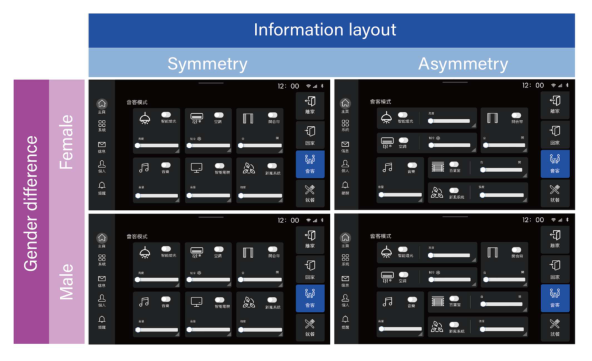
Convenience sampling was employed to recruit participants for this study, comprising 40 individuals, evenly split between 20 males and 20 females. Participants ranged from 18 to 39 years old, all enrolled as students. Stu- dents were chosen as participants for this experiment due to their generally higher level of education, which enhances their understanding and acceptance of the experimental content. A total of 40 participants were recruited for the experiment, and informed consent were obtained from each participant. The prototypes for smart home control software was created using Mock- ingbot software, delivered through an 11-inch iPad Pro with a resolution of 2388x1668 and running the iOS 16.6.1 operating system.The study designed a total of four smart home control interfaces for comparative research as illustrated in the Fig. 1.
316 Lu and Chen
Figure 1: The user interface designs of the experimental prototypes.
Experiment Process The experiment evaluated participants’ task performance while executing tasks on the smart home control interfaces. The most common practice for measuring accurate performance is to use the time required to complete tasks as the measurement metric. After completing the tasks, participants filled out a 7-point Likert scale to assess their subjective preferences when operating the smart home control interfaces.
RESULTS AND DISCUSSIONS Completion Time of Experiment Tasks
By comparing and analyzing the operation performance of the experimental tasks, it is possible to understand how the information layout and user gen- der affect the operation of the smart home central control system. The results of the descriptive statistics and two-way analysis of variance (ANOVA) pertinent to the completion time of the experimental tasks are shown in Tables 1 and 2.
Table 1. The descriptive statistics of participants’ task completion time (unit: second).
Table available in the original PDF paper.
Variable Task1 Task2 Task3 Task4 Number of participant
M SD M SD M SD M SD Layout Symmetry 18.88 5.96 30.16 7.92 14.96 2.61 22.64 3.31 20 Asymmetry 20.81 5.12 32.72 6.60 16.90 2.65 23.73 4.63 20 Gender Male 21.64 5.01 32.41 7.35 16.28 3.05 23.56 3.87 20 Female 18.06 5.65 30.47 7.33 15.58 2.51 22.81 4.22 20
The Impact of Information Layout and Gender on the User Experience 317
Table 2. The results of the two-way ANOVA regarding participants’ task completion time.
Gender 5.723 1 5.723 .338 .564 .009 Information layout× Gender
* Significantly different at α = 0.05 level (*p < 0.05). ** Significantly different at α = 0.01 level (**p < 0.01).
Task 1 completion time did not produce a significant interaction between the smart home center control system interface information layout and gen- der variables (F = 2.996, p = 0.092>0.05; η2=0.08). Task 1 operation time did not produce a significant difference in the main effect of the informa- tion layout variable of the smart home centralized interface (F = 1.384, p = 0.247>0.05; η2=0.04). However, it did produce a significant differ- ence in the main effect of the gender variable of the participants (F = 4.786, p = 0.035<0.05; η2=0.12). Females (M = 18.06, SD = 5.65) took signif- icantly longer to complete Task 1 than males (M = 21.64, SD = 5.01), as shown in Fig 2.
Task 2 completion time did not produce a significant interaction between the smart home center control system interface information layout and gen- der variables (F = 0.079, p = 0.780>0.05; η2=0.00). Task 2 operating time did not produce a significant difference in the main effect of the smart home center control system interface information layout variable (F = 1.187,
318 Lu and Chen
p = 0.283>0.05; η2=0.03), and also did not produce a significant differ- ence in the main effect of the gender variable (F = 0.686, p = 0.413>0.05; η2=0.02).
There was no significant interaction effect between the variables of the smart home center control system interface information layout and partici- pant gender on the completion time of Task 3 (F = 0.128, p = 0.723>0.05; η2=0.00). However, there was a significant difference in the completion time of Task 3 regarding the variable of the smart home center control system inter- face information layout (F = 5.274, p = 0.028<0.05; η2=0.13). Specifically, the task completion time for the symmetry layout (M = 14.96, SD = 2.61) was shorter than that for the asymmetry layout (M = 16.90, SD = 2.65). There was no significant difference in the completion time of Task 3 in participant gender (F = 0.685, p = 0.413>0.05; η2=0.02).
There was no significant interaction effect between the variables of the smart home center control system interface information layout and partici- pant gender on the completion time of Task 4 (F = 0.034, p = 0.854>0.05; η2=0.00). Moreover, there was no significant difference in the completion time of Task 4 in the variable of the smart home center control system interface information layout (F = 0.711, p = 0.405>0.05; η2=0.02). Like- wise, there was no significant difference in the completion time of Task 4 in participant gender (F = 0.034, p = 0.854>0.05; η2=0.00).
In addition, the operation time of the symmetry layout was faster than that of the asymmetric layout in all four tasks, and the operation time of females was better than that of males in all four tasks.
The Analysis of Subjective Evaluations The Analysis of System Usability Scale (SUS) After completing the experimental tasks, participants filled out relevant subjective evaluation questionnaires. Statistical analysis of the results from the System Usability Scale indicated an overall mean score (M = 68.75, SD = 14.44) higher than 68, suggesting good system usability for both the information layout and gender variables in the smart home control interface. Simultaneously, the analysis of variance of the two-factor System Usability Scale (Table 3) revealed that the main effect of information layout (F = 0.749, p = 0.392>0.05; η2=0.02) and gender (F = 1.17, p = 0.286>0.05; η2=0.03) was not significant. There was also no significant interaction between the information layout and gender variables (F = 0.187, p = 0.668>0.05; η2=0.01).
Table 3. The results of the two-way ANOVA regarding the SUS.
Table available in the original PDF paper.
Source SS df MS F F η2 Post Hoc Information layout 160.000 1 160.000 .749 .392 .020 Gender 250.000 1 250.000 1.171 .286 .031 Information layout× Gender 40.000 1 40.000 .187 .668 .005
* Significantly different at α = 0.05 level (*p < 0.05). ** Significantly different at α = 0.01 level (**p < 0.01).
The Impact of Information Layout and Gender on the User Experience 319
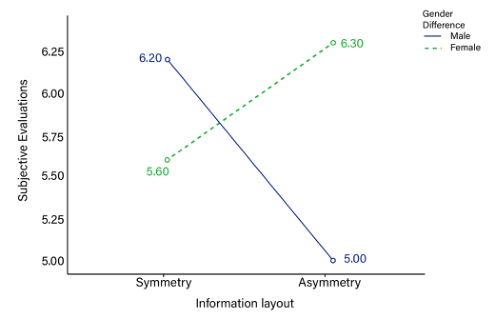
The Analysis of Subjective Evaluations The results of the two-way analysis of variance (ANOVA) among participants for the subjective evaluations of increased user workload are presented in the Table 4, indicating non-significant main effects for both information layout and gender. Specifically, the main effect of information layout was not signif- icant (F = 0.449, p = 0.507 > 0.05; η2=0.01), and similarly, the main effect of gender was not significant (F = 0.880, p = 0.354 > 0.05; η2=0.02). Addi- tionally, through interaction analysis using two-way ANOVA, a significant interaction between information layout and gender was observed (F = 6.485, p = 0.015 < 0.05; η2=0.15). Illustrated by the Fig. 2, under the symmetry lay- out, males (M = 6.20, SD = 0.42) perceived that operating this smart home control would entail an increased workload compared to females (M = 5.60, SD = 0.84). In contrast, under the asymmetry layout, females (M = 6.30, SD = 0.67) believed that task operations would result in a more significant workload than males (M = 5.00, SD = 2.05).
Figure 2: The interaction diagram of subjective evaluations.Table 4. The results of the two-way ANOVA regarding the participants’ subjective evaluations.
Table available in the original PDF paper.
Source SS df MS F p η2 Post Hoc
1.225 1 1.225 .880 .354 .024
Increased user workload
Information layout 9.025 2 9.025 6.485 .015* .153 Gender .625 1 .625 .449 .507 .012 Information layout× Gender
The results of the two-way analysis of variance (ANOVA) among par- ticipants for the subjective evaluations of user operational flexibility are presented in the Table 4, indicating a significant main effect for information layout (F = 5.116, p = 0.030 < 0.05; η2=0.124). Specifically, the symmetry layout (M = 5.55, SD = 0.28) was more flexible than the asymmetry layout (M = 4.65, SD = 0.28). However, no significant difference was observed for the main effect of gender (F = 0.063, p = 0.803 > 0.05; η2=0.00). Moreover, there was no significant interaction between information layout and gender (F = 0.253, p = 0.618 >0.05; η2=0.01).
DISCUSSIONS The objective task performance revealed that females outperformed males. This finding suggests significant differences in task performance among par- ticipants of different genders when operating smart home controls. This difference may be attributed to the narrower visual span of males than females (Kong, 2023). The prototypes in this experiment featured an 11-inch horizontal screen, which might limit the visual field of male participants, impeding their ability to perceive screen content at a glance and thus increas- ing visual search time. With more expansive peripheral vision, females can perceive a broader area at once.
According to the objective task performance, it was found that perfor- mance in tasks utilizing the symmetry layout was faster than those using the asymmetry layout. This finding indicates significant differences in task per- formance when operating smart home control tasks with different interface layouts. This difference may be due to the regularity of symmetrical lay- outs. In contrast, asymmetrical layouts lack uniformity and regularity in their design and arrangement, increasing participants’ difficulty locating targets and consequently prolonging visual search time.
The subjective preferences for smart home control were assessed, reveal- ing that within the symmetry layout, males perceived a more significant workload in operating the smart home control compared to females and the opposite in the asymmetry layout. The reason for this difference may be attributed to the fact that symmetry layouts align more with the character- istics of females throughout the visual search process, as females consider symmetry layouts to be more conducive to search and visual logic. Con- versely, males are less likely to be distracted by irrelevant clues and are more focused on the task, hence not perceiving increased workload in operating asymmetry layouts. This result aligns with previous research indicating that males, compared to females, are better at ignoring irrelevant visual cues and have more excellent executive function (Deaner, Shepherd & Platt, 2007). Additionally, the results of subjective evaluations revealed that operating symmetrical layouts was perceived as more flexible than asymmetrical lay- outs. Asymmetrical interfaces, compared to symmetry ones, include more visual information, leading to increased visual complexity of the interface (Pieters, Wedel & Batra, 2010), thereby resulting in poorer flexibility when operating asymmetry layouts.
The Impact of Information Layout and Gender on the User Experience 321
CONCLUSION
This study focuses on how gender and information layout affect users’ objec- tive task performance and subjective feelings when operating the smart home center control. The main findings are summarized as follows: (1) The task performance of symmetry layout is faster than asymmetry layout. (2) The symmetric layout is more flexible than the asymmetry layout. (3) Females had better performance than males. (4) In the symmetry layout, males felt that operating this smart home central control system would increase the amount of operations more than females, while the opposite was true in the asymmetry layout.
Building upon existing research, this study extends the understanding of the relationship between user interface design aesthetics and user gender, providing significant theoretical support and practical implications for the literature. This study fills a gap by examining the influence of user gender on the user experience of smart home control interfaces. Given the lack of clear theoretical underpinnings for research and evaluation of interface lay- outs in smart home control interfaces based on gender requirements, this study addresses gender differences in user experience of user-centered smart home control interfaces.
This study also has certain limitations. Participants primarily consisted of university students, which may restrict the study’s insights, suggesting a need for further expansion of the population sample. Additionally, differences in participants’ experience with operating smart home controls may influence the evaluation outcomes. Future research can delve deeper into individual differences in user experience based on the foundation of this study, partic- ularly regarding the impact on user experience of smart home control user interfaces.
REFERENCES
Bauerly, M., & Liu, Y. (2008). Effects of symmetry and number of compositional elements on interface and design aesthetics. Intl. Journal of Human–Computer Interaction, 24(3), 275–287. Bhandari, U., Neben, T., Chang, K., & Chua, W. Y. (2017). Effects of interface design
factors on affective responses and quality evaluations in mobile applications. Computers in Human Behavior, 72, 525–534. Choi, J., So, R., & Woo, E. (2019). Smart home decorated with smart home appliances, strategies to enter the US market. Korea Trade-Investment Promotion Agency. Creusen, M. E., Veryzer, R. W., & Schoormans, J. P. (2010). Product value importance
and consumer preference for visual complexity and symmetry. European Journal of Marketing, 44(9/10), 1437–1452. Cyr, D., & Head, M. (2013). Website design in an international context: The role of gender in masculine versus feminine oriented countries. Computers in Human Behavior, 29(4), 1358–1367. Deaner, R. O., Shepherd, S. V., & Platt, M. L. (2007). Familiarity accentuates gaze
cuing in females but not males. Biology Letters, 3(1), 65–68. Del Rio, D. F., Sovacool, B. K., & Martiskainen, M. (2021). Controllable, frightening, or fun? Exploring the gendered dynamics of smart home technology preferences in the United Kingdom. Energy Research & Social Science, 77, 102105.
322 Lu and Chen
Dhir, A., & Torsheim, T. (2016). Age and gender differences in photo tagging gratifications. Computers in Human Behavior, 63, 630–638. Eytam, E., & Tractinsky, N. (2010). The paradox of simplicity: Effects of user
interface design on perceptions and preference of interactive systems. González, E. M., Meyer, J. H., & Toldos, M. P. (2021). What womales want? How contextual product displays influence females’ online shopping behavior. Journal of Business Research, 123, 625–641. Huang, T., Zhou, C., Luo, X., & Kaner, J. (2022). Study of ageing in complex inter-
face interaction tasks: Based on combined eye-movement and HRV bioinformatic feedback. International Journal of Environmental Research and Public Health, 19(24), 16937. Hwang, Y. M., & Lee, K. C. (2018). Using an eye-tracking approach to explore gender differences in visual attention and shopping attitudes in an online shop- ping environment. International Journal of Human–Computer Interaction, 34(1), 15–24. Khalid, R., Christensen, T. H., Gram-Hanssen, K., & Friis, F. (2019). Time-shifting
laundry practices in a smart grid perspective: A cross-cultural analysis of Pakistani and Danish middle-class households. Energy Efficiency, 12(7), 1691–1706. Kong, H. (2023, February). Exploring Changes in Controllability According to Width of Selection Items for Control: Gender Difference Effect on Website Inter- activity. In Future of Information and Communication Conference (pp. 25–32). Cham: Springer Nature Switzerland. Li, Y., Song, F., Liu, Y., Wang, Y., & Ma, X. (2021). Relevance of emotional conflict
and gender differences in the cognitive tasks of digital interface layouts using NIRS technology. IEEE Access, 9, 17382–17391. Lin, C. J., & Hsieh, T. L. (2016). Exploring the design criteria of website interfaces for gender. International Journal of Industrial Ergonomics, 53, 306–311. Moss, G., Gunn, R., & Heller, J. (2006). Some males like it black, some womales
like it pink: Consumer implications of differences in male and female website design. Journal of Consumer behaviour, 5(4), 328–341. Mylan, J., & Southerton, D. (2018). The social ordering of an everyday practice: The case of laundry. Sociology, 52(6), 1134–1151. Nicholls, L., Strengers, Y., & Sadowski, J. (2020). Social impacts and control in the
smart home. Nature Energy, 5(3), 180–182. Oyibo, K., Ali, Y. S., & Vassileva, J. (2016, July). Gender difference in the credibility perception of mobile websites: a mixed method approach. In Proceedings of the 2016 Conference on User Modeling Adaptation and Personalization (pp. 75–84). Pieters, R., Wedel, M., & Batra, R. (2010). The stopping power of advertising:
Measures and effects of visual complexity. Journal of Marketing, 74(5), 48–60. Raff, S., Wentzel, D., & Obwegeser, N. (2020). Smart products: Conceptual review, synthesis, and research directions. Journal of Product Innovation Management, 37(5), 379–404. Richard M. Chebat J. C. Yang Z. Putrevu S. (2010). A proposed model of online
consumer behavior: Assessing the role of gender. Journal of Business Research, 63(9/10), 926–934. Strengers Y, Nicholls L (2018) Aesthetic pleasures and gendered tech-work in the 21st-century smart home. Media International Australia, 166(1), 70–80. Strengers, Y., Kennedy, J., Arcari, P., Nicholls, L., & Gregg, M. (2019, May). Pro-
tection, productivity and pleasure in the smart home: Emerging expectations and gendered insights from Australian early adopters. In Proceedings of the 2019 CHI conference on human factors in computing systems (pp. 1–13).
The Impact of Information Layout and Gender on the User Experience 323
Tuch, A. N., Roth, S. P., Hornbæk, K., Opwis, K., & Bargas-Avila, J. A. (2012).
Is beautiful really usable? Toward understanding the relation between usability, aesthetics, and affect in HCI. Computers in Human Behavior, 28(5), 1596–1607. Wang, J., Wang, Z., & Qiu, S. (2021). Investigate symmetry, complexity, and screen shapes in interface design aesthetics to promote users’ quality perceptions and continuous usage intention of the smartwatch. International Journal of Human– Computer Interaction, 37(20), 1966–1980.
LISTED IN THE AHFE DIGITAL BOOKSTORE CATALOGUE
Explore the complete digital volume
Usability and User Experience
Read this individual research paper free through the original publisher, or explore the full digital proceedings book.
ISBN 978-1-964867-32-8
Explore this ISBN in the AHFE Bookstore ↗Listed in the July 2026 bookstore catalogue; search by ISBN to confirm current availability · Digital book purchase optional