Juan Carlos Dall'asta (2025). Integrating Artificial Intelligence into the Human-Centered Design Process: Enhancing Creativity and User-Centricity in Architectural Education. In: Human Interaction and Emerging Technologies (IHIET-AI 2025): Artificial Intelligence and Future Applications. AHFE Open Access, vol. 161, pp. 173–182. https://doi.org/10.54941/ahfe1005908
This paper examines the role of Artificial Intelligence (AI) within the Human-Centered Design (HCD) framework in architectural education, focusing on its implementation in the MArch program at Xi'an Jiaotong-Liverpool University. Over the last five years, AI has been embedded into the HCD's three core phases: Hear, Create, and Deliver, enhancing creativity, decision-making, and problem-solving.In the Hear phase, AI analyses user-generated data to guide design decisions. In the Create phase, AI emerges as a co-designer, offering innovative ideas and collaborating with human designers to refine design concepts. This partnership is crucial for boosting creativity. In the Deliver phase, AI aids in refining designs by optimising technical and aesthetic aspects through simulations and feedback loops.The integration of AI has notably improved creativity, efficiency, and user-focused outcomes, paving the way for more inclusive and sustainable designs. However, challenges such as ethical concerns and the need to balance AI's analytical capabilities with the intuitive aspects of design remain.Reflecting on AI's journey from experimental use to an integrated tool in HCD, this paper is a starting point for further research to enhance AI's predictive capabilities and its role in preparing students for complex future architectural challenges.
Contextualising HCD and Its Relevance in Architecture Human-centered design (HCD) has profoundly influenced architectural practices, providing a foundation for designs that respond to human needs and experiences. While HCD was not originally conceived as an architectural design methodology, it aligns with several design phases that evolved in Europe during the latter half of the twentieth century. These phases highlight a structured yet flexible approach to design, characterised by empathy, iterative exploration, and a strong focus on user needs.
Historically, HCD has championed environments that go beyond mere functionality to better connect with users. IDEO (2015) articulated that HCD is about shaping designs to fit how people live, want, or need to use spaces
rather than expecting people to adapt to the designs. This philosophy is especially pertinent in architecture, where it guides the creation of innovative spaces that are efficient, humane, and responsive to the changing dynamics of human activities (Kelley et al., 2016).
Today, the relevance of HCD in architecture is more pronounced than ever. Driven by the complex dialogue of human-environment interactions and ever-evolving user demands, architects and designers are tasked with crafting spaces that can adapt to diverse and complex human experiences. This approach ensures that architectural designs go beyond buildings’ structural and functional aspects, embracing their experiential, cognitive, and cultural impacts. Ciecierski and Grabarczyk (2021) point out that by integrating the sensibilities of HCD with contextual design strategies, architects can better understand and respond to the human condition, enriching the overall spatial experience.
Therefore, while HCD is not exclusively an architectural methodology, its principles are well-aligned with the architectural design process, particularly in contextual strategies and philosophies influenced by late 20th-century European thought (Frampton, 2001).
AI’s Emerging Role in Architectural Design Parallel to the advancements in HCD, Artificial Intelligence (AI) has emerged as a transformative force within architectural design, transitioning from a computational aid to a potential intellectual collaborator that enhances both creativity and innovation (Imdat, Prithwish, 2021). The integration of AI in design processes marks a significant shift, where human intuition and computational power combine to redefine problem-solving and creative expression. Recent studies illustrate AI’s capacity to streamline design operations and foster a new form of dialogue between the designer and the medium, one that is iterative and generative (Cheung, Dall’Asta, 2023).
This paper explores AI’s role within the HCD framework, exploring its potential to augment architectural education and practice. By examining AI’s capabilities to simulate and model complex systems, the research highlights how AI can offer innovative ways to approach design challenges, thereby enhancing the designer’s ability to anticipate user needs and adapt creatively (Shneiderman, 2022).
Objective of This Paper After a few years of exploring Artificial Intelligence (AI) as a potential design partner, this paper aims to investigate the possibilities of aligning AI with a more systematic approach within architectural education and practice, such as Human-Centred Design (HCD) (Cheung, Dall’Asta, 2024). This exploration is driven by the recognition that while AI offers significant enhancements in creativity and efficiency, its full potential can only be realised when it is systematically integrated into the design process in a way that prioritises human needs and experiences.
The primary objective of this research is to explore how integrating AI with HCD methodologies can enhance architectural design processes, making
Integrating Artificial Intelligence into the Human-Centered Design Process 175
them more efficient and responsive to human needs. By combining AI’s advanced analytical and generative capabilities with HCD’s focus on empathy and user-centricity, the study seeks to develop a framework that enhances the designer’s ability to address complex challenges while fostering a deeper understanding of the user’s world (Rouse, 1991).
Through this integration, the paper aims to transform AI from a mere tool into a collaborative partner that enriches the design thinking process. This transformation involves a detailed examination of the ways in which AI can augment human agency in design, contribute to more empathetic and user-centred design thinking, and foster innovation in architectural solutions.
This research particularly focuses on the creative phase, where AI collaborates as a thinking partner, suggesting ideas in a Human-AI collaboration with significant potential. This phase emphasises AI’s role as an active collaborator, not just a tool, and explores how this partnership can unlock new creative possibilities in architectural design innovation (Cheung, Dall’Asta, 2024).
THEORETICAL FRAMEWORK HCD and Its Educational Role
The Human-centred design (HCD) is profoundly rooted in the belief that design processes should respond to the needs, behaviours, and emotions of users. This principle is fundamental in architectural education, where students are taught to solve real-world problems by grounding their designs in empirical data, user feedback, and iterative testing. This methodological approach ensures that the outcomes are culturally adequate and experiential resonant, aligning with the users’ expectations and environmental contexts (Myerson, 2004).
Kelley et al. (2016) assert that HCD’s application in education encourages a deep, empathetic engagement with the lived experiences of individuals, which is essential in developing architects who can create more thoughtful and inclusive spaces. HCD methodologies facilitate a pedagogical framework where students learn to design with a holistic view of human factors, integrating accessibility, usability, and aesthetics to produce outcomes that truly respond to user needs.
AI and Human-Centred Design The integration of Artificial Intelligence (AI) into HCD presents a unique theoretical challenge, pushing the boundaries of traditional design paradigms. AI’s potential to alter design thinking introduces a dynamic layer of generative processes that can suggest alternatives, simulate outcomes, and provide deep insights that challenge and expand human-centric methodologies. Kore (2022) discusses how AI, when integrated with HCD, can serve as both a collaborator and a tool, enhancing the design process without diminishing the importance of human intuition and creativity.
This integration demands a balance, ensuring that AI respects and augments human agency within the design process rather than replacing it.
176 Dall’Asta
AI can assist in refining design solutions that are more aligned with human needs, offering a range of possibilities that were previously unattainable through traditional methods alone. By harnessing AI’s capabilities, designers can explore a broader spectrum of design solutions, fostering innovation while remaining firmly anchored in the principles of HCD.
Key Questions How can AI respect and augment human agency in design?
What role does AI play in promoting creativity, empathy, user-centred thinking, and innovation?
Relevant Theories The theoretical underpinning of this paper draws on several key frameworks, including Pask’s Conversation Theory, which lays the foundation for interpreting AI as an interactive agent capable of enhancing the creative dialogue within design processes. In this research, AI is integrated into a process that can be defined as conversational, engaging in a dynamic exchange with the designer. Additionally, Nigel Cross’s research on design thinking (Cross, 2001) is fundamental in understanding how AI can support and enhance design’s iterative and creative aspects. These theories provide a foundation for examining how AI can be effectively integrated into HCD frameworks, promoting a symbiotic relationship where technology and human creativity coexist and mutually benefit each other.
METHODOLOGY
This research employs a mixed-methods approach that blends qualitative and quantitative research methods to assess the effectiveness of integrating AI into HCD in architectural education. The study includes case studies from architectural projects in educational environments and coursework where AI tools have been implemented and evaluates the outcomes based on several criteria: Effectiveness in addressing user needs. Enhancement of creative design solutions. Impact on the educational experience of students. This methodological approach allows for a comprehensive understanding of how AI can transform the HCD process, making it more dynamic and responsive to both the designers’ and users’ needs.
HCD Methodology Revisiting the core principles of Human-Centred Design (HCD) according to IDEO (2015), this section delineates its three main phases: Hear, Create, and Deliver. Each phase serves as a framework for integrating Artificial Intelligence (AI) into the design process, aiming to enhance both the educational approach and the practical application within architectural design.
Integrating Artificial Intelligence into the Human-Centered Design Process 177
Hear Phase The Hear phase initiates the Human-Centred Design (HCD) process through rigorous user research, which is essential for setting the stage for all subsequent design activities. In line with HCD methodology, this phase employs a variety of qualitative research methods, such as in-depth interviews, direct observations, and social studies. These methods aim to capture a comprehensive understanding of user needs and environmental contexts (Ciecierski, Grabarczyk, 2021). Such a meticulous approach ensures that designers gain a deep understanding of user experiences and interactions, which are crucial for informing the design process. In architectural education, this foundational phase instills in students the importance of a contextual approach, integrating cultural, social, and historical elements into their designs. The insights gathered during this phase ensure that all subsequent design decisions are deeply informed and culturally sensitive, accurately reflecting the complexities of human life.
Create Phase Transitioning insights into action, the Create phase is where theoretical knowledge is transformed into innovative design solutions. This phase is characterised by high energy and dynamic exploration, where students harness their creativity and technical skills to develop imaginative and pragmatic prototypes. Students are actively encouraged to engage in ideation sessions, employing a blend of traditional design methods, such as hand- drawing and physical model-making, and advanced AI-driven tools. These AI tools, including generative design software and simulation technologies, allow for the rapid testing of ideas under varied scenarios, pushing the boundaries of what can be achieved through conventional methods alone (Lawson, 2006). By integrating AI, students can explore a broader spectrum of design possibilities, enhancing their capacity to innovate and effectively respond to design challenges.
Deliver Phase The final Deliver phase is fundamental for refining and implementing the design solutions forged in the Create phase. This stage involves detailed prototyping, usability testing, and iterative feedback loops with users, which is crucial for effectively tailoring the design to meet real-world needs (Norman, 2013). AI plays a significant role in this phase by facilitating advanced simulations and evaluations, enhancing the functionality and responsiveness of the designs. This hands-on approach ensures that students and designers can physically interact with their creations, gaining insights that are vital for the final adjustments. By focusing on detailed prototyping, rigorous usability testing, and continuous user feedback, this phase bridges the gap between theoretical design and practical implementation, highlighting the importance of adaptability and continuous improvement in architectural practice.
Integrating AI within the HCD methodology requires specific modifications to these traditional phases to accommodate AI’s capabilities
178 Dall’Asta
effectively. The inclusion of AI aims to enhance the design process, boosting creativity and efficiency while ensuring that the designs remain user-focused.
AI tools such as machine learning algorithms, generative design software, and data analytics platforms are employed throughout all phases. These tools allow for the analysis of complex data sets, the generation of design alternatives, and the simulation of design impacts, which significantly enhance the capacity for informed decision-making (Mehdi, Narjes, 2024).
INTEGRATING AI INTO HCD: CONCEPTUAL FRAMEWORK Artificial Intelligence (AI) is seamlessly woven into the Human-Centred Design (HCD) methodology, supporting the core values of user-focused design while enhancing the process through technological innovation. The integration strategically tracks the three main HCD phases Hear, Create, and Deliver. Each phase is adapted to incorporate specific roles for AI: AI acts as an Inspiration Generator in the Hear phase, a Co-Designer in the Create phase, and a Collaborative Team Member in the Deliver phase. These roles are designed to maximise AI’s potential to augment creativity and efficiency without losing sight of the user-centered ethos that defines HCD.
Phase 1: AI as Inspiration Generator Goal: Understand the context, user needs, and design challenges through comprehensive research, observation, and data collection.
Focus: This phase involves gathering extensive information, analysing user behaviours, and identifying foundational problems that the design must address.
AI Role: In this initial phase, AI acts as an Inspiration Generator by analysing large data sets to identify trends, patterns, and user needs. Beyond traditional approaches, AI helps to uncover a broader range of potential starting points, offering much more diverse design directions than conventional methods. It assists in crafting and administering questionnaires to gather specific user inputs effectively, providing a more nuanced understanding of user needs. After collecting this data, AI processes it to draft insights and highlight trends that inform the design process. By offering many innovative design possibilities, AI opens up a wider range of creative avenues from the beginning, suggesting unconventional solutions and creative alternatives that might not have been considered in traditional approaches (Oxman, 2016).
Example: AI can analyse diverse data sources such as user feedback from social media, behavioural data from interactions with existing environments, and broader urban design trends. It synthesises this information to identify emerging patterns and suggest tailored questionnaires targeting specific user concerns. AI then processes the responses to uncover critical needs, desires, and potential design challenges. This approach refines the design brief and fuels the ideation phase with unexpected, contextually relevant solutions, enabling designers to explore new, innovative directions that align directly with user needs.
Integrating Artificial Intelligence into the Human-Centered Design Process 179
Phase 2: AI as a Co-Designer Goal: Ideation, conceptual design, and exploring design alternatives. This phase transforms abstract ideas into tangible concepts focusing on user experience and feasibility.
Focus: This phase translates the insights gained during the Hear phase into actionable design options, refining concepts and testing their viability (Figure 1).
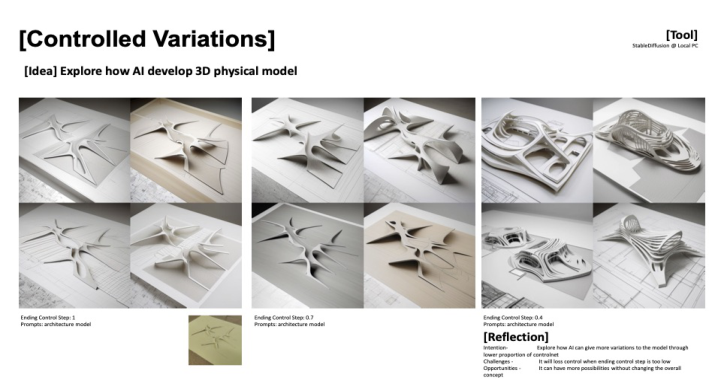
AI Role: AI transitions into the role of a Co-Designer. Here, AI collaborates closely with human designers to explore a range of design alternatives and refine forms, materials, structures, and other parameters. AI assists in generating and simulating multiple design iterations rapidly, providing insights into possible improvements or innovations (Mehdi, Narjes, 2024). Example: AI tools may suggest design ideas through abstraction and reinterpretation, engaging designers in a conversational design process (Cheung, Dall’Asta, 2024). These tools can stimulate various spatial configurations or experiential options based on user needs and contextual data, enabling designers to explore and evaluate a multitude of creative solutions quickly. This approach ensures that the resulting designs are aligned with the design intent and user-centered goals.
Figure 1: Conversational-AI exploration in the design process (source: Gao).
Phase 3: AI in Continuous Design Dialogue & AI as a Collaborative Team Member Goal: Finalise the design, ensuring that all technical, functional, and aesthetic aspects are integrated and optimised for user experience.
Focus: Detailed design development, prototyping, testing, and preparing for implementation and delivery.
180 Dall’Asta
AI Role: Continuous Design Dialogue: AI is integrated into the iterative design process in this final phase, providing continuous feedback and facilitating refinement. It supports human designers in optimising design elements, ensuring consistency, and addressing emerging challenges in real-time. AI tools foster ongoing communication between the designer and technology, offering suggestions for improvements based on performance metrics, user feedback, and new insights.
Collaborative Team Member: In this role, AI facilitates multidisciplinary teamwork, contributing to optimisation, testing, and final detailing. AI manages complex tasks like performance simulation, structural optimisation, and manufacturing feasibility, enhancing the collaborative effort and ensuring the final design is both innovative and practical.
Example: AI could simulate testing the functionality of different materials, recommend design tweaks based on energy efficiency, or help resolve structural concerns based on real-time feedback from team members, proving invaluable in the practical execution of the design.
RESULTS
Integrating Artificial Intelligence (AI) with Human-Centred Design (HCD) methodologies within architectural education has significantly enhanced creativity, user-centrism, and educational impact.
Outcomes From AI-Integrated Design Projects Utilising AI from the initial stages through to final delivery has markedly improved the quality and innovativeness of student projects. AI-enabled simulations, for instance, have facilitated the exploration of diverse design solutions (Cheung, Dall’Asta, 2024). These projects demonstrate enhanced functional efficiency and align more closely with users’ cultural backgrounds and needs, resulting in deeper user-centric outcomes (Norman, Draper, 2017).
Challenges in Aligning AI With HCD Despite these advances, integrating AI within the HCD framework presents challenges. There are concerns that AI could overshadow human creativity, requiring efforts to ensure that AI serves as an augmentative tool rather than a substitute for human input. Ethical considerations, including issues of data privacy and user consent, also pose significant challenges that must be addressed to preserve the integrity of HCD practices.
DISCUSSION AND CONCLUSION Over the past five years, the integration of Artificial Intelligence (AI) within the Human-Centered Design (HCD) framework in architectural education at XJTLU has evolved from initial experimentation with individual HCD phases to a more cohesive and integrated approach. This shift not only streamlines the AI integration process but also ensures that the insights derived from AI align more closely with the overarching user-centred goals of the design
Integrating Artificial Intelligence into the Human-Centered Design Process 181
process. By examining how AI tools can augment each phase of HCD, this research demonstrates that AI has the potential to profoundly enhance both creativity and operational efficiency within architectural design education.
The rapid pace of AI development has posed both opportunities and challenges. While AI has proven invaluable for boosting creative thinking and generating innovative design solutions, it has also raised important questions about the balance between human creativity and machine-driven processes. The key challenge is ensuring that AI remains a supportive partner to human designers rather than a replacement for human ingenuity. This challenge is mitigated through a structured approach to AI integration within the HCD framework, which ensures that user needs, iterative development, and human empathy remain central to the design process.
AI’s ability to analyse large datasets, simulate design scenarios, and predict environmental impacts has enhanced architectural practice by providing new opportunities for inclusive, sustainable, and user-centric design solutions. For example, AI can identify the needs of underrepresented groups and help design functional, culturally and contextually responsive spaces. Furthermore, AI’s predictive capabilities contribute to more sustainable building practices, aligning with global challenges such as climate change.
Despite these advancements, ongoing refinement of methodologies is necessary to ensure that AI tools continue to complement human creativity and user-centered principles. The fluid nature of AI technology requires adaptability. As such, the framework developed in this research must evolve to reflect new technological developments while retaining a strong focus on human needs and design ethics. This evolving dialogue between AI’s computational power and the empathetic design principles of HCD presents exciting prospects for both the academic and professional fields of architecture.
Looking ahead, future research should focus on expanding AI’s role in anticipating user needs rather than simply responding to them. This shift would push the boundaries of design education, establishing new benchmarks for how technology can be integrated into architectural practice. By continuously refining how AI and HCD work together, architectural education can better equip future designers to navigate a world that’s constantly evolving, where creativity, sustainability, and a focus on human needs are at the heart of good design.
ACKNOWLEDGMENT
The author would like to acknowledge XJTLU, Design School, Department of Architecture, MArch Programme.
REFERENCES
Cheung, L. H., Dall’Asta, J. C. (2023). Exploring a Collaborative and Intuitive Framework for Combined Application of AI Art Generation Tools in Architectural Design Process. In B. Muller (Ed.), Proceedings of the AISB Convention 2023. pp. 122–130.
182 Dall’Asta
Cheung, L. H., Dall’Asta, J. C. (2024). Human-computer Interaction (HCI) Approach to Artificial Intelligence in Education (AIEd) in Architectural Design. Eidos, 17(23), pp. 109–131. Ciecierski, T., Grabarczyk, P. (2021). The Architecture of Context and Context-
Sensitivity. Springer. Cross, N. (2007). Designerly ways of knowing. Springer. Frampton, K. (2001). Studies in Tectonic Culture. The MIT Press. Imdat, A., Prithwish, B. (2021). The Routledge Companion to Artificial Intelligence in Architecture. London: Routledge. IDEO. (2015). The Field Guide to Human-Centered Design. Design Kit, San
Francisco, Calif. Retrieved from: d1r3w4d5z5a88i.cloudfront.net/assets/ guide/Field%20Guide%20to%20Human-Centered%20Design_IDEOorg_ English-0f60d33bce6b870e7d80f9cc1642c8e7.pdf. Kelley, T., et al. (2016). The Art of Innovation: Lessons in Creativity from IDEO, America’s Leading Design Firm. Profile Books. Kore, A. (2022). Designing Human-Centric AI Experiences. Apress. Lawson, B. (2017). How Designers Think: The Design Process Demystified.
Architectural Press. Mehdi, S., Narjes, G. (2024). Artificial Intelligence in Performance-Driven Design: Theories, Methods, and Tools. Wiley. Myerson, J. (2004). IDEO: Masters of Innovation. Laurence King. Norman, D. (2013). The Design of Everyday Things. MIT Press. Norman, D. A., Draper, S. W. (2017). User Centered System Design: New Perspectives on Human-Computer Interaction. CRC Press. Retrieved from: dl.acm.org/citation.cfm?id=576915. Accessed 9 June 2019. Oxman, N. (2016). Age of Entanglement. Journal of Design and Science. https://doi.org/10.21428/7e0583ad Pask, G. (1976). Conversation Theory: Applications in Education and Epistemology.
Elsevier. Pask, G. (1976). Styles and Strategies of Learning. British Journal of Educational Psychology, 46(2), pp. 128–148. Rouse, W. B. (1991). Human Centered Design for Complex Systems. Wiley. Shneiderman, B. (2022). Human-Centered AI. Oxford University Press.
LISTED IN THE AHFE DIGITAL BOOKSTORE CATALOGUE
Explore the complete digital volume
Human Interaction and Emerging Technologies (IHIET-AI 2025): Artificial Intelligence and Future Applications
Read this individual research paper free through the original publisher, or explore the full digital proceedings book.
ISBN 978-1-964867-37-3
Explore this ISBN in the AHFE Bookstore ↗Listed in the July 2026 bookstore catalogue; search by ISBN to confirm current availability · Digital book purchase optional