Marilyn Meng, Yubo Wang, Qiuxia Zhang (2025). Directional Kinetic Characteristics of Drop Landing for Patients with Functional Ankle Instability. In: Healthcare and Medical Devices. AHFE Open Access, vol. 171, pp. 162–169. https://doi.org/10.54941/ahfe1006202
This study aimed to investigate the kinetic characteristics, potential injury risk factors, and energy dissipation strategies of bilateral lower limbs during multidirectional drop landings in patients with unilateral functional ankle instability (FAI). Methods: Fifteen male patients with unilateral FAI participated in this study. Kinetic data were synchronously collected using a Vicon infrared motion capture system and a Kistler 3D force platform during single-leg drop landings performed in three directions (forward/oblique/side, FL/OL/SL) for both the unstable and stable limbs. A repeated-measures analysis of variance was conducted to compare the kinetic performance across directions and between sides. Results: Peak vertical ground reaction force (PvGRF), the time to PGRF in the vertical and lateral directions, the loading rate, and hip joint torques were affected by direction (p < 0.05). Hip torques at initial contact were significantly influenced by limb side (p < 0.05), and an interaction effect between direction and side was observed for ankle plantarflexion torques (p < 0.05). Specifically, the unstable limb ankle plantarflexion torques in FL and OL were lower than those in SL, while on the stable limb, plantarflexion torques in FL were lower than in OL and SL. Furthermore, plantarflexion torques were greater in the stable limb than in the unstable limb during FL and OL (p < 0.05). Conclusions: OL exerted higher medial ankle impact forces, while SL, which combines forward and lateral loading components, placed higher adaptive demands on the unstable ankle. FAI patients relied on compensatory strategies, with increased dependence on the stable limb for energy dissipation during drop landing movements.
Functional Ankle Instability (FAI) is a prevalent sports-related condition that often develops as a sequela of ankle sprains. It is characterized by persistent pain and functional impairments, which increase the risk of recurrent injuries during daily and athletic activities. Without timely and effective rehabilitation, FAI may progress to chronic dysfunction, such as
Directional Kinetics of Drop Landing for Patients with FAI 163
joint degeneration or enduring instability. Consequently, comprehensive evaluation of neuromuscular control has become an integral component of the rehabilitation process for FAI patients.
Conventional static assessments are inherently limited, as they fail to accurately capture the demands of neuromuscular control in dynamic environments. In contrast, dynamic assessments provide a more realistic representation of real-world conditions, offering critical insights into patients’ adaptive and compensatory responses under sudden or complex physical demands. Among dynamic testing methods, drop landing holds particular significance in evaluating and rehabilitating FAI patients. Drop landings impose considerable demands on dynamic postural stability (Gribble et al., 2012), making them a robust framework for identifying neuromuscular deficits. As such, they have been widely adopted in biomechanical studies and clinical evaluations targeting lower extremity injuries (Durall et al., 2011).
In sports, participants frequently encounter open-ended scenarios and unpredictable external variables, such as interference from opponents or changes in the equipment trajectories. These uncertainties necessitate not only rapid decision-making but also heightened spatial awareness and positioning skills (Mao et al., 2024). Athletes must adjust their body posture to manage multidirectional dynamic impacts, placing distinct biomechanical and neuromuscular demands on lower limb joint coordination (Head et al., 2024; Wikstrom et al., 2005). For individuals with FAI, deficits in proprioception and neuromuscular control exacerbate challenges of managing multidirectional drop landings, increasing susceptibility to postural instability, inefficient energy dissipation, and a heightened risk of injury (Quatman et al., 2010).
Multiplanar drop landing stability is influenced by bilateral limb coordination (Legg et al., 2024). Research has revealed that neuromuscular control mechanisms often differ between limbs (Wikstrom et al., 2005). These differences manifest in distinct biomechanical characteristics (Hertel & Corbett, 2019), affecting landing cushioning patterns and compensatory strategies. Asymmetries between dominant and non-dominant limbs, prior injury history, and imbalances in load distribution patterns can disrupt landing stability, increase the risk of joint injuries, and alter bilateral load distribution (Saadat et al., 2023). However, most existing research has predominantly focused on unidirectional drop landings, such as forward or vertical movements (Meng et al., 2022). While these investigations have identified certain neuromuscular control deficiencies, they fail to adequately capture the complex demands of multidirectional movements encountered in real-world sports scenarios, limiting a comprehensive understanding of FAI-related functional impairments. Thus, assessing multiplanar drop landing stability is crucial for understanding the dynamic postural stability and neuromuscular control deficits in FAI patients.
Given this background, we hypothesize that FAI patients exhibit distinct kinetic characteristics during drop landings in different directions, with side-specific differences between the stable and unstable limbs and bilateral asymmetries in load distribution and compensatory strategies. By identifying compensatory movement patterns and biomechanical characteristics, our
study aims to inform targeted rehabilitation strategies, enhance ankle function, and reduce reinjury risk.
DATA COLLECTION Fifteen male participants with unilateral FAI were selected for the study (Age: 24.5±2.0 yrs, Height: 180.5±5.1 cm, Weight: 77.2±6.1 kg). Kinetic data were collected for both lower limbs with CAIT scores of 19.2±2.4 for the unstable limb, and 28.5±0.5 for the stable limb (p < 0.001).
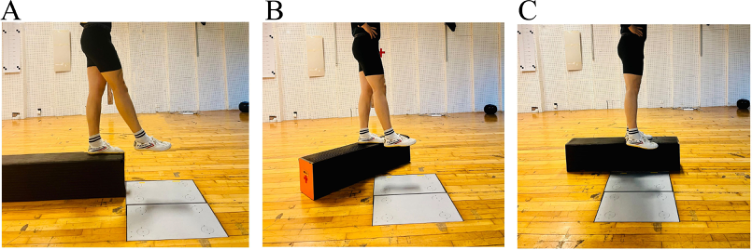
This study adhered to the principles outlined in the World Medical Association Declaration of Helsinki and was approved by the Ethics Committee of Soochow University. All participants were fully informed about the purpose and procedures of the study, and each provided written informed consent before participation. Participants refrained from intense physical activity within 24 hours before testing to avoid muscle fatigue. Before data collection, participants performed a 5-minute warm-up on a treadmill at 2.2 m/s. They then changed into standardized shorts and experimental shoes, and reflective markers were affixed by the experimenter. Drop landing tasks were performed from a 30 cm platform in three directions. FL, Forward landing directly onto the center of the force plate (Figure 1A). OL, Oblique landing at a 45
angle (Figure 1B). SL, Side landing directly lateral to the platform (Figure 1C). During each trial, participants maintained an upright posture, with hands on their hips, and landed on one limb (unstable or stable side). The tested leg landed naturally with toes striking first and pointing forward, maintaining balance for 3 seconds. Participants rested for 30 seconds between trials to minimize fatigue. At least three valid trials were recorded. Trials were excluded if participants failed to maintain balance for 3 seconds, used the non-tested leg for support, or exhibited excessive upper-body movement upon landing.
Figure 1: Schematic diagram of drop landing with three directions: FL(A), OL(B), SL(C).
All data collected from the Vicon system were processed using Visual 3D™ biomechanics analysis software (C-Motion, Inc). Data were smoothed with a fourth-order Butterworth zero-phase shift filter with a cutoff frequency of 6 Hz. Joint torques were calculated using inverse dynamics based on a six-degrees-of-freedom iterative Newton-Euler approach and fundamental
Directional Kinetics of Drop Landing for Patients with FAI 165
algorithms. The moment of initial ground contact (IC) was defined as the time point during drop landing when the ground reaction force (GRF) first exceeded 10 N. Joint flexion and extension torques were denoted by the symbols “+”(for flexion) and “−”(for extension). The Shapiro-Wilk test determined whether the data followed a normal distribution. For normally distributed data, repeated measures analysis of variance (ANOVA) examined the main effects of side (stable vs. unstable) and direction (FL, OL, SL), as well as interaction and simple effects. For variables that were not normally distributed, non-parametric tests such as the Mann-Whitney U test were employed. The significance level was set at α= 0.05.
RESULTS
PmGRF and PlGRF exhibited statistically significant differences influenced by the main effect of landing direction. Specifically, PmGRF was highest during SL, followed by OL and FL (p < 0.001), while PlGRF was highest during FL and lowest during SL (p < 0.001). The timing of PvGRF also demonstrated a significant effect of direction (p < 0.001), with SL showing the longest time to peak, indicating that PvGRF occurred latest during SL. Additionally, T_PlGRF was significantly affected by direction (p = 0.002), with FL showing the shortest time, indicating an earlier occurrence of PlGRF.
The LR of the lower limbs during single-leg drop landings varied significantly across directions (p = 0.029). The highest LR was observed during OL, while the lowest was recorded during SL (Table 1). These variations in LR are illustrated in Figure 1, which graphically represents the differences across landing directions.
At IC, hip joint torques differed significantly between the stable and unstable sides (p < 0.001), with the stable limb displaying higher hip extension torques. The main effects of direction and side, as well as interaction effects, influenced ankle joint torques. For the unstable limb, ankle dorsiflexion torques were lower in FL compared to SL (p = 0.001) and OL (p = 0.029). For the stable limb, ankle dorsiflexion torques in FL were lower than those in OL (p < 0.001) and SL (p < 0.001). Furthermore, during FL, the stable limb exhibited higher ankle dorsiflexion torques compared to the unstable limb (p = 0.03), with a similar pattern observed in OL (p < 0.001). At the PvGRF moment, the hip joint predominantly exhibited flexion. Knee and ankle joint torques were significantly influenced by direction (knee, p = 0.048; ankle, p = 0.004). The highest knee flexion and ankle dorsiflexion torques were recorded during SL, while the lowest occurred during FL. No other variables showed statistically significant differences (p > 0.05).
DISCUSSION
This study highlights differences in PmGRF, PlGRF, T_PvGRF, and T_PlGRF across various directions, underscoring the diverse strategies adopted by FAI patients to cope with drop landing impacts. PmGRF, a key indicator of
medial ankle loading during drop landings, is particularly critical. Elevated PmGRF levels are associated with increased ankle inversion forces, which may heighten the risk of lateral ligament injuries. The lateral collateral ligaments, being thinner and weaker compared to the medial ligaments, are more vulnerable to excessive inversion forces. Medial-lateral GRF not only contributes to excessive medial ankle loading but also plays a crucial role in generating shear forces at the ankle joint, the effects of shear forces on joint stability warrant attention. These forces act parallel to the joint surface and have been identified as key mechanical factors in ligamentous injuries, particularly in individuals with compromised neuromuscular control (Wright et al., 2000). Notably, increased shear forces exacerbate inversion torques, further challenging ankle stabilization and elevating the risk of lateral ligament injuries (Fong et al., 2007). Given that shear forces and PmGRF interact dynamically during landings, their combined effects should be considered when assessing the risk of lateral ankle sprains in FAI patients. This study found that PmGRF was highest during SL and lowest during FL, indicating that SL poses the greatest potential risk for lateral ankle injuries. The increased instantaneous forces and shear stresses during SL suggest a higher load on the joint, challenging the ankle’s stabilization mechanisms. OL follows SL in terms of risk, further highlighting the susceptibility of FAI patients to medial ankle loading in lateral-biased landings. These findings are consistent with those of Kros et al. (2016), who reported a tendency for increased medial ankle loading during balance and walking tasks among individuals with a self-reported history of ankle injuries. Similarly, Sonsukong et al. (2023) found higher risks of recurrent ankle sprains during SL and OL in patients with chronic ankle instability (CAI). The highest average gastrocnemius muscle activity during SL, as reported in their study, underscores the crucial role of the gastrocnemius in stabilizing the knee and ankle joints and absorbing landing forces.
At IC, FAI patients typically exhibit hip extension, knee flexion, and ankle plantarflexion. This hip-extension strategy aligns with Liu et al. (2023), who observed similar patterns in taekwondo athletes during spinning kick landings. In our study, higher hip extension torques were observed on the stable limb compared to the unstable limb, reflecting superior stability in controlling the center of gravity and mitigating vertical impact forces on the knee and ankle. However, differences were evident in ankle movement strategies. Unlike Liu et al., who reported dorsiflexion at IC in taekwondo athletes, this study found that FAI patients exhibited plantarflexion at IC. This discrepancy may result from differing biomechanical requirements: controlled drop landings in this study lacked initial momentum, encouraging plantarflexion to absorb impact forces and reduce ankle joint stress. Conversely, spinning kicks involve momentum transfer and specific body positioning that necessitate dorsiflexion to maintain balance and absorb forces (Schroeder et al., 2021). Notably, in our results, dorsiflexion was observed primarily at the PvGRF moment, indicating delayed neuromuscular responses in FAI patients.
Directional Kinetics of Drop Landing for Patients with FAI 167
Our study corroborated this by observing that, at IC, the hip extension moment of the stable limb was higher than that of the unstable limb. Furthermore, the hip joint on the stable limb transitioned from extension at IC to flexion at the PvGRF moment. This supports Kikumoto et al.’s findings, affirming the hip’s role as a compensatory strategy. During drop landing, the hip joint on the stable limb, especially at the IC moment, plays a more significant role in support and stability. However, while hip extension serves as a compensatory mechanism to mitigate ankle instability, it may inadvertently increase the load on the knee and ankle joints. Xu et al. (2023) observed that individuals consciously reduced knee and hip flexion angles during landing to maintain postural stability, leading to a “stiff” landing pattern. This approach can result in increased impact forces on the supporting leg during landing, thereby elevating the risk of lower limb injuries, including ACL injuries. Such findings suggest that while hip extension aids in compensating for ankle instability, it may also contribute to increased stress on the knee and ankle joints, potentially compromising overall lower limb stability. Furthermore, during drop landing, the lower limbs experience a distal-to-proximal loading pattern, with initial forces managed by the ankle before being transferred to the knee and hip joints. The ankle plays crucial roles in attenuating impact forces during drop landing.
Ishida et al. (2022) pointed out that anterior-posterior center-of-pressure shifts predominantly influence knee and ankle extensor torques, with knee flexion-extension torques being critical for maintaining balance. Similarly, Mornieux et al. (2021) demonstrated that as the angle of side-cutting movements increases, knee loading also rises, heightening the risk of ACL injuries. Our findings suggest that the increased ankle plantarflexion and knee flexion torques observed in both lower limbs of FAI patients during SL result from the larger landing angle. At IC, the hip extension strategy diminishes, transitioning to coordinated movements of the hip, knee, and ankle. Plantarflexion torque, in particular, plays a crucial role in cushioning and absorbing impact forces, thereby influencing the distribution of mechanical loads across the lower limb. These biomechanical adaptations align with previous studies that highlight the role of initial ankle joint angles in mitigating injury risks. Conversely, the stable limb compensated for this limitation by generating higher plantarflexion torques, particularly in FL and OL, where greater control over landing forces was required. These findings highlight a strategic redistribution of load, wherein the stable limb assumes a greater role in energy dissipation to mitigate excessive stress on the unstable limb. Additionally, directional variations in torque distribution patterns further underscore the biomechanical asymmetry in FAI patients. The results demonstrated that SL, which involves a combination of forward and lateral loading, imposed the highest adaptive demand on the unstable ankle, requiring greater reliance on compensatory strategies. In contrast, OL generated higher medial ankle impact forces, which may predispose FAI patients to excessive inversion moments, potentially increasing the risk of lateral ankle sprains. This directional dependency suggests that certain movement patterns, particularly those involving lateral loading components, could amplify instability-related risks in FAI patients.
These results emphasize the biomechanical asymmetries and compensatory adaptations in FAI patients, providing insights into their drop landing strategies. This understanding has potential applications in injury prevention, rehabilitation protocols, and the design of supportive footwear tailored to FAI patients.
CONCLUSION
This study highlights the effects of multidirectional drop landings on neuromuscular control in FAI patients and identifies potential compensatory strategies between unstable and stable limbs. Across all directions, shear forces emerge as a critical risk factor for lower limb injuries in FAI patients. SL poses the largest medial ankle impact forces, while OL demands simultaneous management of anterior and vertical loads, placing higher adaptive requirements on the unstable ankle. Deficits in proprioception exacerbate the risk of recurrent injuries, emphasizing the importance of rehabilitation strategies targeting sensory and motor functions. At IC, FAI patients predominantly utilize a hip-extension strategy for impact dissipation, which may serve as a compensatory mechanism to offset limb instability. However, as drop landing angles increase, the contribution of the hip diminishes, with knee and ankle flexion torques playing a more significant role. The stable limb demonstrates higher energy dissipation, reflecting compensatory movement patterns that favor reliance on the stable limb. This asymmetry underscores the need for interventions that address functional limitations in the unstable limb while optimizing compensatory mechanisms for effective injury prevention and functional recovery.
ACKNOWLEDGMENT
The authors are grateful for the support of the Sports Biomechanics Laboratory at the Physical Education and Sports School of Soochow University, as well as all the subjects and staff.
FUNDING This research was supported by the Jiangsu Provincial Department of Education under the Jiangsu Key Project of Philosophy and Social Sciences Research in Colleges and Universities (2023SJZD143) and the Postgraduate Research & Practice Innovation Program of Jiangsu Province (KYCX25_3518).
REFERENCES
Durall, C. J., Kernozek, T. W., Kersten, M., Nitz, M., Setz, J., & Beck, S. (2011).
Associations between single-leg postural control and drop-landing mechanics in healthy women. J Sport Rehabil, 20(4), 406–418. https://dx.doi.org/10.1123/ jsr.20.4.406 Gribble, P. A., Hertel, J., & Plisky, P. (2012). Using the Star Excursion Balance Test to assess dynamic postural-control deficits and outcomes in lower extremity injury: A literature and systematic review. J Athl Train, 47(3), 339–357. https://dx.doi.org/ 10.4085/1062-6050-47.3.08
Directional Kinetics of Drop Landing for Patients with FAI 169
Head, P. L., Kasser, R., Appling, S., Cappaert, T., Singhal, K., & Zucker-Levin, A.
(2024). The influence of jump-landing direction on dynamic postural stability following anterior cruciate ligament reconstruction. Clin Biomech (Bristol, Avon), 112, 106195. https://dx.doi.org/10.1016/j.clinbiomech.2024.106195 Hertel, J., & Corbett, R. O. (2019). An Updated Model of Chronic Ankle Instability.
J Athl Train, 54(6), 572–588. https://dx.doi.org/10.4085/1062-6050-344-18 Ishida, T., Samukawa, M., Endo, D., Kasahara, S., & Tohyama, H. (2022).
Effects of Changing Center of Pressure Position on Knee and Ankle Extensor Moments During Double-Leg Squatting. J Sports Sci Med, 21(3), 341–346. https://dx.doi.org/10.52082/jssm.2022.341 Kros, W., Keijsers, N. L. W., van Ochten, J. M., Bierma-Zeinstra, S. M. A., & van Middelkoop, M. (2016). Center of pressure during stance and gait in subjects with or without persistent complaints after a lateral ankle sprain. Gait Posture, 48, 24–29. https://dx.doi.org/10.1016/j.gaitpost.2016.04.022 Legg, L., Donahue, T., Peel, S., Piland, S., & Thorsen, T. (2024). Effects of
shoe collar height and limb dominance on landing knee biomechanics in female collegiate volleyball players. J Sports Sci, 42(3), 247–254. https://dx.doi.org/ 10.1080/02640414.2024.2327119 Liu, L., Jia, M., Ma, Y., Lin, S., Peng, Q., Xiong, J., & Zheng, W. (2023).
Biomechanics research on laterality effect between dominant and non-dominant during double roundhouse kick in the competitive taekwondo. Heliyon, 9(10), e20843. https://dx.doi.org/10.1016/j.heliyon.2023.e20843 Mao, M., Yin, Y., Luo, D., Liu, H., & Yu, B. (2024). Evaluation of dynamic postural control during single-leg landing tasks using initial impact force, landing leg stiffness and time to stabilisation. Sports Biomech, 23(2), 182–195. https://dx.doi.org/10.1080/14763141.2020.1833969 Meng, L., Kong, L., Kong, L., Zhang, Q., Shen, J., & Hao, Y. (2022). Effects of visual
deprivation on the injury of lower extremities among functional ankle instability patients during drop landing: A kinetics perspective. Front Physiol, 13, 1074554. https://dx.doi.org/10.3389/fphys.2022.1074554 Mornieux, G., Gehring, D., & Gollhofer, A. (2021). Is There a Sex Difference in Trunk Neuromuscular Control among Recreational Athletes during Cutting Maneuvers? J Sports Sci Med, 20(4), 743-750. https://dx.doi.org/10.52082/ jssm.2021.743 Quatman, C. E., Quatman-Yates, C. C., & Hewett, T. E. (2010). A ‘plane’
explanation of anterior cruciate ligament injury mechanisms: A systematic review. Sports Med, 40(9), 729–746. https://dx.doi.org/10.2165/11534950-000000000- 00000 Saadat, S., Bricarell, K. M., & Gillette, J. C. (2023). Dual tasking increases kinematic and kinetic risk factors of ACL injury. Sports Biomech, 1–14. https://dx.doi.org/ 10.1080/14763141.2023.2271888 Schroeder, L. E., Tatarski, R. L., & Weinhandl, J. T. (2021). Increased Ankle Range of
Motion Reduces Knee Loads During Landing in Healthy Adults. J Appl Biomech, 37(4), 333–342. https://dx.doi.org/10.1123/jab.2020–0281 Sonsukong, A., Vacshalathiti, R., Kiratisin, P., Richards, J., Fong, D. T. P., & Sinsurin, K. (2023). Ankle Biomechanics During Multidirectional Landings in Athletes With Chronic Ankle Instability. Foot Ankle Spec, 19386400231208522. https://dx.doi.org/10.1177/19386400231208522 Wikstrom, E. A., Tillman, M. D., Smith, A. N., & Borsa, P. A. (2005). A new force-
plate technology measure of dynamic postural stability: The dynamic postural stability index. J Athl Train, 40(4), 305–309.
LISTED IN THE AHFE DIGITAL BOOKSTORE CATALOGUE
Explore the complete digital volume
Healthcare and Medical Devices
Read this individual research paper free through the original publisher, or explore the full digital proceedings book.
ISBN 978-1-964867-47-2
Explore this ISBN in the AHFE Bookstore ↗Listed in the July 2026 bookstore catalogue; search by ISBN to confirm current availability · Digital book purchase optional