Jelena Lezdkalne (2025). Tracking Human Factor Recognition in Occupational Accident Investigations: A 10-Year Review from the Quarrying and Aggregates Sector. In: Human Systems Engineering and Design (IHSED2025): Future Trends and Applications. AHFE Open Access, vol. 198, pp. 28–35. https://doi.org/10.54941/ahfe1006758
Occupational accident investigations are a critical component of safety management systems, particularly in high-risk industries such as quarrying and aggregates. Human factors are widely recognized in academic and applied safety literature as major contributors to workplace incidents. Yet, their explicit recognition within organization-led investigations in high-risk operational environments remains limited. Despite growing awareness, many investigations still lean toward identifying technical, procedural, or rule-based failures, leaving behavioural and cognitive contributors underexplored. This study assesses how human factors are recognized, addressed and interpreted in internal accident investigation reports produced over a ten-year period within a single high-risk industrial company operating in the quarrying and aggregates sector. It examines whether the visibility, frequency, and analytical depth of human factor mentions have developed over time, and evaluates the extent to which investigation practices reflect evolving awareness of cognitive and systemic contributors, beyond general attributions like “human error.” A retrospective review was conducted on 150 formal accident investigation reports generated between 2014 and 2024 by a company operating in the quarrying and aggregates sector. Reports were examined to determine whether human factors were referenced - explicitly (e.g., “fatigue,” “communication failure”) or implicitly through behavioural descriptions. Reports that included human factor references were further examined to identify whether specific categories were cited and whether the analysis extended beyond general terms like “human error” to explore underlying causes. A structured checklist was used to ensure consistency in data collection, recording binary presence/absence data and brief explanatory notes. No qualitative coding was applied. Frequency counts were then compiled by year to observe trends in the visibility and analytical depth of HF mentions across the ten-year period. The analysis showed that human factors were mentioned in 60% of reports across the 10-year period. Of these, only 24% offered any detail beyond vague labels such as “human error” or “personal issue”. There, a range of human factor categories was identified, indicating that multiple behavioural and cognitive aspects were recognized to some extent. However, most of these references focused on the actions or decisions of frontline operators, with significantly fewer mentions of supervisory oversight, team-level interaction, or broader organizational influences. Report frequency varied slightly by year, but the proportion of reports recognizing HF remained largely static. This study highlights that, within the examined company, human factors remain underrepresented in formal accident investigations. Over a ten-year period, there was no notable progress in the depth or frequency of HF inclusion, despite increasing attention to the topic in industry discourse. These findings suggest that changes in safety culture and investigative practices require more than awareness and interventions. While limited to a single company, the results may reflect broader patterns within the sector and warrant further comparative research.
Quarrying and aggregates sector, focused on extracting non-metallic materials such as stone, sand, and gravel, remains a cornerstone of the European Union’s construction and infrastructure development. Sector employed 371000 people in European Union in 2022 and generated 173.6-billion-euro turnover for the same period (Eurostat, 2025). Despite its economic significance, industry operates under a unique set of high-risk conditions. Work is often carried out in remote locations, exposed to variable weather conditions, persistent dust, and continuous interaction with heavy mobile equipment. Operations such as drilling,
Tracking Human Factor Recognition in Occupational Accident Investigations 29
blasting, hauling, and crushing are not only physically demanding but are performed in environments with unstable ground, intense vibration, and mechanical hazards from crushing systems (Aliabadi et al., 2019; Bonsu et al., 2016; Ersoy, 2013). It is also recognized that mining has numerous critical problems, such as safety issues, low processing and recycling efficiencies, and high energy consumption requirements (Bonsu et al., 2016; Jiskani et al., 2022). These factors contribute to the sector’s classification as one of the most hazardous in Europe. In 2022 alone, the EU recorded 7637 non-fatal accidents and 44 fatalities (Eurostat, 2025), which demonstrate that serious risks remain and demand thorough preventive actions.
Accident investigation is essential in safety management, aiming to identify causes and prevent recurrence of similar accidents (Reason, 1997; Lezdkalne, 2025), and effective investigations contribute to organizational resilience by uncovering latent risks, informing corrective actions, and promoting a proactive safety culture (Hollnagel, 2014). However, the value of these investigations depends heavily on the depth of analysis and the organizational context in which they are conducted (Dekker, 2002; Hollnagel, 2014; Reason, 1997).
While numerous studies have examined the physical, environmental, and operational hazards associated with quarrying and aggregates work (Aliabadi et al., 2019; Ersoy, 2013; Groves et al., 2007), there is a lack of research focusing on how human factors are actually addressed within the internal processes of occupational accident investigation in this high-risk industry.
Therefore, the aim of this study was to analyse how human factors are represented in occupational accident investigation reports. For this purpose, a set of 150 formal accident investigation reports produced between 2014 and 2024 within a single high-risk industrial company operating in the quarrying and aggregates sector was reviewed. The analysis focused on how human factors were identified and described within these reports.
METHODOLOGY
The research employed a document-based qualitative review of internal occupational accident investigation reports. The study analysed 150 formal occupational accident investigation reports produced between 2014 and 2024 by a single multi-national company operating in the quarrying and aggregates sector in EU countries. The selected company operates multiple quarries and is representative of typical industry conditions.
The scope of this review was limited to completed accident investigation reports for lost time injuries classified as potentially fatal incidents. Other types of incidents, such as first aid cases, near misses, or property damage events, incidents or accidents not classified as potentially fatal were excluded from the analysis to maintain consistency in the severity level and investigative depth of the reports. Additionally, no fatal incidents were reported for the company during the 2014–2024 period, and therefore the findings do not reflect investigation practices related to fatal accidents. The reports covered a wide range of incident types and analysed documents are part of the company’s routine safety management system and were authored by internal safety professionals using a standardized investigation template.
30 Lezdkalne
Each report was reviewed using a structured checklist designed to identify: the presence or absence of human factor reference, and explicitness of such references. For each report, data were recorded in binary form (yes/no) regarding the presence of human factor content, along with brief qualitative notes summarizing any categories or terminology used. Additionally, frequency counts were compiled to track visibility and trends year-over-year.
Registered investigation reports did not contain any personal data, but in order to maintain confidentiality and comply with ethical research practices, all other identifying information such as locations, specific incident details was anonymized prior to analysis. The research was conducted with internal organizational approval as part of a safety improvement initiative.
RESULTS
Initial Classification of Accident Causes Before analysing the presence and depth of human factor considerations, all 150 accident investigation reports were initially screened to determine the primary cause of each incident as stated by the investigation teams.
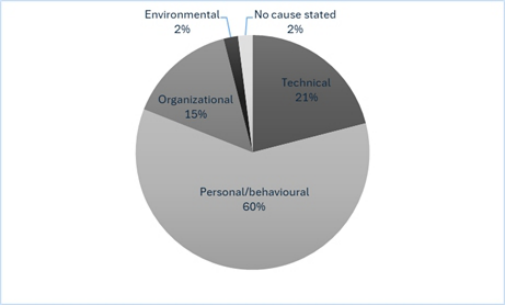
Causes were categorized into four main types: technical, personal (behavioural), organizational, and environmental. Technical causes were cited in 21% of the reports (n = 32). Personal or behavioural causes were cited in 60% of the reports (n = 90). Organizational causes were identified in 15% of the reports (n = 22), whereas environmental causes, such were cited in 2% of the reports (n = 3). In 2% of the cases (n = 3), no primary cause was stated. These reports either lacked sufficient detail or did not include a final cause determination. It is likely that these investigations were incomplete or prematurely closed. Due to the absence of clear causative information, these 3 reports were excluded from the human factors analysis. The initial breakdown of accident causation is presented in Figure 1, which illustrates the proportional distribution of reported causes and highlights the dominance of person-related factors in incident attribution.
Figure 1: Distribution of primary accident causes in investigation reports (n = 150).
Tracking Human Factor Recognition in Occupational Accident Investigations 31
Classification of Human Factor References Following the identification of human factor mentions in 90 out of 150 analysed reports, further examination was conducted to categorize the specific types of human-related issues cited in the investigations. These references were thematically grouped into following five categories by the layout of investigation protocol: improper or wilful behaviour; lack of competence; lack or improper use of protective equipment; lack or improper use of tools by individual; psychophysical condition of the individual.
It is important to note that some of the analysed reports cited more than one human factor category, emphasizing the fact that workplace incidents often result from a combination of behavioural, skill-based, and situational shortcomings rather than a single isolated error. For example, lack of competence and improper tool use were occasionally listed together, might indicate that the choice of improper tool or unsafe working method stemmed from lack of competence or, namely, training necessary for performance of tasks by employee. Also, lack of competence was cited alongside improper or wilful behaviour, suggesting that it might stem from insufficient training, unclear expectations, or inadequate supervision. In several reports, psychophysical conditions were mentioned together with either improper use of personal protective equipment or wilful behaviour. This combination might raise a question if such behaviour was influenced by cognitive overload, emotional strain, or physical exhaustion, which is consistent with known risk factors in the quarrying and aggregates sector 741.
To visually summarize the frequency and distribution of these human factor categories, a quantitative breakdown of their mentions across 90 reports was conducted. Each time a category was cited, it was counted individually, regardless of whether it appeared alone or alongside others, which allowed to count which types of human factor issues were most commonly identified by investigators. The resulting chart (Table 1) presents the total number of mentions for each category.
Table 1: Frequency of human factor categories referenced in accident reports.
Table available in the original PDF paper.
Human Factor Category Number of Mentions Improper or wilful behaviour 9 Lack of competence 24 Lack or improper use of protective equipment 43 Lack or improper use of tools by individual 21 Psychophysical condition of the individual 16
The most frequently cited human factor category was lack or improper use of protective equipment (PPE), with 43 mentions, representing nearly half of all human factor references. This strong emphasis on PPE usage may reflect the influence of compliance-driven safety protocols where visible, enforceable rules are easier to document and assess.
32 Lezdkalne
However, while PPE-related violations are important, their prevalence may suggest a tendency to focus on observable surface-level issues rather than investigating deeper systemic or cognitive contributors.
The second most cited category was lack of competence, noted 24 times, pointing to a recurring concern about insufficient training, knowledge, or skill in execution of tasks, which is crucial within quarry and aggregates sector. Interestingly, this category also appeared in reports that simultaneously cited improper tool use or wilful behaviour, implying that some investigators linked skill deficits with intentionally unsafe or practices.
Lack or improper use of tools by individual was registered 21 times, which likely reflect either poor procedural adherence or insufficient understanding of task requirements, again raising questions about training quality and supervision.
Improper or wilful behaviour was mentioned in only 9 of 90 reports that included human factor references. Considering that blame-oriented explanations have historically dominated workplace investigations, this low frequency is notable. It may suggest a conscious move away from traditional “blame the worker”narratives, reflecting a growing awareness that accidents are rarely the result of a single bad decision or intentional disregard for rules (Heraghty et al., 2020; Zavaglia, 2023). At the same time, the low number of blame-related references could also reflect a more cautious approach to documentation. In some cases, investigators may avoid labelling behaviour as “wilful”due to concerns about legal consequences or damaging relationships within the workforce. It is also possible that blame still exists in practice, for example, through disciplinary actions, but is simply not captured in writing.
Finally, psychophysical condition of the individual, was noted in 16 reports. While this is lower than other categories, its presence demonstrates some awareness of cognitive and psychological influences. Given the physically demanding and repetitive nature of quarry work as well as time pressure to produce certain amount of products for clients, this area remains underrepresented and may benefit from greater attention in future investigations.
Longitudinal Analysis of Human Factor Mentions To explore how human factors were considered across the ten-year dataset, 147 eligible reports were reviewed chronologically based on their year of completion.
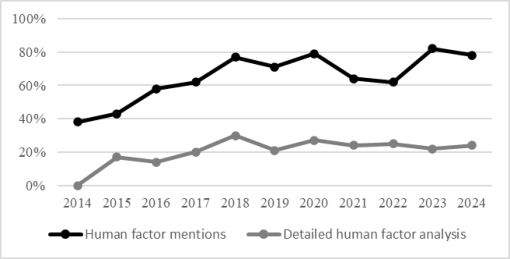
The analysis focused on two key indicators: (1) whether a report included any mention of human factors, and (2) whether the human factor analysis went beyond surface-level categorization to include deeper causal exploration. These data were then expressed as annual proportions and visualized in a line chart (Figure 2), illustrating how both awareness and analytical quality have evolved over time.
As shown in Figure 2, the proportion of reports that included any reference to human factors fluctuated moderately over the period, but did not demonstrate a strong upward trend. Early years (2014–2016) exhibited low inclusion rates, with human factors mentioned in fewer than 50% of
Tracking Human Factor Recognition in Occupational Accident Investigations 33
reports. A notable increase appears around 2017–2019, where human factor mentions exceeded 60%, but this was not sustained uniformly in following years. In the final years of the period (2022–2024), the percentage stabilized closer to the overall average (∼61%), suggesting modest improvement but not a consistent year-on-year increase.
Figure 2: Trends in human factor recognition and analytical depth in accident investigations.
More revealing, however, is the trend in depth of analysis. While surface- level mentions remained common, the share of reports that engaged in substantive human factor analysis (e.g., linking behaviour to training gaps, supervision failures, or procedural ambiguity) remained low across the decade.
Overall, the data indicate that while human factor considerations have become more visible in incident documentation over the ten-year period, the quality and systemic analysis remains inconsistent.
DISCUSSION
The findings of this study offer both encouraging signals and critical information into the state of human factor integration within accident investigations in the quarrying and aggregates sector.
First, the relatively high proportion of reports (60%) referencing human factors suggests that investigators are aware of the importance of human contribution to workplace incidents. However, this surface-level visibility does not necessarily translate into analytical and systemic outcomes.
Despite consistent references to human factors related categories such as PPE use and competence, most reports remained descriptive rather than analytical. Investigators frequently identified a behaviour or omission (e.g., “did not wear protective equipment”), but did not ask why that behaviour occurred or explored contextual factors such as work environment, training adequacy, or supervisory practices.
Importantly, the analysis also revealed that over the ten-year period, there was no strong longitudinal trend toward increasing human factor recognition, which could suggest that while awareness of human factors may have grown informally or rhetorically within the company, it has not yet been
34 Lezdkalne
fully operationalized into investigation practice. This gap between awareness and application remains a core issue in organizational learning and safety improvement.
Several factors may provide explanation, such as time pressure, lack of investigative training, and template-driven reporting tools that may all limit the ability of safety personnel to engage with human factor concepts in a meaningful way. Additionally, organizational culture, particularly in high- risk, production-driven industries, may still prioritize quick attribution and closure over reflective analysis.
The dominance of behavioural categories such as PPE misuse also draws attention. While PPE compliance is undoubtedly important, its overrepre- sentation could indicate a bias toward visible and easily documentable infractions. More latent contributor, such as decision-making context, cognitive load, communication failures, or unclear procedures, were referenced far less frequently, despite their critical role in accident causation.
Although this study focuses on a single company, its results align with wider research indicating that incorporating human factors into practical accident investigations continues to be a widespread challenge across various industries.
Future studies could explore how these findings apply across different sectors, investigate the practical challenges investigators face in incorporating human factors, and evaluate the effectiveness of specific methods or training aimed at improving the depth of causal analysis.
CONCLUSION
This ten-year review of occupational accident investigation reports from a quarrying and aggregates company reveals a gap between the recognition of human factors and their meaningful analysis in practice.
While human factor references were present in the majority of reports, they often remained superficial, categorized within predefined behavioural labels without deeper exploration of systemic, cognitive, or organizational contributors. Only a small subset of investigations demonstrated substantive causal reasoning.
The absence of strong improvement over time suggests that awareness alone is insufficient to drive change in investigative practices.
While this study is limited to a single company, its findings aligns with broader research showing that the integration of human factors into real- world investigations remains a challenge across industries.
ACKNOWLEDGMENT
The author gratefully acknowledges the support and cooperation of the participating company for granting access to internal investigation reports and for their openness to critical evaluation of safety practices.
This publication was prepared with the support of the project “Internal and external consolidation of the University of Latvia” (Project No. 5.2.1.1.i.0/2/24/I/CFLA/007), implemented within the framework of the European Union Recovery and Resilience Facility under reform direction
Tracking Human Factor Recognition in Occupational Accident Investigations 35
5.2 “Ensuring the change of the higher education governance model,” reform 5.2.1 “Reform of Excellence and Governance in Higher Education and Science,” and investment 5.2.1.1.i “Research, Development and Consolidation Grants,” second round “Consolidation and Governance Change Implementation Grants,” Grant No. ESS2024/465d_91.
REFERENCES
Aliabadi, M. M., Aghaei, H., Kalatpuor, O., Soltanian, A. R., Nikravesh, A. (2019).
Analysis of the severity of occupational injuries in the mining industry using a Bayesian network, Epidemiology and Health Volume 41. https://doi.org/10.4178/ epih.e2019017 Bonsu, J., Van Dyk, W., Franzidis, J. P., Petersen, F., & Isafiade, A. (2016). A systems approach to mining safety: An application of the Swiss Cheese Model, Journal of the Southern African Institute of Mining and Metallurgy Volume 116(8). https:// doi.org/10.17159/2411-9717/2016/v116n8a10 Dekker, S. (2002). Reconstructing human contributions to accidents: The new view
on error and performance, Journal of Safety Research Volume 33(3). doi: 10.1016/ S0022-4375(02)00032-4. Ersoy, M. (2013). The role of occupational safety measures on reducing accidents in marble quarries of Iscehisar region, Safety Science Volume 57. https://doi.org/ 10.1016/j.ssci.2013.03.005 Eurostat (2025) Enterprises by detailed NACE Rev. 2 activity and special aggregates.
https://doi.org/10.2908/SBS_OVW_ACT Eurostat (2025) Fatal Accidents at work by NACE Rev. 2 activity. https://doi.org/10.
2908/HSW_N2_02 Eurostat (2025) Non-fatal accidents at work by NACE Rev.2 activity and sex. https:// doi.org/10.2908/HSW_N2_01 Groves, W. A., Kecojevic, V., & Komljenovic, D. (2007). Analysis of fatalities and
injuries involving mining equipment, Journal of Safety Research Volume 38(4). https://doi.org/10.1016/j.jsr.2007.03.011 Heraghty, D., Rae, A. J., & Dekker, S. W. A. (2020). Managing accidents using retributive justice mechanisms: When the just culture policy gets done to you, Safety Science Volume 126. https://doi.org/10.1016/j.ssci.2020.104677 Hollnagel, E. (2014). Safety-I and Safety-II: The Past and Future of Safety
Management. 1st ed. CRC Press, London, p. 200. doi: 10.1201/9781315607511. Ismail, S. N., Ramli, A., & Abdul Aziz, H. (2021). Research trends in mining accidents study: A systematic literature review, Safety Science Volume 143. https:// doi.org/10.1016/j.ssci.2021.105438 Jiskani, I. M., Yasli, F., Hosseini, S., Rehman, A. U., & Uddin, S. (2022). Improved
Z-number based fuzzy fault tree approach to analyze health and safety risks in surface mines. Resources Policy Volume 76. https://doi.org/10.1016/j.resourpol. 2022.102591 Lezdkalne, J. (2025). Integrating human factors into occupational accident investigation: A literature review of methodologies and their applications. Estonian University of Life Sciences, Agronomy Researce Volume 23. https:// doi.org/10.15159/ar.25.036. Reason, J. (1997) Managing the Risks of Organizational Accidents. Ashgate, London. Zavaglia, S. (2023). The 5 principles of human performance: A contemporary
update of the building blocks of human performance for the new view of safety, Professional Safety Volume 68(7).
LISTED IN THE AHFE DIGITAL BOOKSTORE CATALOGUE
Explore the complete digital volume
Human Systems Engineering and Design (IHSED2025): Future Trends and Applications
Read this individual research paper free through the original publisher, or explore the full digital proceedings book.
ISBN 978-1-964867-74-8
Explore this ISBN in the AHFE Bookstore ↗Listed in the July 2026 bookstore catalogue; search by ISBN to confirm current availability · Digital book purchase optional