Zhongting Wang, Yue He, Xiqiang Liu, Zhao Chaoyi, Lei Jiang, Hongzhan Chen, Linghua Ran (2026). Effects of Visual Display Terminal Refresh Rate on Game Performance and Visual Fatigue of Casual Players. In: Safety Management and Human Factors. AHFE Open Access, vol. 227, pp. 28–35. https://doi.org/10.54941/ahfe1007914
Previous studies have shown that high-level gamers benefit from high refresh rates, but prolonged monitor use induces visual fatigue. However, research gaps remain regarding casual players. This study investigates the impact of screen refresh rates (60Hz, 144Hz, 240Hz, 360Hz) on the performance and visual fatigue of 32 casual players. Participants completed three typical FPS game tasks (shooting, tracking, CSGO) under different conditions, with both objective and subjective indicators collected. The results indicate that increased refresh rates improved performance to a certain extent, with 240Hz yielding the best results. For visual fatigue, significant differences were observed in the objective blink rate across conditions, although subjective fatigue scores remained unchanged. In summary, higher refresh rates enhance performance for casual gamers, while lower rates pose higher fatigue risks. Notably, 240Hz balances optimal performance with visual comfort, making it the optimal choice. These findings not only optimize the performance and visual experience for casual gamers, but also provide empirical support for mitigating visual fatigue and health risks associated with prolonged screen use. Based on these results, this study can be further translated into targeted safety management guidelines for diverse usage scenarios (e.g., home entertainment, casual gaming, remote work), aiming to promote a healthy human-device interaction experience.
In 2022, esports were officially included as a competitive event at the Hangzhou Asian Games, catalysing rapid development across the esports industry. According to the latest research data from IDC (International Data Corporation), China’s esports monitor market demonstrated significant growth in the fourth quarter of 2024, with shipments increasing by 62.9% year-on-year. Within this segment, products featuring refresh rates of 180Hz or higher captured 75.2% of the market share. IDC forecasts that China’s esports monitor market will maintain its growth trajectory throughout 2025, with annual shipments projected to increase by 12.4% year-on-year (IDC, 2025).
Effects of Visual Display Terminal Refresh Rate on Game Performance 29 As a key parameter of esports monitors, refresh rate refers to the number of times a display updates images per second, measured in Hertz (Hz) (Li et al., 2025). Compared with monitors with a 60Hz refresh rate, those with a 120Hz or higher refresh rate can present more frames per second, which can effectively reduce the visual difference between adjacent frames (Leclair, 2022), thereby minimizing motion blur and enhancing the smoothness of dynamic images.
Previous studies demonstrated that increasing the refresh rate leads to improved task performance. Claypool et al. (2007) reported that actions that require precise, rapid response, such as shooting, are greatly impacted by degradations in frame rates, while actions with lower precision and response requirements, such as moving, are more tolerant of low frame rates in first- person shooter (FPS) games. In a shooting game that evaluated tracking and hitting skills, target tracking completion time decreased with higher refresh rates for highly skilled players (Spjut et al., 2019). Huhti (2019) pointed out that players’ skill level is a core variable affecting their ability to obtain a smooth gaming experience on high-refresh-rate monitors. Players with a certain competitive level can perceive the enhanced visual smoothness brought by high refresh rates, while casual players are relatively insensitive to the impact of refresh rate changes on gaming experience. Murakami et al. (2020) found that refresh rate affects simple reaction time and argued that high-refresh-rate monitors offer greater advantages in shooting esports competitions.
The potential effect(s) of digital device use on eye health have been of scientific interest over 30 years (Dain et al., 1988). It remains a prominent and increasingly relevant topic (James et al., 2023). In recent years, high- refresh-rate smartphones and computer products have become increasingly prevalent (Leclair, 2022). To our knowledge, no prior relevant studies have been reported on the visual fatigue associated with high-refresh-rate e-sports monitors. Theoretically, higher refresh rates yield smoother image display and enhanced visual experiences; conversely, low refresh rates may cause image flickering or instability, compromise ocular comfort and potentially induce dizziness (James et al., 2023). The human eye can perceive flicker frequencies around 50Hz (Huhti, 2019). Early research by Jaschinski et al., based on CRT display technology, found that at lower refresh rates of 55–90Hz, monocular visual accommodation decreased by 0.06D on average, median blink duration shortened by 6%, and average blink interval lengthened by 15%. The Video Electronics Standards Association (VESA) recommends a minimum refresh rate/frequency of 75Hz to minimise flicker independent of display brightness levels (Parihar et al., 2016). Flicker affects the constancy of visual space. Compared to higher-frequency flickering targets, lower- frequency flickering targets are more easily detected during saccadic eye movements and may potentially distort spatial perception. Therefore, it is recommended that Visual Display Terminal (VDT) refresh rates be set to exceed 120 Hz (Bridgeman,1995).
To sum up, previous studies have shown that players’ skill levels constitute an important factor influencing how refresh rates affect gaming performance. Highly skilled gamers can benefit from higher refresh rates (Spjut et al., 2019;
Huhti, 2019), yet studies exploring the impact of refresh rates on average players’ performance remain limited (Qin et al., 2024). Furthermore, early research predominantly attributed visual fatigue to image flickering at low refresh rates. However, with advances in display technology, screen refresh rates can now reach 240Hz or higher. Whether higher refresh rates can reduce the incidence of visual fatigue requires further validation. To address these issues, the present study aims to determine whether higher display refresh rates enhance gaming performance for common players and explores the impact of different refresh rates on visual fatigue.
METHOD
Design A within-group experimental design study was conducted using a commercial first-person shooting game platform to investigate players’ performance at display refresh rates of 60Hz, 144Hz, 240Hz and 360Hz. The dependent variables as follows:
(1) Game performance: reaction time (time from target appearance to shooting) for shooting task, Accuracy (ratio of target hits to total clicks) for the tracking task, and kill-death ratio (K/D ratio) for the CSGO task. (2) Visual fatigue: including blink rate and subjective visual fatigue. Blink rate serves as a key parameter reflecting ocular fatigue. Research indicates that increased blink rate correlates with visual fatigue (Chen et al., 2014; Guo et al., 2024; Nie et al., 2017). This study employs real- time electrooculography (EOG) recording during experimental tasks, followed by data processing to calculate blink rate.
Subjective visual fatigue assessment utilised the Subjective Visual Fatigue Scale developed by Sheedy et al. (2003), which has been adopted in multiple studies (Kim et al., 2013; Kalra et al., 2023). This scale evaluates individually perceived visual discomfort symptoms including ache, strain, headache, double vision, blur, tearing and burning, using a five-point rating scale (0 = no symptoms, 4 = severe). Participants reported the severity of each symptom based on their actual feelings. The sum of the scores to the symptoms was taken as the subject’s psychological visual fatigue.
Tasks Existing studies have shown that in fast-paced first-person shooter (FPS) games, low refresh rates can cause visual artefacts such as motion blur and stuttering, thereby impairing the player’s performance (Claypool et al., 2007). Therefore, this study selected two operational tasks from FPS games as short-duration experimental tasks: a shooting task (Aimlab Spider Shooting: 10 minutes) and a tracking task (Kovvak: 15 minutes). Task duration is a key factor influencing the onset of visual fatigue (Yin et al., 2022). A 90-minute first-person shooter game Counter-Strike: Global Offensive (CSGO) was additionally selected as the prolonged experimental task.
Effects of Visual Display Terminal Refresh Rate on Game Performance 31 Subjects
Given that players of first-person shooter (FPS) games are predominantly male, 32 casual gamers (30 males, 2 females) with an average age of (23.9 ± 2.6) years were recruited as participants for this experiment. Participant inclusion criteria comprised: (1) with normal or corrected-to-normal vision and normal color vision (2) FPS game players but not professional gamers or esports competitors (3) right-handedness.
To mitigate external factors affecting data accuracy, participants were instructed to ensure adequate sleep within 24 hours prior to the experiment and abstain from consuming alcoholic or caffeinated beverages. Before commencing the experiment, participants were informed of the study’s objectives, potential risks, and their right to withdraw at any time. All participants signed informed consent forms after receiving full disclosure and received corresponding monetary compensation upon completion.
Apparatus, Environment and Procedure Apparatus. Eye movement data were collected using the ocular module of the MP150 multi-channel physiological recorder (sampling rate: 2000Hz) manufactured by BIOPAC, Inc. (USA). Stimuli were presented via a refresh- rate-adjustable gaming monitor (Alienware AW2521H, supporting up to 360Hz refresh rate with 1ms response time). All other screen parameters (brightness, resolution, etc.) remained constant throughout the experiment. The host system comprised an HP ENVY Desktop, equipped with a gaming mouse and keyboard.
Environment. Lighting constitutes a significant factor influencing visual fatigue (Xu et al., 2020), with illuminance exerting the most pronounced effect (Yu et al., 2024), while unsuitable colour temperatures may induce visual discomfort (Zhang et al., 2020). To investigate the patterns of display terminal refresh rate’s impact on visual fatigue, experiments were conducted within a controlled optical laboratory. The average horizontal illuminance at the work surface was maintained at 450 lux, with a colour temperature of 5000 K.
Procedure. For each task, the experiment comprised two phases: a 5-min practice phase to get the participants familiarized with study procedures and a test phase (4 refresh rate levels). The order of refresh rate within each task was counter-balanced among subjects to minimize the ordering effect. The shooting and tracking tasks took 1.5 hours to complete within one day. The CSGO task took 2 hours per refresh rate to complete, participants were required to complete the four conditions (one per refresh rate) within the same fixed time slot (e.g. 9:00–11:00) over four days.
RESULTS
Data Analyses The distribution of all the data is tested. If the data follow a normal or approximately normal distribution and meet the assumptions for analysis of variance (ANOVA), ANOVA is employed; if the data do not satisfy the normal distribution assumption, nonparametric tests are used.
Gaming Performance
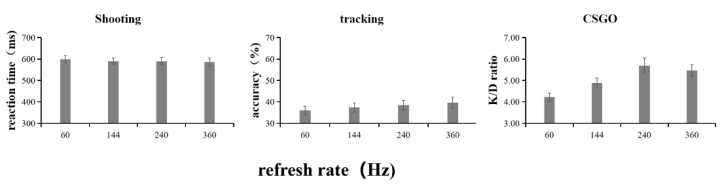
Figure 1 shows the game performance as a function of refresh rate. The results revealed a significant effect of accuracy and K/D ratio for tracking and CSGO task(F (3,11) = 5.261, p = 0.026, ηp² = 0.32 for tracking; F (3,21) = 8.017, p = 0.013, ηp² = 0.53 for CSGO). The results of the post hoc comparison test showed that the performance at 60 Hz was marginally significantly different from that at 240Hz for tracking, and the performance at 60 Hz was marginally significantly different from that at 144Hz, 240Hz and 360Hz for CSGO. Thus, the reaction time did not reach significant for shooting (F(3,11) = 0.731, p = 0.541, ηp² = 0.06).
Figure 1: The performances for the four refresh rates in the three types of tasks.
Visual Fatigue Blink rate
Table 1 presents the results of ANOVA on blink rate. The main effect of refresh rate and time were found significant for all tasks, F(3,440) = 18.077, p < 0.001, ηp² = 0.11(refresh rate), F(9,440) = 24.177, p < 0.001, ηp² = 0.33(time) for shooting; F(3,540) = 20.055, p < 0.001, ηp² = 0.10(refresh rate), F(14,540) = 30.261, p < 0.001, ηp² = 0.44(time) for tracking; F(3,379) = 125.419, p < 0.001, ηp² = 0.50(refresh rate), F(18,379) = 6.187, p < 0.001, ηp² = 0.23(time) for CSGO. No interaction effects were found across the three tasks. The results of the post hoc comparison test showed that the blink rate in the low refresh rate (60Hz, 144Hz) was significantly higher than that in the high refresh rate (240Hz, 360Hz) as shown in Table 2.
Table 2: Blink rate at each level of refresh rate.
Table available in the original PDF paper.
Shooting Tracking CSGO
Refresh rate (Hz)
Mean SD Mean SD Mean SD
60 19.7 7.8 18.1 6.8 19.4 3.3
144 18.3 7.2 16.0 5.9 18.9 4.6
240 15.0 7.7 14.6 5.4 13.3 2.6
360 14.6 8.0 14.7 4.8 13.9 2.3
Subjective Visual Fatigue Subjective visual fatigue under each refresh rate was characterized by the total score difference between pre-test and post-test. The results indicate that refresh rate did not affect perceived visual fatigue, χ² = 5.270, p = 0.153 for shooting; χ² = 5.545, p = 0.136 for tracking; χ² = 0.429, p = 0.934 for CSGO.
DISCUSSIONS Impact of Refresh Rate on Gaming Performance
Our results showed that a high refresh rate can improve game performance for casual players. Specifically, a high refresh rate enhances performance in tracking and CSGO tasks, while no statistically significant difference in game performance was observed across different refresh rates for shooting task. Our results are consistent with Spjut et al.’s findings from the tracking task conducted on high-skilled players. In addition, our shooting task result is consistent with those of Qin et al. (2024), who conducted a 1-minute shooting task with ordinary game players, they found that only 30 Hz differed from the other refresh rates. This may suggest that the refresh rate exhibits distinct mechanisms of action across different task phases in FPS games: Tracking tasks rely on continuous motion representation and real-time position prediction, thus imposing higher requirements on the refresh rate (Spjut et al., 2019; Claypool et al., 2007). Higher refresh rate output is necessary to obtain smoother motion visual input and perceptual experience, thereby supporting accurate tracking performance (Huhti, 2019; Murakami et al., 2020).
Impact of Refresh Rate on Visual Fatigue The finding that blink rate was higher with the refresh rate of 60 and 144Hz, compared to 240 and 360Hz, is supported by previous research showing lower refresh rates are more likely to induce visual fatigue (Bridgeman, 1995; Jaschinski et al., 1996). It is hypothesised that 60Hz and 144Hz may not reach the human eye’s threshold for continuous perception of dynamic signals (Han et al., 2022), requiring the visual system to compensate for image discontinuity through sustained accommodation. The higher refresh rates of 240Hz and 360Hz provide smoother image transitions, reducing the ‘jitter perception’ during eye tracking of targets and alleviating accommodation stress on the ciliary muscles. Notably, the blink rate showed minimal variation between 360Hz and 240Hz. This suggests that 240Hz already satisfies most
participants’ requirements for dynamic image fluidity. Whilst 360Hz boasts higher technical specifications, it may approach the visual cortex’s signal processing limits, meaning further increases in refresh rate yield diminishing returns regarding visual fatigue (Tokey et al., 2025).
However, we did not find any significant differences in perceived visual fatigue across the three tasks where refresh rates increased from 60 Hz to 360Hz. It is possible that compared to tasks like visual search, reading, or video viewing, game task likely heightened participants’ focus on in-game challenges, diminishing temporal awareness while inducing heightened enjoyment or immersion (Zhang et al., 2016). Latent or mild fatigue is often difficult to perceive, which consequently compromises the reliability of subjective assessment scales (Feng et al., 2021).
CONCLUSION
In conclusion, the present study investigated the impact of four refresh rates on gaming performance and visual fatigue among casual gamers. Using three first-person shooter (FPS) game tasks, the findings demonstrated that 240Hz refresh rate monitor proved optimal for both gaming performance and visual comfort. Additionally, visual fatigue induced during gaming exhibits covert characteristics, often remaining unnoticed by players. It is recommended that gamers (particularly children and adolescents) take appropriate breaks every 10 minutes during periods of high-intensity game.
ACKNOWLEDGMENT
The authors would like to thank the participants of the experiment. The authors also thank the editors and the reviewers for their helpful suggestions on this manuscript.
FUNDING This work was supported by Central Basic Scientific Research Operating Expenses Project (No. 522024Y-11415).
REFERENCES
Bridgeman B. Direction constancy in rapidly refreshed video displays [J]. J Vestib Res, 5(6):393–398. Chen C. M, Yu L J, Li J, et al. (2014). Research on comparison experiment of visual
fatigue caused by LCD and OLED Tablet PCs [J]. Industrial Engineering and Management,19(2):7. Claypool K T, Claypool M. (2007). On frame rate and player performance in first person shooter games [J]. Multimedia Systems, 13(1): 3–17. Dain SJ, McCarthy AK, Chan-Ling T. (1988). Symptoms in VDU operators. Am
J Optom Physiol Opt; 65:162–7. Feng Y, Zhu S F, Chen F. (2021) A Review on the development of subjective evaluation of visual fatigue[J]. Chinese Journal of Biomedical Engineering, 40(05):597–607. Guo H R, Qin H, Ran L H, et al. (2024). Visual fatigue of AR glasses based on visual
search tasks [J]. Science Technology and Eingnering,24(35):15074–15081.
Effects of Visual Display Terminal Refresh Rate on Game Performance 35 Han C, Xu G, Zheng X, et al. (2022) Assessing the effect of the refresh rate of a
device on various motion stimulation frequencies based on steady-state motion visual evoked potentials. Front. Neurosci, 15:757679. Huhti J. (2019). The effect of high monitor refresh rate on game experience [J]. openalex. International Data Corporation (IDC). (2025). China PC Monitor Market Quarterly
Tracking Report. https://my.idc.com/getdoc.jsp?containerId=prCHC53268425 James S W, Gareth L, Laura E D, et al. (2023) TFOS lifestyle: impact of the digital environment on the ocular surface. [J], Ocular Surface, 28: 213–252. Jaschinski W, Bonacker M, Alshuth E. (1996). Accommodation, convergence,
pupil diameter and eye blinks at a CRT display flickering near fusion limit[J]. Ergonomics,39(1):152–164. Kalra P, Karar V. (2023). Effect of screen switching and brightness on visual fatigue in AR environments[J]. IETE Technical Review,40(3):303–311. Kim C, Park S, Won M, et al. (2013). Autonomic nervous system responses can reveal
visual fatigue induced by 3D displays[J]. Sensors (Basel, Switzerland),13(10). Leclair, D. (2022). From 60 Hz to 240Hz: Refresh rates on phones explained. PCMAG.
https://www.pcmag.com/news/from-60hz-to-240hz-refresh-rates-on-phones- explained. Li, B., Zhu, P., Qiu, J., Du, L., & Du, F. (2025). Higher refresh rate does not necessarily improve scrolling experience on mobile phones. Behaviour & Information Technology, 1–15. Murakami K, Miyashita K, Miyachi H. A study on the relationship between refresh-
rate of display and reaction time of esports [J]. 2020. Nie B, Huang X, Chen Y, et al. (2017). Experimental study on visual detection for fatigue of fixed-position staff [J]. Applied Ergonomics, 65: 1–11. Parihar J K S, Jain V K, Chaturvedi P, et al. (2016). Computer and visual display
terminals (vdt) vision syndrome (CVDTS)[J]. Medical Journal Armed Forces India. Qin, H H, Zhu Z X, (2024). Investigating the Effect of Display Refresh Rate on First-Person Shooting Games., Computing Research Repository, abs/2406.13027. Sheedy J E, Hayes J, Engle J. (2003). Is all asthenopia the same? [J]. Optometry &
Vision Science,80(11):732–739. Spjut J, Boudaoud B, Binaee K, et al. (2019). Latency of 30ms benefits first person targeting tasks more than refresh rate above 60hz [C]//SIGGRAPH Asia 2019 Technical Briefs. Tokey S S, Boudaoud B, Kim J, et al. (2025). Pushing the limits? frame rate benefits
to players for up to 500hz in first person shooter games[J]. NOSSDAV ‘25: Proceedings of the 35th Workshop on Network and Operating System Support for Digital Audio and Video. Pages 22–28. Xu M W, Jin L Z, Tian X H, et al. (2020). Visual fatigue of VDT operation under different illumination conditions in confined space [J]. Chinese Journal of Engineering, 42(12):1605–1612. Yin Z, Liu B, Hao D, et al. (2022). Evaluation of VDT-induced visual fatigue by
automatic detection of blink features[J]. Sensors (Basel, Switzerland), 22(3). Yu Q, Yan Y H, Zhao P Y, et al. (2024). Effect of VDT task lighting environment on visual health of designers with different constitutions. Journal of Human Settlements in West China, 39(1):142–148. Zhang G H, Lei L. (2016). Online Game Experience: Concept, measurement and
related factors[J]. Studies of Psychology and Behavior, 14(03):411–419. Zhang Y, Tu Y, Wang L L, et al. (2024). Assessment of visual fatigue under LED tunable white light with different blue components[J]Journal of the Society for Information Display, 28(1):24–35.
LISTED IN THE AHFE DIGITAL BOOKSTORE CATALOGUE
Explore the complete digital volume
Safety Management and Human Factors
Read this individual research paper free through the original publisher, or explore the full digital proceedings book.
ISBN 979-8-950676-03-1
Explore this ISBN in the AHFE Bookstore ↗Listed in the July 2026 bookstore catalogue; search by ISBN to confirm current availability · Digital book purchase optional