Ute Trapp, Benjamin Meyer, Anne Scherer-quenzer, Matthias Kiesel (2026). An Open-Source VR Training System for Gynecological LLETZ Procedures. In: Human-Computer Interaction & Emerging Technologies. AHFE Open Access, vol. 233, pp. 466–475. https://doi.org/10.54941/ahfe1007546
Cervical cancer is the fourth leading cause of cancer-related mortality among women worldwide. A common treatment for precancerous cervical lesions is the invasive surgical procedure known as Large Loop Excision of the Transformation Zone (LLETZ). During LLETZ, abnormal tissue is removed using an electrically activated wire loop with minimal tactile resistance. Traditional training relies heavily on observation and supervised practice on patients, raising ethical concerns and limiting learning opportunities. As the electrically activated loop encounters negligible tactile resistance during excision, effective VR simulation of LLETZ is possible without the need for high-fidelity force feedback.We present an open-source VR training system that addresses ergonomic and interaction challenges through a user-centered design process conducted in close collaboration with clinical experts. Core features include enhanced visual realism through speculum visualization with depth cues, multimodal feedback for loop activation (visual smoke and sound), and hysteresis-based switching between room view and colposcope magnification to prevent unintended mode changes. The system further provides a dual-mode interface that separates immersive VR-based surgical training from desktop- or tablet-based analytics, reducing cybersickness for trainees while enabling asynchronous expert consultation. Critical errors that would severely endanger the patient automatically terminate the simulation and trigger explanatory feedback.This work demonstrates how systematically designed interfaces and interaction concepts can mitigate VR ergonomic limitations without relying on expensive hardware, offering a transferable and cost-efficient methodology for medical training, particularly in resource-constrained settings.
Large Loop Excision of the Transformation Zone (LLETZ) is the standard intervention for treating high-grade cervical dysplasia (Wu et al., 2025); however, training opportunities remain limited due to ethical constraints and restricted access to colposcopy equipment. Virtual Reality (VR) is particularly well suited for electrosurgical procedures such as LLETZ, as these involve minimal tactile resistance and can therefore be effectively simulated in non- haptic VR environments (Gallagher et al., 2005). At the same time, VR surgical simulation introduces distinct ergonomic and interaction challenges, Received February 5, 2026; Revised April 3, 2026; Accepted April 21, 2026; Available online July 20, 2026
An Open-Source VR Training System for Gynecological LLETZ Procedures 467 including the absence of physical constraints that prevent unrealistic tissue penetration, susceptibility to cybersickness during prolonged stereoscopic viewing (Biswas et al., 2024), and unintended mode switching caused by tracking noise and involuntary micro-movements.
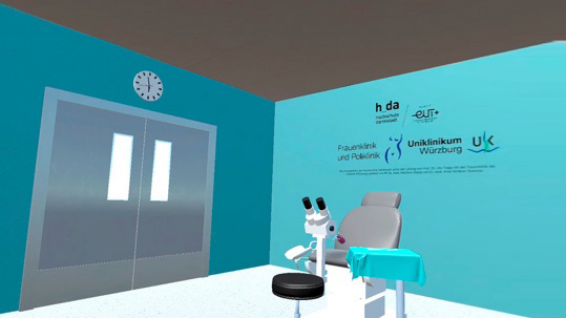
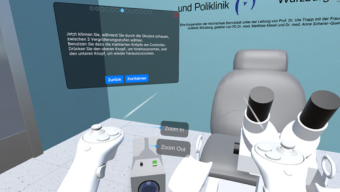
Figure 1: Virtual operating room environment. Spatial relationships and equipment distances replicate clinical settings for ergonomic training, while anatomical abstraction prevents misuse.
In prior work (Trapp et al., 2025), we introduced an open-source VR training system that established the foundational architecture for LLETZ simulation, including real-time mesh cutting, performance metrics capture, and a proof-of-concept dual-mode interface separating VR surgery from desktop analytics. The virtual operating room environment (Figure 1) maintains clinically accurate spatial relationships and equipment positioning while using abstracted patient geometry to prevent misuse. However, systematic ergonomic and interaction design patterns for resource-constrained clinical training contexts remain underexplored. The present work addresses these challenges through iterative refinement in collaboration with clinical domain experts, with comprehensive medical validation currently underway.
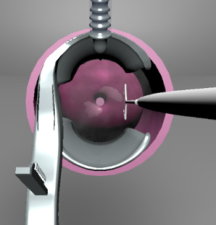
The system introduces four core interaction design enhancements: (1) hysteresis-based switching between room view and colposcope magnification to prevent unintended mode changes caused by tracking noise and micro-movements, (2) multimodal feedback mechanisms – including dynamic smoke visualization, audio warnings, and speculum rendering – that enhance depth perception and compensate for the absence of physical constraints, (3) a unified dual-mode interface architecture enabling fully standalone operation on modern VR headsets with optional cloud synchronization for asynchronous expert consultation (see Figure 2), and (4) a two-phase VR onboarding strategy that separates basic VR familiarization from procedure-specific skill acquisition to prevent cognitive overload among physicians with limited VR experience.
Figure 2: Enhanced visual feedback (left) and world space UI (right).
These enhancements maintain the open-source philosophy (VR-Koni-Trainer, 2026) while supporting resource-constrained clinical education contexts. The contribution of this work lies in demonstrating systematic, user- centered interaction design patterns that mitigate VR-specific ergonomic limitations in electrosurgical training without requiring high-cost hardware or complex haptic systems. While developed for LLETZ procedures, these design strategies are transferable to other colposcopy-guided interventions and minimally-invasive surgical training scenarios.
RELATED WORK
Virtual Reality simulation has demonstrated effectiveness across multiple surgical domains. Systematic reviews document VR’s benefits in orthopedic surgery, where simulation training improves technical skills and translates into measurable gains in operating room performance (Dhillon et al., 2025). In gynecology, current evidence supports incorporating VR-based training for various surgical procedures to enhance technical proficiency (Orejuela et al., 2022). Moreover, VR training is particularly well suited for resource-limited settings, where low-cost simulators have been shown to improve anatomical understanding and procedural confidence, even among trainees with limited prior experience with VR (Bing et al., 2021).
For LLETZ specifically, Kiesel et al. developed 3D-printed physical models offering excellent tactile feedback at low cost, demonstrating higher rates of adequate R0-resections, fewer procedural errors (loop contacts with vagina/speculum), and high overall satisfaction (mean score 1.6/10, where 1 is optimal) (Kiesel et al., 2022). However, physical models inherently lack systematic data capture, objective performance analytics, and reproducible scenarios – areas where digital solutions excel. To our knowledge, no VR-only simulator dedicated to LLETZ training has been reported to date.
ITERATIVE DESIGN VALIDATION Throughout development, we conducted on-site usability testing with physicians- in-training at University Hospital Würzburg. Medical trainees rapidly adapted to the simulated surgical tasks but required initial orientation to VR-specific interaction paradigms. In contrast, computer science students – despite high
An Open-Source VR Training System for Gynecological LLETZ Procedures 469 familiarity with VR interfaces – required extensive practice to achieve acceptable surgical technique. This contrast underscores the primacy of domain-specific expertise over prior VR experience in surgical simulation training.
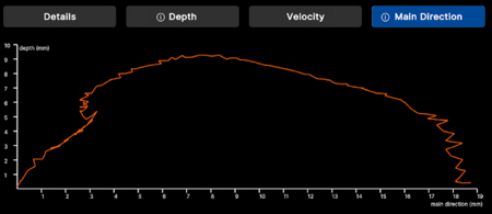
The system is currently undergoing evaluation with experienced gynecologists from the Department of Gynecology at University Hospital Würzburg, and results are pending. Comprehensive medical validation – including standardized usability metrics and analyses of clinical training effectiveness – will be reported in a separate publication upon completion of the study. Preliminary qualitative feedback indicates that the system is particularly valuable for training hand-eye coordination with the colposcope, a critical skill in LLETZ procedures (Sparić, 2016). In particular, medical experts highlighted the digital documentation capabilities, such as automatically generated depth graphs, which can reveal technique inconsistencies that may remain undetected in physical simulator training.
SYSTEM ENHANCEMENTS The VR training system comprises four integrated components: an immersive VR surgical environment, a real-time tissue cutting module, an analytics pipeline, and a dual-mode user interface. While the overall system architecture and core concepts have been described previously (Trapp et al., 2025), this paper focuses on ergonomic and interaction-related enhancements.
Enhanced Realism To improve procedural realism, we implemented detailed speculum visualization and dynamic smoke effects during cauterization (see Figure 2). Clinical experts emphasized that accurate depth perception is critical for achieving complete excision of pathological tissue while preserving surrounding healthy structures. Smoke behavior provides immediate visual feedback regarding the activation state of the electrosurgical loop, reinforcing correct procedural timing.
In addition, the system supports diverse patient scenarios that vary in age, reproductive status, and pathological tissue characteristics. These parameters directly influence optimal surgical strategies, including cutting depth and excision margins, thereby training clinical decision-making alongside technical execution. Ten distinct patient profiles can be selected by instructors, balancing realistic clinical variability with reproducible conditions for standardized assessment (see Figure 3).
To address the absence of physical constraints – a fundamental limitation of VR – we extended the feedback mechanisms beyond basic controller vibration. Without such constraints, users may unintentionally advance instruments unrealistically into tissue. Our current solution incorporates audio feedback that provides immediate depth-related warnings when the loop enters tissue without active cauterization, supporting safer and more realistic instrument handling.
Figure 3: Patient selection (left), patient information for surgery (right).
Dual-Mode UI: VR Procedure With Desktop Analytics A central design decision aimed at reducing cybersickness was to separate immersive surgical interaction from detailed data analysis. Preoperative preparation and postoperative review are therefore conducted on desktop displays or tablets, avoiding prolonged analytical tasks in VR.
This hybrid approach influenced hardware selection. Because sub-millimeter tracking accuracy is required for surgical training, early development and validation were conducted using the Valve Index and its lighthouse-based tracking system. Subsequent in-house evaluation studies demonstrate that the Meta Quest 3 achieves sub-millimeter tracking accuracy under our experimental conditions, validating its suitability for surgical training applications (Schwinn, 2026). While the Valve Index still offers marginally higher tracking precision, the Meta Quest 3 provides a significantly simplified setup, which is a critical advantage in clinical environments with limited technical support.
With Unity 6.3, we unified the VR and desktop interfaces, enabling seamless transitions between modalities. The system supports standalone VR headsets, PC-tethered configurations (e.g. Valve Index), and asynchronous access to performance data via Nextcloud synchronization for desktop computers or Android tablets. This allows trainees to review performance metrics – including multiple analytical graphs (see Figure 4) – at flexible times, supporting both self-reflection and expert consultation.
Figure 4: Example analytical chart showing depth profile along excision trajectory (ideal: cone-shaped).
An Open-Source VR Training System for Gynecological LLETZ Procedures 471 Colposcopy View With Hysteresis
The colposcope view requires careful ergonomic interaction design. In immersive VR, head position is frequently used as direct input; however, tracking noise and involuntary micro-movements can cause rapid and unintended mode switching when simple positional thresholds are applied. To address this, we implement a hysteresis-based state transition mechanism, a well-established principle for noise-robust switching in threshold-driven systems.
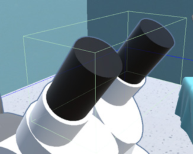
Magnification is activated when the user’s head enters a small trigger volume surrounding the oculars (see Figure 5). Once activated, a virtual head anchor is initialized and follows the user’s head position and rotation with configurable temporal smoothing. Rather than relying on absolute distance to the trigger volume, deactivation is governed by movement-based thresholds: only when the head is outside the trigger box and positional or angular deviation between the virtual anchor and the actual head exceeds predefined break values does the system return to the normal operating room view (see Figure 5). Comparable hysteresis buffering mechanisms have been used in VR/AR interaction research to suppress jitter and stabilize input recognition (Pei et al., 2022), and follow the same principle as classical Schmitt-trigger hysteresis for preventing state oscillation in noisy signals (Schmitt, 1938).
This approach effectively suppresses unintended toggling while preserving immediate responsiveness and maintaining realistic spatial relations between the colposcope and the surgical field.
Figure 5: Trigger box (left), yellow sphere indicating the virtual head position (middle), and adjustable hysteresis parameters (right).
VR-Onboarding Recognizing that many physicians have limited prior VR experience, we propose a two-phase onboarding strategy. First, users complete manufacturer- provided VR tutorials (e.g. Meta First Steps, Valve’s The Lab) to establish basic spatial orientation and controller familiarity. Subsequently, they progress to procedure-specific training within the simulation, learning interactions such as the colposcope zoom control, height adjustment, and loop handling (see Figure 6).
This staged approach contextualizes VR interaction skills within the virtual operating room while avoiding cognitive overload from simultaneous acquisition of VR and surgical competencies. Optional visual aids can be
activated at any time, following established onboarding recommendations (Chauvergne et al., 2023). In addition, controller button mappings are continuously displayed on a virtual wall poster, which dynamically adapts to the specific VR headset in use, providing easily accessible reference information throughout training sessions (see Figure 6).
Figure 6: VR onboarding in the operation room (left), controller button mappings within the environment (right).
DISCUSSION
Iterative validation revealed a clear contrast between domain expertise and VR familiarity: medical trainees demonstrated immediate surgical proficiency despite limited VR experience, whereas computer science students required extensive practice to achieve acceptable surgical technique despite strong VR familiarity. These findings support our two-phase onboarding strategy, which separates general VR mechanics from domain-specific skill acquisition, in line with established best practices for VR user experience design (Hari Chandana et al., 2023). The rapid adaptation of medical experts further indicates that surgical expertise transfers effectively to VR when interface ergonomics are appropriately designed. While systematic reviews document VR’s effectiveness in improving surgical performance across multiple domains (Dhillon et al., 2025; Orejuela et al., 2022), prospective studies tracking patient outcomes are needed to validate whether simulator-based LLETZ training translates to reduced complication rates in clinical practice.
Based on the haptic fidelity classification proposed by Favier et al. (2021), LLETZ training primarily requires low haptic fidelity for hand-eye coordination and medium fidelity for procedural learning, rather than the high fidelity needed for mechanical tissue manipulation tasks such as tumor dissection with scalpels. As noted earlier, the minimal tactile resistance of the electrically heated loop makes LLETZ particularly amenable to non- haptic VR simulation. This assessment informed our decision to employ multimodal feedback – visual, auditory, and vibrotactile cues – rather than costly full haptic systems, demonstrating that careful interaction design can compensate for hardware limitations.
Our hysteresis-based view switching offers an alternative solution to challenges reported in other VR microscopy systems. de Lotbiniere-Bassett et al. (2023) addressed unintended microscope deactivation caused by
An Open-Source VR Training System for Gynecological LLETZ Procedures 473 subtle head movements by introducing explicit thumb-stick-based view locking. While effective, this approach adds an additional interaction step. In contrast, our hysteresis-based mechanism achieves comparable stability through state-dependent movement thresholds, allowing minor head drift without deactivation while still requiring deliberate disengagement to exit the colposcope view. This preserves seamless interaction and reduces cognitive and physical load, aligning with established principles of intuitive VR interaction design (Hari Chandana et al., 2023).
Finally, the choice of standalone VR deployment using the Meta Quest 3 prioritizes accessibility and simplified setup for clinical environments. Our ongoing evaluations indicate that sub-millimeter tracking accuracy is sufficient for surgical training applications, supporting the feasibility of cost- efficient, easily deployable VR systems in medical education.
Limitations and Future Work A comprehensive evaluation with larger cohorts of resident physicians is required to quantitatively assess training effectiveness and skill transfer to clinical practice. The open-source nature of our platform facilitates multi- center studies and adaptation to diverse clinical contexts, which will be pursued in future work.
CONCLUSION
This work presents substantial enhancements to a proof-of-concept VR surgical training system through systematic user-centered design in close collaboration with clinical experts. Key contributions include enhanced procedural realism, ergonomic interaction design with hysteresis-based view switching, a dual-mode user interface to minimize cybersickness, structured two-phase onboarding, and standalone deployment with asynchronous performance analytics.
Following established principles in VR interaction design and haptic fidelity classification (Favier et al., 2021; Hari Chandana et al., 2023), our results demonstrate how thoughtful interface design can address VR ergonomic limitations without expensive hardware. In particular, the system effectively supports hand-eye coordination training for procedures such as LLETZ, where low-to-medium haptic fidelity is sufficient. The proposed approach provides a transferable, open-source methodology for resource-constrained medical training contexts. Ongoing expert evaluation will be complemented by larger-scale studies with resident physicians to validate clinical training impact and skill transfer.
ACKNOWLEDGMENT
This research was supported by initial funding from Darmstadt University of Applied Sciences. We thank the dedicated students whose excellent contributions in project seminars and thesis projects were instrumental in
developing the VR-Koni-Trainer system. Demonstration videos are available at https://konivr.de.
Language model assistance (Anthropic, 2025; OpenAI, 2026) was used to refine technical language and improve manuscript clarity and structure. All scientific content, methodological decisions, and conclusions were independently validated and remain the sole responsibility of the authors.
REFERENCES
Anthropic. (2025). Claude 4.5 Sonnet. Available at https://www.anthropic.com/ claude [Accessed 15/01/2026]. Bing, Eric G.; Brown, Megan L.; Cuevas, Anthony; Sullivan, Richard and Parham,
Groesbeck P. (2021). User Experience With Low-Cost Virtual Reality Cancer Surgery Simulation in an African Setting. JCO Global Oncology, 7, pp. 435–442. doi: 10.1200/GO.20.00510. Biswas, Nilotpal; Mukherjee, Anamitra and Bhattacharya, Samit. (2024). “Are you feeling sick?” – A systematic literature review of cybersickness in virtual reality. ACM Computing Surveys. doi: 10.1145/3670008. Chauvergne, Edwige; Hachet, Martin and Prouzeau, Arnaud. (2023). User
Onboarding in Virtual Reality: An Investigation of Current Practices. Proceedings of the 2023 CHI Conference on Human Factors in Computing Systems. doi: 10.1145/3544548.3581211. Dhillon, Jaydeep; Tanguilig, Grace and Kraeutler, Matthew J. (2025). Virtual and Augmented Reality Simulators Show Intraoperative, Surgical Training, and Athletic Training Applications: A Scoping Review. Arthroscopy, 41(2), pp. 505–515. doi:10.1016/j.arthro.2024.02.011 Favier, Valentin; Subsol, Gérard; Duraes, Martha; Captier, Guillaume and Gallet,
Patrice. (2021). Haptic Fidelity: The Game Changer in Surgical Simulators for the Next Decade? Frontiers in Oncology, 11, pp. 713343. doi: 10.3389/ fonc.2021.713343. Gallagher, Anthony G.; Ritter, E. Matt; Champion, Howard; Higgins, Gerald; Fried, Marvin P.; Moses, Gerald; Smith, C. Daniel and Satava, Richard M. (2005). Virtual reality simulation for the operating room: proficiency-based training as a paradigm shift in surgical skills training. Annals of Surgery, 241(2), pp. 364–372. doi: 10.1097/01.sla.0000151982.85062.80. Hari Chandana, B.; Shaik, Nazeer and Chitralingappa, P. (2023). Exploring the
Frontiers of User Experience Design: VR, AR, and the Future of Interaction. 2023 International Conference on Computer Science and Emerging Technologies (CSET), pp. 1–6. doi: 10.1109/CSET58993.2023.10346724. Kiesel, Matthias; Beyers, Inga; Kalisz, Adam; Wöckel, Achim; Löb, Sanja; Schlaiss, Tanja ; Wulff, Christine and Diessner, Joachim. (2022). Evaluating a novel 3D printed model for simulating Large Loop Excision of the Transformation Zone (LLETZ). 3D Printing in Medicine, 8(1), pp. 15. doi: 10.1186/s41205-022-00143-x Lotbiniere-Bassett, Madeleine de; Volpato Batista, Arthur; Lai, Carolyn; El Chemaly,
Trishia; Dort, Joseph; Blevins, Nikolas and Lui, Justin. (2023). The user experience design of a novel microscope within SurgiSim, a virtual reality surgical simulator. International Journal of Computer Assisted Radiology and Surgery, 18(1), pp. 85–93. doi: 10.1007/s11548-022-02727-8. OpenAI. (2026). ChatGPT 5.2. Available at https://chat.openai.com [Accessed 15/01/2026].
An Open-Source VR Training System for Gynecological LLETZ Procedures 475 Orejuela, Francisco J.; Aschkenazi, Sarit O.; Howard, David L.; Jeppson, Peter C.;
Balgobin, Sunil; Walter, Andrew J.; White, Amanda; Olivera, Cedric K.; Sanses, Tatiana V.; Thompson, Jennifer; Gala, Rajiv B.; Matteson, Kristen; Balk, Ethan M.; Meriwether, Kate V. and Rahn, David D. (2022). Gynecologic surgical skill acquisition through simulation with outcomes at the time of surgery: a systematic review and meta-analysis. American Journal of Obstetrics & Gynecology, 227(1), pp. 29.e1–29.e24. doi: 10.1016/j.ajog.2022.01.031. Pei, Siyou; Chen, Alexander; Lee, Jaewook and Zhang, Yang. (2022). Hand Interfaces: Using Hands to Imitate Objects in AR/VR for Expressive Interactions. pp. 1–16. doi: 10.1145/3491102.3501898. Schmitt, Otto H. (1938). A thermionic trigger. Journal of Scientific Instruments,
15(1), pp. 24. doi: 10.1088/0950-7671/15/1/305. Schwinn, Julian. (2026). Accuracy Evaluation (0.0.1). University of Applied Sciences Darmstadt. Available at https://gitlab.com/darmstadt-university-of-applied- sciences-trapp/accuracy-evaluation [Accessed 05/02/2026]. Sparić, R.; Tinelli, A.; Guido, M.; Stefanović, R.; Babović, I.; Kesić, V. (2016). The
Role of Surgeonsʼ Colposcopic Experience in Obtaining Adequate Samples by Large Loop Excision of the Transformation Zone in Women of Reproductive Age. Geburtshilfe und Frauenheilkunde, 76(12), pp. 1339–1344. doi: 10.1055/s-0042- 113773. Trapp, Ute; Meyer, Benjamin; Kiesel, Matthias and Scherer-Quenzer, Anne. (2025).
Gynecological Surgical Training in VR. 2025 29th International Conference Information Visualisation (IV), pp. 385–388. doi: 10.1109/IV68685.2025.00072 VR-Koni-Trainer (1.0.9). (2026). University of Applied Sciences Darmstadt.
Available at https://gitlab.com/darmstadt-university-of-applied-sciences-trapp/ vr-koni-trainer [Accessed 19/01/2026]. Wu, Jie; Jin, Qianyun; Zhang, Yunmeng; Ji, Yuting; Li, Jingjing; Liu, Xiaomin; Duan, Hongyuan; Feng, Zhuowei; Liu, Ya; Zhang, Yacong; Lyu, Zhangyan; Yang, Lei and Huang, Yubei. (2025). Global burden of cervical cancer: current estimates, temporal trend and future projections based on the GLOBOCAN 2022. Journal of the National Cancer Center, 5(3), pp. 322–329. doi: https://doi.org/10.1016/j. jncc.2024.11.006.
Read this individual research paper free through the original publisher, or explore the full digital proceedings book.
ISBN 979-8-950676-09-3
Explore this ISBN in the AHFE Bookstore ↗Listed in the July 2026 bookstore catalogue; search by ISBN to confirm current availability · Digital book purchase optional