Akisue Kuramoto, Masaya Noguchi, Kosuke Goshima, Daiki Koga, Kazuki Hiranai, Motomu Nakashima (2026). Unsupervised Clustering of Repetitive Task Trials via Tucker Decomposition of Joint-Angle Data Tensors. In: Human Factors in Design, Engineering, and Computing. AHFE Open Access, vol. 238, pp. 1683–1688. https://doi.org/10.54941/ahfe1008396
Movement patterns can vary across repetitions of the same task. This study aims to develop an analysis framework for comparing repeated movement trials in a shared feature space and describing the occurrence of movement patterns across repetitions. Time-series joint angle data was obtained from motion capture data recorded during a seated repetitive lifting task performed by twelve males. Partial Tucker decomposition provided temporal and joint-DOF bases shared across trials within each participant, while retaining trial-specific core coefficients. Gaussian mixture models were applied to these coefficients to group trials with similar kinematic features. Four to seven clusters were selected for each participant. In all participants, the dominant cluster changed in stages as the experiment progressed, although trial order was not used as a feature. Clusters dominant in early trials rarely regained dominance later, while later trials often showed repeated alternations in cluster membership probabilities. These results show that the framework can describe the occurrence and progression of movement patterns during repetitive work.
Repetitive motion is often found in sports and working settings, including manufacturing and construction, for example. During repeating the same task, there can be different motion patterns. Because each trial contains time- varying data from multiple joint degrees of freedom (DOFs), comparisons between trials need to account for both temporal features and differences across joints. Characterizing repetitive movement also requires relating trial-to-trial differences to specific joint motions and examining when each movement pattern occurs across successive trials.
Previous studies have used tensor decomposition to characterize shared and individual movement features. Tensor decomposition has been used to extract shared and individual features of human movement (Takiyama et al., 2022). Tucker core tensors have also been used as sample features for clustering image and video data (Shi et al., 2019). In reaching tasks, probabilistic clustering of hand trajectories has been used to describe trial- by-trial changes during motor learning (Sidarta et al., 2022). These studies provide methods for extracting shared features, grouping movements, and examining changes across trials. However, similar hand trajectories can be produced by different combinations of joint motions (Tseng et al., 2002). Grouping trials by hand trajectory alone may therefore overlook differences in how the task is performed.
This study aims to develop an analysis framework for comparing repeated movement trials in a shared feature space, characterizing their kinematic differences, and describing the occurrence of movement patterns across repetitions. The present analysis uses joint angle time series from multiple joint DOFs. Partial Tucker decomposition is applied to the temporal and joint- DOF modes while leaving the trial mode uncompressed. The resulting trial- specific core coefficients describe how the shared temporal and joint-DOF bases are combined in each trial. Trials are clustered using these coefficients, and the resulting groups are characterized by their joint kinematics and occurrence along the trial sequence.
METHODS
Data Representation and Standardization Motion data are arranged as a 4D tensor x ∈ RT×J×C×N, where T, J, C, N denote the numbers of time samples, joint degrees of freedom (DOFs), kinematic variables, and trials, respectively. Each joint DOF and kinematic variable was standardized using the mean and standard deviation pooled across time samples and trials within the participant. For the selected kinematic variable, partial Tucker decomposition was applied to the temporal and joint-DOF modes while leaving the trial mode uncompressed, corresponding to a Tucker2 model (Tucker, 1966; Kroonenberg and de Leeuw, 1980). This provided shared temporal and joint-DOF bases and trial-specific core coefficients. These coefficients describe combinations of temporal and joint-DOF bases, whereas trial order is not included as a feature. The core coefficients of each trial were vectorized and used as features for clustering.
Rank and Clustering Model Selection Rank candidates of temporal and joint-DOF were generated using mode- wise singular value decomposition. Each rank pair was evaluated by its reconstruction ratio, and pairs below a specified threshold were discarded.
Unsupervised Clustering of Repetitive Task Trials via Tucker Decomposition 1685 The remaining candidates were further screened based on reconstruction accuracy and feature dimension. Gaussian mixture models with diagonal covariance matrices were fitted to the trial features using k-means initialization. Among converged models satisfying predefined bounds on the number of components and minimum cluster-size requirements, the model with the lowest Bayesian information criterion (BIC) was selected for each rank pair. The rank pair with the smallest feature dimension among these eligible models was retained. After that, each group was characterized using posterior-weighted mean joint angles over one task cycle and standard deviations calculated from the original, unstandardized joint time series.
EXPERIMENTS AND DATA PROCESSING Twelve male participants (Age: 23.0 ± 1.0 years old, Height: 172.9 ± 4.7 cm, Weight: 64.0 ± 6.6 kg) were recruited for a seated repetitive manual lifting experiment. Participants sat facing a single shelving unit with three shelves at foot, chest, and eye level. They repeatedly lifted a 1 kg bottle from the chest-level shelf and placed it on the eye-level shelf at a rate of one lift every 2 seconds. To record human body motion, three-dimensional trajectories of markers attached to the participant were recorded at 100 Hz using a ViconTM motion capture system. These trajectories were input to a human musculoskeletal model in the AnyBody Modeling SystemTM to calculate joint angles over time. The analysis described in the previous section was then performed in Python. A cumulative SVD energy threshold of 0.98 was used to generate candidate ranks for each mode. Rank pairs with a Tucker reconstruction ratio of at least 0.975 were retained for subsequent model selection. These threshold values were selected empirically.
RESULTS AND DISCUSSION
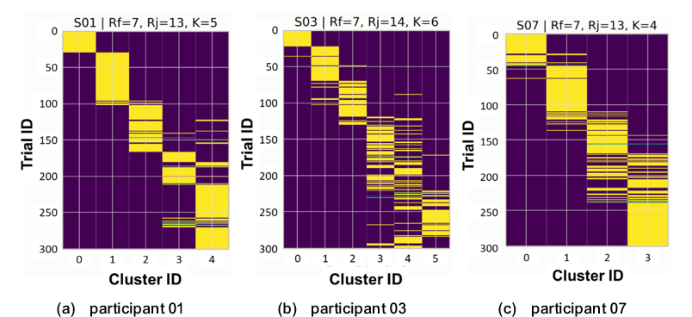
For each participant, posterior cluster membership probabilities were visualized in trial order. Cluster IDs were reassigned according to their timing of occurrence. Figure 1 shows examples of heatmaps, with trial order on the vertical axis, cluster ID on the horizontal axis, and color indicating membership probability. The selected number of clusters ranged from four to seven across participants. In every participant, the dominant cluster changed in stages as the experiment progressed. Clusters that were dominant early in the experiment rarely became dominant again in later trials (Fig. 1(a), (c)). From approximately 2 minutes into the experiment onward, repeated reversals in relative membership probabilities were often observed between clusters occupying adjacent columns in the reordered heatmap (Fig. 1(b)).
Figure 1: Examples of trial-by-trial changes in cluster membership probabilities of motion patterns. The estimated probabilities for each cluster are shown for each trial, with trials number on the vertical axis and cluster ID on the horizontal axis. Color intensity indicates the probability. Cluster IDs were assigned in order of the clusters that appeared most frequently in the early phase of the experiment. Across participants, stepwise changes in the dominant cluster as repetitions progressed, as well as bidirectional transitions among clusters in the later phase, were observed.
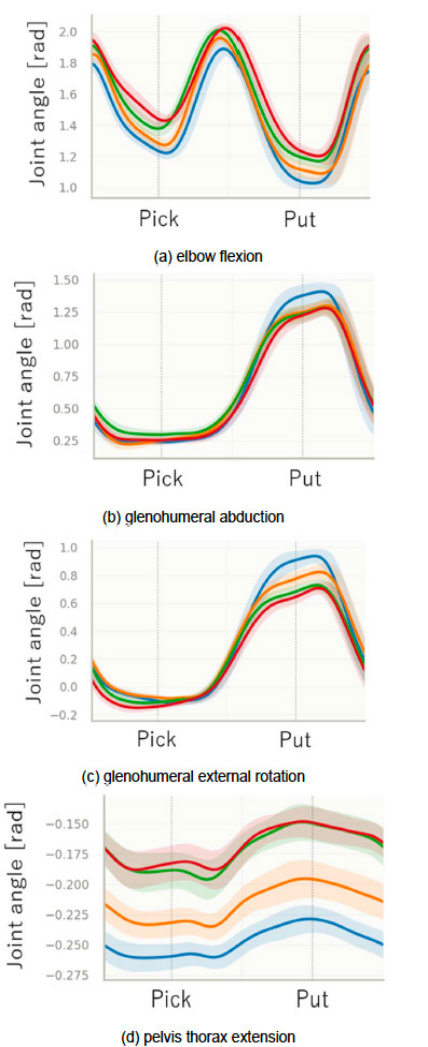
Figure 2 shows the posterior-weighted mean joint angles over one task cycle for each cluster in the participant 07, with shaded bands indicating ±1 weighted standard deviation across trials. The differences between clusters reveal changes in trunk posture and upper limb configuration over the course of the experiment. Pelvis–thorax extension angles were more negative in cluster 0, which predominated early in the experiment, indicating greater trunk flexion. In later-occurring clusters, particularly clusters 2 and 3, these angles were consistently less negative throughout the analysis interval, indicating a relatively more extended trunk posture.
Differences in upper limb configuration were also evident around put. Cluster 0 exhibited greater glenohumeral abduction and external rotation and less elbow flexion than the later-occurring clusters. Thus, the reduction in trunk flexion was accompanied by changes in the shoulder and elbow configurations used to place the bottle on the shelf. These findings connect the temporal progression of cluster membership to interpretable changes in task execution involving both the trunk and upper limb.
Although trial order was not used as a feature, cluster membership probabilities changed with the progression of the experiment. This indicates that the framework can describe changes in kinematic features during repetitive work. These changes included both successive shifts in the dominant cluster and temporary fluctuations or repeated alternations among clusters.
Qualitative inspection of the experimental videos showed that many participants adopted a rounded posture early in the experiment and a more upright posture later. The less flexed trunk posture in the later-occurring clusters of the participant 07 is consistent with these observations and supports the kinematic interpretation of the cluster progression. Participants also appeared to complete the lifting movement more quickly in later trials;
Unsupervised Clustering of Repetitive Task Trials via Tucker Decomposition 1687 the relationship between cluster membership and movement duration remains to be quantified.
Figure 2: Posterior-weighted mean joint angles over one task cycle for each cluster in the participant 07. Shaded bands indicate ±1 weighted standard deviation across trials. Clusters 0, 1, 2, and 3 are shown in blue, orange, green, and red, respectively.
The presence and temporal progression of clusters alone do not establish the existence of discrete metastable states or their relationships with fatigue, familiarization, or adaptation. Continuous changes in movement may also have been partitioned into groups by clustering. Future work should extend the kinematic interpretation across participants and quantitatively examine the relationship between cluster membership and movement features. The stability and reproducibility of the results should also be assessed, including the effects of basis representation and model selection.
CONCLUSION
This study developed an analysis framework combining partial Tucker decomposition and Gaussian mixture clustering to compare repeated movement trials using shared temporal and joint-DOF bases. Application to a seated repetitive lifting task identified successive shifts in cluster dominance and repeated alternations among clusters, without using trial order as a feature. The framework described the progression of movement patterns across repetitions and related representative cluster differences to changes in trunk posture and upper limb configuration. Future work should extend these interpretations across participants, quantify their relationship with movement feature, and assess the stability and reproducibility of the analysis.
ACKNOWLEDGMENT
This study was supported by JSPS KAKENHI Grant Number 25K17568.
REFERENCES
Kroonenberg, P. M., de Leeuw, J. (1980). Principal component analysis of three-mode data by means of alternating least squares algorithms. Psychometrika, Volume 45, pp. 69–97. Shi, Q., Cheung, Y. M., Zhao, Q., Lu, H. (2019) Feature extraction for incomplete
data via low-rank tensor decomposition with feature regularization. IEEE Transactions on Neural Networks and Learning Systems, Volume 30, Issue 6, pp. 1803–1817. Sidarta, A., Komar, J., Ostry, D. J. (2022). Clustering analysis of movement kinematics in reinforcement learning. Journal of Neurophysiology, Volume 127, No. 2, pp. 341–353. Takiyama, K., Hirashima, M., Fujii, S. (2022). Transition between individually
different and common features in skilled drumming movements. Frontiers in Sports and Active Living, Volume 4, 923180. Tseng, Y., Scholz, J. P., Schöner, G. (2002). Goal-equivalent joint coordination in pointing: Affect of vision and arm dominance. Motor Control, Volume 6, No. 2, pp. 183–207. Tucker, L. R. (1966). Some mathematical notes on three-mode factor analysis.
Psychometrika, Volume 31, pp. 279–311.
SEARCH THE AHFE DIGITAL BOOKSTORE BY ISBN
Explore the complete digital volume
Human Factors in Design, Engineering, and Computing
Read this individual research paper free through the original publisher, or explore the full digital proceedings book.