Tamaki T. Mitsuno, Kaoru Wakatsuki (2026). Selection of Underwear Materials for Comfortable Sleeping in Summer Evacuation Shelters. In: Human Factors in Design, Engineering, and Computing. AHFE Open Access, vol. 238, pp. 674–683. https://doi.org/10.54941/ahfe1008299
Global warming has increased the frequency of disasters such as earthquakes, typhoons, and floods in Japan, forcing many people—particularly vulnerable groups such as the elderly—into evacuation shelters where air conditioning is often unavailable because of power outages. This study investigated how the choice of underwear material affects sweat evaporation and thermoregulation during sleep under such hot and humid conditions. A single 68-year-old woman wore five underwear of different material compositions (A: Cotton; B: Cotton/Polyester; C: Cotton/Nylon; D: Polyester; E: Nylon) for 6.5 h/night on from July to September, in a bedroom at approximately 29 °C and 53%RH. Body weight, oral/skin temperature, the sweat weight of clothing/towels/bedding, and urine were measured, and evaporation efficiency was calculated using a heat-/mass-balance model. Fabric thermal and water-vapor resistance were also measured with a guarded hotplate. Evaporation efficiency was highest for A and lowest for B, which retained sweat within the fabric and produced a sticky sensation on the skin. The D retained little sweat but left moisture on the skin because of its low water-holding capacity. These results suggest that selecting cotton underwear may help elderly evacuees sustain effective thermoregulation through sweating when air conditioning cannot be used. Further work with larger and more diverse samples is needed to establish practical guidelines for underwear selection in evacuation shelters.
With global warming, various natural disasters have become a regular occurrence, and Japan is no exception, experiencing a range of disasters (Japan Meteorological Agency). The Kumamoto earthquake in July in 2026, and from August through September—due to Japan being an island nation, a constant supply of water vapor from the surrounding seas led to the formation of linear precipitation zones caused by typhoons and the autumn rain front, resulting in sudden heavy rains across various parts of Japan and subsequent flooding (Meteorological Research Institute Japan and Disaster Prevention Research Institute, 2023). Amid these circumstances, many people have been forced to seek refuge in evacuation shelters because their homes— where they had lived for years—collapsed in the earthquake or were flooded
Selection of Underwear Materials for Comfortable Sleeping in Summer 675 (Kasaoka et al., 2023). Providing comfortable evacuation shelters is an urgent issue; however, in the disaster-stricken areas of Kumamoto this year, a heatwave with temperatures exceeding 35 °C persisted for days on end, yet air conditioning could not be used due to power outages (Casey et al., 2020). In this study, assuming a summer evacuation shelter scenario, we considered strategies for selecting underwear to make the stay as comfortable as possible as a self-help measure (Advanced Cooling Textiles, 2024).
EXPERIMENTAL METHODS Subject and Test Samples
In this study, we focused on elderly women as a vulnerable group in shelter living (Balmain et al., 2018). The subject was a 68-year-old woman. Five types of short-sleeved underwear made of different materials were used in the experiment. The shirts were tailored to the subject’s body type to ensure they covered the same body area. The material properties of the underwear are shown in Table 1. Fabric thickness (THICKNESS GAUGE, TOYO SEIMITSU), and air resistance was measured (KES-F8-AP1, KATO TECH) (Vasile et al., 2025). Samples B/C were blended with cellulose-based fibres, while samples B through E were blended with polyurethane (Onofrei et al., 2012). Sample A was 100% cotton; Sample B was a blend of cotton and polyester; and Sample C was a blend of cotton and nylon. Samples D and E were primarily made of polyester and nylon, respectively. All fabrics were flat-knit; their composition ratios are shown in Table 1, and an illustration of the knit pattern is shown in Fig. 1 (Teyeme et al., 2020).
Table 1: Materials and characteristics of the experimental underwear.
Table available in the original PDF paper.
Sample Percentage of each fiber in the composition Air resistance (kPa·s/m)
B 65 30 0 5 0.079 136.2 0.455 C 25 0 65 10 0.190 140.2 0.425
D 0 88 0 12 0.184 110.8 1.317 E 0 0 85 15 0.027 119.1 1.314
Figure 1: Illustration of experimental underwear.
Figure available in the original PDF paper.
The subject was a 68-year-old woman (height: 159 cm, weight: 57 kg). From July to September 2026, she slept in a bedroom (21.9 m³) with an ambient temperature of 29.2 ± 0.2°C and 52.6 ± 0.5% RH (Lan et al., 2017). During this period, she wore the test short-sleeved underwear (see Table 1) on her upper body and shorts or long pants (100% cotton) on her lower body. During the 6.5-hour sleep period from 10:30 p.m. to 5:00 a.m. the following morning, the following measurements were taken: bedroom temperature and humidity before and after sleep (thermos-hygrometer, DRETEC), the subjects’ body composition (Inner SCAN Dual, RD-800-BK, TANITA), oral temperature (women’s oral thermometer, C531, TERUMO), and skin temperature (Hardy and Dubois 7-point method: measurements taken at the forehead, abdomen, upper arm, back of the hand, thigh, lower leg, and back of the foot using a non-contact thermometer (BT-54X, TANITA). We also measured the weight of sweat absorbed by the clothing and the urine volume upon waking (Digital scale, KJ-222, TANITA) (Weissenberg, 2005). Note that the experimental underwear was worn seven times in total, with the order of wearing randomized for each use.
Thermal Resistance and Water Vapor Pressure Resistance of Experimental Garments The thermal resistance and vapor pressure resistance of the five types of experimental garments were measured in accordance with ASTM F1868- 2017 Part C using a Standard Guarded Hotplate (Thermetrics, USA) (ASTM International, n.d.). The measurement conditions for thermal resistance (vapor pressure resistance) were a plate temperature of 35 °C ambient temperature and humidity of 25 °C (35 °C and 65% (40%) RH, and an airflow velocity of 1 m/s.
Method for Calculating Evaporation Rates From Subjects During Sleep In this study, we used the following values to calculate the amount of water vapor lost during sleep and the amount of sweat absorbed by the bedding. The bedroom volume was modelled as a 6-tatami-mat room in a traditional Japanese house (≈ 21.9 m³). The convective heat transfer coefficient (hc, W/ m²·K) used to calculate evaporation was 3.1 for the supine position, and the evaporation heat transfer coefficient conversion ratio (LR) was 16.5 (ISO 7933 PHS model); the measurement interval (h) was 6.5 hours; the weighting coefficients for mean skin temperature were set as follows: forehead: 0.07, abdomen (trunk): 0.35, upper arm: 0.14, back: 0.05, thigh: 0.19, lower leg: 0.13, and dorsum of the foot: 0.07 (Dubois’ 7-point method) (Ramanathan, 1964).
Furthermore, the theoretical maximum evaporation rate Emax was calculated from the skin saturated vapor pressure (Psk, sat) at 22:30 and 5:00 and the indoor vapor pressure (Pa) (Equation 1). Here, he was approximately a constant term (Equation 2). The maximum evaporation
Selection of Underwear Materials for Comfortable Sleeping in Summer 677 rate [W/m²] was multiplied by the body surface area [BSA, using the Dubois formula] (Equation 3). To convert the maximum evaporation rate to grams, Equation 3 was multiplied by the sleep duration [t s] and divided by the latent heat of vaporization L [2,426 J/g] (Havenith et al., 2013) (Equation 4). Equations (1) through (4) were combined into Equation (5). Using Equation (5), the overall evaporation efficiency [(weight loss – urine volume – sweat absorbed by clothing)/Emax] was calculated (Equation (6). The basic equation is shown below.
Emax [W/m²] = he × (Psk, sat – Pa) = (LR × hc) × Δp (1) Here, he = LR × hc = 16.5 × 3.1 ≒ 51.15 W/ (m² · kPa) (2)
Equation reproduced from the original PDF.
Emax [g] = (LR × hc × BSA × Δp × t) / L (5) Total Evaporation Efficiency = (Weight Loss – Urine Volume – Sweat Absorbed by Clothing) / Emax (6)
Using the above equations, we calculated the amount of transpiration during sleep (total transpiration efficiency × Emax) and the amount of sweat absorbed by bedding (weight loss – (sweat absorbed by clothing + urine volume + transpiration during sleep)).
Statistical Methods We performed t-tests to determine whether there were significant differences among the five sample types in terms of thickness, air resistance, and fabric weight. We also calculated the correlation coefficients between each of these variables. Additionally, we determined the significant differences and correlation coefficients among the samples regarding outdoor and indoor temperature and humidity, oral and skin temperature, the amount of sweat absorbed by clothing, total evaporation efficiency, and the amount of sweat absorbed by bedding, as measured while wearing each sample. The significance level was set at p < 0.05.
RESULTS AND DISCUSSION
Effects of Material Properties and Environmental Condition The fabric thickness of the experimental undershirts was significantly higher for Type D and E than for A, B, and C. The air resistance (kPa·s/m) was significantly lower for Type E than for B, A, D, and C. The fabric weight was significantly higher for Type A, B, and C than for D and E. When the correlation coefficients between the three factors—fabric thickness, air permeability resistance, and weight per unit area—were calculated, a significant negative correlation (−0.998, P < 0.01) was found between fabric thickness and weight per unit area. In other words, the results showed that the thicker the fabric, the lighter the weight per unit area. Generally, thicker
678 Mitsuno and Wakatsuki fabrics tend to have higher weights per unit area; however, underwear samples D and E, which were made of synthetic fibres without cotton, had low weights per unit area and good breathability despite their thick fabric. Consequently, among the five samples used in this study, the results showed that the thicker the fabric, the lower the weight per unit area and the better the breathability. In other words, these fabrics (Types D and E) did not necessarily have poor breathability even though they were thick (Teyeme et al., 2020, Vasile et al., 2025, Onofrei et al., 2012).
SWEATING EXPERIMENT Relationship Between Outdoor and Indoor Temperature and Humidity
Since the perspiration experiments were conducted over a long period, they were carried out at the subjects’ homes. Consequently, external ambient temperature and humidity were not specifically controlled but were left to natural conditions. We examined the significant differences and correlations between outdoor temperature and humidity (using AMEDAS data from the Japan Meteorological Agency for the subjects’ residences) and indoor temperature and humidity. While there was no significant difference between indoor and outdoor ambient temperatures, there was a significant positive correlation between the humidity levels of the two environments (P < 0.05). This suggests that indoor temperature was not influenced by the external environment, whereas humidity was affected on a daily basis. However, since the five types of samples were randomly assigned to subjects for each trial, there were virtually no differences among the five groups; therefore, within the scope of this study, we concluded that the temperature and humidity of the external environment did not affect indoor temperature and humidity.
Relationship Between Indoor Temperature and Humidity and Subject Body Temperature The correlation coefficients between indoor temperature and humidity and the subjects’ body temperature, broken down by sample were calculated. Since there were no significant differences between the bedroom temperature and humidity and oral temperature when wearing each underwear, core temperature did not change under the environmental conditions (26.6–31.0 °C, 41%–58%RH). However, when Type E was worn, there was a significant positive correlation between ambient temperature and skin temperature (upper arm, thigh, lower leg, and top of the foot), as well as a significant positive correlation between relative humidity and skin temperature (forehead, thigh, and lower leg). In other words, when Type E was worn, although oral temperature did not change as ambient temperature and humidity rose, skin temperature did increase. Type E was made of the thickest and lightest fabric, with the best breathability and the lowest thermal resistance. This suggests that while the material provided comfort when worn in a comfortable environment, it actually allowed changes in the
Selection of Underwear Materials for Comfortable Sleeping in Summer 679 external environment to be readily transmitted to the body when ambient temperature and humidity rose. In other words, it lacked the buffering effect against the environment that clothing should inherently possess (Lan et al., 2017; Candas et al., 1995).
THERMAL RESISTANCE AND WATER VAPOR PRESSURE RESISTANCE OF THE EXPERIMENTAL MATERIALS The thermal resistance (Rct, m²⋅K /W) of all underwear fabrics ranged from 0.07 to 0.09, and the net fabric thermal resistance (Rcf, m²⋅K /W) ranged from 0.003 to 0.023, confirming that these fabrics are suitable for ultra-thin summer clothing. Ret ranged from 6.40 to 7.55, and the net vapor resistance of the fabric (Ref ranged from 1.37 to 2.52 confirming that these fabrics possess very high moisture permeability when used in single-layer, lightweight shirts (ASTM International, n.d.). Although these values showed a significant correlation with each other (p < 0.01), there was no significant correlation with other parameters such as body temperature, sweat production, urine output, or evaporation efficiency.
EVAPORATION EFFICIENCY AND SWEAT PRODUCTION Differences in Evaporation Efficiency and Amount of Sweat Adhering to Bedding and Clothing Among Various Underwear Types
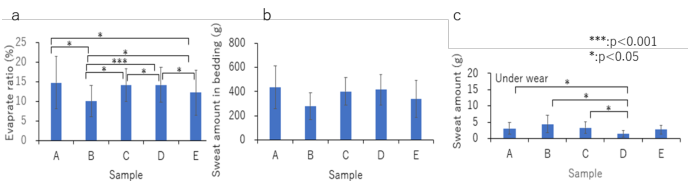
Fig. 2 shows the evaporation efficiency (see Equation 6) and sweat production (defined as the weight of sweat adhering to the underwear and bedding) when wearing each type of underwear. The evaporation efficiency (Fig. 2a) when wearing the five types of underwear showed that type A was significantly higher than that of Type B and E; in particular, Type B had the lowest evaporation efficiency among all samples. Furthermore, there was no significant difference in the amount of sweat absorbed by the bedding regardless of which type of underwear was worn (Fig. 2b). Additionally, the amount of sweat retained by the underwear was significantly lower for Type D than for A, B, and C (Fig. 2c). This is attributed to the fact that Type D underwear is primarily made of polyester, which lacks hydrophilic groups (Eren et al., 2024). Although the material of Type D had a thick fabric and good breathability, its fabric had low water-retention capacity, so the subject often felt that sweat remained on her skin upon waking in the morning (Raccuglia et al., 2018).
Figure 2: Evaporation efficiency and amount of sweat absorbed by bedding and clothing for each type of underwear: a: evaporation efficiency; b: sweat amount in bedding.
680 Mitsuno and Wakatsuki Relationship Between Sweat Absorption by Underwear and Bedroom Temperature, Evaporation Efficiency, and Sweat Absorption by Bedding
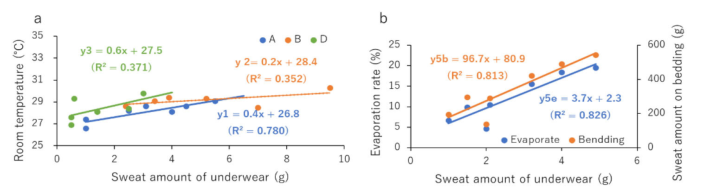
Fig. 3 shows the relationship between the amount of sweat absorbed by the underwear and the bedroom temperature and humidity, evaporation efficiency, and the amount of sweat absorbed by the bedding. There was a significant linear relationship between the amount of sweat absorbed by Underwear Types A, B, and D and the bedroom temperature (Fig. 3a), whereas no such linear relationship was observed for Types C and E. In other words, Types A, B, and D exhibited the property that the higher the bedroom temperature, the greater the amount of sweat absorbed. The y-intercepts (y = 0) of the linear equations y1, y2, and y3 (corresponding to Types A, B, and D, respectively) were 26.8 °C, 28.4 °C, and 27.5 °C, indicating that Type A began absorbing sweat the earliest. Furthermore, the amount of sweat retained during the 6.5-hour sleep period was highest for Type D, followed by A and B; Type B retained approximately three times as much sweat as D. This suggests that Type B either took longer to diffuse the absorbed sweat outward or was unable to fully diffuse it under these environmental conditions, resulting in a sticky sensation remaining on the skin. There was a significant linear relationship between the amount of sweat absorbed by Type E, its evaporation efficiency, and the amount of sweat transferred to the bedding (Fig. 3b). The more favourable the evaporation efficiency conditions in the bedroom, the more sweat Type E absorbed; the absorbed sweat was not retained within the underwear but was almost entirely adsorbed (transferred) to the bedding.
Figure 3: Relationship between sweat absorption by underwear and bedroom temperature, evaporation efficiency, and sweat absorption by bedding. a: Underwear A/B/D and bedroom temperature; b: Underwear E, evaporation efficiency, and sweat absorption on bedding.
Based on the above, Type A can be said to have excellent evaporation efficiency, whereas Type B has low evaporation efficiency. In a hot environment, Type A began absorbing sweat at a relatively low bedroom temperature of 26.8 °C compared to the other wears and retained a certain amount of sweat within the underwear material. In cold environments, the moisture in this underwear lowers thermal conductivity, causing the body surface temperature to drop rapidly; however, because the ambient temperature in this study was high at 30°C, this did not lead to a decrease in body surface temperature (Onofrei et al., 2012; Eren et al., 2024). Furthermore, although the rate of
Selection of Underwear Materials for Comfortable Sleeping in Summer 681 water diffusion from Type A was not particularly fast, it was well-suited to the environmental conditions of this study; consequently, sweat did not remain on the skin but was transferred to the bedding. As a result, there was little sticky sensation or residual sweat on the skin, so the underwear was not uncomfortable. We need to know the fabric’s water absorption/diffusion rates.
Since the temperature and humidity in the bedroom for this experiment were higher than the neutral temperature range (28.0–28.5 °C, 50%RH) (Kido et al., 2022), sweating is important for lowering body temperature. However, since the evaporation efficiency of Type B was significantly lower than that of the other underwear, it can be said that sweating was significantly suppressed (Havenith et al., 2013; Candas et al., 1995). Thus, depending on the material of the selected underwear, it was possible that not only comfort but also body temperature regulation could be affected. Finally, the evaporation efficiency of Type A showed a significant positive correlation with ambient temperature, while that of Type D showed a significant positive correlation with relative humidity. Based on these findings, it appears that knowing the environmental conditions in which one will be spending time can help in selecting the optimal underwear.
SUMMARY Various disasters caused by global warming are occurring with increasing frequency, and Japan is no exception, with people forced to evacuate to shelters. Power outages in such shelters often prevent the use of air conditioning, making it critical to find ways to cope with summer heat. This study examined how underwear material affects sweating and thermoregulation during sleep in a hot, fanless environment, using a single elderly woman as a disaster-vulnerable subject who wore five underwear types (A: Cotton; B: Cotton/Polyester; C: Cotton/Nylon; D: Polyester; E: Nylon). Among the five types, average evaporation efficiency was highest for Type A and lowest for Type B, which retained sweat within the fabric. Type D retained the least sweat, owing to its hydrophobic polyester base, while Type E, despite good breathability, could not diffuse its absorbed sweat effectively in the near-windless bedroom, leaving moisture on the skin. Thus, the pattern of sweat absorption and diffusion varied by material.
Based on the above, it was suggested that even in shelters with hot and humid conditions where air conditioning cannot be used due to a power outage, the simple measure of selecting the right underwear material could either aid or hinder thermoregulation through sweating. In particular, 100% cotton was found to have the characteristic of moderately absorbing sweat while transferring it appropriately to the bedding without allowing it to linger on the skin for long periods; it was therefore considered an effective self-protection measure for the elderly, who are particularly vulnerable in disasters. However, as this study was a case study involving a single elderly woman, there are limitations to the generalizability of the results. In the future, we plan to increase the number of participants and conduct further verification with groups of different age ranges and genders, as well as under
682 Mitsuno and Wakatsuki conditions simulating actual evacuation shelter environments, with the aim of providing specific guidelines regarding the selection of underwear during disasters.
ACKNOWLEDGMENT
We received a grant from the TAKEUCHI Development Project, a public interest incorporated foundation. We would like to express our gratitude here.
REFERENCES
Advanced Cooling Textiles: Mechanisms, Applications, and Perspectives (Review),
2024. https://pmc.ncbi.nlm.nih.gov/articles/PMC10933611/ ASTM International: ASTM F1868 Standard Test Method for Thermal and Evaporative Resistance of Clothing Materials Using a Sweating Hot Plate. https:// webstore.ansi.org/ standards/astm/astmf186814 Balmain, B.N., Sabapathy, S., Louis, M., Morris, N.R.: Aging and Thermoregulatory
Control: The Clinical Implications of Exercising under Heat Stress in Older Individuals, BioMed Research International, 2018, 8306154. https://doi. org/10.1155/2018/8306154 Candas, V., Hoeft, A.: Clothing, assessment, and effects on thermophysiological responses of workers in humid heat, Ergonomics, 38(1), 115–127, 1995. https:// doi.org/10.1080/ 00140139508925089 Casey, J.A., Fukurai, M., Hernández, D., Balsari, S., Kiang, M.V.: Power Outages and
Community Health: A Narrative Review, Current Environmental Health Reports, 7(4), 371–383, 2020. https://doi.org/10.1007/s40572-020-00295-0 Du Bois, D., Du Bois, E.F.: A formula for estimating approximate body surface area when height and weight are known, *Archives of Internal Medicine*, 17, 863–871, 1916. Eren, O., Oğlakcıoğlu, N., Çay, A.: The Effects of Polyester Filament Number and
Accompanying Hydrophilic Fiber Type on Moisture Management and Drying of Double-Layered Knitted Fabrics, AATCC Journal of Research, 2024. https://doi. org/10.1177/24723444241275990 Havenith, G. et al.: Evaporative cooling: Effective latent heat of evaporation in relation to evaporation distance from the skin, Journal of Applied Physiology, 2013. https://doi.org/10.1152/japplphysiol.01271.2012 ISO 7933:2023 Ergonomics of the thermal environment—Analytical determination
and interpretation of heat stress using calculation of the predicted heat strain, ISO, 2023. https://www.iso.org/standard/78240.html Kasaoka, S., Naito, H., Uchigashima, Y.: Poor Environmental Conditions Led to Acute Health Deterioration in Evacuation Shelters Following the 2016 Kumamoto Earthquake, Tohoku Journal of Experimental Medicine, 261(4), 309–315, 2023. https://doi.org/ 10.1620/tjem.2023.J088 Kido, C. et al., A Survey on the Thermal Environment in Bedrooms and Sleep Quality
Among Older Adults in Urban and Rural Areas of Nara Prefecture During Summer, Journal of the Human-Environment System, 25(1), 31–42, 2022. https://www. jstage. jst.go.jp/article/jhes/25/1/25_31/_article Japan Meteorological Agency: Climate Change in Japan 2025, JMA, 2025. https://www.data.jma.go.jp/cpdinfo/ ccj/2025/ pdf/cc2025_gaiyo_en.pdf
Selection of Underwear Materials for Comfortable Sleeping in Summer 683 Lan, L. et al.: Thermal environment and sleep quality: A review, Energy and Buildings,
2017. https://www.sciencedirect.com/science/article/abs/pii/S0378778817317681 Meteorological Research Institute and Disaster Prevention Research Institute, Kyoto University: If Global Warming Continues to Progress, Extreme Precipitation— Including Linear Precipitation Zones—Will Increase (Joint Press Release), 2023. https://www.mri-jma.go.jp/Topics/R05/050919/press_050919.html Onofrei, E., Rocha, A.M., Catarino, A.: Investigating the effect of moisture on the
thermal comfort properties of functional elastic fabrics, Journal of Industrial Textiles, 2012. https://doi.org/10.1177/1528083711425840 Raccuglia, M., Pistak, K., Heyde, C., Qu, J., Mao, N., Hodder, S., Havenith, G.: Human wetness perception of fabrics under dynamic skin contact, Textile Research Journal, 88(19), 2155–2168, 2018. https://doi.org/10.1177/0040517517716905 Ramanathan, N.L.: A new weighting system for mean surface temperature of the
human body, Journal of Applied Physiology, 19(3), 531–533, 1964. https://doi. org/10.1152/ jappl.1964.19.3.531(See also Hardy, J.D., DuBois, E.F.: Journal of Nutrition, 15, 461–475, 1938) Teyeme, Y., Malengier, B., Tesfaye, T., Vasile, S., Van Langenhove, L.: Comparative Analysis of Thermophysiological Comfort-Related Properties of Elastic Knitted Fabrics for Cycling Sportswear, Materials, 13(18), 4024, 2020. https://doi. org/10.3390/ma13184024 Vasile, S., Vega Arellano, J.P., Copot, C., Osman, A., De Raeve, A.: Thermal and
Moisture Management Properties of Knitted Fabrics for Skin-Contact Workwear, *Materials*, 18(8), 1859, 2025. https://doi.org/10.3390/ma18081859 Weissenberg, S.: Insensible Water Loss During Sleep: A Theoretical Exercise, Advances in Physiology Education, 2005. https://doi.org/10.1152/advan.00028.2005
SEARCH THE AHFE DIGITAL BOOKSTORE BY ISBN
Explore the complete digital volume
Human Factors in Design, Engineering, and Computing
Read this individual research paper free through the original publisher, or explore the full digital proceedings book.