Yiqing Cai, Winnie Yu, Lihua Chen (2020). A Finite Element Mechanical Contact Model of 3D Human Body and a Well-Fitting Bra. In: Advances in Applied Digital Human Modeling. AHFE Open Access, vol. 11. https://doi.org/10.54941/ahfe100424
This paper presents the methods of developing a finite-element (FE) mechanical contact model to simulate the interaction between human breasts and a well-fitting bra. In the FE model, the human breasts are modelled as hyper-elastic material, and the bra is meshed as elastic beam and shell. The FE contact model between the breasts and the bra is defined as a contact pair. The mathematical formulation describes the strain–stress contact mechanics of the 3D human body and the bra under pre-tension. The simulation results provide a fundamental guideline for the calculation of the force mechanics of any body–garment interaction.
Clothing physiologists have found that excessive bra pressure not only cause discomfort but also various types of health problems (Lee et al., 2000;Miyatsuji et al., 2002). Bra pressure is affected by the bra size, the style of bra, the elastic modulus of fabrics, the 3D geometric shape and the synthesized elastic modulus of the human body (You et al., 2002). In the past, many research works have conducted wear experiments with sensing elements (inserted between the human body and clothes) to measure garment pressure and the relevant subjective sensations (Kawabata et al., 1988; Makabe et al., 1993; Nakahashi, et al., 2000). However, there are still limitations in practical pressure measurements due to restrictive pressure sensing range and discrete measuring points on a human body. Therefore, a more efficient technique to obtain information about the interaction between a bra and human body is necessary.
Finite elements (FE) methods have been proposed to simulate the biomechanical interactions between human body and garment. Finite elements analysis has been applied to yarn mechanics and fibrous assemblies for decades (Wang, et al., 2011), but the FE research of the contact mechanics between a garment and a human body is still in its infancy. Previous studies (Balaniuk et al.,2007; Perez et al., 2008; Rajagopal et al., 2010; Rajagopal et al., 2008;
Samani,2001; Sinkus et al.,2005) tended to use 3D body surface scanned images, magnetic resonance images (MRI), or Computed Tomography (CT) in prone configurations for constructing geometric model of breast. However, it is so hard to derive the mechanical properties of breast tissues (fat, grand, skin) from in vivo breast indentation tests that most research used ex vivo data (Lu et al., 2009). The breast tissues were overall assumed to be incompressible Krouskop et al., 1998), homogenous (Sarvazyan et al., 1995; Skovoroda et al., 1995) and isotropic (Fung et al., 1993; Krouskop et al., 1998), with uniform density (Jonathan et al., 2007; Wang et al., 2011). Imaoka and Atkinson (1996) built a mathematical model to simulate the interaction between a body and garment, based on an assumption that the body is rigid. Yu et al. (2008) developed a FE model of the female foot for high-heeled shoe design to investigate the plantar contact pressure and internal loading responses of the bony and soft tissue. For the body-bra relationship, Li et al. (2003) developed a computer-generated body model to theoretically calculate the skin pressure distributions, breast deformation and inner stress in the skin based on arbitrary skin, breast tissue and bone. However, the tissue properties were based on the ex-vivo data, the breast boundary was not clearly determined, only single-layer skin was considered, and the single-material bra model was over-simplified.
Knowledge about the interaction between the viscoelastic breasts and multi-layer multi-component bra structure is hitherto unavailable. In this study, a finite-element mechanical contact model for a 3D human body and bra is used to treat the bra as a flexible shell based on elasticity theory. In this model, the human body and garment are meshed as basic cells, the contact cells between body and garment are defined to describe the contact relationship, and the material coefficients are initially assigned based on ex vivo data at specified parts that potentially will contact with the bra, and then by iterative procedure of mixed formulation, the material coefficients are optimized when the predicting results matched with the experimental data. This paper shows the methods and results of the FE simulation of contact mechanics of human body and bra wearing.
FINITE-ELEMENT CONTACT MODEL DEVELOPMENT An overview of the development procedures of the finite-element mechanical contact model between a 3D human body and a well-fitted bra is shown in Figure1, based on the theories of hyper-elastic contact mechanics.
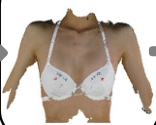
3D Geometry Model Generation Geometry models of the breast and bra were generated from the acquired 3D surface scans of a female subject in standing position after she found the best-fit bra in the fitting trials. The images were saved in ASCII format and loaded into the Rapidform XOR software. As the breast is a visco-elastic deformable body composed of skin, fat and gland (Gefen and Dilmoney, 2007) and the thorax is elastic rigid body, Boolean operations were used to define the breast boundary and intersection surfaces between the breast and thoracic regions.
Breast Sub FE Model Generation The FE models of the breast were generated from the IGS file acquired in Rapidform software. The thorax wall was modelled as a continuous volume and was assumed to completely restrain displacements as the posterior demarcation of the deformable model. Fat and glandular tissues were summarized as one component, and the skin was attached over the breasts as shell elements. The thorax and muscles are considered as one component with uniform mechanical properties. Eder (2013) summarized the mechanical properties of fibro glandular and fat tissues used in previous FE simulations of breasts with cancer cells, but the data for the normal breasts are very limited. Data reported in the literature was not validated because the mechanical properties of individual tissue types were derived from ex-vivo experiments on small specimens, which cannot be measured in-vivo. To solve this problem, the authors in a previous work (Chen et al., 2013) have validated the material parameters of breast tissue and skin by using a bared-breast running experiment. A less than 1% root-mean-square error RMS (Equation 1) of the predicted breast displacement was considered acceptable. Then the optimal values of body material parameters are determined.
F Nd N t Dij E−Dij
2 (1)
Equations and mathematical formulas are available in the original paper PDF.
E )
Dij
where Nt is the number of sample data points, Nd is the number of markers, DE, DF are the displacement obtained from Experiment and FE simulation.
For simulating the breast soft tissues, different material models such as linear elastic, piecewise-linear elastic, exponential elastic, and different hyper-elastic constitutive models were tried out. Eder (2013) concluded that hyper- elastic model is most suitable for modelling the breasts.
Geometry model
FE contact model
Simulation of Nude breast FE Mesh + Boundary conditions 3D surface scan
Breast motion test
Breast sub FE contact model
Validation for Mechanical material properties of breast BW
20
BL BR
Experiment resul t
0 0. 5 1 1. 5 2
Nipple
- 20
Predi ct ed result
Displacement(mm) t (s)
- 40
Bra fitting trials 3D surface scan
Bra sub-model Geometry model generation (Bra sub-model + Breast sub-model)
Pre-tension+ Load + Boundary Conditions
Material properties of fabric
Figure 1. Development of finite-element mechanical contact model
Bra Sub FE Model Generation
FE model of the bra was also generated from the IGS file acquired in Rapidform software. The bra cups, straps and bands are modelled as shells, while the gore is modelled as a beam. Table 1 shows the mechanical parameters and geometric parameters of the bra components.
Table 1. The mechanical parameters and geometric parameters of bra components (From experiment) Components Width(mm) Thickness(mm) Modulus E (kPa) Poisson’s ratio ν
FE Contact Model Generation The relationship between breast and bra during wear is complex. In this study, the model is based on the following assumptions:
(a) The human body is an elastic rigid volume and the breast is a flexible body with hyper-elastic properties.
(b) The bra is an elastic and continuous shell with material linearity and geometric nonlinearity.
(c) The contact between the breast and the bra is in a standing position, considering pre-tension of bra.
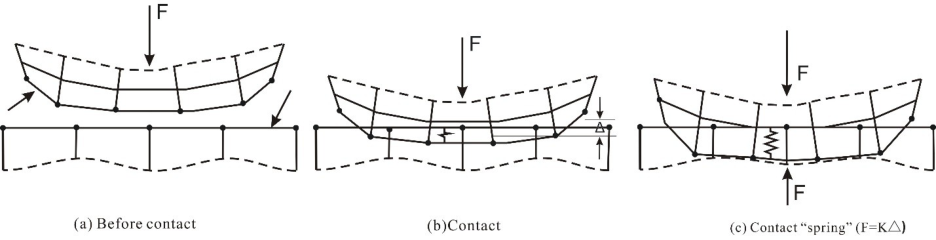
In finite-element modelling, the contact forces must be applied to each nodal point of each finite-element mesh. Based on the assumptions above, different contact elements are applied including surface-to-surface contact, node- to-surface contact, line-to-surface contact, and line-to-line contact, for tracking the contact position, transferring the contact stress and preventing the contact surface from mutual penetration. With the software Abaqus 6.12 (3D Experience Company, France), a combined algorithm of the Lagrange Multiplier, the Penalty Method and Solver Constraints is used to treat the frictional sliding contact problems.
Figure 3. Illustration of contact algorithm
At initial, there is pre-tension (20% tension) and gravity in the FE contact model. The boundary displacement is regarded as the displacement of rigid thorax. As the breasts are attached to the Pectoralis major muscle on the ribcage, the displacement boundary conditions were applied at the posterior surface of the breast.
Based on the Virtual Work Theory (Tan, 2007), the equation for this contact model is
(Equation 1)
while
(Equation 1-a)
(Equation 1-b)
(Equation 1-c)
(Equation 1-d)
(Equation 2)
where:
The whole contact model as an integration of all elements in Equation 2, is presented in Equation 3
(Equation 3)
RESULTS
The material parameters of breast tissue and skin were first obtained from the literature for the initial FE modeling of the thorax, two breasts and a skin layer. Then the parameters were iteratively changed until the predicted results are similar to the experimental results of the nipple displacement in orthogonal directions during bared-breast running as shown in Figures 4a to 4c. It is found that the predicted results matched well with the experimental results in both superior-inferior (z) and anterior-posterior (y) directions, with RMS <1%. In the medial-lateral (x) direction, the RMS is 3.83%, probably due to the large arm swung during the running experiment.
0 10 20
Experiment result-Z
N ip p le D isp la c e m e n
-40 -30 -20 -10
Figure 4a. Predicted result and experimental result of nipple displacement in z-direction
Figure available in the original PDF paper.
Experiment result-Y
-20
N i p p l e D i s p l a c e m -40
Figure 4b. Predicted result and experimental result of nipple displacement in y-direction
Figure available in the original PDF paper.
60
40
20
Experiment result-X FEM Predicted result-X
N ip p le D is p la c e m e n
Figure 4c. Predicted result and experimental result of nipple displacement in x-direction
Figure available in the original PDF paper.
Table 3 Root mean square error percentages of the predicted breast displacements during running Direction x y z
The correspondent values of Young’s moduli of the breasts and skin are shown as Table 4.
Table 4 Material parameters of different body parts
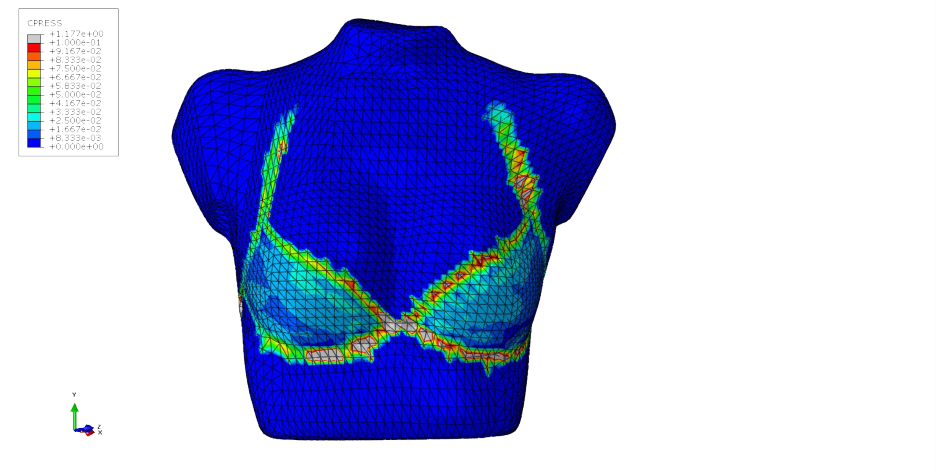
Using the validated material parameters, an FE contact model was developed to simulate the contact pressure between a well-fitting bra and a female subject's breast region. As Figure 6 shows, in this good-fitting condition, the maximum contact pressure is 0.1kPa distributed along the neckline of cup, wire, and the left straps. The cups have not much pressure because it is a natural fit bra. The pressure generated from the center gore to the wire and the straps is due to the tension pulling from the centre back hooks and the back neck. As the left strap has one layer of elastic band while the right strap has two layers for the sliding adjustments, the contact pressure on the left is higher than that on the right.
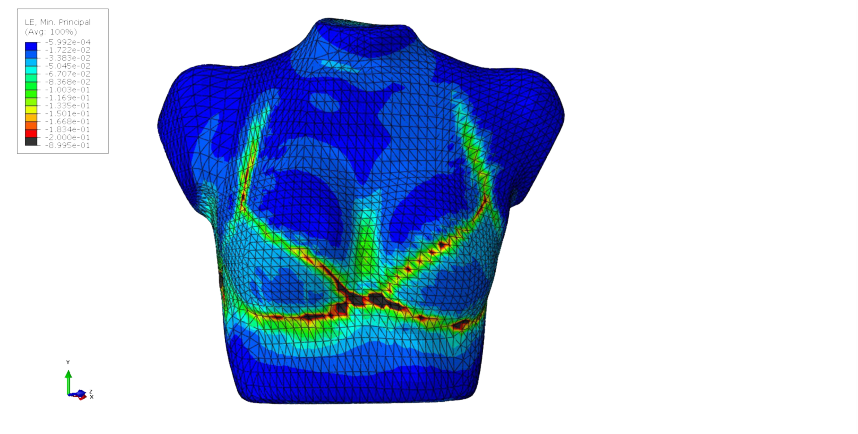
The contact pressure (Figure 5a) and deformation (Figure 5b) are small in the cups, but bigger in the gore and the wire because they are under the highest tension during natural fit bra-wearing. Applied Digital Human Modeling & Simulation (2020)
Figure 5a. Contact Pressure between bra and breastFigure 5b. Deformation between bra and breast
CONCLUSIONS
This paper presents a finite-element mechanical contact model of a simulated well-fitting bra being worn by a female torso. The body is in a standing condition and the pre-tension of bra is considered. This contact model is composed of a hyper-elastic breast sub-model with elastic skin and rigid thorax. The mechanical properties of breast sub-model are validated with experimental data of bare-breasted running. The bra cups are meshed as shell and the gore is regarded as a beam. The simulation results are: (1) The maximum contact pressure is distributed along the bra neckline, the wire, and the left straps in the well-fitting bra. (2) The contact pressure of single strap is higher than the double layers of straps. (3) The contact pressure and deformation in the gore and wire is the highest in a well-fitting bra. This FE contact model shows a promising approach for the calculation of force mechanics of body– garment interaction.
REFERENCES
Balaniuk R., Melo J., (2007). 3D Dynamic Simulation of the Breast, VII Workshop, de Informática Médica. Chen, L. H., Ng, S. P., Yu, W., Zhou, J., & Wan, K. F. (2013). A study of breast motion using non-linear dynamic FE analysis. Ergonomics, 56(5), 868-878. Fung YC, (1993). Biomechanics: mechanical properties of living tissues (2nd) Springer Verlag. Gefen, A. Dilmoney, B., (2007). Mechanics of the normal woman’s breast. Technology and Health Care, 15(4), 259-271. Hibbitt, Karlsson and Sorensen, (2012). ABAQUS Theory Manual: 745-792. Imaoka, H., & Atkinson, J. (1996). Three models for garment simulation. International Journal of Clothing Science and
Technology, 8(3), 10-21 Jonathan P. Whiteley D.J., (2007). Non-linear modelling of breast tissue. Mathematical Medicine and Biology, 24: 327−345. Kawabata, H., Tanaka, Y., Sakai, T., and Ishikawa, K., (1988). Measurement of Garment Pressure: I. Pressure Estimation from Local Strain of Fabric, Sen-i-Gakkaishi, 44, 142–148. Krouskop, T. A., Wheeler, T. M., Kallel, F., Garra, B. S., & Hall, T., (1998). Elastic moduli of breast and prostate tissues under
compression. Ultrasonic imaging, 20(4), 260-274. Lee Y.A., Hyun K.J., Tokura H., (2000). The effects of skin pressure by clothing on circadian rhythms of core temperature and salivary melatonin. Chronobiology international, 17(6):783-793. Li Y., Zhang X., Yeung K.W., (2003). A 3D bio-mechanical model for numerical simulation of dynamic mechanical interactions
of bra and breast during wear. Sen-i Gakkaishi, 59(1):12-21. Lu M. H., Yu W., Huang Q. H., Huang Y. P., Zheng Y. P., (2009). A Head-held Indentation System for the Assessment of the Mechanical Properties of Soft Tissues in vivo, IEEE Transactions on Instrumentation and Measurement, 58(9):3079-3085.
Makabe, H., Momota, H., Mitsuno, T., and Ueta, K., (1993). Effect of Covered Area at the Waist on Clothing Pressure,Seni- Gakkaishi, 49,513–521. Maximilian E., Stefan R., Jalil J., et al., (2013).Comparison of Different Material Models to Simulate 3-D Breast Deformations
Using Finite Element Analysis. Annals of Biomedical Engineering, 42(4): 843-857. Miyatsuji A., Matsumoto T, Mitarai S, Kotabe T, Takeshima T, Watanuki S, (2002). Effects of clothing pressure caused by different types of brassieres on autonomic nervous system activity evaluated by heart rate variability power spectral analysis. Journal of physiological anthropology and applied human science, 21(1):67-74. Nakahashi, M., Morooka, H., and Morooka, H., (2000). An Estimation of the Comfortable and Critical Clothing Pressure Values
on Legs, and an Analysis of Factors Affecting Those Values, Jpn. Res. Assn. Text. End-Uses, 41, 45–51 [in Japanese]. Perez del Palomar A., Calvo B., Herrero J., Lopez J., Doblare M, (2008). A Finite Element Model to Accurately Predict Real Deformations of the Breast, Medical Engineering & Physics, 30(9):1089-1097. Rajagopal R., Lee A., Chung J.H., Warren R., (2008). Creating individual-specific biomechanical models of the breast for
medical image analysis. Academic Radiology, 15(11):1425-1436. Rajagopal V., Nielsen P.M., Nash M.P., (2010). Modeling breast biomechanics for multi-modal image analysis- successes and challenges, Wiley Interdisciplinary Reviews: Systems Biology and Medicine, 2(3):293-304. Samani A., (2001). Biomechanical 3-D finite element modeling of the human breast using MRI data, IEEE Transactions on
Medical Imaging, 20(4):271-279. Sarvazyan A.P., Skovoroda A.R., Emelianov S.Y., (1995). Biophysical bases of elasticity imaging. EJ Jones (Ed.), Acoustical imaging, 21Plenum, New York, NY Sinkus R., Tanter M., Xydeas T., Catheline S., (2005). Viscoelastic shear properties of in vivo breast lesions measured by MR
elastography, Magnetic Resonance Imaging, 23:159-165. Skovoroda A.R., Dawson K.A., Gusakyan D.A, 1995. Quantitative analysis of the mechanical characteristics of pathologically changed soft biological tissues. Biophysics 40:1359–1364. Tan X. (2007). FEM Contact Analysis and its Application on the Release Mechanism Connected to a Plane. Xidian University
Dissertations 3:21-23. Wang, R., Liu, Y., Luo, X., Li, Y., & Ji, S. (2011). A finite-element mechanical contact model based on Mindlin–Reissner shell theory for a three-dimensional human body and garment. Journal of Computational and Applied Mathematics, 236(5), 867- 877. You, F., Wang, J. M., Luo, X. N., Li, Y., and Zhang, X., (2002). Garment’s Pressure Sensation (1): Subjective Assessment and
Predictability for the Sensation, Int. J. Clothing Sci. Technol.14, 307–316. Yu J., Cheung J.T.M., Fan Y., Zhang Y., Leung A.K.L. and Zhang M., (2008). Development of a finite element model of female foot for high-heeled shoe design. Clinical Biomechanics, 23(Suppl. 1), S31-S38.
LISTED IN THE AHFE DIGITAL BOOKSTORE CATALOGUE
Explore the complete digital volume
Advances in Applied Digital Human Modeling
Read this individual research paper free through the original publisher, or explore the full digital proceedings book.
ISBN 978-1-4951-2094-7
Explore this ISBN in the AHFE Bookstore ↗Listed in the July 2026 bookstore catalogue; search by ISBN to confirm current availability · Digital book purchase optional