Lisa Diwischeka, Jason Lissemanb, Stefanie Essersa (2021). Evaluation of and Design Implications for Force-Sensitive Touch Input Devices. In: Advances in Human Aspects of Transportation: Part I. AHFE Open Access, vol. 15. https://doi.org/10.54941/ahfe100634
The increasing amount of innovations in the functionality of car electronics (e.g. advanced driver assistance systems (ADAS) and in-vehicle infotainment systems (IVIS)) leads to new challenges in the research of human-machine-interaction. A recent trend in the automotive industry is the integration of resistive or capacitive touchscreens as input devices into the car cockpit, following a user demand which origins in consumer electronics. Nowadays typical resistive and capacitive touchscreens have certain drawbacks in their distraction potential and their usability, resulting in safety-critical situations and negative user feedback. In this paper a different technical approach towards touch input technology is proposed, which combines the advantages of both resistive and capacitive touchscreens, while eliminating their disadvantages. Two studies -a qualitative expert evaluation and a driving simulator study- evaluating the technology, are presented in this paper.
When designing for a human-machine-interface, the user-centered design process (EN ISO 13407, 2000) is a common approach in terms of optimizing the usability of the designed interface. This process involves iterative testing during research, prototype design, evaluation, and adaptation. At different stages of this process, different usability methods should be employed. In an early stage, rough impressions by experts may be sufficient for the adaptation of an early prototype, whereas the refinement should be conducted by end-users to ensure that the technology is tailored to the human needs, expectations and limitations in the best way possible.
This paper aims at presenting the evaluation and design implications of a technology under development in a user- centered design process. The first paragraphs concern haptic or rather tactile interaction basics and the current status of the technology. Its area of application, the automotive context, is briefly discussed considering multimodality, and to conclude, two usability studies are presented and discussed.
INTERACTION BACKGROUND Haptic interaction
Haptic interaction works bi-directionally; the afferent and efferent fibers enable interaction in both directions, towards and from the brain to the motoric cells. Motoric reflexes can react without intentional initiation of a response, being activated in the spinal cord (Antony W. Goodwin & Heather E. Wheat, 2008). There are two mechanisms of touch in laboratory experiments: passive and active touch.
Passive touch relies mainly on perception mechanisms. Experiments investigating passive touch involve discrimination or absolute sensitivity of the skin when touched passively with an object. Active touch, on the other hand, is the active exploration of an object and therefore its identification. This area incorporates the interplay between different tactile and kinesthetic perceptions, intentional motoric responses, and the cognitive integration (Goldstein, 2008).
Haptic perception in the area of virtual buttons, which is most relevant for the discussed interface, refers mainly to tactile vibration perception via Pacini-corpuscles. These corpuscles are about 1 mm in diameter, located in the subcutis, which is the lowermost layer of the human skin, and they are rapidly fast adapting cells (Halata & Baumann, 2008). They react to frequencies between 20 and 1500 Hz (“1-Consciousness-Sense-Touch-Anatomy- Receptors,” 2012), although their optimal perception is around 200 Hz and at amplitudes below 0.1 μm (Halata & Baumann, 2008). As the adaptation rate of these cells is very high, the perception works best with signals with a sinus-waveform (Birbaumer & Schmidt, 1996).
When a virtual button is activated on a touchscreen or decorative panel, a vibration signal is excited and perceived through the Pacini-corpuscles. This is a completely different mechanism than the push of a mechanical button. Mechanical button pushes are perceived and evaluated via the kinesthetic sense, namely the primary and secondary spindle receptors, which are signaling “the velocity and direction of muscle stretch or limb movement” (Lynette A. Jones, 2000). These cells give constant feedback and enable a subject precisely to allocate the force necessary for activation or deactivation of a mechanical button. There are some hints, that in active touch the perception of force is more important than the perception of the actual surface geometry, although normally they are correlated (to each other). When manipulated, so that they contradict each other, the force perception seems to override the surface geometry perception (Gabriel Robles-De-La-Torre & Vincent Hayward, 2001). This leads to the conclusion that the substitution of kinesthetic feedback via vibrational feedback needs careful design to feel realistic or even “natural” to a user.
Another consideration which has to be made, is that Pacini-corpuscles suffer in their perception abilities from certain age effects, where the perceptional ability decreases over time (Gescheider, Bolanowski, Hall, Hoffman, & Verrillo, 1994). When considering age effects in multimodal systems, it has to be mentioned that they also exist for the acoustic perception. Their extent and amount is dependent on the frequency of the signal (Freigang et al., 2011). There are no or little gender effects are present in terms of tactile perception, with slight higher sensitivity in female persons (Schroeder, 2010).
Conventional touch screen devices face the issue that the substitution of mechanical to virtual buttons is not simply a change in technology, but also in the underlying perceptual processes, as discussed above. The technologies and their characteristics are therefore an important factor when evaluating the interaction with a device.
Touch input devices There are different interfaces for touch input, such as push-buttons, toggle switches, rotary selector switches, or thumb-wheels, etc. For this paper, the focus is on push-buttons, as they are the most common button featured in the automotive context. This considers mainly the interaction of a user with a car, exempting the direct actuators, i.e. the pedal systems and the steering wheel. These mechanical buttons are placed everywhere around the driver: on the steering wheel, in the center stack, on the inside of doors and on the seat. Each original equipment manufacturer has own proprietary requirements and specifications regarding button design. Normally, they contain information about the physical displacement of the spring mechanism, the overall mechanics of the system, the actuation sound, the applied actuation force, and the actuation displacement. There is a certain trend in the automotive industry to substitute mechanical switches with capacitive touchscreens; touchscreen technology is therefore discussed in the following paragraphs.
Touchscreens were first invented in 1965 (Johnson, 1965). The two most common kinds of touchscreens in consumer products are resistive and capacitive touchscreens; surface acoustic wave and infrared touchscreens are too cost- or space-intensive (Philipp, 2013). Therefore, the focus will be on the former technologies.
Resistive touchscreens can be used with gloved hands or any non-capacitive material, but the response times can be very slow. Also, the visual perceptibility of resistive touchscreens is not optimal, especially in bright daylight, due to internal layer light reflection. This makes them a less than optimal solution for the automotive context, although the first touchscreen included in a series vehicle was a resistive touchscreen, the GM Riviera and Reatta (Cox, n.d.). The handling of the system seems to have been too difficult for the users (Badal, 2008). But compared to the following paragraph’s topic, capacitive touchscreens, resistive screens do have some advantages over capacitive technologies: they can be operated with gloves, which is a must in the automotive domain. They are also not as expensive as capacitive touchscreens and can –in contrast to capacitive screens - be used in different levels of humidity, which is also a basic automotive requirement.
Capacitive touchscreens sense the change of induced capacity on the surface of the screen. This means that the identification of activation is realized by a change in the induced electrical field over the surface of the technology. A human hand can function as an electronic conductor; “touching” the screen, or more specifically leading a finger into the capacitive field, leads to a distortion of the field. Wearing gloves often makes it impossible to use a capacitive touchscreen, not to speak of when users who have hand prostheses. Because the sensing is based on an induced electrical field, faulty activation can happen quite easily- activation and deactivation are not precise. Another problem can occur due to the fact that the induced field measures a longer activation of the screen than actually intended by the user. A longer sensing of the activation leads to a delayed deactivation, which may cause faulty activation of a function. The accuracy of capacitive touchscreens is therefore not very high (Philipp, 2013). In the automotive context, due to road vibration, a faulty activation by activating a nearby button instead of the button intended is of high probability with capacitive touchscreens. This leads to certain drawbacks in their distraction potential and their usability, resulting in safety-critical situations and negative user feedback, like with the center stack controls of one of the Ford MyTouch systems. This system is a fully touch-based control panel in the center stack. Ford decided to refrain from this strategy for future models after a tremendous amount of negative user feedback (Ramsey, 2013), which included complains about the lack of tactile feedback on the virtual buttons.
Another topic is the time between intended activation, actual activation, actual deactivation and tactile feedback. The latency of today’s touchscreens in consumer electronics can range between 70 and 170 mS (Agawi, 2013). Typically Eccentric Rotating Masses (ERM’s) or Linear Resonating Actuators (LRA’s) are coupled to the screen or housing to create a tactile feedback upon the detection of an activation. Initiating these tactile feedback events can additionally have a perceived lag which may vary between 30-50mS for ERM’s and 20-30mS for LRA’s (Huotari, 2012), depending on the technology used. Compared to the instantaneous feedback of mechanical buttons, this performance is debatable. While the fastest combination, 90 mS, lies well below human perception thresholds, a total time of 220 mS can definitely not compete with mechanical button advantages in usability. Most capacitive systems that utilize some form of tactile feedback device focus their efforts on detecting an activation – but little focus on providing any tactile feedback for an actual deactivation. This is because detecting an actual deactivation event for a capacitive screen is not possible – as the finger will have already left the touch surface before the capacitive sensing system can actually register a true deactivation.
An additional problem with these systems can be that they normally transfer the vibrational feedback directly through the whole device (Barua, 2013) and that they always have a certain delay (Snell, 2008). Therefore, the instantaneous feedback of mechanical buttons cannot be imitated fully by virtual buttons, no matter how precise they may be.
Every single drawback may also have effects on the subjective quality perception of the interaction and user contentment, particularly when the primary driving task shifts to the secondary tasks, as intended by the designers of consumer electronic devices. These types of feedback were originally designed to be in the primary focus of the user, instead of being performed concurrently with a complex additional task, such as driving. A safe and direct transfer of this technology is therefore very challenging. Original equipment manufacturers (OEMs) are caught between two technologies, which are not suitable or suboptimal for implementation in the automotive domain, but nevertheless feel the need to do so, due to a market pull from their customers, which is originally a technology push from the consumer electronics market.
Taking into account the negative user feedback when introducing capacitive touchscreens into the automotive market as a substitute for any current mechanical button, it is clear that a much more accurate force sensing for activation as well as deactivation is necessary, than is technologically feasible with capacitive touchscreens. Also, the vibrational feedback needs to be spatially optimized and accurate. On the other hand, visibility issues and suboptimal deactivation of resistive touchscreens (which do give a natural kinesthetic response, as the two layers are pushed together) should not happen for displays or buttons in the automotive context. To avoid the impression of being sluggish, the feedback must follow the user activation and deactivation immediately.
The system which was evaluated in the two studies discussed in this paper has a tactile response time under 30mS after the surface application of force. As human tactile perception averages in experiments at about 155mS
((Robinson, 1934), after (Kosinski, 2012)), this latency is sufficiently small and can be considered as instantaneous feedback.
MULTIMODALITY IN THE DRIVING CONEXT There have been different approaches in the research on the integration of multimodal functions in the driving context, which can be divided into the two main categories of comfort and safety functions, such as in-vehicle- infotainment systems (IVIS) and advanced driver assistance systems (ADAS).
The research of IVIS tasks, such as making a phone call, showed that the driver distraction1 does not necessarily decrease, when the multiple use of one resource is split and differentiated across different modalities. There seems to be sufficient evidence, that making a phone call is not a matter of motoric distraction from the steering wheel, but rather of cognitive distraction (Spence & Ho, 2008). These findings are also consistent with the results from Harbluk, Noy, & Eizenman (2002), which have found that the eye glance behavior as a measure of attention shifting did show similar patterns between hand-held and hands-free devices. The difficulty of the task also has a clear influence on the division of attention (Metz & Krüger, 2011). The shift of comfort functions to another modality seems to come at certain cost, regarding the overall workload of a driver (Vollrath & Totzke, 2003). These studies are all conducted in the context of driving without assistance or with common ADAS systems. For these circumstances, the additional attention demands from other tasks are endangering the driver and other traffic participants, and should be as much restricted and avoided as possible. Nevertheless, due to increasing automation in the automotive market, there may be situations where the use of such systems by a driver or even an intended, implemented distraction of the driver may become a necessary tool of keeping the driver in the loop and awake as an operator of an automated system. The focus of this paper, however, is on the development of virtual multimodal buttons for existing systems and those which will be introduced in the near future, so automation issues are not discussed here.
When it comes to safety-critical warnings, other factors have to be considered. Multimodal warning strategies are a sensible approach that lead to faster reaction times (Sarter, 2006), not only in terms of velocity, but also regarding adequacy. It is very time consuming to transfer semantically meaningful information without a visual display (cp. e.g. Fricke, 2009): an acoustic warning without any implications for the cause may lead to orientation reactions, consuming irrevocable, important milliseconds of a driver’s reaction time.
In contrast to these most common scenarios and use cases, the interaction technology presented in this paper is not in itself allocable to one of the two main applications, IVIS and ADAS. It could be used for both, and a focus on one at an early development stage as present seems not necessary to derive the most basic requirements: distraction and workload from a secondary task should be minimized as possible, so the interaction should run as smooth as possible.
A button push can count as a microinteraction. „Microinteractions is about those critical details that make the difference between a friendly experience and traumatic anxiety” (Norman, 2013). It is crucial for any use case, independent of the application, that these microinteractions run smoothly- if they are not thoroughly designed, even a very sophisticated interaction design in terms of user experience and usability will inevitable fail.
The location of the buttons is with the present technology not one of the main considerations. From a technical viewpoint, it is feasible to install this technology in the center stack, the steering wheel, the doors, the seats, or anywhere in the manual reachability of the driver. For the present evaluations, the button location was limited to the steering wheel. These steering wheels with interaction possibilities other than the steering input are called multifunctional steering wheels and nowadays implemented in nearly every OEM model, except for very low-cost cars. The buttons which are implemented are conventionally mechanical buttons, which are restricted in terms of 1 Note that the term „driver distraction“ is used here in the definition by Reagan, Hallet & Gordon (2011): “diversion of attention away from driving, or safe driving; attention is diverted toward a competing activity, inside or outside the vehicle, which may or may not be driving-related; the competing activity may compel or induce the driver to divert attention toward it; and there is an implicit, or explicit, assumption that safe driving is adversely effected”.
space, size and packaging. This is a cost driver for production and a challenging restriction for the automotive creative designers. Another issue is that due to mechanical constraints, the optimization of the button feel is restricted due to mechanical requirements and compromises. Both challenges can be met with the present virtual button concept, as they are lightweight, small, and flexible in packaging as well as freely adjustable in terms of feedback and force sensing thresholds.
The virtual button concept evaluated utilizes an accurate force detection sensing technology, not currently available in the public domain, which is capable of not only detecting the applied force, but the location of the applied force. This is combined with a new tactile feedback technology that is capable of generating a large range of fast tactile responses.
Two of the evaluations are presented in this paper, the first one being an expert evaluation at the very beginning of the development process, and the second one a first user study concerning one part of the design of the interaction.
EXPERT EVALUATION
Background
In the expert evaluation, the main goal was to investigate the general application of the technology and its general preferred design. An expert evaluation is a heuristic evaluation (Nielsen & Molich, 1990) of experts in a specific field. It is a very useful procedure when the exact application or set of features is not determined yet. Expert evaluations are more qualitative than the normal user test, but give less information in a quantitative way, as the number of subjects is normally kept very low (3-5 as a rule of thumb (Jeffries & Desuvire, 1992)). Nevertheless it has been demonstrated that expert evaluations can be far more effective (Jeffries & Desuvire, 1992). It cannot be generally stated that expert evaluations are better than actual user tests, but rather that they focus on different aspects. The importance of the right experts for the usability evaluation cannot be underestimated, as this is the main factor securing the quality of their feedback. A combination of technical knowledge and usability background usually leads to the best results (Nielsen, 1992).
Method
Figure 1. Virtual button surface (prototype).
Figure available in the original PDF paper.
As the most important factor is the expertise of the experts evaluated, the selection of experts was carried out according to the two factors mentioned above: their relation to the technical background and their experience in usability issues. Another factor to consider was that they should contribute different perspectives to the research. In the automotive industry, every OEM aims at a unique design and the highest consistency possible in design. This extends to the sound and feel of mechanical buttons as well. In a development stage as early as this, it would not make so much sense to focus on one OEM only. Hence, the second selection criterion was that among the experts, there should be at least two experts from different OEMs. The third criterion was that although the experts should have some understanding of the technology and of usability, it was aimed to get an interdisciplinary view on the parts of the interaction. The fourth criterion concerns the difference between research and development. Experts were chosen from both domains because whereas research experts generally speaking tend to be more open towards new and innovative prototypes, experts working in development have a better understanding on feasibility. Accordingly, the experts were chosen from different professional backgrounds, OEMs and experiences in development stages, with experience or background in usability. They were one female and four male experts. Four experts worked in industry, one at a university. Two experts had only one OEM as a background, one two, and the remaining two worked for various OEMs.
The interaction surface used in the study was a modified series multifunctional steering wheel produced by
TAKATA. On the left side (the spoke in the 9 o’clock position), the conventional mechanical buttons were left unmodified. On the right side (the spoke in the 3 o’clock position), virtual buttons consisting of the new technology were implemented. Different activation/deactivation force and tactile as well as acoustic feedback settings of the virtual buttons could be controlled by an external laptop.
A red piece of fabric was used during blind testing to cover up the prototype steering wheel. All interviews were recorded with a dictating machine.
When the interviews started, subjects could see the hidden prototype only, yet did not interact with it. The interviewer and the company were briefly introduced before the interview started. The experts were first asked some general questions about demographic data and their driving experience and car usage, before the core interview started. A connection to the prototype was established via questions regarding multifunctional steering wheel familiarity and usage questions. In the next part, the prototype was evaluated without visual display and remained hidden under the fabric. The tactile feedback was not activated at this point. The next part contained blind testing still, with the additional activation of the tactile feedback in a fixed, standardized setting for every expert. Following this evaluation, the prototype was revealed and examined with the support of the visual modality. The subsequent and biggest part of the interview consisted of different threshold settings for activation and deactivation force, as well as tactile and acoustic feedback. The next part consisted of questions regarding possible functional applications and general value appeal questions. Each interview lasted between 1,5 and 2,5 hours.
Results
The interviews were first transcribed into spoken language and then analyzed following the procedures suggested by qualitative content analysis (Mayring, 2000). Categories were developed inductive from the interviews given, but nevertheless followed the raw interview structure proposed in the precedent paragraph. Reliability in qualitative content analysis is limited to inter-coder-reliability, which was ensured due to multiple coding, category development, and comparison of the coded material. The category development thereby followed the proposal made by Mayring (2000) and Philipp (2000).
Most of the participants used their vehicle for everyday purposes, whereas longer journeys or special events were rather rare. Vehicles of all kinds of classes were driven, and everyone was familiar with the usage of multifunctional steering wheels, which shows that the market penetration of this technology seems to be rather high or that the experts were all interested in technology. The focus of the interaction were in most cases directly related to the primary driving activity; the multifunctional steering wheels were used mostly to derive feedback about primary driving task activities such as fuel consumption. IVIS functions were rarely used.
The blind evaluation showed preference of physical boundaries in terms of small ridges over material characteristics only, for example temperature differences. The tactile standardized feedback brought up very diverging opinions concerning intensity and precision. There were also some difficulties for the experts in the standard setting to differentiate between tactile and acoustic feedback. The visual uncovering modified the tactile blind evaluation for some experts. Overall, the appearance and structure of the interface were evaluated positively. There was no preference for a market segment regarding the value appeal questions. Functions which could be covered showed to be highly OEM-dependent and therefore not a topic of discussion here. The different activation and deactivation points as well as the tactile and acoustic feedback setting showed some tendencies, but had also a lot of variability.
DRIVING SIMULATOR STUDY
Background
Although the expert evaluation did produce some good results, the exact settings for specific thresholds remained unclear. For determining these thresholds, several driving simulator studies were designed. One of those is topic of the following paragraphs.
One of the main questions in term of virtual button design is the exact tactile and acoustic feedback setting configuration. As these virtual buttons under discussion are activated by force, the tactile and acoustic feedback is launched at the point of activation of the button, simulating a mechanical button’s “click”.
Method
The experiment took place in a static driving simulator. The study consisted of the independent variables button force, condition, and a feedback combination set with three vibrational and three acoustic feedback settings (high, medium, and low), each combined with each other. All feedback combinations have been designed for their discriminability (using just notable difference calculation) and pre-tested with subjects who would be considered the oldest age group if they were really perceivable as well as perceivable to be different.
In total nine feedback combinations were each combined with two stages of button force (easy and hard). The two conditions mentioned were a sitting only condition in the driving simulator and the other one with driving. A familiarization drive took place previous to the driving with the feedback tests. All settings, force, and condition combination possibilities were tested by each subject, in other words the study was a within design.
A mix of dependent variables was evaluated. A subjective preference rating took place in form of pairwise comparison (David, 1959) between two feedback combinations, and error rate, time-on-task, the maximum applied force, and the driving performance while performing a task (pushing the button as fast as possible in a determined number of pushes) were evaluated for each feedback combination. Demographic data was collected at the beginning of the experiment, and finger temperature was measured before and after the experiment as well.
The sample consisted of 40 subjects with an equal gender distribution. They were distributed over five different age groups (18-29, 30-39, 40-49, 50-59, and > 60).
Results
Pairwise comparison
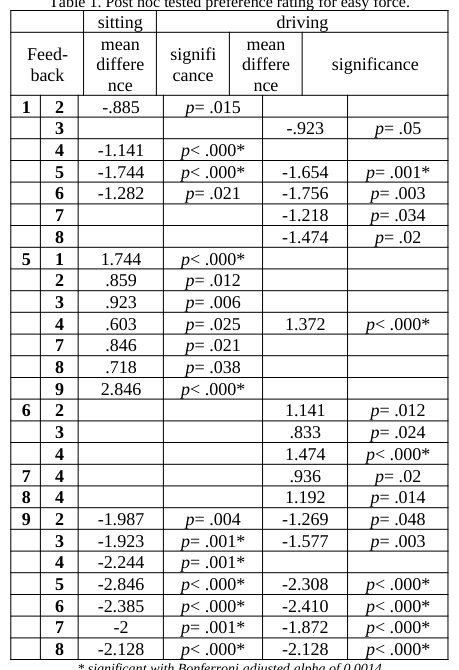
Table 1. Post hoc tested preference rating for easy force.
The pairwise comparison has different quality criteria: the differentiability of the subjects, which means their ability to perceive differences between two feedback combinations; the consistency of their ratings, which means their ability to use the same judgment criterion over the whole pairwise comparison; and concordance, which indicates the similarity in judgments across subjects. At the end of the examination of these criteria, an ANOVA was calculated.
The concordance of the subjective rating (calculated after Bortz, Liener, & Boehnke (2008)) was significant over all four conditions with χ²(38.97) = 121.81, p< .001. Calculating the concordance for each comparison where there was a comparison between two settings which were one-dimensional at one level, the concordance was significant (p> .05) for both tactile and acoustic settings. There was no significant difference between the two forces.
According to a calculation using the law of comparative judgment, the extreme settings were the least preferred ones when acoustic and tactile setting was both either highest or lowest.
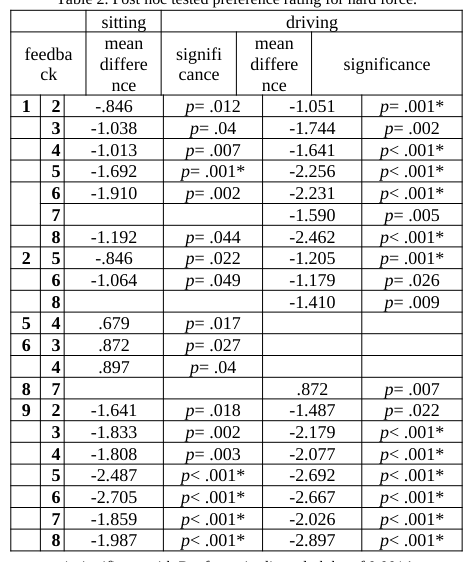
This statement could be supported by a Greenhouse-Geisser-corrected2 ANOVA with a Bonferroni adjusted alpha of 0.0014 for each force, easy (F(3.62, 137.58)= 6.286, p<. 001, = .142) and hard (F(3.83, 145.53)= 9.198,
Table 2. Post hoc tested preference rating for hard force.
p< .001, = .195). In comparison to other settings, the highest and, to a little lesser extent, the lowest feedback combination, were the least preferred feedback settings (see Error: Reference source not found and Error: Reference source not found).
Objective measurements There were significant (ranging from * p<.05, **p<.01, up to ***p<.001) more errors when the vibrational feedback was at the lowest setting, over both conditions and forces with one exception: when the lowest vibrational feedback was coupled with the highest acoustic feedback, the error rate became significant in the driving condition only.
No significant differences could be found regarding time-on-task. This is applicable over the different conditions, forces, and feedback settings.
* significant with Bonferroni adjusted alpha of 0.0014
Concerning the applied force, there were significant differences found in a Greenhouse-Geisser-corrected² (F(4.104, 82.073)= 3.012, p= .022, = .131.) ANOVA with a Bonferroni adjusted alpha of 0.0014 for the lowest setting (both tactile and acoustic) to setting three (lowest tactile and highest acoustic feedback) in the easy force condition. No other effects were found for applied force.
DISCUSSION
There are different implications from the two studies: the first one regarding qualitative statements from the experts, which gave clear impressions on general directions but no results about the feedback categories and the activation and deactivation force. Several studies have been planned, and one conducted study was presented in this paper. No significant age, gender, smoking habits, or finger temperature effects could be found; this is a good indicator for the general ability of humans to perceive the feedback of the buttons. Nevertheless, the sample is far too small to generalize these results. A validation of these findings needs to be conducted with a much larger sample for series production. Additionally, further studies need to consider the activation and deactivation force in more detail. The general push-button sequence needs to be evaluated further in terms of other characteristics than feedback, for example timing between activations, more investigation on the role of sound, and materials and their influence on the microinteraction. The general results of the simulator study discussed seem to point in the direction of a balanced feedback design. And because there are clearly some masking and overlay effects between the two modalities, it cannot be validated that subjects did not switch modalities in their preference rating of the virtual buttons very often. As a consequence, another method than the pairwise comparison, which does minimize the switching possibility between those levels, should definitely be considered in the design of future studies.
CONCLUSIONS
In summary, a first step of the careful evaluation of the discussed touch input device for designing a holistic 2 The law of sphericity was violated.
microinteraction feedback for the driver has been made. It was conducted using different methods and tools according to the user-centered design process. The technology is cost-effective and applicable to a variety of vehicle categories and use cases, making it suitable for a broad range of users with different requirements. The multimodal feedback is evaluated to minimize the cognitive and physical load of the driver, and will be optimized for making the interaction most comfortable for the driver, investigating its efficiency, effectiveness, and user satisfaction. There are further steps to be taken and new methods to be developed. When these methods are implemented and refined through further testing, it will support the iterative redesign and configuration of the virtual buttons technology discussed in this paper. Especially, in an automotive context, the proposed device should then be able through its accuracy to minimize driver distraction and frustration, and enhancing the driving experience while improving driver safety.
ACKNOWLEDGEMENTS
We would like to thank Mareike Last (M.Sc.) and the Department of Psychology and Ergonomics, Chair of Mensch-Maschine-Systeme at the TU Berlin, especially Prof. Dr.-Ing. Matthias Rötting and Dr.-Ing. Katja Karrer- Gauss, for their contribution to this work.
REFERENCES
1-Consciousness-Sense-Touch-Anatomy-Receptors. (2012, February 5). Outline of Knowledge. Retrieved July 8, 2013, from http://www.outline-of-knowledge.info/OKD/1/Consciousness/Sense/Touch/Anatomy/ Receptors/1-Consciousness-Sense-Touch-Anatomy-Receptors.html Agawi. (2013, October 8). TouchMarks II: Touchscreen Latencies in Flagship Tablets. Retrieved from http://appglimpse.com/blog/touchmarks-ii-touchscreen-latencies-in-flagship-tablets/ Antony W. Goodwin, & Heather E. Wheat. (2008). Physiological mechanisms of the receptor system. In Grunwald,
M. (Ed.), Human Haptic Perception. Badal, J. (2008, June 23). When Design Goes Bad Lessons from some spectacular product flops. Wall Street Journal. Retrieved from http://online.wsj.com/news/articles/SB121390461372989357 Barua, A. (2013, June). Dynamic Haptic Feedback in Comparing Spatial Information (Masterarbeit). University of
Tampere. Birbaumer, N., & Schmidt, R. (1996). Biologische Psychologie. Berlin: Springer. Bortz, J., Liener, G. A., & Boehnke. (2008). Verteilungsfreie Methoden in der Biostatistik. Heidelberg: Springer Medizin. Cox, R. W. (n.d.). 1986, Electronics Developed for Lotus Active Suspension Technology. Retrieved July 5, 2013,
from http://history.gmheritagecenter.com/wiki/index.php/1986,_Electronics_Developed_for_Lotus_Active_Susp ension_Technology David, H. (1959). The method of paired coparisons. Proceedings of the fifth conference on the design of experiments in army research development and testing, 1–16. Freigang, C., Schmidt, L., Wagner, J., Eckardt, R., Steinhagen-Thiessen, E., Ernst, A., & Rübsamen, R. (2011).
Evaluation of Central Auditory Discrimination Abilities in Older Adults. Frontiers in Aging Neuroscience, 3(6). Fricke, N. . (2009). Gestaltung zeit- und sicherheitskritischer Warnungen im Fahrzeug. Dissertation. Gabriel Robles-De-La-Torre, & Vincent Hayward. (2001, July 26). Force can overcome object geometry in the perception of shape through active touch. Nature, pp. 445–449. Gescheider, G., Bolanowski, S. J., Hall, K., Hoffman, K., & Verrillo, R. (1994). The Effects of Aging on
Information-Processing Channels in the Sense of Touch: I. Absolute Sensitivity. Somatosensory & Motor Research, 11(4). Goldstein, E. B. (2008). Wahrnehmungspsychologie. Berlin: Spektrum Akademischer Verlag. Halata, Z., & Baumann, K. (2008). Anatomy of receptors. In M. Grunwald (Ed.), Human Haptic Perception (pp.
85–92). Berlin: Birkhäuser Basel. Harbluk, Noy, I. L., & Eizenman, M. (2002). The impact of cognitive distraction on driver visual behaviour and vehicle control. (p. 29). Ontario K1A 0N5 Canada: Transport Canada. Huotari, V. (2012, December 13). Tactile actuator technologies. Presented at the Seminar Haptic Interaction in
mobile environments. Retrieved from http://www.uta.fi/sis/tie/him/schedule/Vesa_Huotari_presentation.pdf
Jeffries, R., & Desuvire, H. (1992). Usability Testing vs. Heuristic Evaluation: Was there a contest? SIGCHI Bulletin, 24(4), 39–41. Retrieved from http://csi.ufs.ac.za/resres/files/p39-jeffries.pdf Johnson, E. (1965). Touch Display - A novel input/output device for computers. Electronics Letters, 1(8), 219–220. Kosinski, J. R. (2012, September). A Literature Review on Reaction Time. Clemson University. Retrieved July 8,
2013, from http://biae.clemson.edu/bpc/bp/lab/110/reaction.htm#Mean%20Times Lynette A. Jones. (2000). Kinesthetic Sensing. In Human and Machine Haptics. MIT Press. Mayring, P. (2000). Qualitative Inhaltsanalyse. Forum Qualitative Sozialforschung, 1(2), 10. Retrieved from https://www.ph-freiburg.de/fileadmin/dateien/fakultaet3/sozialwissenschaft/Quasus/Volltexte/2- 00mayring-d_qualitativeInhaltsanalyse.pdf Metz, B., & Krüger, H.-P. (2011). Distribution of visual attention during distraction: Influence of demands of the
driving task and of the secondary task. In The Second International Conference on Driver Distraction and Inattention (p. 12). Gothenburg, Sweden. Nielsen, J. (1992). FINDING USABILITY PROBLEMS THROUGH HEURISTIC EVALUATION. In Proceedings of CHI ’92 (pp. 373–380). ACM. Nielsen, J., & Molich, R. (1990). HEURISTIC EVALUATION OF USER INTERFACES. In CHI 90
Proceedings (pp. 249–256). ACM. Norman, D. (2013). Foreword. In Microinteractions. Sebastopol, CA: O’Reilly Media. Philipp. (2000). Qualitative Inhaltsanalyse. Philipp (2000, Juni). Qualitative Inhaltsanalyse [28 Abs?tze]. Forum Qualitative Sozialforschung / Forum: Qualitative Social Research [On-Line Journal], 9(31). Retrieved from http://nbn-resolving.de/urn:nbn:de:0114-fqs0803314. Philipp, H. (2013, April). Please Touch! Explore The Evolving World Of Touchscreen Technology. Retrieved July
25, 2013, from http://electronicdesign.com/components/please-touch-explore-evolving-world-touchscreen- technology Ramsey, M. (2013, June 16). Ford to Add Back Dashboard Buttons After Complaints. June 2013). Wall Street Journal. Abgerufen Am. Retrieved from http://online.wsj.com/article/SB10001424127887323566804578549351972660468.html Robinson, E. S. (1934). Work of the integrated organism. In C. Murchison (Ed.), Handbook of General
Experimental Psychology. Worcester, MA: Clark University Press. Sarter, N. B. (2006). Multimodal information presentation: Design guidance and research challenges. International Journal of Industrial Ergonomics, 36(5), 439 – 445. doi:http://dx.doi.org/10.1016/j.ergon.2006.01.007 Snell, L. D. (2008). Force and moment analysis of stacked counter rotating eccentric mass tree shaker energy-
wheel system (Masterarbeit). Iowa State University, Iowa, USA. Spence, C., & Ho, C. (2008). Multisensory interface design for drivers: Past, present and future. Ergonomics 51(1), 51(11), 65–70. Vollrath, M., & Totzke, I. (2003). Möglichkeiten der Nutzung unterschiedlicher Ressourcen für die Fahrer-
Fahrzeug-Interaktion: Using Multiple Resources for the Drivier-Vehicle-Interaction. Düsseldorf: VDI- Verlag.
LISTED IN THE AHFE DIGITAL BOOKSTORE CATALOGUE
Explore the complete digital volume
Advances in Human Aspects of Transportation: Part I
Read this individual research paper free through the original publisher, or explore the full digital proceedings book.
ISBN 978-1-4951-2097-8
Explore this ISBN in the AHFE Bookstore ↗Listed in the July 2026 bookstore catalogue; search by ISBN to confirm current availability · Digital book purchase optional