Matti Schwalk, Stephan Hetzinger, Thomas Maier (2021). Experimental Studies on Driver’s Expectations Regarding the Positions of Display and Control Elements in the Car Cockpit. In: Advances in Human Aspects of Transportation: Part II. AHFE Open Access, vol. 16. https://doi.org/10.54941/ahfe100699
Institute for Engineering Design and Industrial Design (IKTD), Research and Teaching Department Industrial Design Engineering, University of Stuttgart, Germany ↗
The number of functions within the car cockpit is increasing continuously independent from the class of vehicle. The driver’s cognitive resources are mainly occupied by the traffic, while there are several other possible tasks which can be diverting. Driver’s tasks include tasks of controlling the vehicle, checking relevant display information, adjusting navigation or infotainment systems etc. Despite these sources of diversion in safety relevant situations the driver must be able to find crucial display and control elements immediately and without confusion to avoid an accident. In these situations the driver is using evolutionary developed patterns of behaviour which are activated unconsciously and differing from learned system knowledge. The present work is meant to reveal driver’s expectations regarding the positions of relevant interface elements in the car cockpit. Results are concluded on the basis of a standardised cockpit to give independent design recommendations. The effects and relevance of intuitively expected positions in comparison to unfavourable positions of different interface elements are verified by reaction time measurements.
INTRODUCTION Significance An important example for a safety relevant traffic situation is the need of activating the hazard lights immediately if the car has stopped in case of damage or getting into a sudden traffic jam. Another scenario can be the urgent need of blowing the horn if being overseen by another driver. Beside these most important cases there are lots of further display and control elements which can influence the driver’s attention and ability of focussing on the traffic. There are guidelines for ergonomic positioning and arrangement of display and control elements in the car cockpit, cf. primary and secondary control elements in DIN EN ISO 15005, but most of them are still not adapted to the current range of functions in modern car cockpits. In case of emergency it is absolutely necessary to find important interface elements intuitively to avoid an accident. Surely every driver should be aware of all important functions of his own car to be able to react adequately in critical situations. Though there is still a huge amount of vehicles which are used as rental cars or part of a vehicle fleet with almost daily changing drivers. In these cases it is even more important that most relevant interface elements can be found intuitively because drivers of these cars hardly check the whole system of the car before driving and cockpit designs vary between different manufacturers.
Modern Car Cockpit Design Today’s cars provide by far more functionality than necessary to accomplish the task of driving. While the first vehicles were limited to these basic functions, there have been integrated more and more additional elements like speedometer, tachometer, radio and heating followed by electric windows, air conditioning or phone- and navigation systems. Currently there is a huge progress in developing driver assistance systems as well as integrated infotainment including internet connectivity. The result of this technological development has been an increasing number of display and control elements in the car cockpit. To handle this complexity many manufacturers established a central rotary push control like the BMW iDrive or Audi MMI to perform many different operating tasks by using just one single control element. After recognising that this can cause some problems regarding intuitive operation leading to increased mental workload in some situations, most manufacturers started to add additional controls around the rotary push control again. Further technologies are head-up displays, touchpads, voice control and multifunctional TFT displays. In general there is a huge amount of functions in modern cars and there are also many possibilities of positioning displays and controls in the cockpit.
Standards and Guidelines One of the most important tasks of the cockpit engineer is to make sure that all drivers of a corresponding profile are able to reach all crucial controls and operate safely while driving (Tiemann, 2005). There are several standards in designing car cockpits to achieve these demands as well as possible. After Tiemann (2005) a common procedure is the hand and foot reachability determination in accordance to guideline SAE J287 (Society of Automotive Engineers). Thereby mostly the digital human model of RAMSIS software by Human Solutions is used. After defining significance and frequency of use of crucial interface elements the virtual human model can be used to evaluate reachability in different situations (Tiemann, 2005).
Besides different SAE guidelines there are also some norms for the positioning of interface elements in the car cockpit, for example: BS ISO 4040 (2009): Road vehicles – Location of hand controls, indicators and tell-tales in motor vehicles. For hand reachability issues also ISO 3958 (1996) is used, while DIN EN ISO 15005 (2003) describes ergonomic standards regarding driver information and assistance systems. Gaze behaviour is addressed with DIN EN ISO 15007-1 (2002) and discussed below.
In general most of the described guidelines are out of date concerning recent technology standards and the huge amount of functions in modern car cockpits. This is why there are several differences regarding the positioning of displays and controls between various manufacturers and partially even within one brand due to different vehicle models and classes.
OBJECTIVE AND MOTIVATION Gaze Behaviour
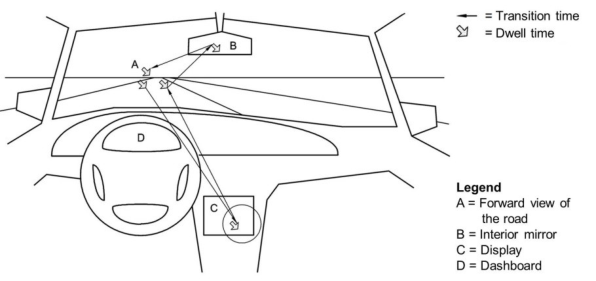
As far as there is no blind operation the driver’s gaze always orientates towards the target respectively the control element before the operation itself. When reading a display first the area of the display is the target before the actual display information can be focused and recognized (DIN EN ISO 15007-1, 2002). Figure 1 shows an exemplary situation of reading a display while driving.
Figure 1: Gaze behaviour in car cockpit, based on DIN EN ISO 15007-1 (2002)
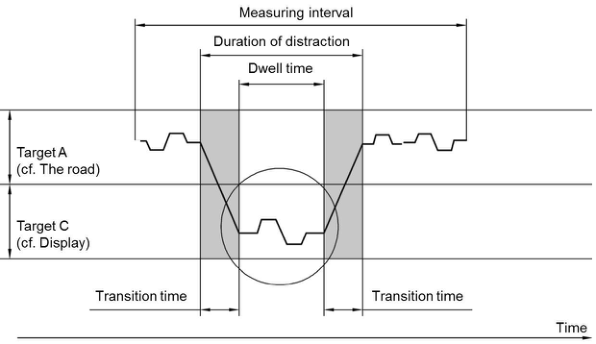
The duration of distraction consists of the transition times for finding an interface element (target C), getting back to the initial area (A) and the dwell time of the gaze on the respective display or control until the demanded information is encoded by the human information processing (figure 2).
Figure 2: Duration of averting gaze off the road, based on DIN EN ISO 15007-1 (2002)
By ergonomic and intuitive cockpit design transition times as well as dwell times can be reduced to achieve a safer driving situation. Through the positioning of important and safety relevant displays and controls within the central visual field transition times can be minimized. Also a clear differentiation of interface elements from the vehicle interior by shape, colour and contrast can support short transition times.
Motivation A survey by the German Automobile Club ADAC has shown that even since the late 1980s many drivers have stated, that “inconsistent, sometimes difficult usability” is bothering them the most about their cars (Färber & Färber 1987). Of course in safety relevant situations it is not acceptable that the driver is struggling with the usability of his vehicle while he should focus on the traffic situation and be able to act and react intuitively. Intuitive operation requires proper design and positioning of interface elements in a way, that persons who haven’t been driving for a longer period of time or switching to another type of vehicle are able to manage the operating safely and clearly at all times (Färber & Färber 1987). This kind of intuitive design is the motivation for the present work. Besides many standards and guidelines regarding ergonomic cockpit design the aim is to reveal the driver’s intuitive expectation of where crucial displays and controls are positioned, when faced with different cockpit designs. The driver’s expectations are based on habits including practice, learning and frequent execution (Enzyklo, 2013a) or pure intuitive determination meaning the ability of the human mind to register a situation immediately (Enzyklo, 2013b).
EXPERIMENT PREPARATION Approach
The presented experimental studies on driver’s expectations regarding the positions of display and control elements in the car cockpit were prepared with a systematic selection of different vehicle classes and manufacturers. Relevant interface elements were classified in terms of frequency of use and importance respecting safety issues. The classification is segmented into primary, secondary and tertiary driving tasks and stationary tasks which are accomplished while the vehicle is not in motion. In total the positions of 21 interface elements were examined within a selection of 15 different virtual car cockpits recorded from driver’s viewing perspective.
Classification of Driving Tasks Based on the definition of primary and secondary driving tasks by Jürgensohn & Timpe (2001) the following classification has been established for the present work:
Primary driving tasks: Actual vehicle control in longitudinal and transverse direction, divided into planning, manoeuvring and stabilising.
Secondary driving tasks: Support of the driver in primary driving tasks, e.g. activating indicators, wipers or headlights.
Tertiary driving tasks: Activities and functions which are not involved in the vehicle control (primary driving tasks) including air conditioning, infotainment or navigation system.
Stationary tasks: Activities which are normally performed only when the car is not moving, e.g. adjusting the positions of seat and mirrors or activating the parking brake.
Basically the secondary and tertiary driving tasks must not affect the driver or distract her or him from the actual primary task of driving safely within the complex traffic situation. Therefore displays and controls regarding secondary and tertiary driving tasks should be found quickly in the driver’s expected positions.
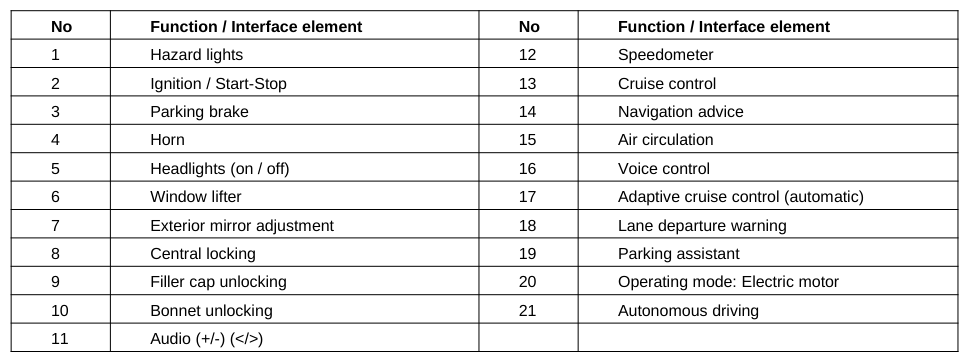
Systematic Selection of Relevant Interface Elements The considerations above in addition with the frequency of use according to Löffler (2010) lead to the following 21 interface elements shown in Table 1, which are going to be examined. The list also includes two future-oriented functions (No 20 and No 21).
Table 1: Selection of interface elements for examination No Function / Interface element No Function / Interface element
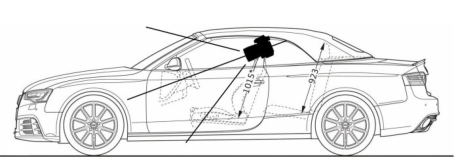
Systematic Selection of Relevant Vehicles The selection of crucial car cockpits for the examination is based on a systematic analysis of current vehicles (models from 2009 to 2014). As a result 15 car cockpits are selected including different vehicle classes, manufacturers and formal designs. Also important for the experimental studies is a comparable view and image section of the cockpits. To simulate a realistic driving situation the driver’s view is selected for all 15 cockpit designs (cf. figure 3).
Figure 3: Defined view for the presentation of different cockpits (Automobilesreview, 2013)
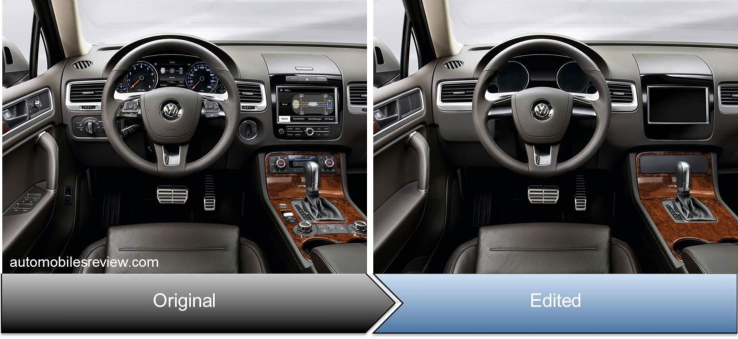
The presented virtual car cockpits were graphically edited to remove all originally existing interface elements. Thus participants had the opportunity to mark their expected positions without being influenced (figure 4).
Figure 4: Graphically edited car cockpit with removed interface elements
EXPERIMENTAL STUDIES Collective of Test Persons
Prior to the actual experiment the participants filled in a questionnaire about their driving behaviour and experience. For the present studies a collective of 33 test persons (12 female, 21 male) with an average age of 37.8 years have been interviewed. 37% of the participants are regularly using more than one car and the average driven distance within one year is 14062 kilometres. The average age of the cars is 7.8 years. 21% of the test persons stated that they have already driven more than 10 different cars for at least a few months, 49% stated 5 to 10 cars, about 30% stated less than 5 cars. 24% often or very often use an unfamiliar car which they are not used to, while just 21% of them extensively familiarise themselves with the new cockpit environment before they start driving. 45% state that the number of interface elements is too high while only 6% say it never occurs that they can’t find a display or control element. In other words 94% of the test persons are rarely, often or very often not able to find some of the interface elements they want to use. Particularly hazard lights (stated by 30% of the participants) and headlights (stated by 21%) are mentioned most frequently in this context.
Procedure After being informed about the subject of the experiment and filling in the questionnaire the participants were asked about their expectations regarding the positions of the 21 selected interface elements in the 15 edited car cockpits. The study was performed with a tablet computer and starting with an introduction page, where the test persons could try out the tablet pen. After that the experiment started. To simulate getting into the car there has always been an exterior view of the vehicle first, followed by the graphically edited cockpit in combination with an advice which interface element position should be marked with the pen. To avoid an extraordinary period of time for the participants not all of the 21 interface element positions were asked within all of the cockpits. Instead within each cockpit a varied selection of the 21 elements was enquired to also randomise the influence of respective cockpit designs.
RESULTS AND DESIGN RECOMMENDATIONS Interpretation of Results
For each participant all marked positions were recorded and visualised, which is exemplary shown in figure 5 for the button of the hazard lights in four cockpits. Red dots indicate the expected positions of different test persons, green dots additionally indicate the desired positions and the blue ring shows the real position in the respective car cockpit. Original images are taken from Automobilesreview (2013).
Figure 5: Car dependent results of expected position of hazard lights button
A significant discrepancy between expected and actual position could e.g. be detected in the Porsche 911 Carrera cockpit as shown in figure 6.
Figure 6: Expected position of hazard lights button in Porsche 911 Carrera (Original image from Automobilesreview, 2013)
Figure available in the original PDF paper.
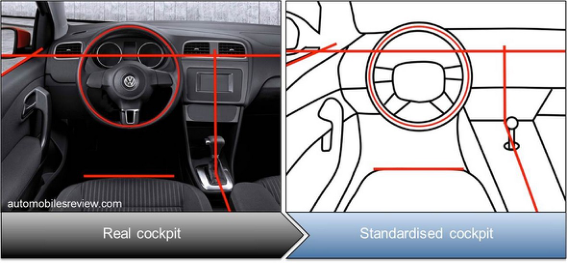
Design Recommendations To derive design guidelines from the results a standardised independent car cockpit with defined grid was generated to merge all data (figure 7).
Figure 7: Original and standardised car cockpit
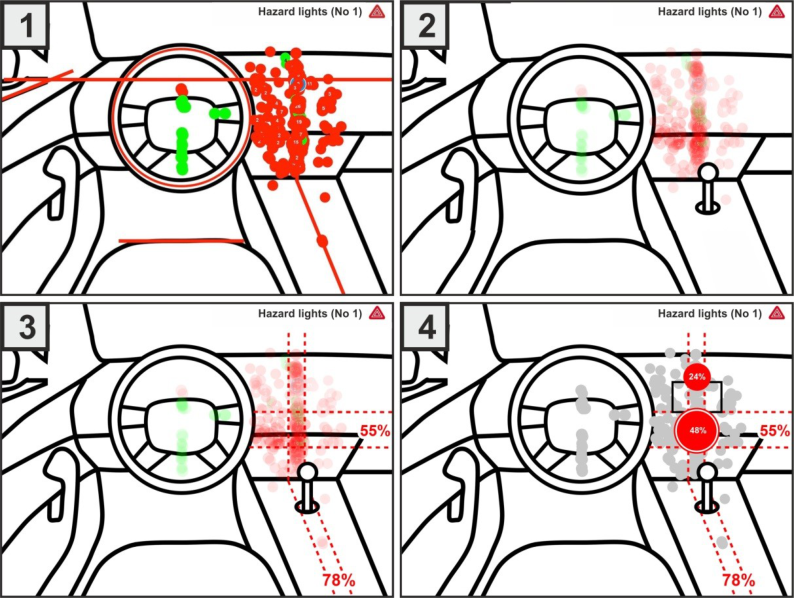
The standardised cockpit is used to gather the data of all test persons and cockpits for each interface element. The procedure is divided into the following four steps (exemplary shown for hazard lights in figure 8):
1) Superposition of all results for the expected position of a specific interface element 2) Representation of mentioning concentration by half transparent layers 3) Percentage of mentioning of expected car independent position in defined areas 4) Design recommendation for positioning of specific interface element
Figure 8: Process of deriving car independent design recommendations
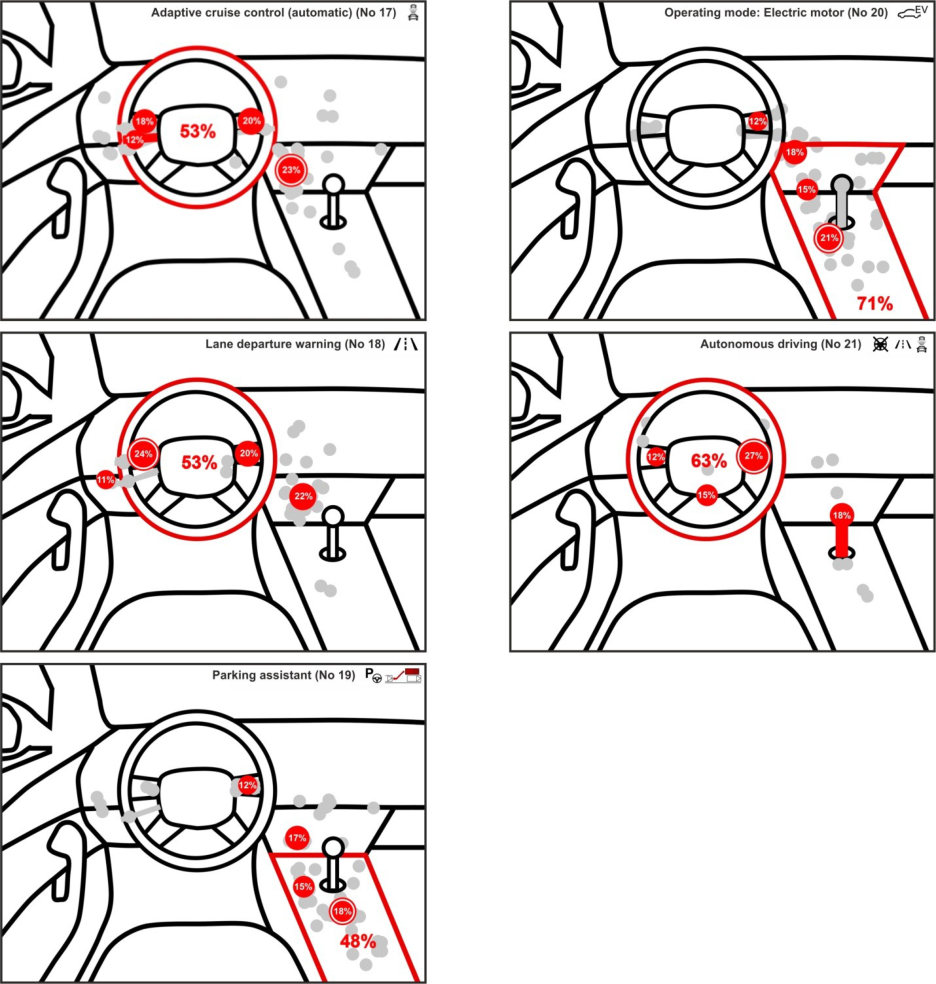
Examination results are concluded as areas of expected positions for each interface element. All derived design recommendations for the selected 21 interface elements in the car cockpit are shown in the following figures 9, 10 and 11.
Figure 9: Design recommendations for interface elements 1 to 8
Figure available in the original PDF paper.
Figure 10: Design recommendations for interface elements 9 to 16
Figure available in the original PDF paper.
Figure 11: Design recommendations for interface elements 17 to 21
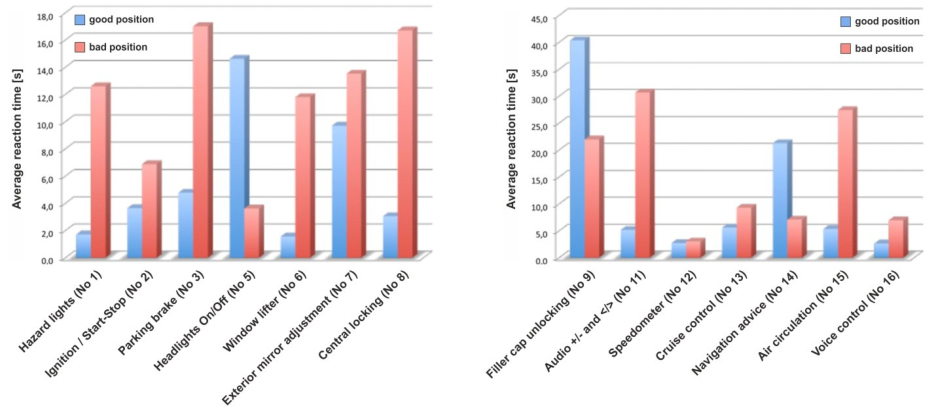
Verification by Reaction Time Measurement In a further study with 6 test persons (2 female, 4 male, average age 36.7 years) the effects of good and bad positioned interface elements were examined to make a first step of verifying the derived design recommendations in a real car cockpit environment. In this study the participants were asked to find selected displays and controls during a simulated driving situation. 14 crucial and common interface elements were chosen and each once placed in a good position, once in a bad position regarding the design recommendations. Interface elements which are unfamiliar or always expected in the same area are excluded. For the experiment display and control elements are printed on photo paper and cut out to be placed in the cockpit of a Toyota RAV4 (from 2009). To generate a situation close to reality also distracting buttons are placed in the cockpit. Real interface elements are either included in the examination or covered respectively visually neutralized. In total three cockpit setups are generated, each containing good and bad positioned interface elements. The order of query is defined in a way that the participant preferably doesn’t recognise interface elements which are going to be asked for later on, while searching for the current one. To simulate the driving situation a video is shown on a tablet computer placed in front of the steering wheel. Thus the gaze of the test person is directed at the virtual road before being asked to search for a respective display or control. During the experiment reaction time is measured. The order of the three cockpit setups is randomised between all participants. Figure 12 shows the results of reaction time measurements.
Figure 12: Results of reaction time measurements
CONCLUSIONS
Overall most of the results are hardly surprising. Many of the expected positions of displays and controls in the car cockpit have either evolved historically or are caused by functional aspects like the spatial proximity to the functional component. On the other hand there are still some current cockpit designs containing interface elements in quite unfavourable and unexpected positions. Regarding safety relevant functions like hazard lights or horn this can lead to dangerous traffic situations. Also long transition times are causing unnecessary distraction, if crucial interface elements cannot be found within a few seconds. Furthermore during the second study it was detected that test persons partially react stressed when they cannot find the respective display or control quickly. Thus an intuitive positioning also supports the driver’s joy of use. Of course the expectations depend on the driver’s individual experience with cars because there are several manufacturer-specific operating concepts. Despite of these facts it would be useful to standardise the positioning of crucial safety relevant interface elements more strictly. For example it is not acceptable that some manufacturers almost hide the button for activating hazard lights somewhere between other similar buttons or in other areas where it wouldn’t be expected by the majority of drivers, e.g. if it is not centred in the cockpit. In general the number of driver assistance systems is increasing continuously and in addition with new drive concepts the complexity of car cockpits increases as well. Although the modern vehicle is able to undertake more and more tasks from the driver autonomously the knowledge about the positions of crucial displays and controls is still important and necessary, especially in case of failure. With the present work it has been accomplished to detect relatively small areas where specific interface elements are expected to be positioned by a majority of questioned drivers. If there are no important interface elements placed in unexpected positions the basis for safe and user-centred cockpit design is given. In this way also unfamiliar cars could be used without obstacles, e.g. rental cars or cars of a vehicle fleet which are additionally often used under time pressure without the opportunity of familiarising with the cockpit before driving. Further examinations should focus even more on the empirical analysis of the influence of structure and shaping of different car cockpits on the expected interface positions. Thereby the number and arrangement of displays and controls should be considered in detail as well.
REFERENCES
Automobilesreview (2013): “High Resolution Car Picture Galleries”. Website: http://www.automobilesreview.com/pictures – accessed 19.05.2013 DIN EN ISO 15005 (2003): “Straßenfahrzeuge – Ergonomische Aspekte von Fahrerinformations- und -assistenzsystemen”. DIN EN ISO 15007-1 (2002): “Messung des Blickverhaltens von Fahrern bei Fahrzeugen mit Fahrerinformations- und
09.05.2013. Färber, Be. Färber, Br. (1987): “Sicherheitsorientierte Bewertung von Anzeige- und Bedienelementen in Kraftfahrzeugen”. In: FAT Schriftenreihe Nr.64. Frankfurt am Main: Forschungsvereinigung Automobiltechnik e.V. (FAT) ISO 3958 (1996): “Straßenfahrzeuge, Personenkraftwagen – Handreichweiten des Fahrzeugführers”. Jürgensohn, T. Timpe, K.P. (2001): “Kraftfahrzeugführung”. Springer-Verlag, Berlin. Löffler, S. (2010): “Priorisierung von Interfacefunktionen in Fahrzeugcockpits der Kompaktklasse”. Student research project,
University of Stuttgart: Institute for Engineering Design and Industrial Design (IKTD) Tiemann, R. C. (2005), “Cockpits im Automobil – von der Idee zum Insassen”. Expert-Verlag, Renningen.
LISTED IN THE AHFE DIGITAL BOOKSTORE CATALOGUE
Explore the complete digital volume
Advances in Human Aspects of Transportation: Part II
Read this individual research paper free through the original publisher, or explore the full digital proceedings book.
ISBN 978-1-4951-2098-5
Explore this ISBN in the AHFE Bookstore ↗Listed in the July 2026 bookstore catalogue; search by ISBN to confirm current availability · Digital book purchase optional