Johann Winterholler, Krzysztof Chmara, Christian Schulz, Thomas Maier (2022). Use of Adaptive Controlling Torques with the Aim to Transfer Information by the Haptic Perception Channel. In: Advances in Ergonomics In Design, Usability & Special Populations: Part I. AHFE Open Access, vol. 18. https://doi.org/10.54941/ahfe100803
Institute for Engineering Design and Industrial Design, Research and Teaching Department Industrial Design Engineering, University of Stuttgart, Germany ↗
The investigations show that the haptic perception channel can systematically be applied for information transfer. As the results show special haptic feedbacks like amplitude changes, rotary changes or blocks at the end of the torque function are recognized very well. The results also show that haptic feedbacks can be used in combination with visual displays to transmit information. The transmission of information through the haptic and visual perception channel is even better than the purely visual transmission. But this statement must be backed up by further studies in order to show that the haptic transmission of information to the user via a central control element leads to a reduction of operating time, visual distraction and cognitive stress in difficult tasks.All in all, this approach allows innovative interfaces so that the usability of products can be improved and the operational safety can be increased.
The technical progress of human-machine interfaces leads to an increase of functions and, associated to this, to a growing number of control elements and audiovisual displays (Hampel and Maier 2011). As a result a reduced usability and an overload of the human perception channels can be noticed. Particularly the visual perception channel is overloaded which might lead to operating errors.
An approach to optimize this is to use an adaptive control element. According to Petrov an adaptive control element is characterized by its ability to vary and adapt its gestalt (structure, shape) depending on the context of the human- machine interaction (Petrov, 2012; Janny et al, 2013). In combination with a haptic feedback, an adaptive control element can be adapted to different tasks. For example it can be used to transmit information haptically so that the visual channel of the user is being relieved in situations of complex information input.
The aim of the current research is to investigate how this haptic feedback should be designed. The result could be a style guide with concrete parameters which facilitate the development of control elements with adaptive controlling torques. Figure 1 shows exemplary how such a style guide could be designed.
Ergonomics In Design, Usability & Special Populations I (2022)
Ergonomics In Design, Usability & Special Populations I (2022)
Figure 1. Exemplary style guide for adaptive controlling torques depends on the task BASICS
Figure available in the original PDF paper.
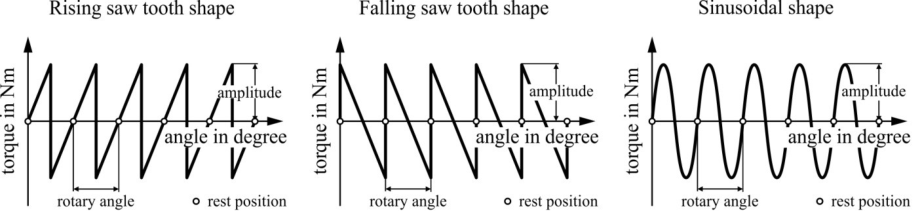
Controlling torques of rotary control elements can be divided into the type of entry. For example there are a mono- stable, a continuous and a discrete value input. The main difference between them is the number of detents. This paper investigate the discrete value input. As figure 2 shows this type of entry can be also divided, e.g., into a rising and falling saw tooth shape as well into a sinusoidal shape. The parameters which can be varied are the amplitude and the rotary angle in each case.
Figure 1. Torque functions and parameters of discrete value input according to (Hampel, 2011) Scientific investigations (Hampel, 2011; Winterholler, 2013) and practice show (Reisinger, 2009) that the falling saw tooth shape is preferred. The reason is the best comfort and precision impression. This can be explained by the typical characteristic of this function. The steep rising angle of the rest position ensures a high stability. In turn, this causes a high impression of comfort and operating quality. That's why the following investigations were carried out with the falling saw tooth shape.
METHOD
This paper describes two research studies which investigated the use of variable control torques for information transfer. The first research study investigated the recognition of defined changes based on the scientific findings by Hampel (Hampel, 2011). The second research study was built on the first study and investigated whether an information transfer through the haptic perception channel is possible during a primary task is done. Both research studies were carried out with a torque test bench which was developed by Hampel (Hampel, 2011). The diverse functions were created with MATLAB Simulink and the control surface with dSpace ControlDesk.
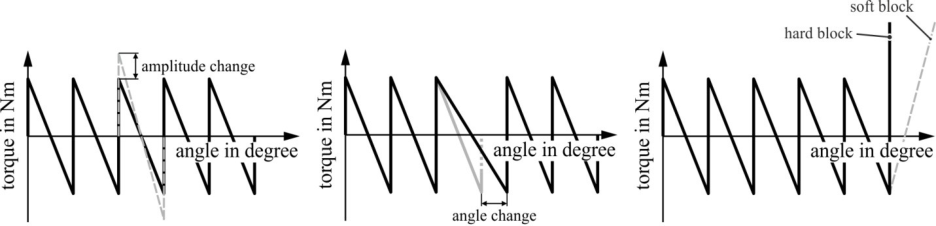
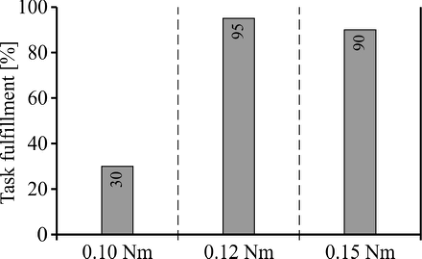
Experimental Set-up of the First Research Study At first it was investigated whether a single amplitude change at a defined point at the torque function (see figure 3) can be recognized. Such a function can be used, e.g., to show the center of a list or a preferred value through the haptic perception channel. Further, it can be used during a long list to get an approximate orientation without the need of a visual control. Starting from a rotary angle of 24 degree and a torque of 0.08 Nm the torque was increased at the defined point to 0.10 Nm, 0.12 Nm and 0.15 Nm.
Ergonomics In Design, Usability & Special Populations I (2022)
Figure 3. Torque functions with amplitude (left) and angle (middle) change at a defined point and with hard respectively soft block at the end of the torque function (right)
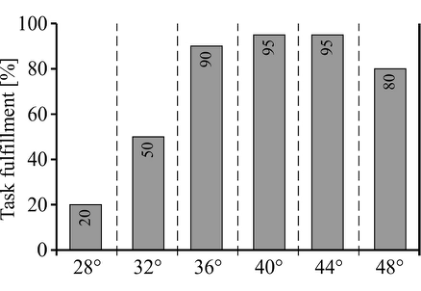
The second experiment investigated changes at the rotary angle (see figure 3). The question was whether they can be recognized and used for information transfer through the haptic perception channel. Such a function might show the change of a menu or of grouped zones. Starting from a torque of 0.08 Nm and a falling saw tooth shape the rotary angle was changed from 24 degree to 28, 32, 36, 40, 44 and 48 degree.
The last experiment of the first research study investigated whether a block at the end of the torque function can be detected and which kind of block (hard or soft) the users prefer. Such a function might show the end of a list or a menu and could help to find, e.g., a preferred value. Starting from a rotary angle of 24 degree and a torque of 0.08 Nm torque functions with a hard block and torque functions with a soft block (see figure 3) were created. It was investigated which kind of block was preferred depending on whether a scale was visible or not.
Results of the First Research Study
Figure 4 shows that users recognize a change of the amplitude at a defined point. Best results are achieved by a change from 0.08 Nm to 0.12 Nm (factor of 1.50). A higher increase (from 0.08 Nm to 0.15 Nm, factor 1.88) is also recognized very well. However, a large increase can cause that the following detent will be jumped over because of the very large factor of increase.
Figure 4. Results of experiment with amplitude change at a defined point The results of the second experiment also show that such functions can be used as a haptic display (figure 5). Remarkable results are achieved by changes from 24 to 36 or higher degree. The task fulfillment is 90 to 95 percent and confirmed that such functions can be used to show the change of a menu. Smaller changes were hardly or rarely detected. Further investigations can be done with a change from 24 to 36 degree because higher changes do not achieve significant better results.
Ergonomics In Design, Usability & Special Populations I (2022)
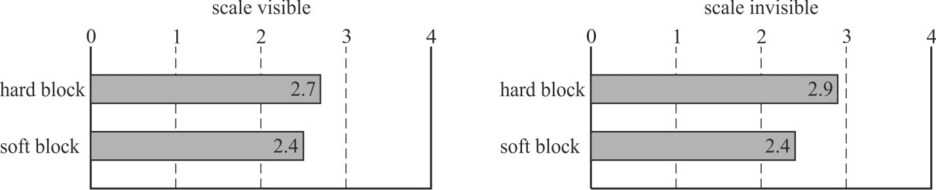
Figure 5. Results of experiment with angle change at a defined point The results of the experiment with a block at the end of the torque function shows that the users prefer both a hard and a soft block when a scale is visible (see figure 6). Although the value of the torque function with a hard block is higher there is no significant difference. When the scale is not visible the hard block is preferred (see figure 6). This can be justified by the fact that a hard block transmits information very clear and accurate so that the user knows immediately that he has reached the end, e.g., of a list.Figure 6. Results of experiment with hard and soft block at the end of the torque function Experimental Set-up of the Second Research Study
Based on the findings of the first research study and the investigations from the scientific literature (Grane and Bengtsson, 2005) a second research study was done. This research study investigated whether an information transfer through the haptic perception channel is possible while a primary task is done. Further this study investigated whether the operating time can be reduced by using the haptic perception channel for information transfer in addition to the visual perception channel. That means that the user would get distracted less from the primary task and thus could better react in critical or difficult situations. The hypothesis of this research study was that the results, e.g., operating time, are better when information is being transmitted multimodal (visual and haptic).
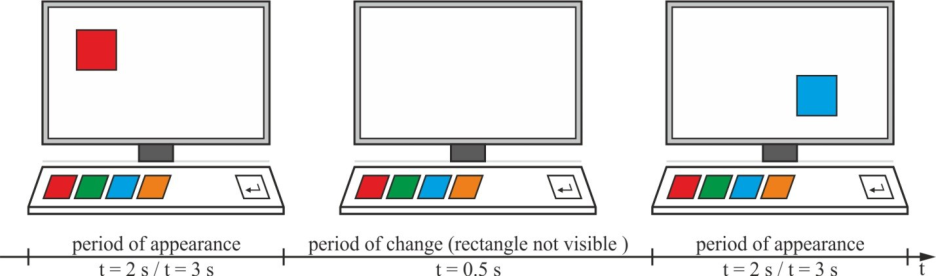
In order to investigate this hypothesis an experimental set-up was necessary. First of all the primary task was defined. The aim was to design a task which requires the attention of the user all the time. For this a software was programmed in which a rectangle appeared at regular time intervals at different positions (see figure 7).
Ergonomics In Design, Usability & Special Populations I (2022)
Figure 7. Software to simulate primary task
After each position change the rectangle's color changed randomly between red, green, blue or orange. The position of the rectangles also changed randomly. To simulate different degrees of complexity the time in which the rectangles were visible could be programmed freely. For a task with a low complexity the rectangle was visible for the time of 3 seconds and for a task with a higher complexity for the time of 2 seconds. Through this software the permanent observation of an environment and the reaction to changes are simulated.
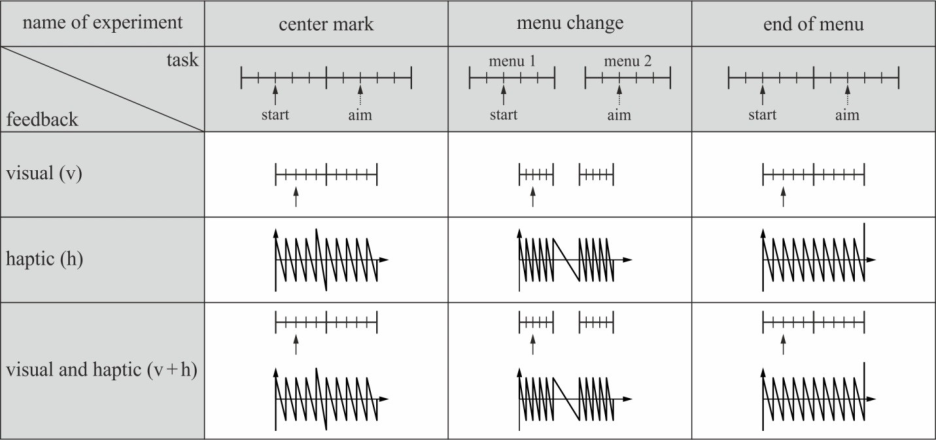
In addition to the primary task a secondary task was defined based on the results of the first research study. The aim of the secondary task was to set a defined value along a ten-step scale using the rotary control element of the test bench. All in all three different secondary tasks were defined, whereat the principle was always the same. Each of these tasks had to be done without a haptic feedback (visual), with a haptic feedback and combined (visual and haptic). Figure 8 shows the experimental set-up of the second research study.
The aim of the experiment "center mark" was to set up the value along a ten-step scale from 2 or 3 (the starting point varied) to 7. At first the value had to be set up without a haptic feedback. The subjects only saw a ten-step scale with an indicator and had to set up the value while they had to do the primary task. After that the task was repeated but now the value had to be adjusted purely haptic. For the haptic feedback a single amplitude change at a defined point at the torque function was selected. Starting from a rotary angle of 24 degree and a torque of 0.08 Nm the amplitude was increased at the defined point to 0.15 Nm. As the results of the first research study show such a function can be used in order to find a special point, in this case the center of a scale. The subjects knew that the amplitude change simulate the center of the scale. That means they only had to indicate the amplitude change and then set up the value by turning the rotatory control element two detents forward. In the third passage the subjects had the opportunity to set up the value both visual and haptic (see figure 8). It was left to the subjects, if they set the value with the help of the visual control or with the help of the haptic feedback.
Ergonomics In Design, Usability & Special Populations I (2022)
Figure 8. Theoretical experimental set-up of the second research study In the second experiment ("menu change") a change between two menus was simulated. Therefore the scale respectively list and the haptic feedback have been adapted (see figure 8). The haptic feedback was a change at the rotary angle at a defined point. Based on the results of the first research study the rotary angle changed from 24 degree to 36 degree. The torque of the falling saw tooth shape was set up to 0.08 Nm. As the results of the first research study show a change at the rotary angle can be associated with a change between two menus.
The aim of the third experiment ("end of menu") was, similar to the first experiment, to adjust a value from 2 or 3 (the starting point varied) to 7. The difference was the haptic feedback. Instead of the amplitude change at a defined point a hard block at the end of the torque function was defined. Again a torque of 0.08 Nm and a rotary angle of 24 degree were set up. The aim was to recognize with the help of the block the end of the scale (value 10) and then adjust the value 7 by turning the rotary control element three detents back.
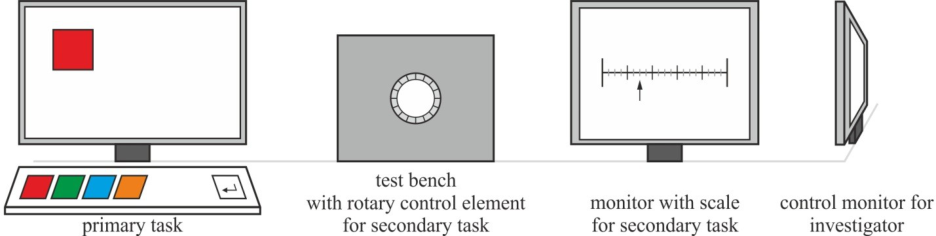
As figure 8 shows 9 experiments were carried out during the second research study. Combined with the primary task with low complexity (t = 3 s) and with higher complexity (t = 2 s) there were a total of 18 experiments. Figure 9 shows the real experimental set-up.
Figure 9. Real experimental set-up of the second research study
The described experiments were carried out in a period of one week with a total of 10 subjects (5 male and 5 female). All 18 experiments took about 30 minutes and were carried out under laboratory conditions. The average age of the subjects who were primarily students was 26 years (4.0 years standard deviation). The average body size of the subjects was 175.6 cm (6.0 cm standard deviation).
The test procedure was always beginning with the investigator describing the whole investigation. After that the Ergonomics In Design, Usability & Special Populations I (2022) torque functions and the special changes (amplitude change, rotary change and block) of the functions were explained theoretically. Then the subjects had the opportunity to test the functions at the test bench extensively. Afterwards the primary task was explained with the request to perform the task as well as possible and without errors. In a following test exercise which took about 10 minutes the subjects had enough time to test the experimental set-up. After this teach-in phase the 18 experiments were carried out in a random order.
Results of the Second Research Study
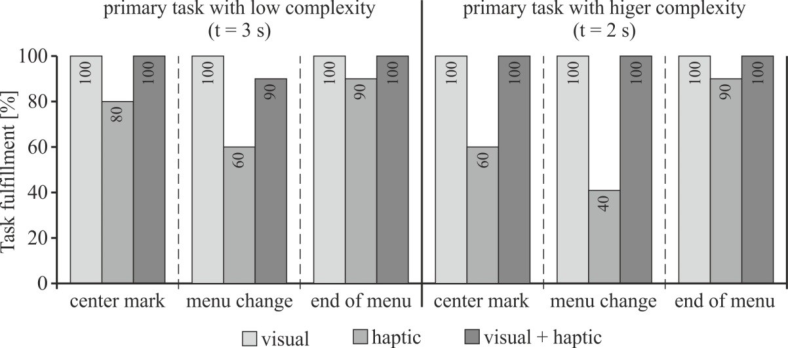
Figure 10 shows the results of the task fulfillment. As expected the tasks which were done with visual control were fulfilled always with 100 percent. The situation is similar in tasks which were done combined (visual and haptic). With one exception, the tasks were also always fulfilled with 100 percent. Tasks which were done purely with the haptic feedback (without a visual control) have insufficient results (see figure 10). It seems that the complexity of the primary task does not have an effect on the results when the tasks are done visual or combined.
Figure 10. Task fulfillment of second research study
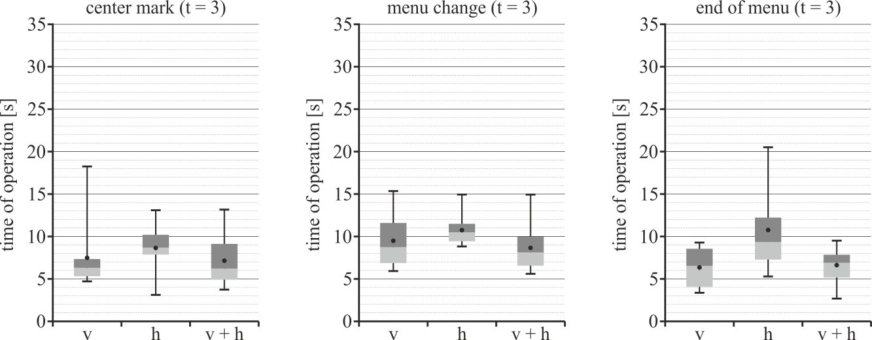
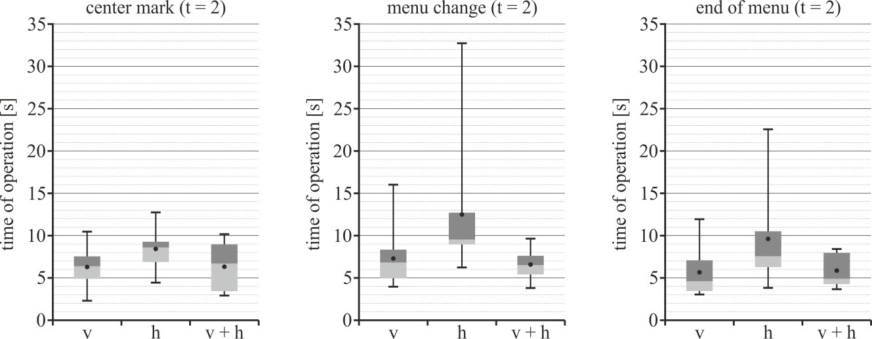
Figure 11 and 12 show the subjects' operation time of the three secondary tasks (center mark, menu change and end of menu) while doing the primary task. It is noticeable that the average operating time (marked as dot in figure 11 and 12) is always higher in tasks which were done purely haptic. It is also visible that these tasks have the largest outliers and that the subject partially needed 20 or more seconds to fulfill the tasks.
Figure 11. Operation time of second research study for primary task with low complexity (t = 3) Remarkable and positive is that the average operating time of combined (visual and haptic) tasks is better than the average operating time of purely visual tasks. In general also the standard deviation is better. The error rate respectively task fulfillment (see figure 10) and the operating time (see figure 11 and 12) allow conclusions about Ergonomics In Design, Usability & Special Populations I (2022)
the efficiency which is not bad for tasks that were done combined (visual and haptic). But all in all it is difficult to say that the above mentioned hypothesis was confirmed definitely. Therefor the differences of the results are too low.
Figure 12. Operation time of second research study for primary task with higher complexity (t = 2) Interesting are the results of the experiment "end of menu". Theoretically the operation time should be much higher when the subjects use the haptic feedback for adjustment. Finally, the operating displacement is longer than in the purely visual setting. But the results show that the operation time is even equal. A reason could be that a combined feedback (visual and haptic) provides a more secure feeling. Therefore the subjects can concentrate on the primary task because they do not have to avert their glance. And this leads to an equal operation time.
CONCLUSIONS AND OUTLOOK The investigations show that the haptic perception channel can systematically be applied for information transfer. As the results show special haptic feedbacks like amplitude changes, rotary changes or blocks at the end of the torque function are recognized very well (see results of first research study). The results also show that haptic feedbacks can be used in combination with visual displays to transmit information (see results of second research study). The transmission of information through the haptic and visual perception channel is on a low scale even better than the purely visual transmission. But this statement must be backed up by further studies in order to show that the haptic transmission of information to the user via a central control element leads to a reduction of operating time, visual distraction and cognitive stress in difficult tasks.
Further the investigation, especially the second research study, must be carried out with more subjects. The results of the second research study should be regarded as a preliminary investigation which should be pursued and intensified. In this context, the investigated torque functions should be adapted. Some of the subjects indicated that they did not perceive the haptic feedbacks clearly while completing the primary task. A reason could be the distraction and complexity of the primary task which must be taken into account in the determination of the torque function parameters.
All in all, this approach allows innovative interfaces so that the usability of products can be improved and the operational safety can be increased.
REFERENCES
Grane, C., Bengtsson, P. (2005), "Menu Selection with a Rotary Device Founded on Haptic and/or Graphic Information", in: Ergonomics In Design, Usability & Special Populations I (2022)
Eurohaptics Conference and Symposium on Haptic Interfaces for Virtual Environment and Teleoperator Systems Hampel, T. (2011), "Untersuchungen und Gestaltungshinweise für adaptive multifunktionale Stellteile mit aktiver haptischer Rückmeldung", Stuttgart, Universität, Institut für Konstruktionstechnik und Technisches Design, Dissertation Hampel, T., Maier, T. (2011), "Active rotary knobs with adaptive torque feedback - conflict of goals between positioning
accuracy and difference threshold", in: 11th Stuttgart International Symposium Automotive and Engine Technology, Stuttgart, pp. 437-452 Janny, B., Winterholler, J., Petrov, A., Maier, T. (2013), "Adaptive Control Elements for Navigation Systems", in: Posters, Part I, HCII 2013, CCIS 373, Stephanidis, C. (Ed.). Berlin, Heidelberg: Springer-Verlag, pp. 473-477 Petrov, A. (2012), "Usability-Optimierung durch adaptive Bediensysteme", Stuttgart, Universität, Institut für Konstruktions-
technik und Technisches Design, Dissertation Reisinger, J. (2009), "Parametrisierung der Haptik von handbetätigten Stellteilen", München, Technische Universität München, Lehrstuhl für Ergonomie, Dissertation Winterholler, J., Böhle, J., Maier, T. (2013), "Informationskodierung mittels variabler Stellmomente im nutzerzentrieren Design",
in: Stuttgarter Symposium für Produktentwicklung, Spath, D., Bertsche, B., Binz, H. (Ed.). Stuttgart
Ergonomics In Design, Usability & Special Populations I (2022)
LISTED IN THE AHFE DIGITAL BOOKSTORE CATALOGUE
Explore the complete digital volume
Advances in Ergonomics In Design, Usability & Special Populations: Part I
Read this individual research paper free through the original publisher, or explore the full digital proceedings book.
ISBN 978-1-4951-2106-7
Explore this ISBN in the AHFE Bookstore ↗Listed in the July 2026 bookstore catalogue; search by ISBN to confirm current availability · Digital book purchase optional