Marcello Silva e Santosa, Marcelo M. Soaresb (2022). Ergonomic Design Thinking - Approaching Ergonomics Through a New Way For Performing Innovation in the Workplace. In: Advances in Ergonomics In Design, Usability & Special Populations: Part II. AHFE Open Access, vol. 19. https://doi.org/10.54941/ahfe1001270
Design Thinking is somewhat understood as a tool for acquiring design optimization but still far from being considered as an instrument for competitive advantage. The main idea to that approach is based on the concept that one can apply the kind of thinking designers employ when solving problems to business related or work system optimization. Instead of ordinary decision-making methods, designers resource to iterative processes. This translates into nonlinear reasoning and creative thinking. Thus, according to Design Thinking theory, we can apply innovative schemes and creative actions in the course of carrying out any kind of project, or even business venues. The proposition set forth in here approaches alternative project management methods in which workplace optimization is considered an end user product, like in HFE related processes contexts. Therefore, usability and participatory design is thought to be a necessary demarche to produce and user friendly work environment. A set of successful cases employing the preliminary versions of this “under construction” model, is presented through the text in order to both contextualize the methodology and validate its implementation. Final considerations ask for open participation from HFE professionals and academic community in general for ample consolidation of the model.
Design Thinking may be seen by some as a new fad, a buzzword used as a marketing strategy to achieve some sort of competitive advantage. In fact, the term defines a concept that have ties to both theoretical and practical multidisciplinary themes, such as participatory project, simultaneous engineering and others. But its originality is not exactly related to its project management adherence, but to the ideation mindset especially present in product design approaches. The idea is to apply the kind of thinking designers employ when solving problems. Instead of Cartesian and straightforward – in terms of sequential actions – ways of sorting out alternatives and merging them into general solutions, designers usually tend to reason in a iterative, holistic manner, not only in innovation projects but also in a broader range of actions. Thus, according to Design Thinking theory, we can apply innovative schemes and creative actions in the course of carrying out any kind of project, or even business venues.
Design thinking presupposes a multiphase and non-linear process known as fuzzy front end, allowing for constant interaction and learning, associated with another non-conventional decision making process called abductive thinking. Abductive thinking has to do with the way designers formulate inquiries through the apprehension or comprehension of a given phenomenon, when questions and answers derive from information gathered from Ergonomics In Design, Usability & Special Populations II observation of a real context surrounding the problem. An article in the Harvard Business Review by Tom Brown (2008) outlines Design Thinking applications. According to the author, what is envisioned is not particularly an invention or innovation process, but an entire system evolving around it. According to him, this would really make a difference because first we set up a marketplace, then a setting for the product to become useful and thrive.
Human Factors and Ergonomics processes on its turn, also bases its actions and subsequent diagnostics of work situations in a thought-through real context, which must incorporate both formal and informal aspects of the workplace. In order to offer comfort safety and occupational health to users of a given work environment, it must also incorporate the organizational culture in which the system is in. Thus, in order to expedite and potentialize its results as a productivity improvement technique, HFE actions must take in account corporate guidelines, organizational culture and climate and tune in with the so-called sustainability tripod, which automatically infers special concern to social responsibility.
Ergonomic Design must be understood as the type of ergonomic action that anticipates real word inadequacies and produces devices, equipment, workspaces and work systems, positively embedded with ergonomic principles. Although it is the most cost-effective way of applying Human Factors and Ergonomics in the workplace, it is not widely used by organizations. Instead, what is normally seen is that Ergonomists & Human Factors professionals are called in to consult and help with workplace inadequacies, often times, when it is not possible to apply HFE principles anymore. Either the work system is fully structured or the cost of engineering is too high, which deems most effective changes unfeasible. The combination of HFE and Design Thinking might shift decision-makers’ ideas toward Ergonomics, sometimes seen as a minor contributor to occupational health instead of a powerful organizational management, which, definitely, it is.
BACKGROUND
In order to offer full understanding of this proposal, it is necessary to list some concepts from which the Ergonomic Design Thinking approach is formed up. It must be emphasized that there is no Scientific Revolution going on here as to the thoughts of Kuhn (1977) and others. The proposed context does not intend to disenfranchise other theories or bury previous ideas on how to proceed in order to acquire good HFE project results. Its unpretentious, quite humble mindset is due to what real scientists have learned for ages: there is no better way, only the way that serves one present purpose.
Design Thinking Due to being a relatively new concept and to its multidisciplinary characteristics, there is no precise definition of Design Thinking, even though they all lead to the designers’ way of dealing with innovation matters to project management aspects. However, we can use the definition by Brown (2008), “Design thinking can be described as a discipline that uses the designer’s sensibility and methods to match people’s needs with what is technologically feasible and what a viable business strategy can convert into customer value and market opportunity.”
Thus, in essence it is a fully participatory design method, employing multidisciplinary actions not only in the developmental stages of the product design process. It goes further to post-occupational evaluation by professionals and end users themselves. After all, when it comes to designing workspaces, the workers will be at the same time the most affected by product results and the ones most likely to contribute with important insights about whatever is being designed for them. Design Thinking is considered a natural evolution of Design as an applied social science. Traditionally, designers focused their attention on improving looks and functionality of products. In recent years they have broadened their approach, creating entire systems around products and services they work at.
Design thinking incorporates constituent or consumer insights in depth and rapid prototyping, all aimed at getting beyond the assumptions that block off optimal solutions. Thus, design thinking is inherently optimistic, constructive and experiential for users and designers alike. It addresses the needs of the people who will consume a product or service and the infrastructure that enables it. This strategy of involving users in design projects and solving other problems in work systems have been employed by HFE professionals for a long time. It is called Ergonomic Design.
Ergonomics In Design, Usability & Special Populations II
Ergonomic Design We call Ergonomic Design the appropriation of Ergonomic Principles into Systems Design and that can be a work device, a piece of equipment or an entire work environment. Therefore, it is directly related to innovation and project management. Designers usually do not relate Ergonomics to work activity adequacy. In fact, from furniture to cars, from appliances to their packages, ergonomics can be incorporated to everything people see around them.
Unfortunately, among all types of ergonomic actions, Ergonomic Design is the least used by organizations in general. It is a cultural – bad – habit, and it is because most key people in companies do not think ergonomics should be incorporated in early phases of the product development process. “We use to say Ergonomics is a design project terminator” (Shipyard Manager, personal communication). This report represents a quite accurate view of how many people view Ergonomics exactly because – contrary to common sense – it is presented to them in the last stages of product development. Even though we rarely think of ergonomics contributions outside product development processes, it can be applied to service implementations and even work systems. In addition, that adherence to work systems and workstation adequacy leads to the concept of Job Design.
Job Design The process of job design has been adequately defined as, “...specification of the contents, methods, and relationships of jobs in order to satisfy technological and organizational requirements as well as the social and personal requirements of the job holder.” (Buchanan, 1979). Thus, we can infer that Ergonomics and Human Factors has a very important role to play when it comes to convey the right environment to the right job, which in turn send us back to Ergonomic Design. In addition, sorting out alternatives and relationships in the design of work systems is a complex task and it cannot be accomplished without employing a nonlinear design management model, such as Design Thinking.
Everything a worker need, workstations, work environments, work devices; they all should perform better when created in a planning environment that incorporate an iterative, creatively chaotic, yet productively systemic mindset. That kind of thinking that is usually present when designers translate those “qualities without a name” (Alexander, 1977) into a product and other powerful tools needed to handle a multitude of problems, included those unavoidable “design roadblocks” that arise here and then.
METHODOLOGICAL FRAMEWORK The idea in Design Thinking is that there should not be a formal methodology, instead, general guidelines should function as a roadmap, averting miscarriage of the plan. Thus, if one wants to assure a way of successfully carrying out a plan, general guidelines must combine on one hand sequential actions and creative thinking on the other. Creating thinking implies mind abstraction in order to leave doors open to good and apparently bad ideas too. In terms of HFE actions, naturally we are talking of Participatory Actions, which means that ideas will come from different actors in the Design process. A set of common HFE and Design methodologies are presented in the sequence so to clarify the forthcoming Ergonomic Design Thinking Model.
Design Methodologies Design Methodologies tend to attract some controversy, but nothing is as damaging as people known as “methodology worshippers”, meaning they place the means (methods) above the ends (objectives). In other words, the problem with any methodology, not only product design ones, is when the methodology becomes more important than what it is supposed to deliver. It creates an achievement contradiction of sorts: instead of facilitating the result, main objective of the methodology application, rigidity when employing it will most likely bring setbacks and an adverse outcome.
Designers always rely to some sort of sequential method to carry out their design projects. Some even write about them in a more theoretical manner, which seems like a Design paradox. Other Design theorists prefer to point out different ways to rethink design. Alexander (1977) suggests users to not only participate in their design needs but learn to do it themselves a path previously – in a philosophical sense – set by Robert Sommer in his book “Design Ergonomics In Design, Usability & Special Populations II
Awareness”, that warned designers – especially architects – over the implications of their mishandling of living spaces. The same author recognizes the importance of User Design and see those initiatives as revolutionary because “user design invites, incites and implies participation of outside observers” (Sommer, 1971).
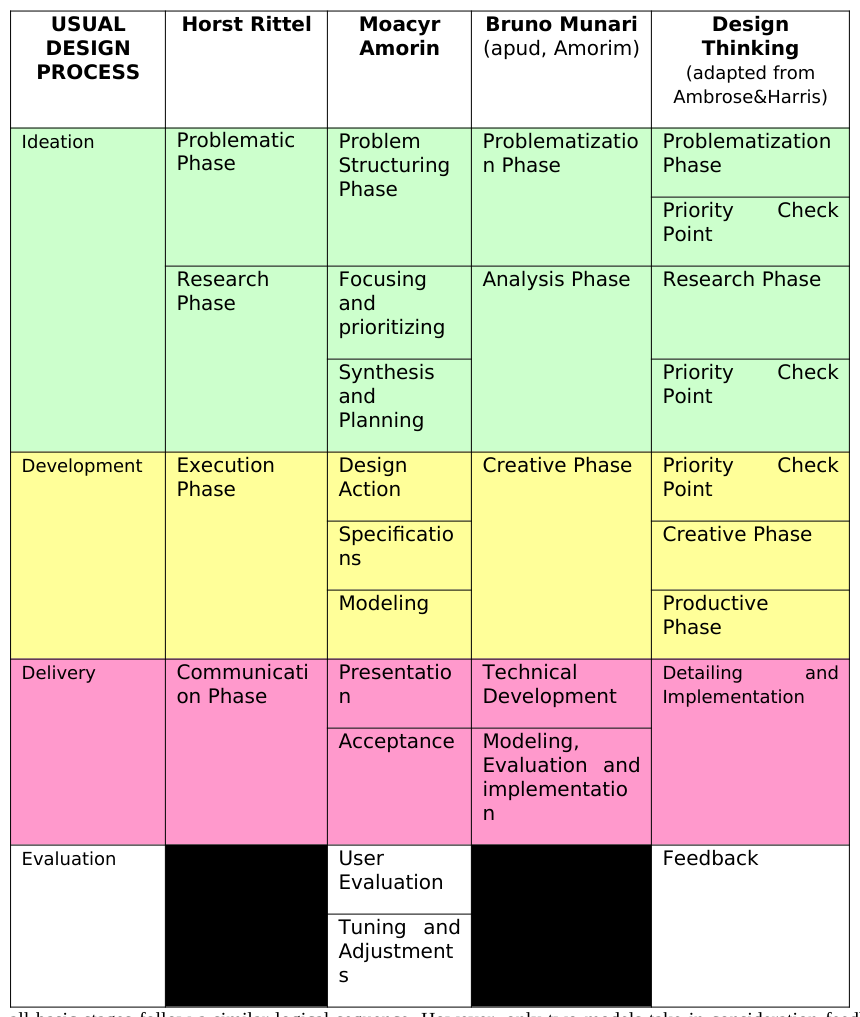
As an exercise, Amorim (2013) presents a methodology derived from a selected combination of Design Methodologies (Ambrose&Harris, 2011; Amorim, 2013; Rittel, 1984; Munari, 2008). Table 1 describes design methodology starting from general design project processes, trying to establish an equivalence relationship among all models.
Table 1. Combination of Design Processes. Source: Amorin, 2013, adapted by Santos, 2014.
seen, all basic stages follow a similar logical sequence. However, only two models take in consideration feedback mechanisms. That, along with the fact that designers usually cut off their involvement after product is delivered, Ergonomics In Design, Usability & Special Populations II adheres to the notion that real user participation is generally meager.
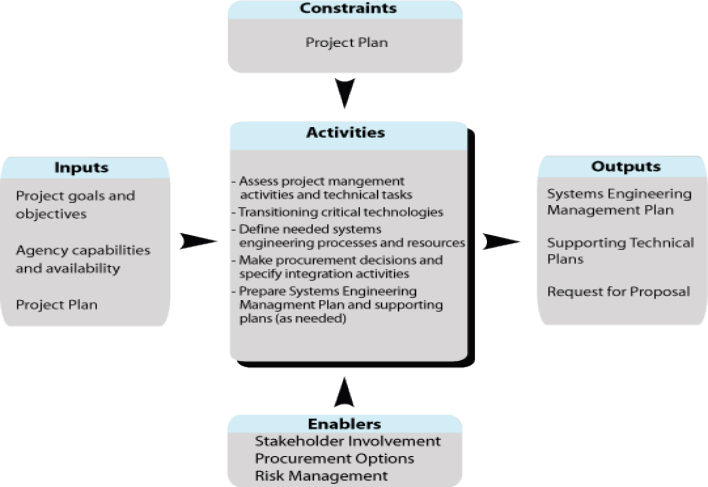
Systems Engineering Models System Modeling is an Industrial Engineering approach of dealing with operational processes. In thesis, every work activity is as transformation process, where inputs (wills) arrive, are then transformed into goods or services and at last delivered (wishes) to society or inside flow production logics (Figure 1). However, systems modeling is somewhat linked to HFE processes not only by semantics but also because of its sociotechnical equivalency. The System Modeling approach is triggered by a quest for answers – just like HFE processes – and presupposes an interrelationship among environmental constraints and job design, as pointed out by some authors (Smith & Carayon, 2000). A model of Systems Engineering reasoning is showed in the sequence.
Figure 1. Overview of system engineering approach on project (or operations) management tasks
Source: US Department of Transportation, 2010.
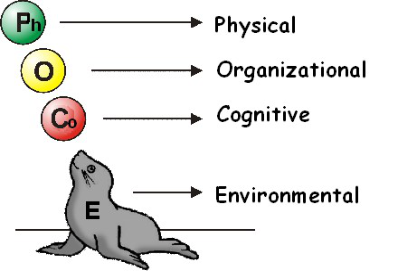
Phocoe Model Santos (2010) bring us an ergonomic methodology – or a set of methods and tools – called Phocoe Model, which is actually a more appropriate name for what is meant to be. The model serves as a framework to converge multiple HFE operational aspects and is derived from Carayon (2000) and her Balance Theory, which relates WMD with lack of organizational maturity. Starting from the sociotechnical notion that an organization is a system in itself but also a part of a larger whole, the model addresses the need of organizational and environmental balance in order to fulfill the requisites for proper Ergonomic and Human Factors adequacy. A seal – representing environment – trying to keep all other known ergonomic domains in equilibrium (Figure 2), illustrates the model.
Ergonomics In Design, Usability & Special Populations II
Figure 2. The PhOCoE Model for for Workspace Study and Design.
Source: Santos, 2010.
Balance Theory As they were trying to understand and relate the effects of work organization to workspace’s constraints, Smith and Carayon (2000) have conceived their Balance Theory. In this job design model, they relate WMD to Organizational arrangements and other aspects. The model establishes a link between organizational culture and a conditional predisposition to poor job design and poor overall work conditions. Thus, it lends a sense of systemic interdependency between ergonomic actions and organizational maturity.
Ergonomic Design Thinking Model Ergonomic Design Thinking must be seen as a model and not a formal methodology. It does combine and employ a series of specific and nonspecific tools and methods. Thus, if one feels like it, it may also be called a methodology of sorts. As mentioned before, a general model is what a formal methodology should always have been: the logics of a way. Therefore, during implementation of Ergonomic Design Thinking models one may undertake a series of actions using a variety of tools and techniques. However, not always, it will be possible to utilize all of them and neither there is a rigid order to their use. Because of its implicit characteristics – being a roadmap – the EDT Model has not a general framework, but a Best Practices Flowchart. In more simple ergonomic actions, those guidelines convert into a Banner – Ergonomics Best Practices Banner – that is suggested to be hanged in a well visited area. It is usually used in occupational training sessions as well.
For the sake of providing a general model framework, may we present an scheme containing the basic elements and phases in the proposed model. The steps on Figure 3 follow overall convergence of methodologies as showed on table 1.
Figure 2. Ergonomic Design Thinking
Figure available in the original PDF paper.
Model Framework.
Source: Santos,
2014.
The main difference is that the HFE working
Ergonomics In Design, Usability & Special Populations II group in charging of defining the sequential steps identified the importance of having three prioritizing phases. In fact, the notion here is that of a decision-making demarche, as milestones represent. Called “Priority Check Points”, those milestones allow for rapid calibration and adjustment of the process. An instrument was specifically designed for helping with priority evaluations. For doing that we resource to a tool called “Fuzzy-SIC Prioritizing Tool” or F-SIC for short.
Fuzzy-SIC Prioritizing Tool Presented by Santos & Grecco (2014) the F-SIC tool derived from the SIC Priority Matrix (Santos, 2012) developed with the intent of providing decision-making aids during HFE processes. The difference from the previous version is that the former uses Fuzzy Logics applied to the HFE Design process to achieve results that are more reliable. Since HFE processes presuppose user participation, some kind of semi-quantitative approach delivers credibility to the quality based data gathering. It was originated from the idea that HFE actions have to rely on multipurpose team – HFE professionals, users and other stakeholders´ interests.
With a more credible diagnostics of a work situation, HFE professionals may produce “design opportunities” to improve the work environment. In order to contextualize this, a series of cases in which Ergonomic Design Thinking concepts were employed will be presented next. They range from early stage applications to wide-range examples that include the use of the SIC tool.
PRELIMINARY EXPERIENCES Major Energy Company
In this project, the objective was to create conditions for the organization to move up to an upper level of Ergonomic Maturity (Santos et.al, 2009). In order to achieve that, it was agreed the Ergonomics Team should perform a full EWA (ergonomic work analysis) of the entire company located in a major oil producing area in Brazil. As a sub product of those evaluations, it was proposed to raise opportunities in terms of Ergonomic Design. The main obstacle immediately found was the Corporate Maturity Level in the business. Complex, large organizations mean complex structures, which poses direct threat to ergonomics. Since Ergonomics usually deal with improving from the inside out, changes must be quickly implemented or fade way in the sea of bureaucracy those enterprise normally share. The passage below illustrates part of what is called an Opportunity Identification ritual. It happen during construction of a brand new facility, a 6-story building supposed to shed the entire administrative workforce spread out in several smaller buildings around the area.
- (EWT) Can we visit the new building with a group of future users and see if there could be any suggestion regarding to the work environment, workspace adequacy or any other user aspect?
- (HSE Manager) I don’t think they would allow us…
- (EWT) Couldn’t we discuss this ….and who is “they” ?
- (HSE Manager) Well, the Floor plans belong to the Architecture, the Building is Engineering’s responsibility, but not construction itself, which belongs to Out-Shared Services Division…plus this contract (Ergonomics) is tied to HSE Division, so no chance there…
- (EWT) Couldn’t we try to discuss this, set up a meeting with them all... we really think it would be...
- (HSE Manager) (cutting off dialogue) …I said forget about it!
Eventually construction was over and just past the final days of the HFE contract deadline. It was then realized that it would have to be adapted to serve the work force, since it had grew to more than 10% what was predicted during architecture planning phase. Electrical installations and layout inadequacies were spotted even before allocation of administrative personnel. One manager, that by sheer luck decided to visit the building just prior to its completion, noticed that her office was placed right in front of the main elevator door, from where most of the people come out Ergonomics In Design, Usability & Special Populations II to that floor. It does not take much intelligence to predict what would have happened if she had not requested the – costly – change. The Ergonomics Work Team (EWT) watched the building being raised up right before their eyes, without being able to prevent what was bound to happen, and it eventually did.
However, this initial experience was not a total failure. We were able to participate in several opportunities in which ergonomics principles and user participation were combined to develop user-friendly work systems. In one of them, it was first met a villain of the user-friendly positive outcomes. Alexander (1977), an architect and polemical figure, yet admired by his theories, suggests that everything in life has an essence, a shared perception of an optimum solution for a given problem. He calls it “Quality without a Name”, which are translated into Pattern (design) languages. In addition, the same author points out those Patterns should not be seen as Standards.
Setting aside legal and technical conformity to specifications, a Standard is truly an anti-pattern. They only prevail because some necessary continuity or by sheer desire for keeping up with the Status Quo. There are several examples of anti-patterns effusively used today, such as glazing, those environmentally unsound glass curtains that cover up commercial buildings – and even some residential ones – worldwide. They did not become prevalent because of architects; after all they hardly visit their creations after they are ready to the public. In fact, bad solutions usually prevail because customers never complain about them.
Oil Rig In this second experience, the focus was more specific. The EWT needed to address certain work inadequacies in critical processes of an offshore oil rig operation in the same region of the first example. Initially we performed a major walkthrough, in order to understand the nature of the problems and why do inadequacies happen in such a controlled production process, an overly regulated activity, in the first place. It was found similar intercurrences to those in the first example. Excessive paper work, segmented job design, multi-decisory levels, all add up to factors that create chances for errors. The excerpt below illustrates one of such problems. In this particular case, the inadequacy brought up both HFE constraints and economical ones.
“- (EWT) What is this big package sitting there?
- (Safety Technician Supervisor) This is the crane´s windshield.
- (EWT) Oh, yes. We noticed a broken windshield when we visited up there. But why it has not been replaced yet…It looks it has been sitting there for a while?
- (ST Supervisor) It has indeed…It was ordered about six months ago, but the routing is not that simple…First a request has to be put in here and, once approved internally, it goes to our land based office. Then the office approves it and submits to Purchasing Division. Purchasing has to quote, deal with taxation and other particularities (Note: Equipment is imported with no distributor in Brazil) and eventually place a final purchasing order. When part arrives, it has to go through customs, federal income office and other regulatory agencies before is allowed to be shipped t us.
- (EWT) It sounds tiresome, but why is it still sitting in storage?
- (ST Supervisor) Well, the windshield has a mounting rubber seal that wraps around the crane frame where the windshield sits in tightly…..When they hauled off the broken one, they threw away the fitting along with other debris…Now we’ve got to repeat the entire process for that part alone!”
In a Oil Rig time is definitely money, so we could not afford to employ our model to its full extent, but we did resource to creative thinking instead. In one event, a team was set up to analyze a particular problematic work situation. The driller station may be considered the most important job in an oil rig. Setting aside reasonable proportions, its role is similar to that of a Formula One pilot.
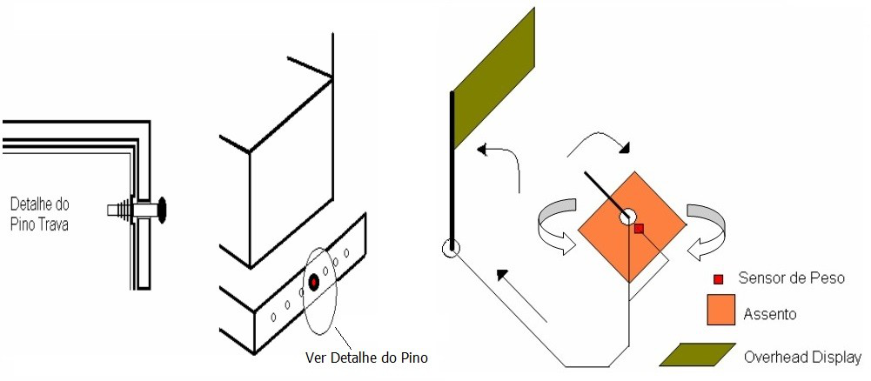
The Scudery as a whole wins or loses, but without a good racer, there is no chance for success. Therefore, his workstation is designed for his full appropriateness, following anthropometric guidance. In fact, the seat alone follows a rare rule: it is designed for the individual’s exact body measures. However, the driller seat in the studied Oil Rig was far from being adequate in terms of comfort, safety or functionality. It did not even have an adjustment Ergonomics In Design, Usability & Special Populations II control. The track where the seat ran rusted off and fixed to a position that did not attend one single user individually let alone multiple individual susceptibilities. The EWT investigated utilization history for that workstation and found out it had been changed over time. The following photos show the evolution for that particular situation all the way to the team’s proposed solution (Figure 5). The photo to the left show the original problem, when operator had to improvise a stick to reach buttons on a switchboard. To the right, an initial solution – not jointly designed with users – in which a metal switchboard was placed in the way of operators when standing up. The red circle in center of that picture shows the point where people constantly hit their heads on the panel.
Figure 1. Resulting Participatory-Driven evolved solution to job constraint.
As pictures show, workstation controls and seat adjustment controls never worked properly. Being set in one fixed position, besides creating discomfort for every operator, made it especially difficult to handle overhead commands. It was then envisioned two simple devices, one for facilitating in and out access and another to allow easier seat positioning along the seat’s lower track. The following excerpt shows part of a conversation that took place during implementation of the design solutions that had been brought up by the EWT actions.
“- (Drilling Supervisor) I think those proposals are very doable… but explain to me what is the advantage of using those retaining pins for the lower track?
- (EWT) Well, actually the welding shop workers came up with the idea. They said it will do no good keeping repairing the seat tracks since harsh atmosphere most likely will keep on oxidizing everything.
Ergonomics In Design, Usability & Special Populations II
- (Drilling Supervisor) Those guys are full of it…they are there only for eventual repairs and emergencies so they keep having those “creative” ideas…don’t they know that those makeshift pins will rust just as much?
- (EWT) Yes they do…and that’s the whole point: a cheap, easy to find solution for solving a major discomfort and potential health hazard…it will rust and eventually break, but there will be a whole lot of spares right below deck and not all the way across the ocean (*).”
(*) The seat and accessories were manufactured in Sweden.
Automotive Manufacturer Company The purpose here is not a conventional Ergonomic Design related project. In this major multinational auto manufacturer in Sao Paulo, Brazil, the contractor asked for a tool for assessing fatigue in various work activities. In a sense, it would still be considered an Innovation Project, since it involved developing an idea related to technological modernization processes. Many factors contribute to the workload experienced by individuals at work. Factors include the nature of the work, somatic aspects, acquired training, motivation, and environmental influence. They all affect energy throughput through the physiological service function of supplying power and oxygen for muscle metabolism. If work conditions improve, the workload tends to be reduced, even though it may not happen immediately for the work pace takes time to be adjusted. However, after a set of technological improvements has been implemented for some time, it takes no sense to keep using the same cycle times and planning methods that were designed under other reality without calibrating the data.
In the course of this ergonomic contract, a method intended to prevent distortions when setting up fatigue recovery time was developed. Operational activities were then targeted for the development of the Rfad method. The contractor, a major automotive industry in Brazil, decided to review its time planning wanted more accurate numbers, so that the amount of time allocated to fatigue recovery could become a more reliable variable to be computed into their current time sheets. Initially, a multidisciplinary Ergonomic Work Team (EWT) was established. One physician, one architect, two engineers, two designers, one physiologist – all with Human Factors & Ergonomics background – and four other certified ergonomists, formed up the group.
The team was divided in two groups: one for the fieldwork activities and another responsible for data analysis, project management and coordination of activities along with the customer’s project team. As a way of characterizing the situation at hand, it was decided to carry out a series of ergonomic analysis in selected workstations. Those 45 workstations were considered the most critical in a set of production centers. The EWT did not participate in the selection process. The following excerpt briefly illustrate how diverse can workload perceptions be depending on management’s role and proximity to shop floor reality.
“- (Department Manager) We decided to start analyzing 45 workstations deemed critical in terms of ergonomic impacts. If the pilot program succeeds, then we might extend the project.
- (EWT Project Manager) Well, can you tell us what was the criteria to sort out those workstations?.
- (Department Manager) To be honest with you, all I know is that some supervisors and managers chose stations they were more familiar one in 4 or 5 different production centers.
- (EWT Project Manager) But was there any factors considered, like epidemiologic data, accident and work-related medical occurrences, etc.?
- (Department Manager) I really don’t know…I would guess this was negotiated with floor personnel based on perceived muscular effort involved in each task…I am sure Medical Department did not get involved…they actually disagreed with this project….
Ergonomics In Design, Usability & Special Populations II
- (EWT Project Manager) Isn’t it a little odd? I mean, not choosing workstations REALLY critical will return a wrong diagnostics…the fact Medical Dept. didn’t establish work-related root cause for problems and production didn’t employ technical considerations, such as energy expenditure measurements, we may not have hard data on this…
- (Department Manager) I understand…but consensus and rationality is kind of difficult to reach in here…let’s start something and see what we can get.”
Construction Site HFE Actions Due to the construction industry growth in recent years, this demand is a recurrent one in Brazil for quite some time. However, the question posed is: how could HFE contribute to a type of operational activity so full of particularities and peculiarities? There is no production line in the construction industry and even though we can use multiple project plans – in Building Construction – every single job is different due to external circumstances. To add up, people move a lot in this business, either for relocation, to other companies or because of change of professional status. One day a person is working in the colder south region as a electrician assistant, the next he (or she) is in warmer northeast as a plumber helping building a dam. Although there is not much recollection of how initial conversations went on, it was probably like the following block.
“- (HFE Manager) The scope asks for a full evaluation of 400-500 workers in a building site, plus office personnel, but we will have only 3 weeks to finish everything.
- (EWT Member 1) We do a functional analysis of each critical work situation, as pointed out by the workers themselves, then we keep on evaluating all the rest by inference and equivalency. We will gather all the data in one week and we will still have the other two to tweak it out here and there….
- (EWT Member 2) For clerical personnel will be easy. Tasks in nature involve the same kind of physical and cognitive impacts, so we prepare a “10 Ergonomic Errors Cartoon” in where we “hide” work inadequacies in a big banner and post in the coffee room. We’ve done it before….
- (HFE Manager) And what about the Action Needed Plan? We all know that an Ergonomics & HF Assessment is not complete without a AN Plan.
- (EWT Member 1) We will have one. We will call it Best Practices Guidelines, derived from the Best Practices Flowchart with a set of representative work activities or tasks in terms of each construction phase. Then, we expose the common problems associated to each one of them and suggest alternatives in terms of postures or attitudes to minimize any eventual risks. This is especially important for operational personnel, therefore it should be placed in the cafeteria.
- (HFE Manager) Sounds like a plan…let’s go for it!
FINAL CONSIDERATIONS Ergonomic Design Thinking should be treated as a general model for participatory actions in the workplace. Naturally, Ergonomic Design, Product Development and Job Design are possible terrain for its dissemination. All those actions demand some slack in their sequential actions in order to allow creative thinking to flourish. In this text, we presented only an initial overview of the model followed by a handful of preliminary experiences. But people involved in those experiences have been “spreading the disease” quite well. Several monographs have won Ergonomics In Design, Usability & Special Populations II their authors their Master’s Degree, three doctoral thesis approached the idea and one post-doctoral fellowship resulted from the model in the past 5 years.
Some of those professionals also have their successful HFE practices thriving because of it so we feel we are at least on the righteous path so far. The main advantage of Ergonomic Design Thinking is definitely its methodological flexibility and broad outreach for the various contexts one may face in a work environment. In fact, it should be used “outside the box”, since ergonomics and human factors is definitely not a property of one single organizational domain. People that have been consulting in human factors and ergonomic for so many years have seen good ideas fade way in the course of an imposed “perfect” methodology for their actions. However, sometimes people get so tied up to the rigidity of a methodology that the ends become a mere detail of a mean. In other words, a methodology is a roadmap in which people rely on to reach from point A to point B without losing track.
As to the Design end, conscious professionals have learned for years and years about the power of their actions, for good or bad. “If I’d asked my customers what they wanted, they’d have said ‘a faster horse”, once said Henry Ford. On the other hand, Frank Lloyd Wright (1867-1959), a believer in the so-called organic architect that solemnly preconizes harmony among men and nature, once said that he could kill any happy marriage with a bad floor plan if he wanted to. A good design is only as good as others, not their creators, perceive them as so. In addition, our lives and our health can be affected by poor design choices. Thus, even HFE decisions not based on users behavior and nature can lead to disastrous outcomes. Regardless all constraints that may arise in workplace construction, designers ultimately share with engineers most of the work environment inadequacies – due to negligence or omission – we still see out there. As people say, hell is full of well-intended folks.
At last, it is fair to say that companies intuitively use design thinking to an extent, but most stop short of embracing the approach as a way to move beyond today’s conventional problem solving. Organizations resist in taking a human-centered approach because they cannot grasp at the perspective of trying something entirely new, born in the midst of a balance of users’ needs, technology, and organizational constraints. As Brown (2007) said, “One of the biggest impediments to adopting design thinking is simply fear of failure.” The notion that there is nothing wrong with experimentation or failure as a source of learning can be difficult to accept. However, design-thinking culture will grow on and encourage plain, sometimes even quick makeshift prototyping as part of the creative process, not just as a way of validating finished ideas. Continuous employment of our model should bring its steady improvement, consolidating it as a technique and allowing for its consolidation. We also hope further collaboration – as it becomes possible by peer reviewing – will enlighten darker spots in the methodology and incorporate collective value to the entire process.
REFERENCES
Alexander, C. et.al. (1977), A Pattern Language: Towns, Buildings, Construction. New York: Oxford University Press. Alsene, E., (1999), Internal changes and project management structures within enterprises, Project Management, Vol 17, Issue 6, December, Pages 367-376. Ambrose, G, Harris, P., (2008) Design Thinking, Chicago: University of Chicago Press. Amorin, M. et al., (2013), Project Methodology for Design, Ergonomic Methodology and Design Thinking: Convergence in
Developing Solutions in Design, in Cadernos Unifoa Especial Design, Vol 1, December, Pages 49-66. Brown, T. (2008), Harvard Business Review, June 2008, Pages 84-92 GENTE/COPPE Laboratory (2012), Collection of Project Reports (2008-2012)., Rio de Janeiro, GENTE Ergonomics Lab. Hartley, J.R. (1998), Concurrent Engineering - Shortening Lead Times, Raising Quality, and Lowering Costs, Portland: Productivity Press. Hendrick, H, (2004), Handbook of Human Factors and Ergonomics Methods, London: Taylor & Francis. Hendrick, H. ; Kleiner, B. (2002), Macroergonomics – Theory, Methods and Applications, Boca Raton, CRC Press. Kohn, P.J. (ed.), (1999), Ergonomic Process Management – A Blueprint for Quality and Compliance, New York: Lewis
Publishers. Pasmore, W. (1994), Creating Strategic Change: Designing the Flexible, High-Performing Organization, New York: Wiley, John & Sons. Pikaar R., Koningsveld, E., Settels, P. (eds) (2008), Meeting Diversity in Ergonomics, Amsterdam: Elsevier. Rittel, H. (1984) , Second-Generation Design Methods, In N. Cross (Ed.), Developments in Design Methodology, John Wiley &
Sons, New York, pp. 317-327. Santos, M.(et.al) , (2009), Can we really opt in terms of ergonomic methodologies and/or approaches? Annals of XVII IEA Congress, Beijing.
Ergonomics In Design, Usability & Special Populations II
Santos, M. (2010), 4th International Conference on Applied Human Factors and Ergonomics - AHFE 2010 Conference Proceedings, Miami. Santos, M. (2012), The PhOCoe Model – Ergonomic Pattern Mapping in participatory design processes, Work Vol 41 (2012)
2643-2650. Smith, M., Carayon, P., (2000) A Balance Theory of Job Design and for Stress Reduction, International Journal of Industrial Ergonomics, Vol 4, 67-79. Sommer, R. (1971) Design Awareness, New York: Rinehart Press. Vidal, M., Santos, M., (2009), The Ergonomic Maturity of a Company Enhancing the Effectiveness of Ergonomics Processes,
Annals of XVII IEA Congress, Beijing. Wilson, J & Corlett, N. (eds.), (2005), Evaluation of Human Work, 3rd. Edition, Boca Raton, CRC Press. Zink, K.(Ed), (2008), Corporate Sustainability as a Challenge for Comprehensive Management, Kaiserlautern, Physica-Verlag.
Ergonomics In Design, Usability & Special Populations II
LISTED IN THE AHFE DIGITAL BOOKSTORE CATALOGUE
Explore the complete digital volume
Advances in Ergonomics In Design, Usability & Special Populations: Part II
Read this individual research paper free through the original publisher, or explore the full digital proceedings book.
ISBN 978-1-4951-2107-4
Explore this ISBN in the AHFE Bookstore ↗Listed in the July 2026 bookstore catalogue; search by ISBN to confirm current availability · Digital book purchase optional