Hokyoung Blake Ryua, David Parsonsb, Hyunjeong Leea (2021). Using Game-Based Collaborative Learning to Enhance Critical Thinking Skills. In: Advances in Affective and Pleasurable Design. AHFE Open Access, vol. 14. https://doi.org/10.54941/ahfe100594
Critical thinking is an essential quality in complex problem solving. Many researchers have proposed that collaborative peer learning could enhance critical thinking, because learners could understand more diverse views by sharing different perspectives on a given situation. The work presented in this paper aims to explore a possible relationship between game-based collaborative learning and critical thinking. A serious mixed reality business game was developed and employed in the present study. Twenty-five undergraduate students were recruited and divided into three groups: an individual learning group, and two collaborative learning groups with distinct learning conditions. After completing the experimental learning tasks, the participants were asked to create presentations, either alone (for the single players) or with their partners, to outline their approaches to solving the problems presented in the game. The results indicate that the three groups showed only slight differences in learning performance (e.g., memorization); however, the difference in their levels of critical thinking was more significant. There appeared to be a strong relationship between learning in pairs and an array of positive intellectual outcomes. Further, the different learning conditions between the two collaborative learning groups also led to significant differences in the level of critical thinking.
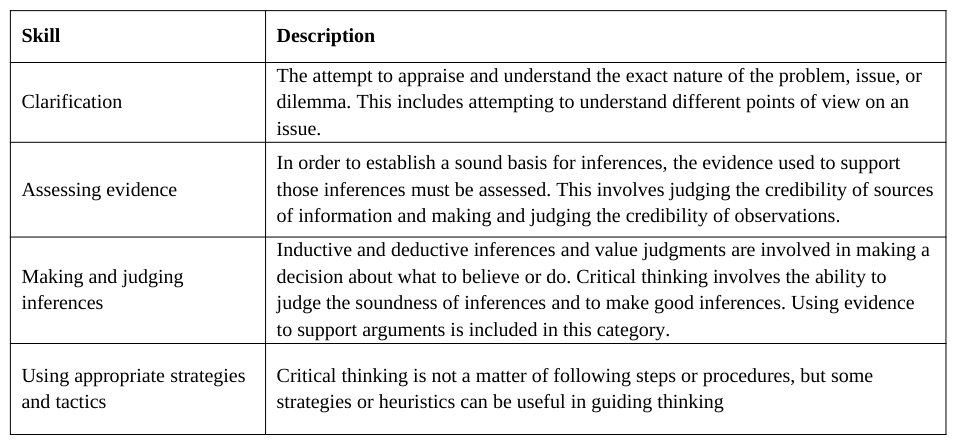
Critical thinking is an integral part of many common activities. It has long been considered an important ability, and not just in the field of education. For example, the ability to analyze given information and propose new solutions that did not exist before has been a core part of thinking skills in many workplaces. Willingham (2007) referred to critical thinking as “[…] seeing both sides of an issue, being open to new evidence that confirms your ideas, reasoning dispassionately, deducing and inferring conclusions from available facts and solving problems”. To develop critical thinking, many kinds of skills are needed. Bullen (1998) defined four categories of critical thinking skills in his study, as shown in Table 1.
Affective and Pleasurable Design (2021)
Table 1: Critical thinking skills (Bullen, 1998)
Collaborative learning has been proposed as one way to enhance critical thinking. According to Dillenbourg (1999), collaborative learning can be defined as “[…] a situation in which two or more people learn something together.” Interacting with other people in collaborative learning is thus different from individual learning in all of the four aspects of critical thinking described in Table 1. Gokhale (1995) suggested that collaborative learning could enhance the development of critical thinking through the process of evaluating, discussing and clarifying a partner’s thinking, in conjunction with externalising one’s own thinking process to the partner.
Numerous studies have shown the positive relationship between collaborative learning and critical thinking. However, most research on collaborative learning has been conducted through an examination of its effects on the individual setting (Dillenbourg, 1999), by which an individual learns something independently, and collaborates later to discover some things they have missed. The ability of collaborative learning to enhance critical thinking skills has thus been largely tested in a traditional multiple-choice setting. In contrast, Ku (2009) demonstrated that open-ended problems seem more appropriate for evaluating the level of critical thinking, by allowing people to demonstrate their own thinking more flexibly.
Frameworks for the Evaluation of Learners’ Thought Processes Hew and Cheung (2005) proposed a generic framework to evaluate the quality of a learner's thinking skills. In their study, students’ thinking processes were divided into two types: surface thinking and in-depth thinking. In surface thinking, learners tend to use ideas or concepts that have already been presented in the learning material when proposing their own solutions. According to Hew and Cheung (2005), surface thinking is revealed by (1) using given learning materials without advancing one’s own ideas (2) repeating what has been said or learned without adding new elements (3) proposing several solutions but refraining from deciding on the most suitable one. By comparison, with in-depth thinking, learners are more likely to create new information from collected data, and develop new strategies with wide and diverse interpretations (Hew & Cheung, 2005).
How to Measure Critical Thinking in Collaborative Learning According to Gokhale (1995), collaborative learning can enhance critical thinking skills through evaluating, discussing and clarifying a partner’s thinking and, at the same time, revealing one’s own thinking processes to the partner. These are common views about the relationship between collaborative learning and critical thinking. Affective and Pleasurable Design (2021)
However, most of the previous studies have been carried out by using multiple-choice formats or questionnaires, and little has been done with qualitative analysis (e.g., the California Critical Thinking Skills Test (CCTST)).
When it comes to qualitative analysis, content analysis has been widely applied to uncover critical thinking indicators in collaborative learning. In particular, Henri (1989) explains about two types of messages (independent and interactive) that come into play when interacting with a partner. Independent messages cover the topic of discussion, but there are no implicit or explicit references to any other messages. Interactive messages, on the other hand, respond to and elaborate on others’ messages. Such interactive messages could convert surface thinking into in-depth thinking during collaborative learning, and this could enhance critical thinking.
In the present study, when evaluating critical thinking, we applied content analysis. The main point of content analysis is to analyze the conversation that takes place during the learning process (however, the learning outcome also needs to be considered through other quantitative analysis methods), by which we try to uncover differences in performance between single players (individual learning) and pair-players (collaborative learning) when measuring critical thinking in decision-making situations.
RESEARCH QUESTION The main research question addressed in this study was: Is there a difference between individual learning and collaborative learning with respect to demonstrating critical thinking skills?
EXPERIMENTAL DESIGN Participants
The study evaluated critical thinking through a mobile game modeled on a real world business situation. Twenty- five undergraduate students majoring in Industrial Engineering at Hanyang University participated in the experiment. They had similar prior knowledge levels. Participants were randomly assigned to one of three groups:
- Group 1: Individual learning group with single player mode - Group 2: Collaborative learning group with pair-player mode - Group 3: Collaborative learning group with two single player modes
Materials
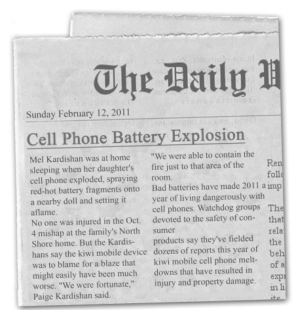
(A) “Kiwi MobileSim” A serious business mobile game, “Kiwi MobileSim”, was used for the present study. It was designed based upon location-aware and mixed reality technology. The purpose of the game is to recognize each department’s 1 position in a virtual company (Kiwi Mobile) and identify the problems or issues the company is facing. In the game, players have to move around a specified area separately using the direction view in Figure 1(a), in order to find specific locations that provide information for them. When players arrive at a given location, an interview video file begins to play automatically (Figure 1(b)). After viewing the video, players can gather extra information by asking experts in the mobile game and searching for artifacts around the location (Figure 1(c)).
There were a total of five locations that players had to visit for their learning about a simulated business situation. In the single player mode (group 1), the player individually visits all the locations. In the pair-player mode (group 2), each player visits only four departments; one player does not receive information about the Marketing Department, and the other one does not receive information about the R&D Department. In the two single player mode (group 3), both players visit all the locations together. We intentionally designed the game setting like this in order to examine how well participants would collaborate with their partners, to see how sharing the missing information triggers their collaborative process.
1 Assembly Department, R&D Department, Marketing Department, Quality Assurance Department, and CEO’s office Affective and Pleasurable Design (2021)
(a)
(b) (c)
Figure 1. Mobile game “Kiwi MobileSim”
(B) Presentation Files Critical thinking is processed by a learner’s basic situational understanding of the learning material. By introducing an intentional step focused on the learner’s basic situational understanding, we expect that the participants would recall and organize their basic situational understanding before moving on to the next step of evaluating their critical thinking level. This experimental setting would encourage our participating learners in both individual learning and collaborative learning groups to be critical thinkers.
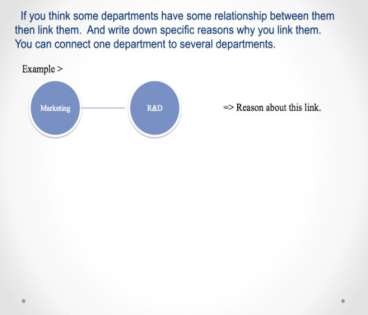
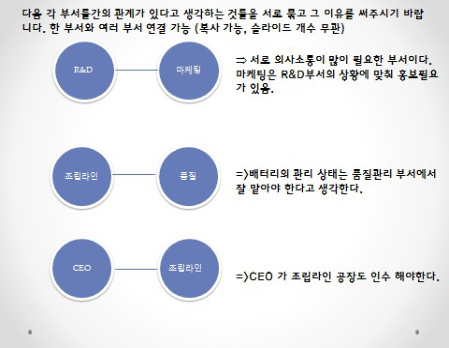
To identify basic situational understanding, a reference for how well participants learned by using the mobile business game, the participants were asked to write down the information that they got from each business department (Figure 2(a)) To identify critical thinking levels and observe the differences between groups, we asked the participants, “If you think some departments have some relationships between them, link them and write down the specific reasons why you have linked them”. (Figure 2(b)).
Procedure The experiment consisted of two parts. In the first part, the participants played “Kiwi MobileSim” for about 30 minutes. In the following 30 minutes, they were required to create presentations to evaluate their memorization and critical thinking levels. When evaluating memorization, the main experimental task consisted of writing down information about each department’s situation in detail, while the critical thinking part consisted of linking the related departments and providing reasons for this thinking. Group 1, the individual learning group, made the presentation file alone, while Group 2 and 3, the collaborative learning groups, made the presentation file together in their pairs. Apart from this, the remaining conditions during the experimental procedure were identical for all groups. Affective and Pleasurable Design (2021)
(a) (b)
Figure 2. Presentation files to evaluate memorization and critical thinking levels
RESULTS
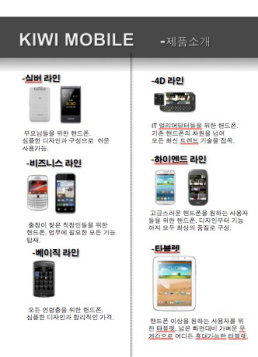
Evaluating Basic Understanding Level Through this step, we identified that all three groups had a solid understanding of the main departments’ situations. However, there were slight differences among the three groups with respect to their representation of this information. The individual learning members (Group 1) tended to write more specifically compared to the collaborative learning members (Groups 2 and 3). For example, concerning the marketing department, one of the additional learning materials was a product brochure from Kiwi mobile (Figure 3). Most of the individual learners listed each product line one by one, “1) Silver line 2) 4D line 3) Basic line 4) Business line”, while the collaborative learning groups tried to write down the information in a more simple, summary format, including their own interpretations of the artifacts, for example, “There are many product lines for targeting a wide range of markets and diverse age groups”
Affective and Pleasurable Design (2021)
Figure 3. Product brochure of the marketing department
Critical Thinking Level As to surface thinking, our participants usually illustrated simple organizational structures (such as single links with other departments (Figure 4(a)), using ideas or proposing solutions based on the given learning materials. There are no new ideas in their presentation files. However, with in-depth thinking, some participants explained the corporate situations using complex links (Figure 4b)) rather than single links, and also proposed solutions that considered wider perspectives not referred to in the learning material.
(a) (b)
Figure 4. Presentation files of Group 1 and Group 2
Affective and Pleasurable Design (2021)
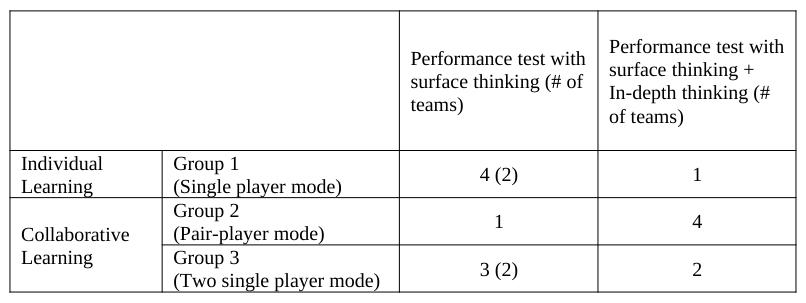
Table 2: Results of critical thinking levels in surface and in-depth thinking
Table 2 illustrates the overall results of this study. In Group 1, only one outcome was evaluated as being the output of in-depth thinking, while four outcomes of Group 2 and two of Group 3 were evaluated as such. Through this result, we could identify that the collaborative learning groups were thinking more critically, especially when faced with deficient information.
More interestingly, among the teams whose learning output was evaluated as surface thinking, two teams of Group 3 and two participants of Group 1 provided the identical learning output (Figure 5). Among the two types of messages – interactive and independent – we thus infer that independent messages were conveyed between team members in Group 3, while more interactive messages were conveyed between Group 2 members. Relatively less information made team members more collaborative.
The results revealed that 7 in-depth thinking teams were also able to process surface thinking. When comparing Groups 1 and 2, Group 2 (= 4) outperformed Group 1 (= 1) in terms of in-depth thinking. Comparing Groups 1 and Group 3, however, there seems to be no difference in either surface thinking (4 vs. 3) or in-depth thinking (1 vs. 2). A closer investigation indicates that the performance produced by the two surface thinking teams in Group 1 are identical to that provided by the two surface thinking teams in Group 3 (Figure 4). A plausible explanation could be that simply grouping individual learners with full information does not in itself guarantee effective in-depth thinking in collaborative learning.
Group 2 (= 4) outperformed Group 3 (= 2) on the measure of in-depth thinking. Although Group 2 did not have full information from their learning materials compared to Group 3, Group 2 might have better grounds for collaboration due to their pair-player mode. On the other hand, although Group 3 teams acted in a collaborative learning mode, they might have less motivation for in-depth thinking compared to Group 2.
Affective and Pleasurable Design (2021)
Figure 5. Presentation files from Group 1 and Group 3
Figure available in the original PDF paper.
CONCLUSIONS
In this study, our first research goal was to compare the critical thinking of individual learning groups and collaborative learning groups by using a mobile business game. Additionally, the second research goal revolved around how deficient knowledge motivates collaborative learning processes, which we tested by constructing two collaborative learning groups with different game playing modes.
When evaluating memorization abilities, results revealed that there are no significant differences among the three groups (one individual learning group and two collaborative learning groups). Learners in individual learning groups tended to depict and understand situations in greater detail. Collaborative learning groups usually described situations in a simplified manner as a result of the knowledge externalization that took place among partners.
When evaluating critical thinking, there were significant differences between individual learning groups and collaborative learning groups in our study, and also between the two types of collaborative learning group. Most individual learning groups provide simple analysis, in other words, surface thinking. Collaborative learning groups with deficient information performed relatively well (in-depth thinking) compared to the collaborative learning groups that had sufficient information, and interactive messages rather than independent messages were conveyed between the team members during their collaborative learning due to their need to get the information that was unavailable to the individual.
REFERENCES
Bullen, M. (2007): “Participation and critical thinking in online university distance education” The Journal of Distance Education/Revue de l'Éducation à Distance, 13(2), pp. 1-32. Cheung, W. S., & Hew, K. F. (2005): “How can we facilitate students’ in-depth thinking and interaction in an
asynchronous online discussion environment?” Case study. 2005 Annual Proceedings-Orlando: Volume # 113. Dillenbourg, P. (1999): “What do you mean by collaborative learning?” Collaborative-learning: Cognitive and computational approaches, pp. 1-19. Entwistle, N., & Waterson, S. (1988): “Approaches to studying and levels of processing in university students.”
Journal of Educational Psychology, 58, pp. 258–265. Gokhale, A. A. (1995): “Collaborative learning enhances critical thinking”. Journal of Technology Education, Volume # 7. Ku, K. Y. (2009): “Assessing students’ critical thinking performance: Urging for measurements using multi-
response format.” Thinking Skills and Creativity, 4(2009), pp. 70–76. Scouller, K. (1998): “The influence of assessment method on students' learning approaches: Multiple choice question examination versus assignment essay”. Higher Education, 35(4), pp. 453-472.
Affective and Pleasurable Design (2021)
LISTED IN THE AHFE DIGITAL BOOKSTORE CATALOGUE
Explore the complete digital volume
Advances in Affective and Pleasurable Design
Read this individual research paper free through the original publisher, or explore the full digital proceedings book.
ISBN 978-1-4951-2109-8
Explore this ISBN in the AHFE Bookstore ↗Listed in the July 2026 bookstore catalogue; search by ISBN to confirm current availability · Digital book purchase optional