Asma Naz (2021). Design Driven by Sensory Perceptive Variability. In: Human Systems Engineering and Design (IHSED2021): Future Trends and Applications. AHFE Open Access, vol. 21. https://doi.org/10.54941/ahfe1001161
Fear, anxiety, and stress of perceived or real threats of ailment, unemployment, lack of physical contacts and isolation, and movement restrictions leading to remote work and education are some of the new realities arising from the Covid-19 pandemic. New and exacerbated existing mental and physical health concerns are crucial when rethinking living spaces. This paper presents the de-sign concept for an architectural “intelligent” system that will adapt to the user. It will generate, in real time, variable “affective environments” by manipulating space perceptual parameters in order to accommodate a user’s wants, needs, and desires. Machine Learning (ML) provides the data that drives perceptual variability. The concept can be applied in healthcare (e.g., recovery rooms, care units) where sensory stimulation is key to treatment.
Human Systems Engineering and Design (IHSED 2021) https://openaccess.cms-conferences.org/#/publications/book/978-1-7923-8987-0
INTRODUCTION
The Covid-19 pandemic has given rise to critical mental and physical health problems for people around the world due to extreme stress, anxiety, fear, and home confine- ment for extended periods of time that it entails (Abbott, 2021). Work and education are carried out remotely in order to avoid exposure to the dangerous virus. It is clear that the Covid pandemic dictated the urgency of a new style of living (Roberts, 2022). It leads to a paradigm shift in architectural space design: assist in enhancing the lives of the people forced to stay at and work from home.
Despite the limits imposed on life, work, and leisure, the surrounding environ- ments, contexts, and situations constantly change, whereas the human-made artifact called architecture remains constant. The designed habitats provide people with non- variable “environments” to live, work, study, and socialize in. Human beings are adaptive. Their environment changes (seasons, people they interact with, etc.). Through design, in particular architecture, non-variable “environments” are made available. The question is: Would a variable, adaptive environment be helpful to those who interact with it?
This paper presents the design concept for an interactive system of an “intelli- gent” adaptive living space where both interacting elements (the human being and the spatial environment) have the capacity to adapt to one another. The living space pro- vides sensory-perceptive variable “environments” in real time. Its perceived affect, feel, and appearance transform in order to adapt to the user’s moods, activities, needs, or desires while its physical size and shape remain unchanged. Environmental varia- bility is obtained through modifications of properties of light: Color, Brightness, and Visible Area. Data drive variability of perceptual experiences and allow for person- alization of the space. This includes aesthetic perceptual data, demographic and so- cio-cultural information, environmental data, etc. The space accommodates a user’s anticipatory actions (Naz, 2016) that may derive from aesthetic preferences, unpre- dictability, and creativity. Machine Learning is the interface for the source of data and enables the living space “learn” to adapt.
In this paper, examples are presented in order to demonstrate affective space gen- eration in a single space for different contexts. The application of such designs can also extend towards healthcare, as well: postoperative recovery rooms, nursing care- units for persons suffering from physical disabilities, trauma, autism, dementia, and other mental impairments. These patients can benefit from personalized, sensory- pleasing environments in coping with pain, anxiety, and stress.
RELATED WORKS In this section, the perception of light as a design parameter, the concept of emotional space creation in the context of traditional architectural practice, and the current prac- tices of AI-related tools in Creative Content design are discussed.
Human Systems Engineering and Design (IHSED 2021) https://openaccess.cms-conferences.org/#/publications/book/978-1-7923-8987-0
Properties and Perception of Light Light gives form and shape to space. There are three important properties of a light source—color, brightness, and visible area—that designers manipulate to create an affect to a space. The colors in the traditional color wheel can be divided into warm color (red, orange, yellow and their combinations) and cool colors (blue, green, purple and their combinations). However, perception of color is dependent on its relative distance from the absolute red or absolute blue on a color wheel. Perceptions of light and color are inseparable. We can feel a light warm or cold, or a color bright or dark.
Color is a psychophysiological stimulant—with natural, biological and cultural connotation—that evokes emotional responses from the observer. (For instance, red is a sign of fire, love, passion, or anger in many cultures. Blue indicates the feeling of calmness, sadness, or illness.) A study was conducted in prison cells for men regard- ing the relationship between psychological and cultural connotations of color and hu- man psyche. The study revealed that by painting the walls pink—which is recognized as a feminine color in many cultures—male aggression could be significantly reduced (Alter, 2014).
Color and brightness are used as depth perception cues. “Brightness” is the per- ception of light created by a luminous source. Like all sensations, brightness or dark- ness is immeasurable, relative, and contextual. In his color studies, “Homage to the Square,” Bauhaus artist and educator Josef Albers demonstrated the science of color: perception and interactions, depth perception, and optical illusions created by colors (Albers, 2013). He stated that color never appears as it is. We perceive one color in relation to another. Based on empirical studies (observations and experiments con- ducted in virtual environments) (Naz, Kopper, McMahan and Nadin, 2017), certain affirmations can be made:
Brighter colors appear closer and darker colors appear distant to the viewer.
Warm colors appear advancing (nearer) and cool colors appear receding (far). This phenomenon known as “atmospheric perspective.”
Brighter rooms feel more spacious than darker rooms. Brighter rooms with cool colors feel more spacious than darker rooms with warm colors (Albers, 2013).
Warm colors feel more exciting than cool colors.
Blue light feels cooler and elicits feelings of discomfort and loneliness when used on large surfaces (Nielsen, Friberg and Hansen, 2018).
A strong volume of light is a strong definer space (Ching, 2014). Stage designers often use this technique to create small-scale spaces, especially for soliloquies. A well-lit space—where the wall edges (boundaries) are visible—makes us feel safe and secure. However, fading light (i.e., light without any visible wall edges) weakens the sense of enclosure. We have no idea how big or small the space is. Designers often use this type of lighting to make a space feel endless or to create a sense of insecurity or danger lurking in the corner.
Human Systems Engineering and Design (IHSED 2021) https://openaccess.cms-conferences.org/#/publications/book/978-1-7923-8987-0
Affective Space-Creation “Affect” broadly encompasses moods, feelings, emotions, and preferences (Eysenck and Keane, 2015). To an observer, a space can be perceived to have various psycho- logical, physiological, and aesthetic dimensions: warm, soft, cozy, exciting, calming, narrow, intimate, spacious, depressing, comfortable, pleasant, scary, and so on (Loe- wenberg, 2012). Through subjective interpretations, such perceptions can have an impact on the observer’s mood, emotions, feelings, activities, physiological states, and behavior (Nadin and Naz, 2019). The architectural space is perceived not only as separate parts, but in its entirety: shape, size and volume, basic sensations of color, light, texture, and sound and their interrelations (Ching, 2014). In addition to that, memories and imagination play an important role in the perceptual process (Bachelard, 2014). Our feelings of safety, security, spirituality, comfort, discomfort, and danger are reconstructed from the architectural images we have experienced in the past. We derive aesthetic and temporal meanings from the ephemeral qualities and essence of the sensory-perceptive elements such as light, color, texture or sound (Zumthor, 2003). Space perception and emotions share a reciprocal relationship, one affecting the other.
Machine Learning and Neural Networks Neural networks are often used in image, pattern, speech recognition, and computer vision applications. Computer Vision (CV) is an important application of DL that utilizes classifiers such as letter recognizer and shape detector, etc. to identify and classify an object in order to interpret and “understand” the visual world (Colton et al., 2015). Computational Creativity (CC)—a term that combines AI, cognitive psy- chology, philosophy, and the arts (Cope, 1991)—aims to match human-level creativ- ity in linguistics (Gervás, 2009) and art, such as music (Wiggins, Pearce and Müllen- siefen, 2011) and painting (Colton, 2012). CC tools have reached a level of sophisti- cation in terms of learning to create new artworks with minimal input (Colton et al., 2015). The use of computational neural networks and Generative Adversarial Net- works (Goodfellow et al., 2014) can create realistic (Zhu et al., 2017), as well as styl- ized images.
The “AI Perception System” of the gaming software Unreal Engine provides sen- sory data in the gaming environment (such as sources of sound). The “AI Perception Component” acts as stimuli that are mainly audio (what AI can hear) and visual (what AI can see) (Unreal Engine, 2019). In terms of AI spatial perception, the vision and the spatial navigation were limited to 3D mapping (reconstruction in real time) and classifying environmental features as semantic objects on 2D images. Currently AI is able—with use of Kimera, an open-source library—not only to generate a 3D map, but also to label objects, people, and structures within that map in real-time (McFar- land, 2020).
Human Systems Engineering and Design (IHSED 2021) https://openaccess.cms-conferences.org/#/publications/book/978-1-7923-8987-0
ADAPTABILITY THROUGH INTERACTION This paper presents the design concept of an “intelligent” architecture space that adapts to human needs and desires through interaction while being restricted in phys- ical size and shape. As humans adapt to constantly evolving environments and situa- tions—e.g., any diurnal or seasonal changes, functional and social interactions—the space could also adapt to human needs in real time through generating personalized sensory “environments.”
Imagine a room that can change its color, brightness or darkness, sense of size or scale, and affective properties through modifying certain properties of light in a user- defined architectural space for work, rest, or socializing. A “bright” and “open” space may feel “comfortable,” “spacious,” and ready for work. The same room may feel “exciting” or “stimulating” when the person is in a creative mood; “calm” and “inti- mate” when it’s time for meditation or contemplation; and “soft” and “cozy” when it’s time to rest. The perceived affective qualities of the various environments will transform based on user needs.
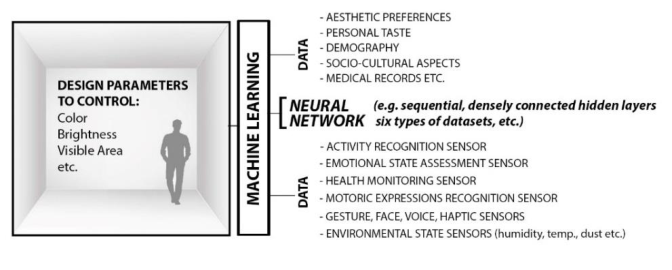
Calm, soft, cozy, spacious, intimate, warm, cold, etc.—all these perceptual vari- abilities of space are driven by data: aesthetic and personal taste, demographic, socio- cultural, medical records, and activities. With the help of sensors, the user’s emotional state assessment, health monitoring, motoric expression, gesture, face, voice, haptic and activity recognition sensors, as well as environmental state (humidity, tempera- ture, dust etc.) can be collected. The room can sense the mood, or the intended activity through the ambient intelligence-based technologies that will monitor through a net- work of smart, computer devices with wireless sensors.
Adaptability will occur in both directions. The subjectivity and unpredictability of perception and emotional responses to the living space will constantly influence human behavior and actions in that space. Personalization will evolve. The space will spur creativity in new ways, motivating and initiating new needs and desires for the user (Nadin, 2009). In order to adapt, the space must have the capacity to observe, “learn” and update itself to predict future interactions. The intelligence is in the ability to learn and decide autonomously.
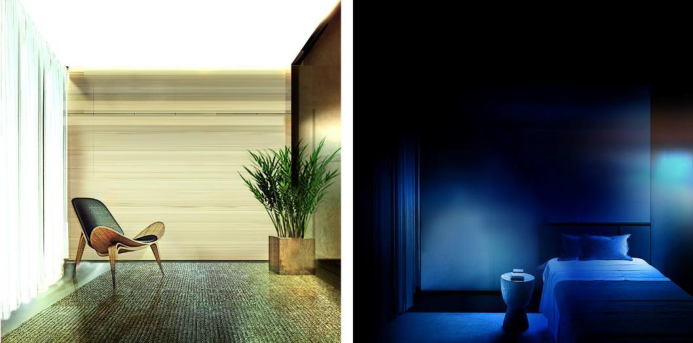
Ever since the Covid pandemic started, the living conditions of many people have been within the confines of four walls. At times of stress, fear and sickness, the feel- ings of anxiety, claustrophobia and insecurity are having detrimental effect on health. What if the adaptive space can trigger feelings of calmness, relaxation, safety and tranquility to help counter those feelings? The space must have the ability to change its perceived affect to feelings of safety and comfort. Figure 1 shows some examples of affective space creation using color, brightness, and visible area as three design parameters.
Human Systems Engineering and Design (IHSED 2021) https://openaccess.cms-conferences.org/#/publications/book/978-1-7923-8987-0
EXAMPLES The following images (see Figure 1) are some examples of affective space creation using properties of light (color, brightness, and visible area) as design parameters.
Figure 1. Affective space creation through manipulating properties of light MACHINE LEARNING AS AN INTERFACE
Machine Learning (ML) is the interface for all data gathered from the user and envi- ronment (see Figure 2). It concerns a learning process that will be not only cognitive, but also perception-based. Data collection on aesthetic choices of the occupant is cru- cial to initiate interaction. Similar to the concept of face-morphing (Blanz and Vetter, 1999), the system can also change from one emotional state to another.
Human Systems Engineering and Design (IHSED 2021) https://openaccess.cms-conferences.org/#/publications/book/978-1-7923-8987-0
Figure 2. Conceptual diagram of Machine Learning as an interface Data Collection on Aesthetic Choices
To initiate design of human-space interaction, the first stage is to identify the design parameters with the understanding of how to generate intended emotional scenes. As part of the data collection process, a user-study was conducted with two computer- generated, static images with the intention of evoking opposite emotional responses. The design parameters (Color, Brightness, and Visible Area) were manipulated dif- ferently for the same scene (See Figure 3). One image was intended to evoke “scar- iness” and had a darker, bluish color with very little area of visibility. The other was intended to evoke “coziness” and had a predominantly reddish, earthy tone, brighter with clearly visible surroundings.
Figure 3. Images of the same scene intended to evoke different emotional impacts: “scariness” (left) and “coziness” (right).
Figure available in the original PDF paper.
We asked participants if these images indeed evoked the intended emotion of “cozi- ness” or “scariness.” In a within-subject, qualitative, online user-study, there were twenty-two (22) participants (14 males and 8 females). Their ages ranged between 25 to 50 years (M=34.50, SD=8.17). The images were displayed side by side and partic- ipants were asked to rate the emotions evoked in terms of “coziness” or “scariness.” The findings were satisfactory as twenty-one (21) participants agreed that the design parameters of each space indeed evoked the feeling that was intended. Only one per- son stated that the left image felt serene, melancholic, yet comfortable.
Human Systems Engineering and Design (IHSED 2021) https://openaccess.cms-conferences.org/#/publications/book/978-1-7923-8987-0
Training Machine Learning In order to evoke perception-based emotional responses, the ML needs to be trained how to create specific environments by manipulating certain design parameters. As an ongoing experiment of training ML, some data from the previous study were used as a reference point. The exact values for Color, Brightness, and Visible Area were required by which the scenes could be perceived as “scary” or “cozy.” In order to col- lect a large amount of data within a short period of time, the scene was simulated in Unity and run via server. Appropriate measures were taken so that the scenes did not have unnatural lighting. The scenes were rated by the participants on their degree of “scariness” or “coziness.” A total of 1400 datasets were collected as the basic training data. The Deep Learning (DL) model was designed on KERAS—an Open-Source Neural Network library written in Python—that runs on top of TensorFlow 2.0.
The results looked promising. The training loss, validation loss, and the predic- tions were satisfactory. But the degree of accuracy was low. For better accuracy, more training data is needed. It was possible to train ML into learning what design parame- ters to select in order to evoke certain feelings. The training can be further improved by selecting participants from a comparatively homogenous background (i.e., similar in age range, demography, socio-cultural background, etc.). It is a work in progress.
CONCLUSIONS
This design concerns an architectural “intelligent” system. The living space acts as an interacting element in order to adapt to humans, creating variable sensory pleasing environments within the restrictions of the four walls. The design is based on percep- tion that is immeasurable and subjective. The goal is to personalize each space ac- cording to the user’s needs. By responding to the variability of space, new needs will occur and the actions and behavior of occupants may change. The concept of the interactive system is a platform for evaluating the anticipatory aspects of the inhabit- ants.
The design parameters were properties of light: Color, Brightness, and Visible Area. Some data of aesthetic significance were gathered for initiating the design. As mentioned before, training ML is a work in progress. The initial training of ML looked promising, however a lot more data need to be gathered for accuracy. Data should be collected from people of similar socio-cultural and demographic back- ground.
At a time of global pandemic, sensory pleasing environment, personalization, and circadian rhythm-based lighting is crucial for emotional and physical well-being. In addition to the emotional effects of the pandemic (fear, anxiety, stress), the system can assist in setting up incentives to facilitate a regular, healthy, active life on a day- to-day basis. This is also true for people who assist patients for long hours (e.g., in ICUs, recuperating rooms, cabins or care units for patients).
Human Systems Engineering and Design (IHSED 2021) https://openaccess.cms-conferences.org/#/publications/book/978-1-7923-8987-0
ACKNOWLEDGMENTS
I wish to extend my gratitude to the Hanse-Wissenschaftskolleg/ Institute for Ad- vanced Study, Germany for the Junior Research Fellowship. My gratitude to Dr. Rainer Malaka (University of Bremen, Germany) for his valuable time and supervi- sion. I sincerely thank Dr. Mihai Nadin (antÉ – Institute for Research in Anticipatory Systems, USA) for his constant support. I also thank Georg Volkmar and Boxuan Liu for their research support.
REFERENCES
Abbott, A. (2021). COVID’s mental-health toll: how scientists are tracking a surge in depression. Nature, 590(7845), pp.194-195. Albers, J. (2013). Interaction of color. Yale University Press. Alter, A. (2014). Drunk tank pink. Penguin. Bachelard, G. (2014). The poetics of space. New York: Penguin Books. Blanz, V. and Vetter, T. (1999). A morphable model for the synthesis of 3D
faces. Proceedings of the 26th annual conference on Computer graphics and interactive techniques - SIGGRAPH ’99. Ching, F. (2014). Architecture: Form, space and order. John Wiley & Sons. Colton, S. (2012). The painting fool: Stories from building an automated painter. Computers and Creativity, pp.3–38. Colton, S., Halskov, J., Ventura, D., Gouldstone, I. and Cook, M. (2015). The paint-
ing fool sees! New projects with the automated painter. In: ICCC. pp.189–196. Cope, D. (1991). Computers and musical style. Oxford: Oxford University Press. Eysenck, M. and Keane, M. (2015). Cognitive psychology. Psychology Press. Gervás, P. (2009). Computational approaches to storytelling and creativity. AI Magazine, 30(3), p.49. Goodfellow, I.J., Pouget-Abadie, J., Mirza, M., Xu, B., Warde-Farley, D., Ozair, S.,
Courville, A. and Bengio, Y. (2014). Generative adversarial networks. NIPS. pp.2672–2680. Loewenberg, P. (2012). Architectural and emotional space. Center 17: Space & Psyche, pp.16-41. McFarland, A. (2020). Advancement in “Spatial-AI” enables robots to perceive phys-
ical environments like a human. Unite.AI. https://www.unite.ai/advancement- in-spatial-ai-enables-robots-to-perceive-physical-environments-like-a-human/. Nadin, M. (2009). Anticipation and the artificial: aesthetics, ethics, and synthetic life. AI & SOCIETY, 25(1), pp.103–118. Nadin, M. and Naz, A. (2019). Engineered perception architecture for healthcare.
In: PETRA. ACM, pp.77-85. Naz, A. (2016). Interactive living space design for neo-nomads: Anticipation through spatial articulation. In: M. Nadin, ed., Anticipation Across Disciplines. Basel: Springer, pp.393-403. Naz, A., Kopper, R., McMahan, R. and Nadin, M. (2017). Emotional qualities of VR
space. In: IEEE Virtual Reality (VR). Los Angeles: IEEE, pp.3-11.
Human Systems Engineering and Design (IHSED 2021) https://openaccess.cms-conferences.org/#/publications/book/978-1-7923-8987-0
Nielsen, S., Friberg, C. and Hansen, E. (2018). The ambience potential of coloured illuminations in architecture. Ambiances, (4). Roberts, P. (2022). COVID-19 is changing design paradigms. [online] Stantec.com.
https://www.stantec.com/en/ideas/covid-19-is-changing-design-paradigms. Unreal Engine (2019). https://www.unrealengine.com/en-US/. Wiggins, G.A., Pearce, M.T. and MüllensiefenD. (2011). Computational modeling of music cognition and musical creativity. Oxford University Press. Zhu, J.Y., Park, T., Isola, P. and Efros, A.A. (2017). Unpaired image-to-image trans-
lation using cycle-consistent adversarial networks. 2017 IEEE International Conference on Computer Vision (ICCV). Zumthor, P. (2003). Thinking architecture. AGM.
Human Systems Engineering and Design (IHSED 2021) https://openaccess.cms-conferences.org/#/publications/book/978-1-7923-8987-0
LISTED IN THE AHFE DIGITAL BOOKSTORE CATALOGUE
Explore the complete digital volume
Human Systems Engineering and Design (IHSED2021): Future Trends and Applications
Read this individual research paper free through the original publisher, or explore the full digital proceedings book.
ISBN 978-1-7923-8987-0
Explore this ISBN in the AHFE Bookstore ↗Listed in the July 2026 bookstore catalogue; search by ISBN to confirm current availability · Digital book purchase optional