Xiyan Dai, Lee Yu-Chi (2022). Investigating preferred listening levels when using noise-canceling headphones among male graduate students. In: Usability and User Experience. AHFE Open Access, vol. 39, pp. 168–174. https://doi.org/10.54941/ahfe1001705
Many pieces of the literature showed that the potential risk of hearing loss was increasing among the general public, especially in adolescents and young adults, caused by prolonged exposure to loud music. Users tended to listen to music with a higher volume in noisy environments (e.g., intersections and subways) than in quiet ones. According to the WHO-ITU standard level for adults (80 dBA for 40 hours a week), the listening habits worse than the recommended standard might cause hearing damage. At present, the increasingly popular Noise-canceling headphones (NCHs) can reduce environmental noise to a certain extent. Whether users would lower the volume of music when using an NCH is a concern of the research. NCHs have different listening modes for dealing with ambient noise. Hence, the primary purpose of this study was to investigate the effect of different NCHs modes on pedestrians’ preferred listening levels (PLLs) in a noisy environment and to evaluate whether their listening levels were in a safe range.Methods: Fifteen male graduate students with normal-hearing ability participated in the study. The independent variable was the modes of NCHs, including Noise Cancellation (NC), Off, and Transparency modes. The PLLs were determined by each participant and recorded as the dependent variable. Before the experiments, participants were asked to report their headphone-use habits for assessing whether they exceeded a safe listening level. During the experiments, the ambient noise of heavy traffic intersections was played through two speakers. Participants were asked to put on the headphone with a specific mode by random orders. Subsequently, each participant was requested to adjust the volume of the music until it “sounded best.” The measurements were repeated twice for the three modes. A one-way repeated measure ANOVA with Bonferroni pairwise comparisons was used for statistical analysis. Results: The results indicated that the headphone modes significantly impacted the PLLs (p<0.001). Based on the Bonferroni pairwise comparisons, participants selected the highest PLLs with the Transparency mode (67.21 dBA), followed by the Off mode (60.77 dBA), and NC mode (55.83 dBA). Besides, the self-reported results showed that the usage of headphones was five days per week and three hours per day on average. From the results, the PLLs selected by the subjects were all lower than 80 dBA, and the average listening time did not exceed 40 hours per week. It implied that the participants' listening habits were at safe listening levels. Conclusion: In a noisy environment, different headphone modes have impacted on PLLs adjustment. The PLLs selected with the NC mode are significantly lower than those with Off mode and Transparency mode. The findings of this study suggested that using NC mode in a noisy environment could reduce the risk of hearing loss compared to the other headphone modes.
Personal listening devices (PLDs) have been popular for many years, such as the early CD players and MP3 players in the early years. Listening to music on headphones has become a daily habit for many people, while improperly using these convenient devices may potentially cause hearing loss (Butter- baugh and Gordon-Pershey, 2019). The WHO estimates that 1.1 billion young people (aged from 12 to 35) worldwide are at risk of hearing loss due to exposure to noise from recreational environments with an excessive volume of PLDs (Organization, 2015).
With the increased usage of PLDs, hearing loss and hearing impairment have become a concern in the health of teenagers and young adults (Comunità and Picinali, 2019). The U.S. National Health and Nutrition Examination Survey (Shargorodsky et al. 2010) indicated that the prevalence of hearing loss among adolescents was increased from 3.5% to 5.3% from 1994 to 2006. (Henderson et al. 2011) showed that the proportion of people listening
Investigating Preferred Listening Levels when Using Noise-Canceling Headphones 169
to music on headphones had increased by about 75% compared to 1990 in the United States.
A single exposure to extremely intense sound and long-term, repeated exposure to noise can both cause damage to the auditory system and result in noise-induced hearing loss (NIHL) (Punch et al. 2011, Basner et al. 2014). It has been shown that PLDs can produce volumes sufficient (> 85dBA) to cause hearing damage (Fligor et al. 2004, Hodgetts et al. 2007). (Fligor et al. 2004) recorded peak output levels of up to 123 dB (A) for PLDs. (Hodgetts et al. 2007) recorded average peak output levels of up to 110 dB (A) when people used MP3 devices and various headphones. In addition, most studies focused on PLDs evaluation pointed to at least two factors that may contri- bute to NIHL: high output sound levels and prolonged listening (Hong et al. 2013). The WHO standard level for adults was 80 dBA for 40 hours a week (Organization, 2019). Exceeding this range may lead to NIHL.
The PLLs usually depend on the level of background noise. In places with high ambient noise levels, headphones users tend to raise the volume of music, which increases the risk of hearing loss (Hodgetts et al. 2007). Now, increasingly popular NCHs usually achieve good noise reduction through a combination of active noise-cancellation and passive noise-cancellation. Active noise-cancellation technology is based on the noise cancellation system carried within the headphones. Real-time generation of sound waves with the same amplitude and opposite phase of the noise, through the inverse super- position of the two, to achieve the noise reduction effect (Narahari, 2003). The passive noise-cancellation mode involves physical isolation, such as sili- cone earplugs or earmuffs, to block external high-frequency noise (Liang et al. 2012). Because NCHs have the characteristic of reducing noise, NCHs users may reduce music volume in noisy environments. This study aimed to investigate the different NCHs modes’ effect on pedestrians’ PLLs in a noisy environment and to determine whether their listening levels were within a safe range by combining their daily use time.
METHOD
Participants Fifteen male graduate students (average stature: 175.00±4.61 cm and body weight: 74.93±22.61 kg) were recruited and volunteered to participate in this study. The participants’ age ranged from 21 to 26 years, with a mean age of 23.53±1.12 years. All participants used headphones regularly. The ave- rage frequency for using headphones was more than 3 hours per day and 5 days per week. Participants were required to have normal hearing sensitivity (> 20 dB HL at 500, 1000, 2000, 4000, and 6000 Hz) (Hodgetts et al. 2007, Hodgetts et al. 2009). None of them had an impairment history of otologi- cal disease. Written consent forms were provided to participants before the experiment.
170 Dai and Lee
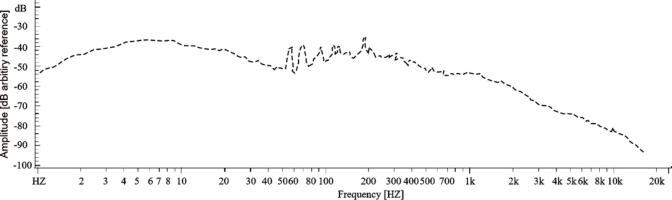
Figure 1: Spectrum of noise recorded on busy traffic intersections as the background noise.
Materials
Noise-Canceling Headphones (NCHs) An AirPods Pro (MWP22CH/A, APPLE) was chosen for this study. It was an ANC headphone that was launched in 2019 (Vladyko et al. 2020). Com- mon NCHs have three modes for users to adjust: Noise Cancellation (NC), Off, and Transparency mode. NC mode involves an active noise controller to detect undesirable ambient noise and counter it with an anti-phase. For Off mode, it means turning off NC. The in-ear earbuds act as passive noise- cancellation, and physically isolate the ear canal from the outside world, preventing sound waves from reaching the eardrum. In addition, the Tran- sparent mode allows outside sounds to enter the headphones and helps the users be able to hear outside sounds more clearly.
Experimental Music A soothing song was chosen because it contains minimal amplitude fluctuati- ons. The song’s narrow dynamic range reduced the possibility of participants needing to make adjustments throughout the song to accommodate ampli- tude variability. The loudness range of the song used in the study was 8.6 LU, which is similar to the dynamic range of the song selected by (Hodgetts et al. 2007, Hodgetts et al. 2009).
Environmental Noise Collection Assessment of PLLs occurred in the environment of busy traffic intersections. The noise sample was measured and recorded at an intersection with high traffic flow. Figure 1 represents the frequency spectrum for the selected noise sample. The noise is concentrated in the low-frequency range of 0-200 Hz, which is typical of the internal combustion engine roar from vehicles. Accor- ding to the upper limit of environmental and functional area noise stipulated in the Acoustic Environmental Quality Standard of the People’s Republic of China (File no. GB 3096-2008), the traffic intersection noise sample was broadcast at 70 dBA SPL.
Investigating Preferred Listening Levels when Using Noise-Canceling Headphones 171
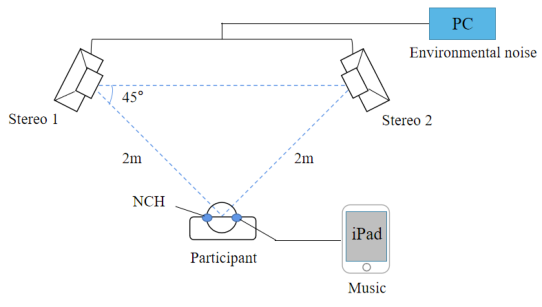
Figure 2: Experimental setting.
Self-Reported Questionnaire Before the experiment, participants filled out a listening habit survey. The questionnaire was mainly used to obtain the duration and frequency of using headphones. The results of the survey were applied to evaluate the risk of hearing loss by using headphones under the three NCHs modes.
Experimental Procedures The experiment was carried out in a quiet laboratory (22 dBA, 7m x 10m x 4m). Two stereos were placed 2 meters away from the participant at 45 degrees azimuth (Worthington et al. 2009, Breinbauer et al. 2012) and were used to broadcast environmental noises. A pair of NCHs that connect to the iPad via Bluetooth was provided to the participants. The selected music was played on a loop via the NCH. The experimental setting is shown in Figure 2.
Before the experiment, participants were tested by an audiometer, and their hearing was required to be better than 20 dB HL at 500, 1000, 2000, 4000, and 6000 Hz (Hodgetts et al. 2009). All subjects had normal hearing and no ear diseases. Subsequently, participants were required to fill out a survey about their headphone-using habits. Then, participants were asked to wear the NCH and walk at their usual speed (about 3 km/h) in the same place. The researcher played ambient noise on a loop, then chose an NCHs mode randomly and asked the participants to adjust the volume up or down on the iPad while walking for one minute, until the music sounded best to them. The initial volume was also randomly selected. After the participants found their PLL, the level was applied continuously and all participants were asked to listen for about 1 min for confirming the PLLs selection. The experimenter measured sound pressure levels based on the volume that the subjects adju- sted. Moreover, about three-minute-rest was given after each condition was completed. Each NCHs mode was tested twice in random orders.
Statistical Analysis All data analyses were performed by SPSS 25.0 (IBM Corp. Armonk, NY). A one-way repeated measure ANOVA with Bonferroni pairwise comparison
172 Dai and Lee
Table 1. Comparison of the averaged PLLs chosen by the participants in various NCH modes and the pos hoc results (unit in dBA).
Table available in the original PDF paper.
Mode Mean SD 95% C.I.
NC 55.831 A* 8.826 50.943-60.718 Off 60.772 B 6.092 57.398-64.146 Transparency 67.219 C 5.852 63.979-70.460 *Bonferroni pairwise comparisons results; C.I.: Confidence intervals.
method was used for statistical analysis. The independent variable was NCHs modes with 3 levels (NC, Off, and Transparency). The dependent variable was PLLs. A p-value lower than 0.05 is considered significant.
RESULTS AND DISCUSSION
Table 1 shows the average PLLs chosen by the participants under the busy traffic intersection noise when using different NCHs modes. The repeated measure ANOVA revealed that the NCHs mode significantly affected PLLs (F(2, 28) = 33.666, p < 0.001; eta squared = 0.706, observed power = 1.000). Furthermore, Bonferroni pairwise comparisons revealed that the PLLs under NC mode were significantly lower than those with Off and Transparency mode (NC vs Off: t = −4.942, p = 0.004; NC vs Transparency: t = −11.389, p < 0.001). The highest PLLs were found under the Transparency mode com- pared to the others (Transparency vs Off: t = 6.447, p < 0.001; Transparency vs NC: t = 11.389, p < 0.001).
The results of this study showed that in the presence of busy traffic noise, both NC mode and Off mode were effective in reducing the volume levels selected by the participants, with an average reduction of 6–11 dBA compa- red to Transparency mode. Therefore, headphones with NC functions can reduce PLLs in noisy environments. The results differed from the study of (Butterbaugh and Gordon-Pershey, 2019). They pointed out that using NCHs didn’t help listeners enjoy music at lower and safer decibel levels. In addition, this study also found a significant difference between NC and Off, which is inconsistent with the study of (Hodgetts et al. 2007), who found that under street noise, wearing an over-the-ear NCH had no significant effect on PLLs when turning NC on or off. These may account for the different frequencies of environmental noise. Active noise-cancellation mainly reduces low-frequency noise, while passive noise-cancellation mainly reduces high- frequency noise (Liang et al. 2012). In this study, the busy traffic intersection noise was mostly in the low-frequency band. Hence, the effect of NC mode could be obviously obtained in the busy traffic environment. Additionally, (Liang et al. 2012) reported that PLLs were influenced by the different envi- ronmental noises. Therefore, further research is needed to investigate the effects of using NCHs under different environmental noise conditions and provide users with beneficial usage recommendations.
Based on the participants’ reports of headphone use habits, the participants of the study used headphones on average more than 5 days per week for approximately 3 hours per day. The longest use time was 5 hours per day, 7
Investigating Preferred Listening Levels when Using Noise-Canceling Headphones 173
days per week, with a maximum total of 35 hours. On the other hand, the PLL measured in the experiment was 77.979 dB (A) at the highest, which did not exceed the safe listening level specified by the WHO-ITU standard level for adults (80 dBA for 40 hours a week) (Organization, 2019).
In this study, the special function on the iPad was used to convert the par- ticipants’ chosen volume into PLLs. In addition, there are other calibrations and sound pressure measurements in dBA, such as the KEMAR manikin head, real ear measurement, and artificial ear measurement(Liang et al. 2012). Different conversion methods may have errors that lead to over or undere- stimation of PLLs. Also, a soothing song with a narrow dynamic range was chosen in this study. If people listen to more rhythmic music in reality, the PLLs set may be different from the result.
In addition, the SPL of busy traffic intersections noise in the experiment was 70 dBA (according to the Chinese national standard), but the actual environment may be much higher than 70dBA. In louder ambient noise, head- phone users may also increase the volume. Therefore, in noisy environments, it is particularly important to select an appropriate headphone mode. Accor- ding to the experimental results, the NC mode can reduce 11 dBA compared to the Transparency mode. Choosing NC mode may greatly reduce the risk of hearing damage caused by listening to music at a high-level volume.
CONCLUSION
In noisy traffic environments, both NC mode and Off mode can significantly reduce PLLs. The lowest PLL was found in the NC mode, followed by the Off mode. In summary, the PLLs selected by the participants (male graduate students at SCUT) and the daily use time were all at safe hearing levels. NCHs seem to help reduce the risk of hearing damage caused by listening to high levels of music in the presence of background noise. Therefore, choosing the right headphone mode under different ambient noises is more beneficial to hearing health. Furthermore, future studies should also include a wider range of gender groups. The safety of using NCHs in various ambient noises of different SPL should also be considered.
REFERENCES
Basner, M., Babisch, W., Davis, A., Brink, M., Clark, C., Janssen, S., & Stansfeld, S. (2014). Auditory and non-auditory effects of noise on health. The lancet, 383(9925), 1325–1332. Breinbauer, H. A., Anabalón, J. L., Gutierrez, D., Cárcamo, R., Olivares, C.,
& Caro, J. (2012). Output capabilities of personal music players and asses- sment of preferred listening levels of test subjects: Outlining recommendations for preventing music-induced hearing loss. The Laryngoscope, 122(11), 2549–2556. Butterbaugh, S., & Gordon-Pershey, M. (2019). The Usefulness of Active Noise Cancelling Headphones when Listening to Music in the Presence of Ambient Noise. eHearsay, 17. COMUNITà, M. & PICINALI, L. (2019) Published. Estimating ear canal volume
through electrical impedance measurements from in-ear headphones—Initial results. Audio Engineering Society Conference: 2019 AES INTERNATIONAL CONFERENCE ON HEADPHONE TECHNOLOGY, 2019. Audio Engineering Society.
174 Dai and Lee
Fligor, B. J., & Cox, L. C. (2004). Output levels of commercially available portable compact disc players and the potential risk to hearing. Ear and hearing, 25(6), 513–527. Henderson, E., Testa, M. A., & Hartnick, C. (2011). Prevalence of noise-induced
hearing-threshold shifts and hearing loss among US youths. Pediatrics, 127(1), e39-e46. Hodgetts, W. E., Rieger, J. M., & Szarko, R. A. (2007). The effects of listening environment and earphone style on preferred listening levels of normal hearing adults using an MP3 player. Ear and hearing, 28(3), 290–297.HONG, O., KERR, M. J., POLING, G. L. & DHAR, S. J. D. M. (2013). Understanding and preventing noise-induced hearing loss. 59, 110–8. HODGETTS, W., SZARKO, R. & RIEGER, J. (2009). What is the influence of
background noise and exercise on the listening levels of iPod users? 825–832. Liang, M., Zhao, F., French, D., & Zheng, Y. (2012). Characteristics of noisecanceling headphones to reduce the hearing hazard for MP3 users. The Journal of the Acoustical Society of America, 131(6), 4526–4534. Narahari, N. (2003, November). Noise cancellation in headphones. In M. Tech.
credit seminar report, Electronic Systems Group, EE Dept, IIT Bombay. ORGANIZATION, W. H. (2019). Safe listening devices and systems: a WHO-ITU standard. PUNCH, J. L., ELFENBEIN, J. L. & JAMES, R. R. (2011). Targeting hearing health
messages for users of personal listening devices. Shargorodsky, J., Curhan, S. G., Curhan, G. C., & Eavey, R. (2010). Change in prevalence of hearing loss in US adolescents. Jama, 304(7), 772–778. Vladyko, A., Elagin, V., & Rogozinsky, G. (2020). Method of early pedestrian war-
ning in developing intelligent transportation system infrastructure. Transportation Research Procedia, 50, 708–715. World Health Organization. (2015). Make listening safe (No. WHO/NMH- /NVI/15.2). World Health Organization. Worthington, D. A., Siegel, J. H., Wilber, L. A., Faber, B. M., Dunckley, K. T., Garstecki, D. C., & Dhar, S. (2009). Comparing two methods to measure pre- ferred listening levels of personal listening devices. The Journal of the Acoustical Society of America, 125(6), 3733–3741.
LISTED IN THE AHFE DIGITAL BOOKSTORE CATALOGUE
Explore the complete digital volume
Usability and User Experience
Read this individual research paper free through the original publisher, or explore the full digital proceedings book.
ISBN 978-1-958651-15-5
Explore this ISBN in the AHFE Bookstore ↗Listed in the July 2026 bookstore catalogue; search by ISBN to confirm current availability · Digital book purchase optional