Ana Filomena Curralo, Pedro Miguel Faria, Antonio Curado, Paula Azeredo, Sergio I. Lopes (2022). Designing a UX Mobile App for Hydration and Sustainability Tracking in Academia. In: Usability and User Experience. AHFE Open Access, vol. 39, pp. 67–77. https://doi.org/10.54941/ahfe1001692
1 Escola Superior de Tecnologia e Gestão, Instituto Politécnico de Viana do Castelo, Rua da Escola Industrial e Comercial de Nun’Alvares, 4900-347 Viana do Castelo, Portugal; Escola ID + , Instituto de Investigação em Design, Media e Cultura, 3810-193 Aveiro Portugal ↗
2 Escola Superior de Tecnologia e Gestão, Instituto Politécnico de Viana do Castelo, Rua da Escola Industrial e Comercial de Nun’Alvares, 4900-347 Viana do Castelo, Portugal; ADiT-Lab, Instituto Politécnico de Viana do Castelo, Rua da Escola Industrial e Comercial de Nun’Alvares, 4900-347 Viana do Castelo, Portugal ↗
3 Escola Superior de Tecnologia e Gestão, Instituto Politécnico de Viana do Castelo, Rua da Escola Industrial e Comercial de Nun’Alvares, 4900-347 Viana do Castelo, Portugal; proMetheus, Instituto Politécnico de Viana do Castelo, Rua da Escola Industrial e Comercial de Nun’Alvares, 4900-347 Viana do Castelo, Portugal ↗
4 Escola Superior de Tecnologia e Gestão, Instituto Politécnico de Viana do Castelo, Rua da Escola Industrial e Comercial de Nun’Alvares, 4900-347 Viana do Castelo, Portugal ↗
Higher Education Institutions (HEIs) are favored atmospheres in the civic training of their audiences, undertaking a major role in Global Sustainable Development. The management of waste packaging represents a huge environmental footprint, particularly the plastic water bottles which constitute a major example of everyday waste that directly impacts our lives, not only ecologically, but also economically. Hence, the project RefillH20 proposes to reduce the sales of plastic water bottles in the 6 schools of the Polytechnic Institute of Viana do Castelo (IPVC), respective bars, canteens, and halls of residence. For this purpose, a smartbottle, equipped with a radio frequency identification (RFID) chip, has been designed and integrated within an institutional ecosystem, that includes several smart refill stations, enabling an automatic filling process with no physical contact with the equipment. This approach enables not only the computation of water consumption metrics typically used for hydration assessment but also the computation of relevant sustainability metrics and indicators through a mobile application, such as the number of refills per period of time, amount of consumed water, the estimated amount of averted plastic waste considering different approaches (temporal, cumulative, individual or referring to colleges, classes, etc.), the energy-saving from overall waste reduction and reduction of greenhouse gas (GHG) emissions and information on users’ environmental footprint. This work presents the development of a high fidelity UX Mobile App prototype, which aims to allow users of RefillH20 ecosystem to monitor their water intake habits, as well as their contribution to improving the overall environmental sustainability in academia, and thus promoting the creation of awareness regarding their effective ecological footprint. By using a UX Design approach, the users have been involved interactively with these new digital products and services idealization, through their appearance and how they feel, use and remember such interactions.
The Refill_H20 project was designed to reduce consistently the purchase of single-use plastic water bottles in the six schools of the Polytechnic Institute of Viana do Castelo (IPVC), this includes bars, canteens and academic resi- dences. Plastic use reduction eliminates the corresponding plastic waste and pollution. Also, reducing plastic water bottles purchase allows promoting awareness and mindset changes in the consumption habits of the IPVC popu- lation (students, teachers and employees), favoring an overall reduction in the production of disposable waste, whose recycling process is energy consuming and produces greenhouse gas emissions.
The IPVC facilities (schools, bars, canteens and residences) are annually attended by more than 5,000 students with an annual consumption of around 51,000 small plastic bottles (0.5 l) and 15,000 large plastic bottles (1.5 l). This produces 1,215 kg of plastic waste. The large local consumption and the young age of the population, more prone to change, makes this setting interesting for a pilot project aimed at the implementation of a model for gradual replacement of undesirable single-use plastic water bottles, meeting the needs of the target population, and eventually allowing the replication of the solution in other similar environments in Portugal.
In a first stage, the Refill_H20 Project included a survey of the IPVC community. This allowed the identification of consumption habits of stu- dents, teachers and employees concerning water bottles. The survey invited the population to identify a set of physical, aesthetic and functional requi- rements to allow the creation of specifications to develop a sustainable and intelligent water bottle (Mendes, 2021a). The collected data concerned mate- rial, volume, automatic opening and closing, easy refill, durability, aesthetical appearance, and communication with a platform to allow managing water consumption (Mendes, 2021b).
Simultaneously with this survey, a water refill station was designed and developed, including a set of innovative features, for installation in the IPVC premises . In an early stage, the characteristics of the water for distribu- tion were studied, introducing purification, filtration and aroma systems. In addition to studying the quality of the water for consumption, a reading device was incorporated in the refill station to allow communication with the sustainable smartbottle and the consumption management platform. A digital screen displays information on the amount of plastic saved in each filling, total number of fillings in the station since the date of first operation, energy savings associated with plastic waste reduction, and the corresponding reduction in GHG emission (Martins, 2021).
This article presents the Refill_H20 Mobile App, included in the Refill_H20 system. This App tracks behavioral patterns concerning the quan- tification of water intake, encourages water intake and the reduction of the ecological footprint by reusing the Smartbottle and the refill machines avai- lable in the IPVC premises. This document is organized as follows: Section 2 introduces the UX mobile app design methodology; Section 3 presents the results and the usability evaluation assessment; and Section 4 presents the conclusions and suggestions for future research.
Designing a UX Mobile App for Hydration and Sustainability Tracking in Academia 69
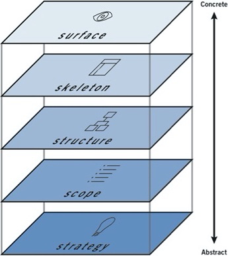
Figure 1: The 5 planes of UX by Jesse James Garret.
UX MOBILE APP DESIGN – METHODOLOGY The term User Experience (UX) was coined by Donald Norman (b.1935) in the 1990s encompassing all the particularities involving the experience with a product (Norman, 2004). UX is an area that introduces techniques and methods of analysis and design, to develop applications with good usability, focusing on users’ needs. It concerns how the user experiences a product or service. UX covers the whole product or service acceptance, involving all aspects of a product, pragmatic and hedonic. This area of study aims at ease of use and new interface techniques to support users’ tasks, ensuring better access to information and generating more powerful forms of communication (Valente, 2017).
A fast-growing and multidisciplinary domain, UX Design is also under- stood as the creation and synchronization of elements that affect the user’s experience with a specific company, to influence perceptions and behavior. Such elements include touch, hearing, smell and products the users interact with virtually, such as digital interfaces (Walter, 2011). UX Design plays a key role in mobile applications development due to the large influence on a product success. The user experience is determined by different factors, inclu- ding user performed actions, the surrounding space and the specific product, service or system. To develop a mobile application it is important to highli- ght user preferences, behaviors and reactions concerning the interaction with the service. Usability and UX are thus fundamental aspects to consider in mobile applications development. A user-friendly application will produce a more positive user acceptance (Nielsen, 2012). Within the scope of the vari- ous methodologies developed in the field of UX design, this project was based on the methodology proposed by Jesse James Garrett (Garrett, 2011), pro- posing a five-stage project, composed of 5 layers or planes, from abstract to concrete: Strategy, Scope, Structure, Skeleton and Surface (Figure 1).
Each layer/plan is supported on each other and is analyzed in an increa- sing mode from the most abstract to the most concrete. Strategy is the first layer of this process, which aims to obtain a general perception of the issues involved in the initial situation of the problem, that is a collection of the main information related to the project and, mainly, of the user’s needs. The first stage is intended to obtain a general perception of the issues involved
Table 1. Analysis of similar products.
Table available in the original PDF paper.
App1 App2 App3 Good visual inter- face Unattractive visual interface Visual Interface Free version - force the pro version Installation Easy and fast to download
Easy and fast to download
Easy and fast to download Objective Calculation
Calculates the amount of water to be ingested per user’s weight
Calculates the amount of water to be ingested per user’s weight
Calculates the amount of water to be ingested per user’s weight Advertising Moderate Does not have Too much Reminders Drink water warning
Only if authorized Drink water warning Achievements Does not have Does not have Evolution level - achievements
in the initial problem, that is, a survey of the main information related to the project and mainly the users’ needs. A detailed characterization of the mobile applications currently available on the market was carried out, and it was synthetically possible to conclude that there is a large supply. Regarding mobile applications to control water consumption, three Apps were analy- zed according to the parameters shown in Table 1. Most existing solutions record daily and monthly intake and present a statistical data analysis in the form of graphics. The next step was to develop Personas, with the goal of creating a stereotype of a user to help to decide about the product’s characte- ristics, navigation, interactions, and the aesthetics that the App should have. The Personas, illustratively, represent the variation of needs of a real user, for taking decisions about the development of the App, with the goal of bet- ter enhancing the UX. These Personas are idealized to make them consistent, creating identities around these characters, defining names, physical chara- cteristics, details and specific information, based on the results of previous research. Questions are asked around the personas to help to keep the users in the designer’s mind, during the development of the project. The definition of the Personas was important in this first stage of the App development, since it allowed the development of a narrative focused on providing the best user satisfaction (Carvalhido et al., 2021).
The next layer is Scope and establishes the functional aspects to be develo- ped in the application, establishing the user’s role. Then, the Scope layer was implemented, where the problem to be solved was materialized. The Scope can be divided into functional specifications and content requirements. The functional specifications consist of the functionalities that the App should support. Content requirements, on the other hand, refer to the informa- tion that needs to be provided to the user. For the App Refill_H20 those are presented in Table 2.
The Structure layer, can be proposed in the form of a navigation flowchart, with the goal of structuring the user’s interaction with the App. It is divided in two parts: the Interaction Design and the Information Architecture. The
Designing a UX Mobile App for Hydration and Sustainability Tracking in Academia 71
Table 2. App functionality and requirements.
Table available in the original PDF paper.
Application Functionality Content Requirements User account Login with e mail of the IPVC Possibility to charge By school card or credit card Water quantity management: Filling and drinking Achievement (Awards) Weight report Include specific data Automatic reminder Mobile notification History of recharges Local Database Feedback Report to the content Rewards Database/achieving targets Color customization System/Software Water Benefits Database
information architect is the individual who organizes patterns inherent in data, transforming what is complex into something clear and who creates the structure or map of a given piece of information, to enable others to cre- ate their own path towards knowledge (Wurman, 1998). In the App project under development, the information architecture gathers the present conce- pts and segments in a logical way, that the information will originate the functionalities to be developed. This step enables the development of more objective and understandable functionalities (Carvalhido et al., 2021).
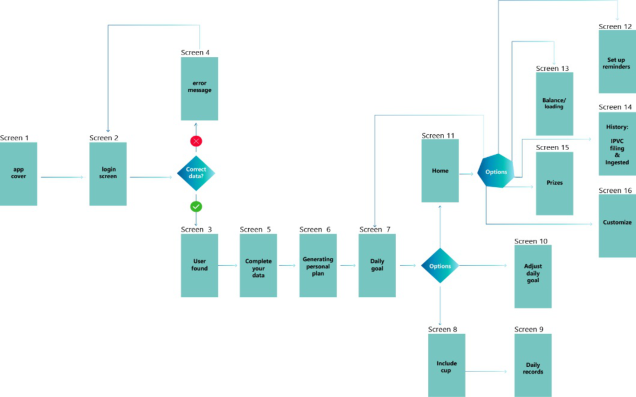
The Skeleton defines the navigation systems, corrections and adjustments to interface elements and the development of all screen wireframes. Wire- frames are represented in a schematic document, often detailed, used to represent the behavior of the visual elements of the various screens to unify the interface and the navigation design. After the detail regarding the organi- zation of the application content, a first sketch was made to visualize the graphic layout. These understandable drawings, called wireframes, repre- sented through a flowchart (Fig. 2) help the designer to perceive the set of interactive elements present in each of the App screens.
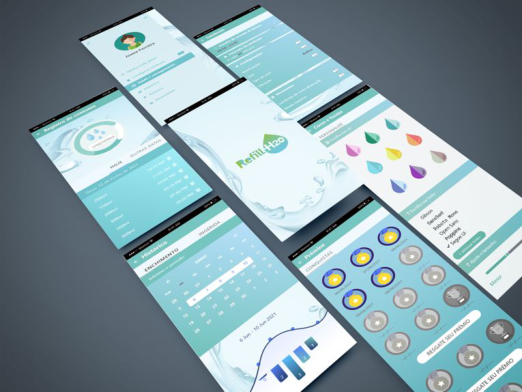
In the Refill_H20 App the wireframes were developed through sketch dra- wings, in order to show the content of each screen. Thus, the first versions of the App screens were designed in a simple way, without the use of colors or images allowing for greater flexibility in adding and removing features to be developed, without concern for the final aesthetics of the App. The Sur- face layer is where the visual elements that outweigh their meaning and the emotions, they may eventually generate are relevant, since this is a project used by different age groups, so its accessibility and readability are crucial. In this sense, screen colors influence the communication of a product/appli- cation and help integration into the users’ imagination. Currently, there are several websites that check the overlay of text on colors and help to iden- tify the best compositions, in order to ensure a better readability. For the present project, the “contrast checker” of WebAIM was used. Several high- fidelity screens were developed for the Refill_H20 App (Fig. 3) seeking to meet the functional specifications and content requirements previously esta- blished, such as water intake and the reduction plastic bottle purchase, waste
and pollution, thus reducing the ecological footprint. Some of these screens were implemented using Adobe XD Software.
The App prototype was developed according to the methodology proposed by Garrett (2011), using Adobe XD. The prototype presents an easy, intuitive navigation among screens, allowing the highlighting of three adjectives that characterize the overall concept of the application: disclosure, sharing and approach between users, promoting a good user experience.
Designing a UX Mobile App for Hydration and Sustainability Tracking in Academia 73
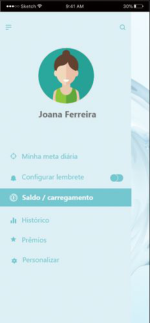
Figure 4: App main screen.
RESULTS AND USABILITY ASSESSMENT A high-fidelity prototype was built with the screens logical sequence, accor- ding to the conceptualized functionalities defined in the methodology. The prototype was extremely useful, as it allowed discovering the strengths and weaknesses of each interface, reaching the most correct interface. Synthe- tically, the screens showed the flow of the main functionalities. When the application is started for the first time, the user is directed to the registration screen through the IPVC email. After registration, the application is launched and the user is directed to a hydration plan. Plan l presents a form divided in 5 sections: Name, Date of Birth, Gender, BMI and Daily Goal (of water intake). On Date of Birth, the user is presented with a calendar provided by Android (DatePicker) to choose the birthdate. In the BMI section the user must enter his weight and height and the BMI (Body Mass Index) is calcu- lated. The BMI results from the division of the weight by the square of the height, with weight in kilograms (Kg) and height in meters (m). The user must also set some goals, such as the daily water intake in liters (L). To cho- ose the volume of water intended for intake, there are 4 volumes available to adjust to the user’s goal: 1.5 L, 1 L, 0.75L and 0.50L. The data inserted by the user is stored and available for subsequent access and modification. The application’s main menu is displayed laterally (Fig. 4) showing a list of exi- sting features: daily water intake target; reminder setting; balance/charging; historic; prizes and customization.
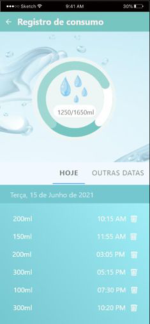
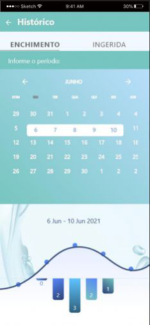
The link daily target displays the menu intake record (Fig. 5). This layout allows the user to insert his daily water intake. For this purpose, the user must press the circular graph on the screen on the bottle(s) corresponding to the volume of water intake. The graph updates in real time the percen- tage of water intake according to the target. The historical screen groups the records of water intake by Today, Last Month and Last Year (Fig. 6). Visua- lized through graphs, the evolution of water consumption is recorded in the different time intervals. The prizes screen is used to register the fulfillment of the hydration plan, whenever the bottle is filled in the filling machines, a
Figure 5: Intake record.Figure 6: Historic.
prize is registered and awarded. At the end of the month, a remuneration is attributed to the user(s) with more fillings. It is also possible to customize the colors of the App screens.
Usability tests are particularly important because those involved in the project already know the App and this impairs their judgement of actual difficulties in interacting with the interface, since they are already adapted to eventual problems. To carry out such tests, a “facilitator” must indicate the users which tasks are to be performed. The facilitator also encourages users to evaluate the interaction and should prevent user frustration upon not being able to perform the required tasks (Krug, 2000). The usability tests consisted of individual interviews with users, in which they were asked to perform a set of tasks in the final product. The main goal was to identify the difficulties in the application use and to detect required adjustments. The application experience of use is very important since the user may reach his goal but the experience may not be positive, and therefore the application will not be successful.
Designing a UX Mobile App for Hydration and Sustainability Tracking in Academia 75
For the sample profile, the users of the tested application were members of the IPVC community, aged between 20 and 50 years-old. Usability tests were performed by 9 users, 6 female and 3 male. According to Nielsen (2000), it is not necessary to include a larger pool in the tests because it will not assure better results. Although some users indicated navigation difficulties in the prototype, as it was very slow at the moment of the test, most users had a good opinion on the App prototype, considering the interface design intuitive, appealing, readable and adequate. They also highlighted the App’s ability to stimulate water intake, the graphic environment, the ability to personalize the App and the achievements during use.
CONCLUSION
The Refill_H20 application was implemented to track behavioral patterns concerning the quantification of water intake, encouraging water consum- ption and consequently promoting the reduction of the ecological footprint by reusing the Smartbottle and the refill machines available in the IPVC pre- mises. Therefore, this application allowed to extend the Refill_H20 project and widen its objectives towards sustainability in academia. To know bet- ter the target population also allows realizing they can improve their health through increased water intake, while decreasing the ecological footprint, avoiding plastic bottles. It should be noted that the application will require further study over time, due to technological enhancements. An advancement today may be obsolete tomorrow. It is also not possible to assure its constant use, which remains a subjective issue although preliminary studies provide positive indicators. The availability of the application will allow assessing its popularity and acceptance visually. It will be possible to collect users’ opi- nions and trends and subsequently equate habits and forms of use. Only the development of the application to a state of large-scale use will allow its evaluation by a large scale, diverse set of users, leading to more informed conclusions. For this purpose, the optimization of the application interface is proposed for a near future, developing advanced graphical components.
FUNDING This research was funded by the Program Environment, Climate Change and Low Carbon Economy, created following the establishment of a Memorandum of Understanding between Portugal and Iceland, Liechten- stein and Norway, under the EEA and Norway Grants 2014-2021, for the program areas of Environment and Ecosystems (PA11), and Climate Change Mitigation and Adaptation (PA13), under the scope of the project 10_SGS#1_REFILL_H20”. António Curado co-authored this work within the scope of the project proMetheus, Research Unit on Materials, Energy, and Environment for Sustainability, FCT Ref. UID/05975/2020, financed by national funds through the FCT/MCTES.
ACKNOWLEDGMENT
Um agradecimento especial ao Programa Ambiente, Alterações Climáticas e Economia de Baixo Carbono, criado na sequência da assinatura do Memo- rando de Entendimento entre Portugal, Noruega, Islândia e Liechtenstein, tendo em vista a aplicação em Portugal do Mecanismo Financeiro do Espaço Económico Europeu (MFEEE) 2014-2021 nas áreas programáticas Ambiente e Ecossistemas (PA11), e Mitigação e Adaptação às Alterações Climáticas (PA13), pela atribuição do financiamento 10_SGS#1_REFILL_H20, selecio- nado no âmbito do Aviso Small Grants Scheme #1 – Projetos para a prevenção e sensibilização para a redução do lixo marinho. Este Projeto contribui para a execução do Objetivo n.° 1 do ‘Programa Ambiente’: “Aumentar a apli- cação dos princípios da Economia Circular em sectores específicos”, e do Output 1.3 do Programa, através de promoção da Economia Circular pela “Redução de plásticos nos Oceanos, de origem em atividades terrestres”, em conformidade com o Anexo I do Acordo de Programa assinado a 27 de maio de 2019.
REFERENCES
Carvalhido, A., Novo, R., Faria, P.M., Curralo, A. (2021). “A User Experience Design Process in Mobile Applications Prototypes: A Case Study”, in: Advances in Design and Digital Communication II. DIGICOM 2021, Martins, N., Brandão, D. (Ed.). Garrett, J. (2011). The Elements of User Experience: User-Centered Design for
theWeb and Beyond. Berkeley: New Riders. Krug, S. (2000). On not throwing the baby out with the dishes. Interpreting test results. Don’t Make Me Think! A Common Sense Approach to Web Usability. Martins, P., Lopes, S.I. , Cruz A.M.R. and Curado, A. (2021b). Towards a Smart &
Sustainable Campus: An Application-Oriented Architecture to Streamline Digi- tization and Strengthen Sustainability in Academia, Sustainability, 13, 3189, DOI: 10.3390/su13063189. Mendes, J., Curralo, A., Curado, A., Lopes, S.I. (2021a). The Sustainable Smartbottle: A Proposed Design Methodology to Minimize Plastic Pollution. In: Martins N., Brandão D. (eds) Advances in Design and Digital Communication. Digi- com 2020. Springer Series in Design and Innovation, vol 12. Springer, Cham, DOI: 10.1007/978-3-030-61671-7_27 Mendes, J., Curralo, A., Curado, A., Lopes, S.I. (2021b) Fostering Sustainabi-
lity on Campus: Design of an IoT-Enabled Smartbottle for Plastic Reduction in the Academic Environment. In: Raposo D., Martins N., Brandão D. (eds) Advances in Human Dynamics for the Development of Contemporary Societies. AHFE 2021. Lecture Notes in Networks and Systems, vol 277. Springer, Cham. DOI: 10.1007/978-3-030-80415-2_3 Nielsen, J. (2000). “Why you only need to test with 5 users”, in: Nielsen Norman Group, Fremont, CA. Available at: https://www.nngroup.com/articles/why-you-o nly-need-to-test-with-5-users Nielsen, J. (2012). Usability 101: Introduction to Usability. Available at: https://ww
w.nngroup.com/articles/usability-101-introduction-to-usability/ Norman, D. (2004). Emotional Design: Why We Love (or Hate) Everyday Things.
New York: Basic Books.
Designing a UX Mobile App for Hydration and Sustainability Tracking in Academia 77
Valente, T. (2017). Aplicação móvel para controlo de cálculos renais e consumo de água. Coimbra: Instituto Politécnico de Coimbra. Available at: https://comum.rc aap.pt/bitstream/10400.26/19414/1/TANIA_VALENTE.pdf Walter, A. (2011). Designing for Emotion. New York: A Book Apart. WebAIM Website: https://webaim.org Wurman, R. (1998). Information Architects. New York: Graphis.
LISTED IN THE AHFE DIGITAL BOOKSTORE CATALOGUE
Explore the complete digital volume
Usability and User Experience
Read this individual research paper free through the original publisher, or explore the full digital proceedings book.
ISBN 978-1-958651-15-5
Explore this ISBN in the AHFE Bookstore ↗Listed in the July 2026 bookstore catalogue; search by ISBN to confirm current availability · Digital book purchase optional