Yunyan Zhao, Lisi You, Wenguang Li (2022). Morinhuur Music Visualization Device Design. In: Ergonomics In Design. AHFE Open Access, vol. 47, pp. 387–396. https://doi.org/10.54941/ahfe1001961
Using Morinhuur music as the research object of intangible cultural heritage music visualization, based on the synaesthetic effect, through research and analysis of Morinhuur music’s historical development, performance skills, and musical characteristics, using focus interviews, questionnaire surveys and other qualitative and quantitative methods to collect organized into visual data charts such as Sankey Diagrams. The visual aspects of the retrieved different music information are applied to the visualization device using the Processing programming language and the imaging technology of the Kinect equipment. A visual presentation of Morinhuur music is proposed, and visual design is used to enhance the digital protection and transmission of intangible cultural heritage music.
Morinhuur has a distinct regional and artistic value as a representative musical instrument of Mongolian music culture. It is a world-class intan- gible cultural treasure that represents Mongolian spirit and culture. Mori- nhuur underwent a succession of advancements from production technology to performance approaches during the 1960s and 1980s, thanks to the work of numerous generations of artists, including Salaxi, SangduRen still, Zhang Chunhua, Qi Baoligao, and others. Morinhuur’s ability to play and produce music has ushered in a golden era of progress.
At present, the means of digital protection of Morinhuur is single, this paper attempts to use the design method of synaesthesia to further explore the art of visual expression of Morinhuur music, combined with digital new media to promote its inheritance and development. The theme of Morinhuur is inseparable from “Nature”, “Hometown”, etc., as a national musical instrument with rich regional peculiarities. The music style is solidified severely, and it is diminishing day by day under the influence of today’s mainstream music.
There are limitations in Morinhuur’s propaganda and promotion, with too much emphasis on the words “prairie,” “hometown,” and “nation,” which not only makes people yearn for, but also creates a “sense of distance” and “strangeness,” making it difficult to attract the general public; lack of
mainstream music media platform communication, public awareness is low, and communication efficiency is low. Lack of mainstream music media plat- form communication, public awareness is low, and communication efficiency is low. How to transform traditional Morinhuur music into a more popular form of musical expression can serve as a model for other non-legacy music transformations.
RESEARCH BACKGROUND Morinhuur and Musical Features
Morinhuur, as one of the most representative national musical instruments of the Mongolian nationality, has profoundly penetrated into the production and existence of the Mongolian people, and is directly tied to the Mongolian people’s living environment, after more than two thousand years of deve- lopment. Mongolian nationality’s performance and production talents are valuable intangible cultural heritage.
The ancient Morinhuur finally formed the shape of the present Mori- nhuur after more than two thousand years of development and evolution (see Table 1). Many researchers have looked into the origins of Morinhuur and combed out a relatively clear evolution process.
Morinhuur, the Mongolian grassland’s most popular musical instrument, has grown in popularity over the years. Mongolian grassland culture is inti- mately linked to Morinhuur music. When people think of Morinhuur, they probably picture immense grasslands. Morinhuur music is also a popular way for people to learn about Mongolian culture.
The Morinhuur is regarded as a sacred musical instrument among Mon- golians. Mongolians “living after water and grass” have relied on animal husbandry for thousands of years to ensure their survival and progress, and they rely heavily on natural resources, therefore they place a high value on the harmonious relationship between man and environment. Grassland noma- dic culture has a tremendous influence on aesthetic standards and tastes in art. Prairie pastoral ballads and Morinhuur music all extol the pursuit of a humanistic ideal of peace and co-prosperity that champions nature and man-nature cooperation. Through the rhythm, span, and pitch change of the music, deduces the prairie sky high and wide, the beautiful scene of galloping horses, and so on, through the rhythm, span, and pitch change of the music, vividly depicts the serene and solemn atmosphere of grassland culture.
Morinhuur music arose from the immense prairie, and Morinhuur music is a musicalized prairie. Morinhuur transmits the broad-minded, entrepreneu- rial, tolerant, and harmonious cultural background of grassland culture with its mellow and melodious timbre, lyric, deep and broad melody, and lyric, deep and broad melody. It also symbolizes Mongolian people’s humanistic spirit of “blending of sentiments and scenes and the connection of man and nature.”
Overview of Visualization Research Visualization is a theory, method, and technology that uses computer gra- phics and image processing technologies to convert discrete data and visual
Morinhuur Music Visualization Device Design Research 389
Table 1. Evolution and development of Morinhuur.
Table available in the original PDF paper.
Dynasty Development situation Shape and system Xi Qin, Tang Dynasty Most academics assume that Xi instruments from the Tang Dynasty are Morinhuur’s “Distant Ancestor.”
Yuan Dynasty, ‘Qobuz’
The Mongolians called it “Huuer,” and the word “Qobuz” was first traced back to “Li Yue Zhi in the Yuan Dynast” .
Song Dynasty, Horsetail Huur
Musical instruments with ponytails as bows and Mullah strings appeared in the northern border areas during the late Song Dynasty .
Yuan Dynasty,Chaoer
The first appearance of Chaoer was during the Yuan Dynasty.
Modern Morinhuur
Famous Morinhuur musicians, such as Sangduren Still, Qi Baoligao, and Salasi, have innovated Morinhuur from production technology to performance approaches since the 1950s.
elements into visuals or images on the screen. One of its branches is music visualization. Music visualization focuses on the interaction of audio, visuals, and images, primarily in the domains of music, digital audio, graphics, image processing, virtual reality, and so on.
Many European and American scholars have conducted exploratory study on music visualization, with some findings being published in a variety of domains. Wassily Kandinsky wrote a book called “Point, Line, Plane: the Basis of Abstract Art” in which he points out that the link between “point, line, plane” and color in painting and music has something in common. Through the timbre of different instrumental music, Kandinsky’s paintings such as ‘Creation VIII’ and ‘Composition VII’ take varied shapes and color elements and present a wonderful sense of rhythmic music and painting through their rich mix of state and picture composition, through the tim- bre of different instrumental music. The oil painting “Broadway Jazz” by Mondrian combines red, yellow, and blue lines to divide distinct proportions of the picture, creating a unique order and rule to portray the visual beauty of musical rhythm.
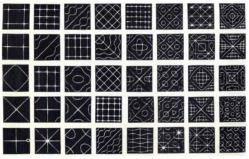
In the sphere of physical research, the father of modern acoustics, Ger- man physicist Chladni Ernst Florens Friedrich, used the physical property of sound amplitude audio to spread a thin layer of sand on the plate, and the sound vibration was turned into intuitive visuals through the medium of sand. The “Chladni Graphics” (see Figure 1), which gives rise to the
Figure 1: Chladni graphics.
concept of phonology, is a diagram made by Chladni in accordance with this phenomena.
John Milton Cage Jr. an American composer, transforms words into visual symbols in sheet music. In 2009, American musicologist Theresa Sauer, inspired by John Cage’s Semiotics, released the book ‘NOTATIONS 21’, which comprises the scores of more than 100 internationally reno- wned composers and documents the illustrative visual symbols of these works.
In China, there is little research on music visualization design, and the focus of research is mostly on the state of development of music visualization, as measured by the methodology of diverse music genre visualization, music visual expression, and so on. In the journal computer Simulation, Tong Kana, Huang D, and Xu Ming published “Music Visualization and its Research Pro- gress”in 2008. They defined music visualization, examined research progress and examples of music visualization at home and abroad on various levels, and forecasted its future development trend. In the study of Music Informa- tion Visualization, Liang X, a doctor of the China Conservatory of Music, attempted to further explore the visualization of musical instruments, singing information, and images from the relationship between the nature of music information visualization and other disciplines . In the same year, Cheng M, Master of Dalian University of Technology, published Visual Visualization of Good looking Folk Music National Instrumental Music, a comparative examination of Chinese and Western classical musical instruments was con- ducted, as well as the practice of visual transformation of folk music into dynamic visuals. It is demonstrated by experience that the analytical idea of music visualization of Northern Shaanxi Folk songs is feasible, in Wang Xiao’s research of Music Visualization Design with the theme of Northern Shaanxi Folk songs written by Wang Xiao, Master of Xi’an Academy of Fine Arts in 2020.
According to the aforementioned literature, there are currently few resea- rches on music visualization expression in the field of Morinhuur music, so the author has chosen Morinhuur music as the theme for designing and stud- ying music visualization device. investigate how to employ audio-visual tools to illustrate music design and research, and expand the multi-dimensional experience of Morinhuur music.
The Importance of Morinhuur Music Visualization As a national musical instrument with rich regional characteristics, the theme of Morinhuur is inseparable from “nature”, “hometown”, etc., and its
Morinhuur Music Visualization Device Design Research 391
music style is solidified, so it is difficult to meet the aesthetic needs of con- temporary people. There are limitations in Morinhuur’s propaganda and promotion, with too much emphasis on words like “grassland,” “home- town,” and “nation,” which not only make people yearn for, but also produce a “sense of distance” and “strangeness,” making it difficult to attract young people; lack of mainstream music media platform communication, public awareness is low, and communication efficiency is low; lack of mainstream music media platform communication, public awareness is low, and com- munication efficiency is low. As a result, it is required to research Morinhuur music visualization, investigate the visual and dynamic presentation of Mori- nhuur music, increase the representation of music information, and increase the emotional resonance of the audience. To encourage more people to listen to and comprehend Morinhuur’s music.
MUSIC VISUALIZATION Synaesthesia
In “Synaesthesia”, Mr. Qian Zhongshu wrote, “in daily experience, vision, hearing, touch, smell and taste can often communicate with each other or communicate with each other in the fields of eyes, ears, mouth, nose and body. The color appears to have temperature, the sound appears to have an image, the cold and warm appear to have weight, and the scent appears to have an edge.”
Music and Visual Color “Sound is the color that can be heard, and color is the music that can be seen,” the legendary musician Malion famously stated. From a physical standpoint, sound and color are natural variations, and the nature and frequency range of people’s senses differ. The relationship between sound and color is a source of inspiration for many artists.
The spectral makeup of the light that reaches the human eye determines diverse hues optically. The hue of monochromatic light is entirely determined by the frequency of the light; the hue of mixed color light is determined by the relative amount of light at various frequencies. The spectral composition of the light source and the reflection (or transmission) qualities of the object surface define the color of the item.
The most prevalent type of synesthesia is color hearing. Bass is associated with dark hues, and treble is associated with brilliant colors.
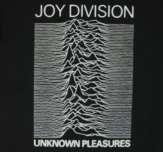
Music and Visual Images Music is a visual as well as an aural art form. With sound in continuous or intermittent movement, music represents the artistic picture of “both speech and feeling.” The cover design of all types of music records is the most basic transformation between sound and vision. The 100th pulses of the pulsar (also known as the death Star) on the cover of Joy Division’s most classic pulse pattern album (see Figure 2) convey the repressed and uneasy emotions in the entire album from the visual level, so that people have audio-visual
Figure 2: Album cover for joy division “unknown pleasures”.
interaction before hearing the music, and convey the composer’s core ideas and musical characteristics.
The fundamental elements of music are rhythm, melody, harmony, as well as strength, speed, and form. The music’s ups and downs are ordered in a rhythmic arrangement. The melody is generated, and this is represented in the visual art, which is an image that varies on a regular basis.
VISUAL DESIGN OF MORINHUUR MUSIC First of all, through the literature research method, read a large number of related literature, the subject content analysis, case analysis, existing statistical data analysis. Sort through a vast number of current examples, comprehend application scenarios, related methodologies, and implemen- tation approaches for music visualization, and summarize the important content for music visualization design. Second, conduct user research by meeting with local Morinhuur musicians, teachers, and students to gain an understanding of Morinhuur music art, music theory knowledge, and the current state of Morinhuur dissemination. Using the method of observation, analyze the research object, record and analyze the difficulties faced by Mori- nhuur lovers in the process of learning Morinhuur, and determine the demand point. Finally, sift out the necessary Morinhuur music visualization aspects using surveys and in-depth interviews, then design and develop the related device.
Design of Morinhuur Music Visualization Questionnaire In order to understand the feeling of users listening to Morinhuur music, we set up a questionnaire to extract visual elements from Morinhuur music, and quantify the visual elements of Morinhuur music through users’ subjective feelings of Morinhuur music.
The questionnaire is primarily intended at those who have had music lear- ning experience, and it performs a survey on the audience using single choice questions, multiple choice questions with fill in the blanks, and a matrix single selection table, starting with color cognition, timbre subjective cogni- tion, and preference for Morinhuur music. The questionnaire is divided into three sections: the first section investigates the audience’s gender, age, music education background, and known musical instruments; the second section investigates the subjective assessment of Morinhuur’s timbre; and the third section investigates the subjective sensation of Morinhuur music, including
Morinhuur Music Visualization Device Design Research 393
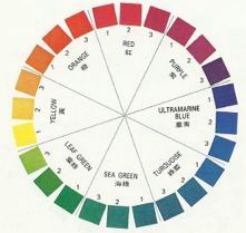
Figure 3: ‘The color card’.Figure 4: Tone corresponding color table of Morinhuur.
the color of different tones, the subjective feeling of the style of Morinhuur music “Hong Yan,” and so on.
The network releases channels, such as moments retweet, WeChat groups, and other channels. It is primarily distributed to young individuals aged 18 to 30. A total of 60 valid samples were gathered after a period of que- stionnaire collecting, with a 100% effective rate. Inner Mongolia, Beijing, Shanghai, Hebei, Sichuan, Hunan, Zhejiang, Hainan, Guangxi, Shenzhen, and other locations sent samples.
Conclusion of the Study on the Visualization of Morinhuur Music From the questionnaire (see Figure 3), 28% of the respondents believe that the timbre of Morinhuur is described as melodious, thick, distant, vast, deso- late and vicissitudes. 47.01% of respondents chose to focus on the green blue and group cyan range, do giving respondents a dull color feeling. 26.42% of the respondents chose yellow, which re gave them a bright and light color feeling. 24.53% of the respondents chose the intermediate color of red area, MI which gave them a warm and cheerful color feeling. The respondents who chose red 1 and yellow 1 accounted for 13.21% and red 3 accounted for 11.32% respectively, mainly in the red area (see Figure 4). The respon- dents who chose Orange 2, yellow 1 and green blue 3 accounted for 13.21% respectively.
60% of the respondents thought that the feeling of “Hongyan” was calm and peaceful. 38% of the respondents believed that the feeling of “wild goose” was due to and deep.
DESIGN OF MORINHUUR MUSIC VISUALIZATION DEVICE Creative Concept
This Music Visualization device aims to deconstruct Morinhuur music on a visual level, transforming abstract sound into concrete pattern, utilizing syna- esthesia to transform the auditory feeling of the music into the visual feeling of the picture, and collaborating with scientific and technological means of interactive projection.So that people can appreciate music on a visual level, and to immerse the viewer and sense the charm of Morinhuur through a light performance experience. With intriguing imagery and modest performance experience involvement, this Music Visualization device focuses on enha- ncing the audience’s sense of participation and stimulating people’s interest in Morinhuur music.
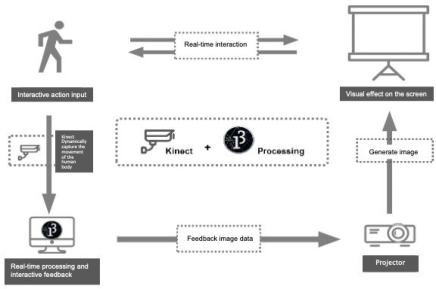
Design Prototype The projector, Kinect body sensor, and projection screen are the essential components of this Music Visualization system. The viewer simulates the movements of the Morinhuur by placing his hand in front of the screen, which is detected by the Kinect somatosensory camera and transmitted back to the application. Finally, the set software completes the interaction by controlling the playing pace of Morinhuur music and generating visual patterns.
Technical Note The Kinect2.0 body sensor is used in this Music Visualization gadget. Kinect includes a sensor for real-time dynamic human bone tracking, which allows it to recognize a series of interactive gestures. The input of three-dimensional gesture is completed through task bone node tracking and gesture recognition received by Kinect, and the visual pattern is formed by further recognition processing by Processing following feedback to the computer.
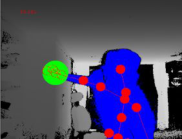
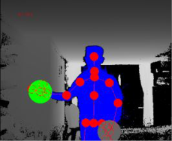
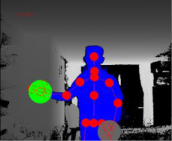
When the experiencer stands in front of the big screen, the somatosensory camera will capture the human body image in the form of real time silhouette, giving people a strong sense of scientific and technological experience. The screen silhouette varies with the human body’s movement, and the filling color in the silhouette changes with the human body’s movement, allowing up to six individuals to interact at once. When the experimenter raises his arm, the interactive signal is triggered, and the visualization software is launched (see Figure 5).
Human Body Movement Recognition The three dimensional human skeleton node coordinate data and rotation information are included in every frame of human body data acquired by Kinect v2. The xx system uses this data to generate and construct the human skeleton topology in real time, as well as to extract the ske- leton node to define the bone vector. Finally, the data set is created using multi-class and training, as well as action recognition categorization (see Figure 6-9).
Morinhuur Music Visualization Device Design Research 395
Figure 5: Technology implementation path.Figure 6: Training action recognition.Figure 7: Training action recognition.Figure 8: Field test.
Processing Processing to Generate Visual Patterns Processing does not provide library files; instead, third party library files are used. Sound, Beads, and Minim are the most common.
The main contents are as follows: The audio file object is created with Processing and the Minim library and utilized as the audio file input port, or signal source; Play a piece of music (Mp3); Determine its audio quality; The use of images to adjust the audio value; Use the audio to classify the data and dynamically display them in the graph.
Figure 9: Field test.
Figure available in the original PDF paper.
CONCLUSION
The Morinhuur has distinct regional and national qualities as a representative musical instrument of Mongolian music tradition. It is a world-class intangi- ble cultural heritage that represents the Mongolian spirit and culture. It also has a distinctive aesthetic value. The innovative visual design of Morinhuur music not only helps to promote and protect Morinhuur music, but it also helps to disseminate Morinhuur to other areas and be liked by more people.
REFERENCES
Cheng Miaomiao. Good looking folk music [D]. Dalian: Dalian University of Technology, 2019. D. Mingming and W. Feng, “Impact of background music on reaction test and visual
pursuit test performance of introverts and extraverts,” International Journal of Industrial Ergonomics, vol. 78, p. 102976, Jul. 2020 Jia Yi (2019). Research on the origin of Huur Music (3), 11 Li Yuan. (2001). On Qi baoligao’s innovation of Morinhuur. Beijing: Central University for Nationalities. MINGMING D, FENG W. Impact of Background Music on Reaction Test and Visual
Pursuit Test Performance of Introverts and Extraverts[J]. International Journal of Industrial Ergonomics, 2020, 78: 102976. Shun L I , Guo X , Jianguo W U . Human action recognition method based on key frame and skeleton information[J]. Transducer and Microsystem Technologies, 2019. Tong kana, Huang Dongjun, Xu Ming. Music Visualization and its research progress
[J].Computer simulation, 2008, 01. Wang Xiao. (2020). Research on Music Visualization Design with the Theme of Northern Shaanxi Folk Songs. Xi’an Academy of Fine Arts. Xu Bihai, sun Xiaoli. (2011) Origin of Morinhuur. Journal of Sichuan University of
Arts and Science, 2011, 3. Zhang Jinsheng. (2009). Morinhuur in transition. Hohhot: Inner Mongolia Normal University. Zhu Yun, Ling Zhigang, Zhang Yuqiang. Research progress and prospects of
machine vision technology[J]. Journal of Graphics, 2020, 41(6):871–890.
LISTED IN THE AHFE DIGITAL BOOKSTORE CATALOGUE
Explore the complete digital volume
Ergonomics In Design
Read this individual research paper free through the original publisher, or explore the full digital proceedings book.
ISBN 978-1-958651-23-0
Explore this ISBN in the AHFE Bookstore ↗Listed in the July 2026 bookstore catalogue; search by ISBN to confirm current availability · Digital book purchase optional