Christopher Nemeth, Adam Amos-Binks, Gregory Rule, Dawn Laufersweiler, Natalie Keeney, Yuliya Pinevich, Vitaly Herasevich (2022). Real Time Battlefield Casualty Care Decision Support. In: Healthcare and Medical Devices. AHFE Open Access, vol. 51, pp. 157–164. https://doi.org/10.54941/ahfe1002112
Tactical combat casualty care (TCCC) involves care for casualties in armed conflict from one’s own service (e.g., U.S. Marine Corps), other services (i.e., U.S. Army, Air Force,), allied forces, adversaries, and civilians. To minimize injury and preserve life, medics perform TCCC which includes casualty retrieval, stabilization and documentation, transport, triage, and treatment. In future scenarios, delays in evacuation are expected to require extended care including prolonged field care (PFC) over hours to days, increasing the potential for complications such as bloodstream infection (sepsis). Most medics have only simple equipment and essential medications and will need assistance at point of care to make decisions on how to treat more complex cases and perform procedures in an austere setting.We describe a project for the Defense Health Agency (DHA) over 3 years to develop and evaluate the Trauma Triage Treatment and Training Decision Support (4TDS), a real-time decision support system (DSS) to monitor casualty health. The operating 4TDS prototype uses the Samsung smart phone and tablet certified for use in the Department of Defense (DoD) Nett Warrior program. Connection to a simple VitalTag (Pacific Northwest National Laboratory, Richland, WA) vital signs monitor placed on a casualty at point of injury (PoI) will stream patient data including heart rate, respiration rate, peripheral oxygen saturation (SpO2), and diastolic and systolic blood pressure. Nurses, technicians, and physicians can use the tablet to display an expanded data set including lab values while providing care at a Battalion Aid Station (BAS) and Field Hospital (FH).4TDS includes a Machine Learning (ML) model to indicate shock probability, risk of internal hemorrhage, and probability of the need for a massive transfusion. The shock model was trained on Mayo Clinic Intensive Care Unit (ICU) patient data, then evaluated in a 6-month “silent test” comparing shock prediction with actual clinician diagnoses. The model only uses 6 vital signs, which is suited to battlefield care, while other published results include lab tests (e.g., lactate), and produces a Receiver Operator Characteristic Curve (ROC) of 0.83 for shock detection. The model only decreases by 0.05 90 minutes, identifying shock probability well before its onset. Medic reviews indicate a 30-minute advanced warning would be more than sufficient to initiate treatment.Medics who provide PFC may need to perform life-critical procedures such as shock management, cricothyroidotomy intubation, and transfusion that may not have been used for an extended period. 4TDS includes refresher training in how to perform such a procedure, as well as whether to perform the procedure. Usability assessments with healthcare providers from the Army, Navy, and Air Force at Joint Base San Antonio, TX have demonstrated 4TDS and its capabilities align with TCCC practice. This work is supported by the US Army Medical Research and Materiel Command under Contract No. W81XWH‐15‐9‐0001.
Tactical Combat Casualty Care (TCCC 2012) involves care for casualties in armed conflict from one’s own service and other services (i.e., U.S. Army, Air Force), allied forces, adversaries, and civilians. Medics minimize injury and preserve a casualty’s life through retrieval, stabilization and documen- tation, transport, triage, and treatment. In the future, delays in evacuation are expected to require extended care including Prolonged Field Care (PFC WG 2015) over hours to days. Such delays can increase the potential for complications such as insufficient blood flow (shock), bloodstream infection (sepsis), internal bleeding (hemorrhage), and lead to performance of more complex treatment. Most medics have only simple equipment and essential medications and will need assistance at point of care to make decisions on how to handle more complex cases and procedures such as transfusion in an austere, remote, unsupported setting.
The Trauma Triage Treatment and Training Decision Support (4TDS) is a real-time decision support system (DSS) to monitor casualty health (Nemeth et al 2021). 4TDS includes two artificial intelligence (AI) models. One indica- tes the current risk of internal hemorrhage and probability of the need for a massive transfusion (more than one unit of red blood cells). The other indica- tes the future probability of shock. Both models rely solely on six vital signs to scan data for effects of trauma that can lead to morbidity and mortality if not detected.
The 4TDS software prototype operates on an Android smart phone or tablet configured for use in the Department of Defense (DoD) Nett Warrior program. The phone is connected to a VitalTag (Pacific Northwest National Laboratory, Richland, WA) vital signs monitor placed on a casualty at point of injury (PoI). The monitor streams real time patient vital signs, including heart rate, respiration rate, peripheral oxygen saturation (SpO2), and dia- stolic and systolic blood pressure. Nurses, technicians, and physicians can use the tablet to display expanded data including lab values while providing care at a Battalion Aid Station (BAS) and Field Hospital (FH). Medics who provide PFC may need to perform life-critical procedures that may not have been used for an extended period. 4TDS includes refresher training in how to perform, as well as whether to perform, such procedures.
RESEARCH DESIGN AND METHODS The project used a triangulated multi-method approach to design, develop, and evaluate 4TDS and its algorithms. Applications for human subject rese- arch began the process with submissions to the Western Institutional Review Board (IRB) (field studies) and Mayo Clinic (shock model) and Stanford University (hemorrhage model). After IRB approvals, the applications were submitted to and approved by the Army Human Subjects Research Protection Office (HRPO).
Literature Review
A review of key TCCC publications [see Army MEDEVAC (2017), Hospi- tal Corpsman (2019), TCCC (2012)] extracted protocols that define pre- hospital tasks a medic is to perform. Results formed the basis for two representations that military medical subject matter experts (SMEs) reviewed.
Rapid Prototyping Development of quick prototypes can make initial concepts more concrete and elicit reactions to refine project direction (Woods and Dekker 2001, Hof- fman et al., 2010). A workflow diagram reflected the team’s expectations about how 4TDS would fit into TCCC. Use cases described in narrative form how the smart phone/vital signs sensor would be used at PoI, and how the tablet would be used at a BAS or FH. The team developed multiple examples of interface screens that detailed how the system would operate and presen- ted them to SMEs to elicit responses about how the interface and procedures could be designed to support TCCC.
Subject Mater Expert (SME) Review Design Requirements Review—A series of in-depth interview sessions lasting 45 to 90 minutes sought reactions to the initial rough prototypes from 17 SMEs from the Army (68W medics), Navy (Independent Duty Corpsmen), and Air Force (Independent Duty Medical Technicians). Participants had an average of 17 years of service in military medicine, including 4 deployments. Each session reviewed medic task workflow and procedures and interface examples. The SME recommendations guided prototype concept refinement.
Real Time Battlefield Casualty Care Decision Support 159
Training Scenarios—Medics who provide TCCC and PFC may need to per- form life-critical procedures (e.g., shock management, cricothyroidotomy). However, they may not be familiar with the procedure, or may not have used it for an extended period. Two SMEs shared recommendations for refresher training scenarios based on their extensive career experience providing deplo- yed casualty care. 4TDS includes refresher training in how to perform, as well as whether to perform, such procedures.
Algorithm Development and Evaluation Both AI models were developed in parallel with the 4TDS prototype.
Hemorrhage Risk/Massive Transfusion Probability—The hemorrhage model indicates low, medium, or high risk of internal bleeding. The Bio- technology High Performance Computing Software Applications Institute (BHSAI) at Fort Detrick, MD developed the Automated Processing of the Physiologic Registry for Assessment of Injury Severity (APPRAISE) hemor- rhage detection model, which uses standard heart rate and blood pressures vital signs and was designed to be easily interpretable and understood even by novice medics. BHSAI had previously used data retrospectively collected on adult trauma patients (>18 years old) from three independent clinical stu- dies performed at three different sites to develop the reference for the final model of the Hemorrhage Risk Index (APPRAISE-HRI) algorithm (Reifman et al., 2015).
APPRAISE can initiate assistance from the Massive Transfusion Protocol (MTP) that incorporates several clinically relevant, immediately available data that are too complex for manual calculation at PoI. The Uniformed Services University of the Health Sciences (USUHS) developed the MTP algo- rithmm with Emory University from clinical findings gathered in a literature review of the Joint Traunma System (JTS) Clinical Practice Guidelines (JTS 2021) and tested in large military and civilian trauma data sets. Their neu- ral network approach consistently proved to be sensitive, specific, and well calibrated to predict a combat casualty’s the need for massive transfusion.
Shock Probability Model—The shock model was trained on Mayo Clinic Intensive Care Unit (ICU) patient data, then evaluated in a 6-month “silent test” comparing shock prediction with actual clinician diagnoses. The model only uses 6 vital signs, which is suited to battlefield care and is designed to predict shock up to 90 minutes ahead of shock onset. Model performance was evaluated using the Receiver Operating Characteristic (ROC) Curve, a plot that depicts the diagnostic ability of a binary classifier system (e.g., sho- ck/no shock) as its criterion (discrimination threshold) is varied. Plotting the true positive rate (TPR) against the false positive rate (FPR) at various thre- shold settings creates a ROC. The Area Under Curve (AUC) is the percentage of randomly drawn pairs for which this is true (correctly classifies the two patients in the random pair) and represents true and false positive tradeoffs.
Protype Development Based on results from design requirements reviews, the team used agile deve- lopment (Paetsch, Eberlein, and Maurer, 2003) to program both phone
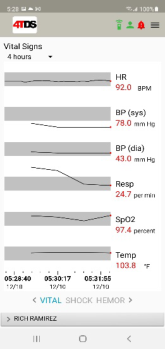
Casualty vital signs Shock probability Hemorrhage risk/massive transfusion probability
(Figure 1) and tablet interface prototypes. Repeated, recursive development of 4TDS concepts provided an early version for users and stakeholders to review and provide comments that were used to improve later versions. Pro- totypes demonstrated phone user interface design and function, ability to stream data from an external sensor to monitor patient vital signs, displays indicating shock probability and hemorrhage risk, training scenarios, and BAS/FH patient data displays on the tablet. Reviews made it possible to collect user responses on what 4TDS does, how it fits TCCC, and to guide improvements.
Usability Assessment/Acceptance Test Two rounds of field assessments at Joint Base San Antonio, TX (JBSA) in December 2020/January 2021 and November 2021 enabled the team to determine user acceptance and how well use of the decision support aligned with TCCC and PFC.
4TDS/Shock Model—Twenty-eight exceptionally qualified SMEs evalua- ted 4TDS in December 2020 (1 USN and 23 USA) and January 2021 (4 USAF). Four different scenarios included tasks for the participant to perform. One script called for evaluating the phone interface and shock management using de-identified actual patient data. Three sought to evaluate medic and clinician use of the BAS/FH and training interfaces on the tablet. Partici- pants used response sheets to give comments and respond to statements on a scale from 1 (strongly disagree) to 7 (strongly agree) on criteria such as suitability for prehospital care, confidence in decisions, speed finding and using information, ease of use, and more.
HDATS/MTP/VitalTag—Field evaluation in November 2021 included a range of novice through expert military healthcare providers. Forty-seven
Real Time Battlefield Casualty Care Decision Support 161
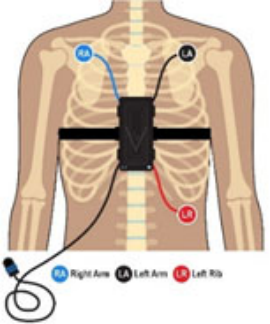
medics from the Army, Navy, and Air Force evaluated use of the VitalTag sensor (Figure 2) and HDATS/MTP algorithm displays. Years of experience favored more junior (23) and more senior (14) medics. Participants donned the VitalTag’s 3-EKG lead and SPO2 finger cuff, viewed their vital signs in real time on the 4TDS phone display, then removed the leads. Two casualties were then presented in the HDATS app in a PFC scenario, and the participant was asked to evaluate hemorrhage risk and probability of the need for a massive transfusion. Each participant provided comments and scale ratings to statements like they did in the earlier field assessment.
RESULTS
4TDS and VitalTag Sensor—Usability assessments in November 2021 with healthcare providers from the Army, Navy, and Air Force at JBSA demonstra- ted medics and clinicians find 4TDS and its capabilities align with TCCC/PFC practice.
Table 1 shows mean ratings for responses to statements on the user response form. A mean score of 4.0 indicates neutral on a 7-point scale. None were below 5.0.
All participants were able to accurately assess casualty condition and successfully complete the scenario. Participant comments also enabled the team to refine display and scenario details.
Shock Model—While other published results include lab tests (e.g., lactate), the 4TDS model only uses 6 vital signs, which is suited to battlefield care in an austere setting. Test results produced a receiver operating chara- cteristic (ROC) curve of 0.83 at shock onset and decreased to 0.78 when detecting shock 90 minutes ahead of onset. Medics had indicated during the Design Requirements Review that a 30-minute advance warning would be more than sufficient to initiate preventive care.
Hemorrhage Risk Model/Massive Transfusion Probability—Validation tests use data from both Stanford University Medicine and Linking
Table 1. November 2021 sample mean ratings (Nemeth, et al.2022).
Table available in the original PDF paper.
Mean rating Hemorrhage Risk 6.2 The HDATS hemorrhage risk display fits with TCCC practice 6.1 The display is useful as a way to gauge the risk of hemorrhage 5.4 I am better prepared to manage hemorrhage in a casualty using this display. 5.6 I am confident about my patient care decisions using the HDATS hemorrhage risk display
Transfusion Probability 5.9 The massive transfusion probability display fits with TCCC practice 5.8 The display is useful as a way to gauge the need for a massive transfusion 5.5 I am better prepared to manage massive transfusion in a casualty using this display 5.6 I am confident about my patient care decisions using the massive transfusion display The 4TDS App/Sensor 6.0 Use of 4TDS fits with TCCC practice 5.8 The Vital Tag sensor was easy to use 5.6 The 4TDS smartphone app was easy to use 5.8 Using the 4TDS smartphone app, I could find the information I needed to make a decision 5.6 Using the 4TDS smartphone app, I could find the information I needed to make a decision quickly
Comparison 5.4 I can find the information I need more easily in HDATS than I can using current tools. 5.4 I can find the information I need more quickly in HDATS than I can using current tools. 5.5 HDATS better supports the way I do my work than current tools (e.g., checklists, blood pressure cuff) 5.1 I would feel more confident making future clinical decisions using HDATS than using current tools 5.0 HDATS supports the way I do my work better than current tools
Investigations from Trauma and Emergency Services (LITES 2021). Succes- sful demonstration of APPRAISE should result in the 95% CI upper bound LR for HRI I < 0.60 and the 95% CI lower bound LR for HRI III >2.0. These results would also demonstrate that the 95% CI upper bound LR for HRI I < the 95% CI lower bound LR for HRI II and the 95% CI upper bound LR for HRI II < the 95% CI lower bound LR for HRI III.
CONCLUSION
Participatory design ensured 4TDS and its AI models reflected medic and clinician mental models and work processes. It also built support among
Real Time Battlefield Casualty Care Decision Support 163
potential users should the system transition to operational use. Consulta- tion with TCCC and PFC SMEs during training and interface development ensured close alignment with both standard of care and practical considerati- ons of actual care in the field. Usability assessments with healthcare providers from the Army, Navy, and Air Force at Joint Base San Antonio, TX confirmed 4TDS and its capabilities align with TCCC practice.
ACKNOWLEDGMENT
The authors are grateful to the military healthcare providers who generously gave of their time to participate in this study. This work is supported by the US Army Medical Research and Development Command under Contract No. W81XWH-15-9-0001 and US Army Medical Materiel Development Activity under Task Order No. W81XWH-20-9-0014. The views, opinions and/or findings contained in this report are those of the author(s) and should not be construed as an official Department of the Army position, policy or decision unless designated by other documentation. In the conduct of research where humans are the subjects, the investigator(s) adhered to the policies regarding the protection of human subjects as prescribed by Code of Federal Regulati- ons (CFR) Title 45, Volume1, Part46; Title32, Chapter 1, Part 219; and Title 21, Chapter 1, Part 50 (Protection of Human Subjects).
REFERENCES
Army MEDEVAC (2017). Critical Care Flight Paramedic Standard Medical Operating Guidelines. MEDEVAC Proponency. School of Army Aviation Medicine. Ft. Rucker, AL 36362. Hoffman, R., Deal, S., Potter, S. & Roth, E. (2010, May-June). The practitioner’s
cycles: Solving envisioned world problems. IEEE Intelligent Systems. 6–11. Hospital Corpsman (2019). NAVEDTRA 14295B. Navy Medicine Manpower, Personnel, Training and Education Command (NAVMED MPT&E). 4075 Dickman Rd Suite 308, JBSA Fort Sam Houston, TX 78234. JTS (2021). Clinical Practice Guidelines. Available from the Joint Trauma System
web site: https://jts.amedd.army.mil/index.cfm/PI_CPGs/cpgs. LITES (2021). Linking Investigations from Trauma and Emergency Services. Available at the LITES web site: http://www.litesnetwork.org. Nemeth, C., Rule, G., Laufersweiler, D., Grey, S., Keeney, N., Antrim, S., Giem,
C., Spencer, J., Gosink, L., Subramanian, M., Tamang, S., & Reifman, J. (2022). Hemorrhage Detection and Treatment System (HDATS). Final Technical Report. Contract W81XWH-20-9-0014. U.S. Army Medical Research and Development Command, Fort Detrick, Maryland 21702-5012. Nemeth, C., Amos-Binks, A., Burris, C., Keeney, N., Pinevich, Y., Pickering, B., Rule, G., Laufersweiler, D., Herasevich, V. & Sun, M. (2021, January-February). Decision Support for Tactical Combat Casualty Care Using Machine Learning to Detect Shock. Mil Med. Society of Federal Health Officials (AMSUS). (186) Issue Supplement_1: 273–280. https://doi.org/10.1093/milmed/usaa275. Paetsch, F, Eberlein, A. & Maurer, F. (2003). Requirements Engineering and Agile
Software Development. Proceedings of the Twelfth IEEE International Work- shops on Enabling Technologies: Infrastructure for Collaborative Enterprises (WETICE’03). 1080-1383/03.
PFC WG (2015, March). Prolonged Field Care Teaching and Training Recommendations. USSOCOM Prolonged Field Care Working Group. Retrieved on 14 Oct 2015 from http://prolongedfieldcare.org/about/. Reifman, J, Liu, J., Khitrov, M., Edla, S. & Reisner, A. (2015). Automated Analysis of
Vital Signs Identified Patients with Substantial Bleeding Prior to Hospital Arrival. US Army Medical Research and Materiel Command, Fort Detrick, MD. TCCC (2012). Tactical Combat Casualty Care Handbook. No. 12–10. Center for Army Lessons Learned (CALL). Retrieved 15 December 2018 at CALL web site: https://call2.army.mil/toc.aspx?document=6851&filename=/docs/doc6851/12- 10.pdf. Woods, D.D. & Dekker, S.W.A. (2001). Anticipating the effects of technology change:
A new era of dynamics for human factors. Theoretical Issues in Ergon Sci. 1(3): 272–282.
LISTED IN THE AHFE DIGITAL BOOKSTORE CATALOGUE
Explore the complete digital volume
Healthcare and Medical Devices
Read this individual research paper free through the original publisher, or explore the full digital proceedings book.
ISBN 978-1-958651-27-8
Explore this ISBN in the AHFE Bookstore ↗Listed in the July 2026 bookstore catalogue; search by ISBN to confirm current availability · Digital book purchase optional