Alexander Mueller, Simon Buck, Fabian Schmiel, Lampros Tsolakidis (2022). Systematic and user-oriented development of physical interface for vehicle ultrafast charging. In: Human Factors in Transportation. AHFE Open Access, vol. 60, pp. 192–199. https://doi.org/10.54941/ahfe1002449
Status Quo: Electric vehicles currently available on the market have a real maximum range of approx. 400 - 500 km at low temperatures (source: Electric Vehicle Database). The shortest charging time of an electric vehicle is currently approx. 22 min. to charge the vehicle battery with max. 270KW from 5% to 80% (source: PAG).Problem: The range and the time required to refill the energy storage of electric vehicles are not yet as long as those of vehicles powered by internal combustion engines. For the user, these deficits are associated with a loss of comfort, especially on long-distance journeys.Method of Resolution: A promising approach is to significantly reduce the charging time by increasing the charging power with simultaneous and efficient dissipation of the waste heat. Technically, this is to be implemented with a vehicle-external cooling fluid, which is provided by the charging infrastructure. The question arises how the novel thermal interface then necessary can be physically integrated into the charging process, into the vehicle and into the charging infrastructure with special consideration of user requirements. The paper presents the design of three prototype connectors, using the standardized product development method described in VDI 2221. Requirements are defined from the analysis of the competitive environment and the required integration of a thermal interface. On the one hand, the focus lies on the technical and physical requirements related to the electrical and thermal power transmission, on the other hand, the human-product requirements related to the physical use are assigned special importance. For the conception, the derivation of Function Structures and subsequently the identification of all sub-functions serves as an essential basis. Partial functions of the interface that have proven themselves in the electrical power transmission of the standardized CCS interface (source: IEC 62196-3 / SAE J1772) are adopted. Essentially, the sub-functions "leakage-free coupling / decoupling", "overcoming closing resistances" and "user-friendly connector handling" are identified as design-critical. By defining and selecting suitable versions of the sub-functions, three interface concepts are systematically derived and evaluated against each other in test person studies. The result shows that vehicle ultrafast charging with electrical and thermal power transfer and with only one connector is possible for all users and all vehicle types from an ergonomic point of view. A test person study shows that the users prefer the handling of the new interface compared to the charging standard currently used on the market and a separate, hydraulic power transmission.
Current Situation and Problem Electric vehicles currently available on the market have a real highway maxi- mum range of approx. 400 - 500 km at low temperatures (Electric Vehicle Database, 2022). The shortest charging time of an electric vehicle is curren- tly approx. 22 min. to charge the vehicle battery with max. 270KW from 5% to 80% (Porsche AG, 2019). It becomes apparent, that the range and the time required to refill the energy storage of an electric vehicle are not yet as short as those of vehicles powered by internal combustion engines. For the user, these deficits are associated with a loss of comfort, especially on long-distance journeys.
Method of Resolution One approach to significantly reduce the charging time is to further incre- ase the charging power and to efficiently dissipate the waste heat generated during fast charging with a novel thermal interface. The question arises how
Systematic and User-Oriented Development of a Physical Interface 193
this novel thermal interface can be physically integrated into the charging process, into the vehicle and into the charging infrastructure with special con- sideration of the user requirements. This paper presents the design of three prototype connectors. The standardized product development method accor- ding to VDI 2221 (VDI, 2019) is used. Requirements are defined from the analysis of the competitive environment and the required integration of a thermal interface. On the one hand, the focus is on the technical-physical requirements related to the electrical and hydraulic power transmission, on the other hand, special importance is assigned to the human-product requi- rements related to the physical use. For the conception, the derivation of a function structure and subsequently the identification of all subfunctions serves as an essential basis. Partial functions of the interface that have pro- ven themselves in the electrical power transmission of the standardized CCS interface (SAE, 2017) are adopted. The ergonomic aspects of this design and the verification of whether these are preferred to an extended state of the art are checked by means of two test person studies (Schmiel, et al., 2022).
REQUIREMENTS AND FUNCTIONAL ANALYSIS An analysis of requirements and functions serves as the basis for the holistic development of the fast-charging interface. First, the essential requirements are determined. Based on this, the functional analysis is carried out, from which all necessary and critical functions of the charging process result. The electrical power transfer subfunctions are taken from the state of the art CCS (SAE, 2017). Since the requirements definition describes a solution field with partially conflicting requirements, function structures for different interface concepts are created.
REQUIREMENT DEFINITION In the project consortium, various main requirements have emerged regar- ding the design of the new connector. In addition to the technical-physical requirements (e.g. cooling capacity, volume flow, line pressure, pressure drop, line diameter, freedom from leakage, relative positioning of the thermal inter- face), particular importance is assigned to the human-product requirements (e.g. anthropometric connector design and system-ergonomic design of the charging process (Tsolakidis, et al., 2022). The initial determination of the main requirements is carried out by means of an analysis of the state of the art in research and technology.
Function Structure For the derivation of the functional structures, vehicle fast charging is first divided into various sub-processes in chronological form, followed by the description of a functional chain (Pahl, et al., 2005), which is composed of the novel and/or critical novel subfunctions listed below: 1. Removal from the charging pole/transport to the vehicle, 2. Plugging in at the vehicle, 3. closing connection in the vehicle, 4. Thermal energy transfer, 5. Opening connection in the vehicle 6. Unplugging/transport back to the charging pole, 7. Attaching
at the charging pole. Figure 1 shows an example of the functional structure of a novel interface for vehicle fast charging with integrated liquid interface without backward compatibility.
Critical Functions Since the additional fluid lines and interfaces in the cable and connector incre- ase the package size and weight, ergonomics is identified as a critical function as an umbrella term for transport and handling operations. In addition, it is expected that the requirement for leakage-free couplings will lead to an increased mating force, which is why the closing and opening processes are considered separately as a critical function (cf. Figure 1).
Connector Handling Due to the required thermal power transmission of the system, two fluid lines are needed. These lines make the connector’s cable significantly heavier, and the increased diameter increases the cable’s bending stiffness. In addition, the fluid couplings increase the weight and size of the connector. The main objective of development is therefore the user-oriented design of the charging interface, taking into account the changed framework conditions (especially hose stiffness and hose and connector weight) for a classic design collective (5th percentile woman - 95th percentile man) (cf. (Bubb, et al., 2015)).
Closing and Opening Procedure In order to guarantee freedom from leaks, quick-action couplings are to be used for the fluid supply and discharge, which are self-sealing when the connection is opened and closed. However, all couplings offered on the market which sufficiently meet the technical-physical specifications require closing forces which need to be overcome during use and which significantly exceed the maximum acceptable insertion force (36 N) of a limit percentile (5th percentile woman) (Schmidtke & Rühmann, 2013) due to their design. Consequently, to enable operation nevertheless, a mechanism for closing and opening the couplings must be integrated. Due to the need for such a novel mechanism, this function is considered critical within the development activity.
CONCEPTION OF THE PHYSICAL CHARGING INTERFACE Based on the formulated requirements and the derived functional structu- res, alternative versions of the individual subfunctions are first systematically generated. The use of intuitive creativity techniques (e.g., the 635 method (Rohrbach, 1969)) has proven to be effective in this context. The functional expressions were then combined in a morphological box (Schindler, 2018); by combining the different functional expressions, different solution pathw- ays and subsequently three concept variants result. A two-plug variant, in which the state of the art is supplemented by a second interface relating to hydraulic power transmission, a single-plug variant, in which the plug is redesigned and all interfaces are contained in one plug, and an extended single-plug variant, which also takes backward compatibility into account. A
Systematic and User-Oriented Development of a Physical Interface 195
Figure 1. Function structure of a novel fast charging interface (One-plug variant).
Figure available in the original PDF paper.
Table 1. Concept variants of a novel physical charging interface.
Table available in the original PDF paper.
Two-plug variant One-plug variant One-plug variant with backwards compatibility
backward-compatible connector is useful if the novel connector can also be used to charge conventional vehicles that do not have a thermal interface. The first approaches to representing the new interface, which do not yet meet all ergonomic requirements, are shown in Table 1.
The design focuses in particular on shaping the plug handling, which is considered critical, and on developing a mechanism to support the closing and opening process. Due to the increased bending stiffness of the cable and the increased weight of the cable and connector, the users perform the connector handling with both hands clasping (Bullinger, 1994), so that the maximum force of the users can be applied comfortably. Due to the increased cable bending stiffness, the connector is always oriented relative to the veh- icle, this means also in the hooked-in state. Since two test runs are planned for ergonomic evaluation (cf. Section 4), the findings obtained from the first test run with an impact on product design are incorporated in form of an iteration loop (detail optimization).
Various mechanisms for supporting the closing and opening process are being developed, for which patent registration is in progress at the time of drafting the report.
ERGONOMIC CONCEPT EVALUATION In order to test the ergonomic suitability of the new charging interface, two test person studies were carried out with 30 test persons each (Schmiel, et al., 2022). The test evaluation was based on questionnaires (subjective evaluation) and video recordings (objective evaluation).
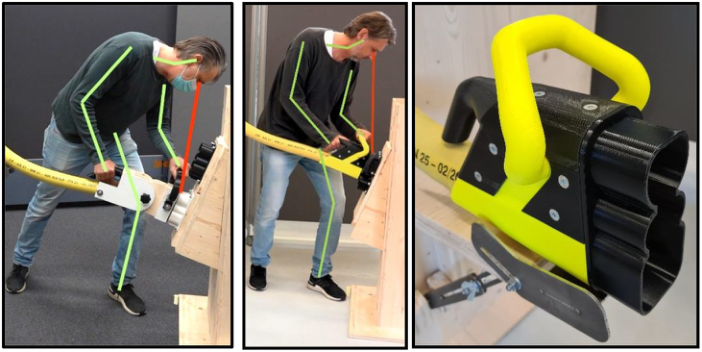
Evaluation Anthropometric Product Design In an initial study, it is examined whether the new connector with increased weight and higher cable stiffness can be used without any problems by any person at vehicle socket heights that are considered critical. For this purpose, a prototype charging pole was constructed with an adaptable ergonomics model of the single-plug variant (cf. Fig. 2, left). On the vehicle side, two socket heights were represented, each of which forms a design limit of a com- fort zone determined for the test collective by means of RAMSIS® (Human Solutions GmbH, 2022). It is evaluated whether the gender or the body size
Systematic and User-Oriented Development of a Physical Interface 197
Figure 2: Left: 98% man using ergonomic model of first test series, centre: 98% man using improved model within comparative study, right: Improved one-plug solution.
have an influence on the liking of the plug or the plugging process. The signi- ficance of the results is tested using a t-test (Meier, 2020). 18 men and 12 women with heights ranging from 153 cm to 195 cm participated in the study.
Comparative Study In the second study, two different versions of the plug were compared. One is the plug with integrated fluid interface discussed here, the other is the extension of the state of the art with an additional cable/plug in which the fluid lines are accommodated. The intent of this study is to show which of the two variants users prefer. For this purpose, both charging stations were set up next to each other and used by the test person’s one after the other (cf. Fig. 2 Centre). On the vehicle side, one socket in the middle of the previously identified comfort zone is used. It is evaluated which of the two connector types is preferred. The significance is tested with a right-sided hypothesis test (Schiefer & Schiefer, 2018). Fifteen men and 15 women with heights ranging from 153 cm to 195 cm participated in the study.
Statistical Evaluation The result of the first study shows that neither the height nor the gender of the user has a significant influence, which is why the statement can be made that the plug can be used by everyone despite its higher weight and greater cable stiffness. The evaluation at different socket heights did not show any significant difference in the evaluation either, which is why it is assumed that the plug is usable for all socket heights within this comfort zone. The second study shows that the proposed design with one plug is significantly preferred to the design with two plugs, both in terms of the entire charging process and in individual sub-steps.
CONNECTOR DETAIL OPTIMIZATION Several aspects of the ergonomics prototype that could be improved were identified based on the video evaluation of the first study. These improve- ments were incorporated into the first 3D printed prototype of the connector. The main improvement was a better grip-design of the front handle. In the initial test, the grip obscured the view of the socket, which is why the body posture was adjusted, resulting in a strongly flexed posture (the body posture depends on the line of sight). To prevent this, the handle was redesigned into a cranked V-shape. In addition, the hand posture becomes more natural, as the main axes of the hand and forearm are now aligned and the subjects can thus adopt a more favourable wrist angle. The rear grip was also cranked to enable a natural wrist posture. The range of grips for both hands distributes the increased load of the new connector to both arms of the users. Symme- trical design allows comfortable use for both left- and right-handed users. Figure 2 right shows the new type of plug for fast charging.
DISCUSSION AND CONCLUSION This paper presents the development of a new charging interface which, in addition to electrical energy transfer, also enables thermal energy transfer between the vehicle and the charging station. The applied method for pro- duct development has proven to be successful, the presented content proves that the handling of the new charging interface is possible for all users and all relevant charging socket heights. It is noteworthy that users prefer the one-plug version of the charging interface to the two-plug version. However, it must be mentioned that in the comparative study the positioning of the charging sockets in front of the charging pole was not varied and represen- ted an optimal condition. A change in the position and/or orientation of the vehicle charging socket relative to the charging pole that requires bending of the hose during hose feed or removal can have an influence on the evalu- ation result. It is envisaged that after completion of the patent process, the closing and opening mechanism will be presented in a holistic prototype and finally evaluated. The applied method for the user-oriented development of the quick-charging interface is in principle transferable to the development of any user-oriented products.
ACKNOWLEDGMENT
The described research activities were part of the collaborative project “COOLEV”, funded by the German Federal Ministry of Economic Affairs and Climate. Sincere thanks on behalf of the entire project consortium for the funding of this project.
REFERENCES
Bubb, H., Bengler, K., Grünen, R. & Vollrath, M., 2015. Anthropometrische Fahrzeuggestaltung. In: Automobilergonomie. Wiesbaden: Springer Vieweg, p. 182. Bullinger, H.-J., 1994. Ergonomie. B. G.. s.l.:Teubner Verlag.
Systematic and User-Oriented Development of a Physical Interface 199
Electric Vehicle Database, 2022. [Online] Available at: http://www.ev-database.de [Accessed 10 01 2022]. Human Solutions GmbH, 2022. Ramsis allgemein. [Online] Available at: https://www.human-solutions.com/de/produkte/ramsis-allgemein/index.html [Accessed 12 01 2022]. Meier, L., 2020. Wahrscheinlichkeitsrechnung und Statistik : Eine Einführung
für Verständnis, Intuition und Überblick. Berlin, Heidelberg: Springer Berlin Heidelberg. Pahl, G., Beitz, W., Feldhusen, J. & Grote, K. H., 2005. Pahl/Beitz Konstruktionslehre: Grundlagen erfolgreicher Produktentwicklung Methoden und Anwendungen. 7. ed. Berlin, Heidelberg: Springer. Porsche AG,2019. [Online] Available at: http://newsroom.porsche.com/de/produkte/
taycan/laden-18540.html [Accessed 10 01 2022]. Rohrbach, B., 1969. Kreativ nach Regeln. Methode 635, eine neue Technik zum Lösen von Problemen. Absatzwirtschaft. 12, Issue 19, pp. 73–76. SAE, 2017. SAE J1772 (IEC 62196-3). SAE Electric Vehicle and Plug in Hybrid
Konstruktion. München: Carl Hanser Verlag, p. 435. Schmidtke, H. & Rühmann, H., 2013. Druckkräfte gegen die Vertikalebene B. In: B. f. W. u. Beschaffung, ed. Handbuch der Ergonomie (HdE) mit ergonomischen Konstruktionsrichtlinien. Koblenz: Karl Hanser Verlag. Schmiel, F., Buck, S., Tsolakidis, L. & Mueller, A., 2022. User-Centered Development
and Evalua-tion of a Physical Ultrafast Charging Interface, USA: IHSI. Tsolakidis, L., Buck, S., Schmiel, F. & Mueller, A., 2022. User-friendly embeding of vehicle fast charging in primary vehicle use with persona models, USA: AHFE. VDI, 2019. VDI 2221 Design of technical products and systems – Model of product
design., Berlin: Beuth Verlag GmbH.
LISTED IN THE AHFE DIGITAL BOOKSTORE CATALOGUE
Explore the complete digital volume
Human Factors in Transportation
Read this individual research paper free through the original publisher, or explore the full digital proceedings book.
ISBN 978-1-958651-36-0
Explore this ISBN in the AHFE Bookstore ↗Listed in the July 2026 bookstore catalogue; search by ISBN to confirm current availability · Digital book purchase optional