Alexander Mueller, Benjamin Elster, Lampros Tsolakidis, Moritz Deininger (2023). Investigations on User Acceptance of Fast Charging Stations in Drive-Through Layouts for Electric Vehicles. In: Human Factors in Architecture, Sustainable Urban Planning and Infrastructure. AHFE Open Access, vol. 89, pp. 137–146. https://doi.org/10.54941/ahfe1003688
Until today, the range and the time to fill up the energy storage of an electric vehicle takes much longer than that of vehicles with combustion engine. For the user, these deficits are associated with a loss of comfort, especially during long-distance journeys. One possible approach to significantly reducing charging times is to provide the option of thermal power transfer in addition to electrical power during vehicle fast charging in order to dissipate heat during the fast charging process and thus further shorten the charging process. This approach is selected in the publicly funded research project CoolEV.Despite these and comparable efforts, charging time will not be comparable to the time required for refuelling in the foreseeable future. The question arises as to what extent shortening the charging time can contribute to increasing convenience. The possibility of completing the charging process like a short "pit stop" in the drive-through is seen as a decisive gain in convenience. Closely related to this is the question of how long vehicle users maximally remain at the vehicle during charging in order to then immediately continue their journey. As a result, a statement can be generated as to whether charging stations in a drive-through layout are target-oriented and under which conditions they are to be preferred to those with parking bays.In order to investigate the questions, an architectural model of an ideal loading park with a drive-through layout is first created. This model is then imported into a VR environment and animated allowing test persons to virtually experience and evaluate the charging process. Subject tests are conducted and user behavior as a function of charging time is captured and documented by video. The results are compared and discussed with the subjective impressions of the test persons, which are collected with questionnaires.
The CoolEV project consortium, consisting of the Porsche AG, Hydac Coo- ling GmbH, Zentrum für Sonnenenergie- und Wasserstoffforschung Baden- Württemberg (ZSW), the IFS of the University of Stuttgart and the Esslingen University, is working on the optimization of the electric car charging sta- tion of the future. One focus is on a significant reduction in charging time,
high customer benefit and, as a consequence, heat dissipation, efficiency and cost-effectiveness of future fast charging.
Electric vehicles (EV’s) currently on the market have a real highway range of only about 400 - 500 km at low temperatures. The shortest charging time of an electric vehicle (state of the art) is currently about 22 minutes to charge a vehicle battery with max. 270KW from 5% to 80% (Porsche AG). The- refore, it is evident that the range and the time to fill up the energy storage of an electric vehicle takes much longer than that of vehicles with combu- stion engine. For the user, these deficits are associated with a loss of comfort, especially on long-distance journeys.
Worldwide research and development on electric cars is therefore dedi- cated, among other things, to the objective of further reducing long battery charging times. One possible approach to this is to provide not only electrical power but also the possibility of thermal power transfer during vehicle fast charging in order to dissipate heat during the fast charging process and thus further shorten the charging process, as investigated in the publicly funded research project CoolEV (BMWK). This paper agrees with this consideration, but it must be taken into account that even when this new technology is used, the charging times are significantly longer than those of a classic refuelling process.
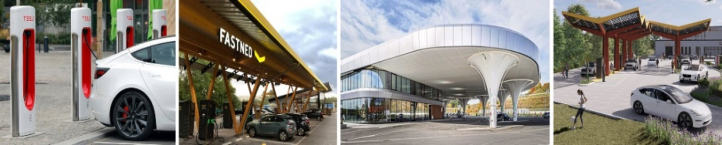
When researching current and future charging options, it is noticeable that in addition to charging parks in the conventional layout, in which vehicles are charged in parking bays, the charging option in a drive-through layout is also increasingly being propagated (Fig. 1). The question which of these concepts is best suited for fast vehicle charging is currently not answered by research and education, and will be examined in this study. Since it is assumed that customer preference for the charging layout is related to the charging time, subject tests are carried out in which the charging time is varied. On this basis, systematic statements can be made regarding the acceptance of charging layouts as a function of the charging time. This study is based on the assumption that people who want to charge quickly under time pressure will remain at the charging column during the process.
To answer this research question, a charging infrastructure for fast char- ging is generated first. For this purpose, an ideal layout is built virtually in CAD (Trimble Inc.), taking architectural principles into account. This is the
Investigations on User Acceptance of Fast Charging Stations in Drive 139
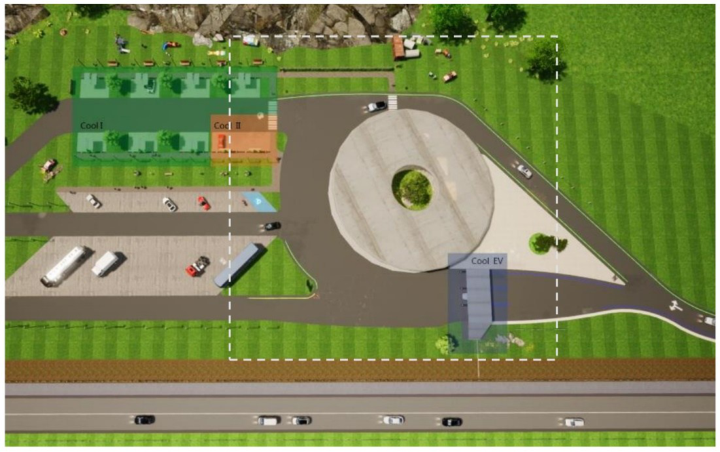
layout of a charging park for fast charging in a drive-through layout. For this purpose, a VR environment is censored (Epic Games) and animated. Data is generated in order to be able to carry out tests with different charging times. In the test, it can thus be recorded how long test subjects remain at the charging station depending on the charging time.
VR (Virtual Reality) VR is ubiquitous today. With its help, virtual, that is, non-existent, artifi- cial environments can be created. VR environments can be visually linked to objects in reality (e.g., representation of a conference room) or completely detached from them (e.g., visualization of chemical processes). The virtual environment can have properties and possibilities of action, which are also available in reality. Furthermore, it can have additional or other properties that might not even exist in reality in this form (Knoll et al.). By means of sui- table technologies, VR applications can create immersions, in other words, give the user the feeling of being part of this artificial environment. The degree of immersion depends mainly on six aspects: Extensiveness, Match- ing, Surroundness, Vividness, Interactability and Plot. (Knoll et al.) In the VR environment, subjects are placed in a virtual world, where they are exposed to certain tasks and situations in order to gain knowledge. The respective sce- narios are programmed individually for each experiment and can be changed spontaneously. This is also a big advantage of VR. Not only can changes be made quickly, but situations can also be created that may not have existed before. In addition to VR glasses, there are also two manipulators that allow the test person to grasp, operate and move things in the virtual world. The physical movements of the test persons are recorded at any time in order to generate further insights later.
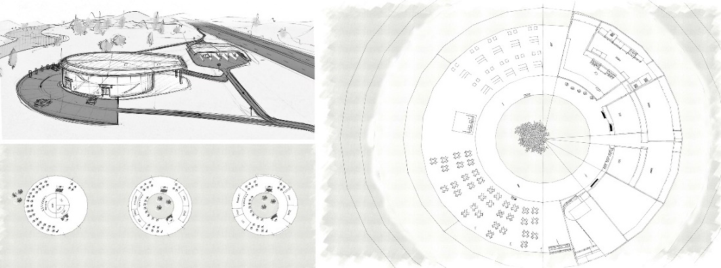
Architecture of the Experimental Setup The concept of an experimental landscape corresponding to a realistic modern scenario was generated (Fig. 2). This was picked up and transferred into a feasible virtual scenario.
Figure 2: Preliminary design (top left) and floor plan development.
In order to facilitate quality and localization, the first step was to define the orientation. The concept of localization is to be seen somewhat simplified in this context. While in the ideal case architecture and context merge, here a solved variant was chosen that works in itself, but can also be used in other specific locations.
The design itself consists of inner and outer space. Since the charging sta- tion is usually positioned along streets, the building is oriented away from the street and into its own courtyard. The exterior space is for mobility, so it is used for parking, refueling, and for travelers to dwell.
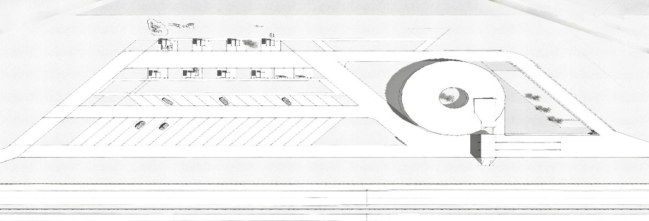
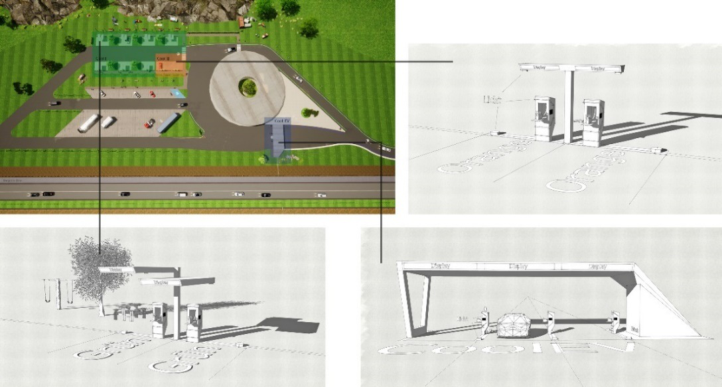
Several shapes and arrangements were generated and combined with each other. The choice for the test setup falls on a variant that can be applied generally to infrastructure main axes and that does not consider specific envi- ronmental restrictions. (Fig. 3). The charging park consists of three different charging options. There is the ultra-fast charging station in a drive-through layout (this will receive special attention and evaluation later in this test), the medium-fast charging, and the conventional charging, which is still common at present (Fig. 4).
Figure 3: Site plan.Figure 4: Charging columns (top left: site plan) | bottom left: slow charging | top right: medium-fast charging | bottom right: ultra-fast charging “CoolEV”.
Investigations on User Acceptance of Fast Charging Stations in Drive 141
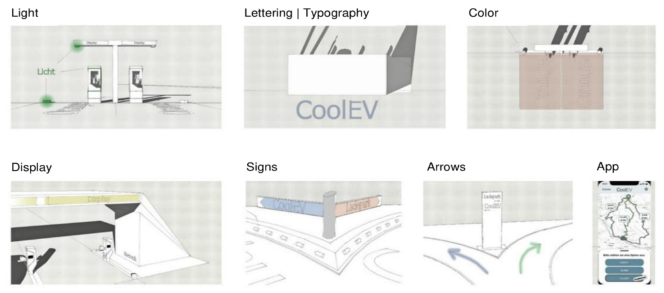
The number of charging columns shown corresponds to the number deri- ved from calculations by ZSW. There are three CoolEV ultra-fast charging columns, four medium-fast and 14 normal charging options. Care was taken to ensure that the different charging columns are also recognizable and distinguishable in terms of appearance. Each charging column has the same elements in order to ensure a charging column assignment later on.
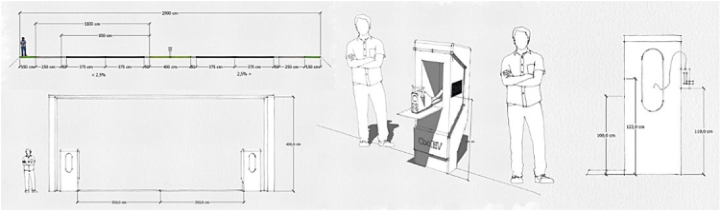
To enable this assignment, each charging pole contains a light source, coloured assistance (e.g., a coloured roadway), written assignment and a display that can be individually configured (Fig. 5). The dimensions com- ply with the construction guidelines (Fig. 6) and the facility is barrier-free (Neufert et al.).
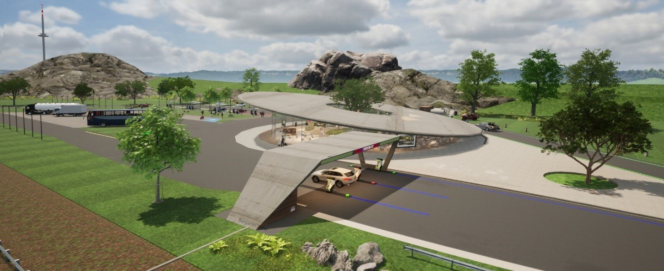
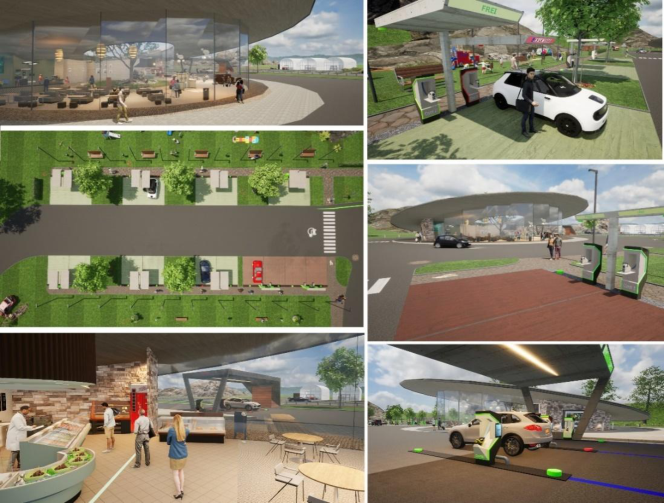
The loading park itself was adapted to the technical and design require- ments. To ensure a realistic scenario, a restaurant and parking facilities were also integrated. The surroundings were also adapted to the test requirements (Fig. 7).
In order to use the waste heat generated during ultrafast charging, there is a greenhouse (Fig. 8). However, this is only one of many variants, because the heat generated can of course also be used in other ways.
User Types The description of the typical user is essential for the user-centred design of the product. User types are selected that have already been described
Figure 5: Charging column assignment.Figure 6: Extract from the infrastructure dimensioning.Figure 7: Modelled charging park.Figure 8: Details of the modelled charging park.
in the research project and whose described user scenarios are well sui- ted in answering the present research question. The selection falls on the performance-oriented and innovation-oriented customers (Tsolakidis et al.). These two design-critical user types were integrated into the test sequence and the existing user scenarios were detailed.
EXPERIMENTAL PROCEDURE First, the different user types and the user scenario described are explained to the test subjects. Then the test person is asked to fill out the first part of a questionnaire, in which the following information specific to each user type is collected: Age, gender, educational background and experience with electric
Investigations on User Acceptance of Fast Charging Stations in Drive 143
Figure 9: The action area resp. The imaginary boundary.
vehicles. In order to familiarize the test persons with VR control, a training world (Unreal Engine) is loaded. Small tasks are now to be practiced here so that they become familiar with the controls (with the manipulators) and the VR experience. Then the test environment is loaded and the task of an EV charge is explained. The request to behave as in real life is impressively addressed to the test subjects. The actual experiment, namely the execution of a quick charge is carried out, thereby the action area for the test persons was limited (Fig. 9). All movements, actions and times of the test person are per- manently documented by video and by means of a test protocol. After the end of the test, the second part of the questionnaire is handed out. This is used primarily to record the following participant feedback: Is the loading time appropriate? Would you spend the charging time at the charging column? What charging time would you consider to be appropriate? How long do you estimate the charging process took? Did the VR environment distract from the actual attempt? Which charging layout would they prefer? For this purpose, the person conducting the test filled out an accompanying evalua- tion form. Questions from the subjects about the background and motivation of the experiment were explained afterwards.
RESULTS
The test subjects were aged between 23 and 63 years, predominantly male and with an affinity for technology. Comprehensive measurements were per- formed at periods of 5 min and 10 min (N = 15; N = 9), random samples at periods of 2.5 min and 15 min (N = 5). The evaluation was based on the first 5 trials at times 2.5; 5; 10 and 15 min (N = 5). For the test times 2.5;
5; 10 and 15 min, the first 5 valid tests were evaluated and analyzed in each case (Table 1).
As expected, there are considerable gaps between the perceived and mea- sured results. An exception here is the test of the 2 1/2 minute recharging time, which can still be compared most closely with a normal refueling. For a 5-minute waiting time, the measured results are acceptable (more than 50% accept the waiting time by remaining at the column). For a test time of 15 min, a different picture emerges when it comes to the complete waiting time of 15 min: all leave their charging column and look around in the VR envi- ronment. When the charging columns were left, it happened relatively early: depending on the charging time, Ø 00:56-02:01min resulted. In general, the longer the charging time, the more often the subjects left the charging station and the more often they returned to the car to check the charging time. The same was true for the imaginary boundary of the VR landscape. It is remar- kable that the vast majority of test persons prefer the drive-through layout to the parking bay (that is, the conventional situation), but this statement can- not be supported with the objectively collected data. Those who decided in favor of the parking bay layout gave the following reasons: there is no time pressure here, there are no cars coming from behind, so it is easier to recover. The VR is perceived as realistic and hardly distracting.
Table 1. Analysis of the user experiment and the survey.
Table available in the original PDF paper.
DISCUSSION
The test results should be viewed with caution. Since VR was still new to most of the test participants, it represented a major distraction from the actual que- stion, even though the majority stated almost in amazement that they had felt
Investigations on User Acceptance of Fast Charging Stations in Drive 145
“as if they were in real reality”. The subject is here in a new world and con- sequently quite often busy exploring the VR environment and diving into it. (Even though it was emphasized before the test start that he should behave like in reality). On the other hand, a totally real scenario, such as a freeway service station, is not possible either, because normal actions, such as sitting down on a bench and resting for a short while or having a leisurely meal in a restaurant, in short: to relax and entertain oneself on a daily basis, are not possible here. Furthermore, the movements, at least as developed in this expe- rimental setup, are not really close to reality. The test person could teleport by means of manipulators (joystick) much too fast (short distances could be covered by walking, but long distances could be covered by teleporting with a giant step).
The developed user types in which one was supposed to empathize were only partially accepted, because the test persons had problems to imagine themselves in other persons. For example, the behaviour associated with the time pressure addressed in the scenario (completing the charging process quickly and purposefully) was not observed in all subjects. Most subjects indicated in the questionnaire that they felt “like they were in a real world” and times were acceptable to them; however, they generally did not behave this way. A tendency towards a more aloof and rule-free behaviour could be observed.
If one now evaluates the test results in detail, then much could speak in favour of the drive-through solution. It looks like a familiar gas station, and the test subjects sort and behave accordingly. However, the fact that people do not stay at the assigned column (especially not with the 10 and 15 minute specifications) may also have quite banal reasons: Who wants to wait at a charging station for 10 or 15 min. when they have an attractive environment to explore? The situation is different for the two short charging times of 2 1/2 min and 5 min. For these times, the concept works very well. On the other hand: if the test persons leave the charging column and the drive-through charging station during the waiting time, for whatever good reasons, then a drive-through charging station makes less sense, then the customer is better served with a parking bay layout that offers him every possible freedom. He does not have to follow other charging customers wai- ting behind him. He can take advantage of all the leisure facilities offered by the service area and relax as he pleases.
Therefore, if one assumes that when leaving, the drive-through concept has failed because one should behave as in a pit lane, then this would only be practicable with short loading times. Because the test subjects already leave the charging station early at 5 min, and completely at 10-15min. Wishes expressed by the test subjects, such as going for a walk, drinking at a café or eating something and going to the playground with the children, do not fit into the concept in terms of time. As can be seen from the data, 2 1/2 or 5 min is still almost completely spent waiting at the charging column. Especially with partial charges (e.g., 20 - 50%), the drive-through concept plays out its strengths. From 10 min on, no one waits any longer. At 15 min, the charging time is increasingly described as “unacceptable”. However, it is important to note that a large number of the test persons had no experience
with EV’s. Those who were used to EV’s and their special, real charging times were predominantly more patient, but they also left the charging column in between.
CONCLUSION
This leads to a clear result: a drive-through charging station may be a good idea - but it does not hold up in terms of the absolute advantage of a charging park. Here, the service area with its convenient parking and simultaneous charging of the batteries gives the customer a great deal of temporal free- dom. The customer can also charge for a short time, he can (which is highly desirable from the point of view of traffic policy) recover sufficiently from the stress of driving and at the same time enjoy all the offers of the service area if he wants to. Above all, and this seems to us to be the winning argument, the customer can also enjoy all the advantages of a drive-through service station. This means that a decision against a pit–stop charging station in drive-through layout does not mean a disadvantage for the road user anyw- here, but saves the cost bearers of a service station many useless investments, i.e. it means a win-win situation.
However, if in the future the subjects’ attitude towards EV charging chan- ges and charging times of about 5 min become technically possible, then the results have to be reconsidered. Even with longer charging times, the concept of the drive-through charging station can in principle be implemented archite- cturally, but in this case the focus is not on remaining at the charging column, but on avoiding driving backwards after the charging process. In order to optimize this concept, new decision chains can be developed based on the evaluations, with which new layouts can be derived.
REFERENCES
BMWK, https://www.bmwk.de/Redaktion/DE/Artikel/Industrie/elektromobilitaet- foerderprogramm-elektro-mobil.html, last access: 31.01.2023. Epic Games, Inc., www.unrealengine.com, last access: 10.11.2022. Knoll, M.; Stieglitz, S. (2022). Augmented Reality und Virtual Reality – Einsatz im Kontext von Arbeit, Forschung und Lehre, HMD Praxis der Wirtschaftsinformati- kvolume 59, https://link.springer.com/article/10.1365/s40702-022-00840-5#ref- CR45, last access: 10.11.2022. Neufert, E., Kister, J. (2022). Bauentwurfslehre: Grundlagen, Normen, Vorsch-
riften über Anlage, Bau, Gestaltung, Raumbedarf, Raumbeziehungen, Maße für Gebäude, Räume, Einrichtungen, Geräte mit dem Menschen als Maß und Ziel; Handbuch für den Baufachmann, Bauherrn, Lehrenden und Lernenden (43. Aufl.). Wiesbaden: Springer Vieweg. (ISBN 978-3-658-34236-4). Porsche AG (Dr. Ing. h.c. F. Porsche AG), news-room.porsche.com/ de/2021/produkte/porsche-taycan-neues-einstiegsmodell-heckantrieb- zwei-batteriegroessen-23427.html, last access: 10.11.2022. Trimble Inc., www.sketchup.com, last access: 10.11.2022. Tsolakidis, L.; Mueller, A.; Buck, S.; Schmiel, F. (2022). User-Friendly Embedding of Vehicle Fast Charging in Primary Vehicle Use with Persona Models. In: Katie Plant and Gesa Praetorius (eds.) Human Factors in transportation. AHFE (2022) International Conference. AHFE Open Access, vol. 60. AHFE International, USA. https://doi.org/10.54941/ahfe1002489.
LISTED IN THE AHFE DIGITAL BOOKSTORE CATALOGUE
Explore the complete digital volume
Human Factors in Architecture, Sustainable Urban Planning and Infrastructure
Read this individual research paper free through the original publisher, or explore the full digital proceedings book.
ISBN 978-1-958651-65-0
Explore this ISBN in the AHFE Bookstore ↗Listed in the July 2026 bookstore catalogue; search by ISBN to confirm current availability · Digital book purchase optional