Sandra Beltran, Manoela Lopes, Rodolfo Vilela, Marco Querol, Gabriel Eroico, Ildeberto Almeida (2022). Expanded Method of Accident Analysis and Prevention – MAPAEX: an incident analysis in a railway company. In: Safety Management and Human Factors. AHFE Open Access, vol. 64, pp. 70–79. https://doi.org/10.54941/ahfe1002630
Introduction. Organizational and systemic analyses of workplace accidents do not include systematic methods of stimulating workers' learning and empowerment. Objective. The purpose of this study is to present an incident analysis in a railway passengers transport system using the Expanded Method of Workplace Accident Analysis and Prevention (MAPAEX). Methodology. MAPAEX is a collaborative tool that looks at the accident as an unexpected result of contradictions among the different elements of an activity system. A contradiction is a historically accumulated structural tension within and between activity systems. Identifying contradictions in the activity development subsidizes the elaboration of hypotheses about their origins. The proposition of solutions implies in modeling the activity system to overcome the identified contradictions and stimulate a movement towards a safer and more efficient production. Results. In this paper, a case study on the application of MAPAEX is presented with emphasis on the phases of analysis and solution modeling, which are centered on historicity, contradictions, and mediations in activity systems. The workers who participated analyzed an incident and understood the causes of the event in a systemic way, with emergence of their protagonism. With MAPAEX as a formative intervention, the researchers stimulated local actors to analyze problems consecutively, looking for innovative solutions through reconceptualization of the object/motive of the work activity. Discussion. This new accident analysis method combines activity ergonomics and activity theory. The multi-voice collaboration and a systemic approach develop expansive learning. Differences between this method and other systemic approaches are highlighted. Conclusions. MAPAEX showed to be a powerful tool for the development of analysis of workplace accidents, contributing with the innovation of concepts and methodological and practical procedures.
Expanded Method of Accident Analysis and Prevention – MAPAEX 71
INTRODUCTION
Understanding human and organizational factors (HOF) as latent conditi- ons to workplace accidents allows to propose systemic solutions, avoiding the search for scapegoats and punitive actions that only hinder learning (Heragthy et al. 2020). Many authors (Lindberg et al. 2010; Underwood and Waterson, 2013; Drupsteen and Guldenmund, 2014) highlight that there are few organizational accident analysis techniques put to the test. Recently, some studies reviewed accident investigations (Lenné et al. 2012; Read et al. 2012; Wang et al. 2013), and others presented case studies heading towards a systemic analysis, using methods such as Accimap (Kee et al. 2017; Lee et al. 2017) and Human Factor Analysis and Classification System - HFACS (Chen et al. 2013; Li et al. 2019). Our critical view of most of those analysis models is that they rely on the protagonism of an external researcher or on safety professionals, rather than involving local actors.
The method presented in this paper is based on the Method for Accidents Analysis and Prevention – MAPA in Portuguese, which was created to replace the old approach of safety as a practice limited to blaming the victims or following regulations. Instead, MAPA, based mainly in activity ergonomics, understands the accident as the product of a network of multiple interacting factors.
After a decade using MAPA, the research group came to know practices that eased transformation of work situations. Because of that, an incorpo- ration of the Cultural-Historical Activity Theory (CHAT) and Expansive Learning Theory (Engeström, 2015) led to an expansion of the MAPA object and it was renamed - Expanded Method for Accident Analysis and Preven- tion - MAPAEX. This study presents an incident analysis in a railway system using the MAPAEX.
MATERIALS AND METHODS
MAPAEX is a collaborative tool that looks at the accident as an unexpe- cted result of contradictions among the different elements of an Activity System (AS). This system is composed by a subject oriented towards an object (social motive of the activity), that acts through the mediation of instru- ments, tools, rules, division of labor and a community. A contradiction is a historically accumulated structural tension within and between AS, and manifests itself as disturbances, such as accidents, breakdowns, problems and ruptures (Engeström, 2015). As a formative intervention, in MAPAEX the researcher stimulates local actors to analyze problems consecutively, looking for innovative solutions, such as safer and more efficient production, through reconceptualization of the object/motive of the work activity that leads to the transformations of other activity elements, for example, instruments or rules.
Two principles must be highlighted in the application of MAPAEX: multi- voicedness (Engeström, 2001) and double stimulation (Sannino, 2015). The first of them presupposes that people that take part in work have different interests and points of view about the activity they perform, therefore, it is necessary to widen the set of actors to include the voices of those who are not
heard in the work process. In this study, workers from operations, maintena- nce, stations, operational control, procedures definition, safety and human resources participated in analysis and creation of solutions.
The second principle - double stimulation - is the use of two stimuli: one is a mirror data that reflects a workplace reality that tries to trigger an emo- tional engagement. In this case, we used some photos, entries of recorded interviews or sessions and some lists or charts that participants had created in previous sessions. The other is a neutral artifact or concept that tries to boost rationalization and concretizing solutions to the tasks/problems under discussion, for example, a timeline, a chart, a mental map, or an activity model, that is always empty for the participants to fill.
The method starts with negotiation, ethnographic data collection and training workshops, followed by questioning and analysis (of usual work, changes, barriers, history and contradictions). The conclusion of system dia- gnosis is followed by solutions’ modeling, assessment, implementation and evaluation of the new model, and finally consolidation of the new practice.
This study was developed in a Brazilian railway company that transports up to 3 million passengers per day in a 270 km network. Work safety issues came up in eight accidents - people being hit by moving trains - with 12 deaths in 6 years. For MAPAEX, on average, 15 workers met in ten weekly two-hour sessions. Exceptionally, the last session lasted six hours. This paper will focus on the results achieved with the analysis and solutions modeling.
In the incident chosen for analysis, a train ran over a piece of machinery in permanent tracks (PT). A maintenance team - Team 2 - had asked permission to work on the tracks using a hydraulic jack. However, another team - Team 1 - was working on the tracks using the permit given to Team 2. When the train came, workers did not have enough time to detach the jack and it was hit.
RESULTS
Questioning The first MAPAEX session is made so that consensus is reached within the group about the existence of a problem in the AS to be analyzed. After mirror data on the activity of PT inspection were presented, participants discussed their perceptions about the main risks for being hit, recognizing that when tracks are shared between simultaneous activities of maintenance and trains circulation/operation increases this risk. In this phase, participants recognized the problems and they committed to a joint analysis, as well as the making of solutions.
Usual Work Analysis From the second to the fifth sessions participants discussed the usual work in the activity concerning PT inspection. Thus, they described how it is accom- plished, who took part, what were its main difficulties and variabilities and, what was done when interacting with other activities. In this step parti- cipants discussed in depth the process of asking permission and receiving authorization to access the tracks.
Expanded Method of Accident Analysis and Prevention – MAPAEX 73
Urgent activities may be fulfilled through the release of a priority request of access (extra permit), which can cancel other access requests if they are incompatible. Depending on the urgency of the maintenance job, there will not be enough time for a meeting to make these requests compatible. Prio- rities consider the operational impact that a track closure can have. Users and media complain when platforms get crowded or transport is suspended, especially at peak hours. Commonly a team uses an approved access permit granted to a different team. In this case, Team 1, in order to avoid asking for an extra permit, used an authorization given to Team 2. This is an unforeseen procedure that allows time for accomplishing deadlines; similar decisions had been successfully taken in the past.
Additionally, signposts should have been set for both teams’ jobs, but the conductor had been informed about just one of them - what could have indu- ced a cognitive trap: seeing the first team on PT, he could have considered that from that point onwards the tracks were clean, without other workers. Besi- des, even though conductors are informed about the teams working along the whole track when they start their shifts, the information does not detail the exact stretch of track where they are located. And, in this case, activities were happening in a curve, which also hindered visualization of team 2 at work.
Change and Barriers Analysis Between the fifth and sixth sessions, the group proceeded to the change analy- sis (Leplat and Rasmussem, 1984) and barriers analysis (Hale et al. 2007; Hollnagel, 2008). Participants explored the systemic conditions related to organizational changes that contributed to the incident. Participants also identified potential risks and prevention, monitoring and protections barriers present or absent in the system. The workers listed some barriers regarding the risk of being hit in the tracks.
During the sessions, it was mentioned that adjustments had to be made by different teams of workers that searched to answer in the field to unforeseen problem situations. Maintenance workers experienced time pressure when working in an operating track. Besides, they also experienced other situations that could reduce the time interval available to finish their jobs, including difficulties in reaching the tracks, transporting materials and equipment and walking along the tracks to the stretch where the job is to be done.
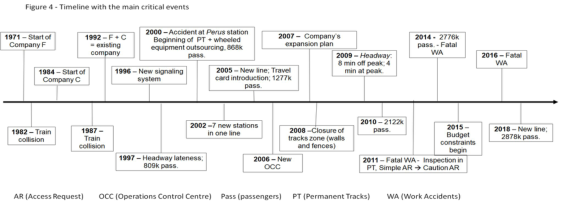
Historical Analysis Historical analysis happened between the seventh and eighth sessions. The main changes that led to the incident were placed by the participants in a timeline (second stimulus) showing the main critical events or the pathoge- nic organizational factors (Dien et al. 2012), for instance the asynchronous evolution between the maintenance and operation systems, and different operational practices inside the company (see Figure 1).
The increased flow of passengers and the modernization process; moreo- ver, the fusion process did not manage to fully integrate the different cultures in the company. Even after 23 years, it was possible to verify that some
Figure 1: Timeline with the main critical events.
procedures still reveal the persistence of cultural traits of antique former companies.
Recently, over a period of 13 years, the number of passengers passed from 809 thousand to more than 2 million per day. As years went by, the com- pany bought more modern trains or renovated the existing ones, for instance closed doors operating trains, integration with Operation Control Center (OCC); at the same time, maintenance continued to work with hand-operated equipment, old and heavy. During this period, the increase in the number of circulating trains led to a headway1 reduction - from an average of 24 minu- tes to the current average of less than 8 minutes, varying among the seven existing lines.
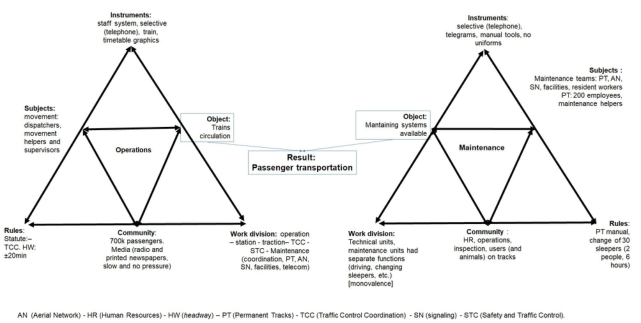
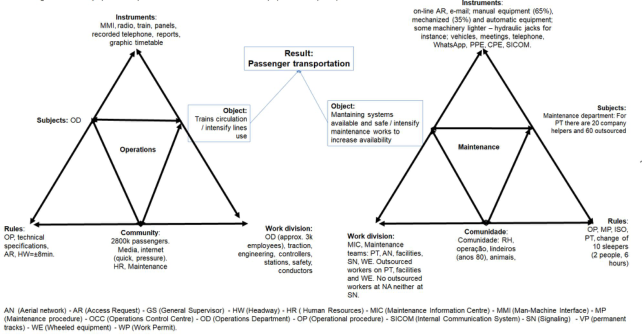
The three mentioned aspects - asynchronous modernization, decrease of the headway and cultural clash affect safety in ways that are not easy to predict. Participants analyzed this timeline and defined two critical periods, in which significant changes happened in the mediating elements of two AS in the company - operations and maintenance - that have different objects but share the same result, namely transporting passengers (see Figures 2 and 3).
Figure 2: Activity Systems of operations and maintenance - decade 70/80 - industrial era.
1Time interval between the arrival of two sequential trains at a station
Expanded Method of Accident Analysis and Prevention – MAPAEX 75
Figure 3: Activity Systems of operations and maintenance - nowadays - computerized era.
Contradictions Analysis Between the eighth and ninth sessions the participants identified the existing contradictions. The main contradiction they pointed out were related to the activities of operation and maintenance that have to share the track when working. At the same time that safe operation depends on maintenance, whereas maintenance hinders and slows down the operation. Likewise, main- tenance cannot do a good job because trains usually continue to run while they quickly need to repair the lines. The operations department is given pri- ority when disputing space in permanent tracks, since it is responsible for the flow of passengers. Headway reduction increased the wearing of many lines, and therefore the demand for maintenance work teams, who had to work with old equipment and a smaller headcount. Additionally, the pressure for speeding up their work results in the adoption of shortcuts such as the one of not presenting a formal demand for extra access. Participants highlighted an internal contradiction among the company norms, expressing that if they were to follow every existing rule and procedure the transportation would stop or they would be obliged to work with less quality.
Modeling of Contradictions and Assessment of the New Model In summary, the incident involved interaction between maintenance activities and passenger transport service, in a situation where the emergence of a vari- ability (need for a second intervention on a stretch of track where there was already an authorization for another service) was handled with a decision to “ride along” on the first authorization (without formalizing a second auth- orization request), which was favored by the fact that similar practices had already been adopted in the system. Additionally, there was inadequate com- munication between the train operator, the OCC, and the track maintenance teams 1 and 2.
This occurs in a system without an alternative track for train circulation, which requires highly efficient risk management. And, missing the opportu- nity to learn from that the access request system was proving inadequate to handle the existing demands and was therefore being bypassed in a way that created unaddressed risks.
Historical development of the system with accelerated increase of passen- ger circulation and decrease of time for maintenance, as well as the difficulties in access requests contribute to the occurrence. This historical aspect is explained as having origins in contradictions arising in the system between rules and activities, with growing demands on maintenance, service opera- tion, and time pressures. Acting by prevention requires anticipating impacts of these changes. The introduction of innovations and or the emergence of variabilities embed the potential triggering and or acceleration of processes of system migration toward accidents.
In ninth and tenth sessions, participants discussed possible solutions, their positive and negative implications and they examined the implications of a new AS. They designed a canvas summarizing 19 proposals of systemic solu- tions related to the identified contradictions and discussed at length positive and negative aspects of both the contradictions and the proposed solutions.
DISCUSSION
MAPAEX developed two dimensions: systematicity and protagonism. Syste- mic approach is related to the identification of organizational factors, which is the most important step of learning (Dien et al. 2012, Drupsteen and Guldenmund, 2014). The introduction of the AS model in MAPAEX has hel- ped us to understand passenger transportation (the activity’s object) as an element dialectically connected to other mediating elements, and how the contradictions among them appeared as accidents in the tracks. When the participants drew operations and maintenance AS, it became a lot clearer how their decisions affected the system’s safety.
Both the organizational learning theory and the Learning from Incidents approach have used the concept of learning agency, in which actors must be willing to engage actively in the experience in order to genuinely get kno- wledge of it and make sure that learning experience is incorporated in the organization. This type of agency means to be actively involved in the events’ analysis and investigation (Drupsteen and Guldenmund, 2014). However, these examples of agency are rare when one looks at the accident analysis literature. Besides, even though these theories and approaches aim at reach- ing agency and organizational learning, they do not systematize the learning process with concrete tools, as it happens in MAPAEX.
MAPAEX developed the dimension of protagonism or transformative age- ncy (Sannino et al. 2016). In this case, protagonism passed gradually from researchers-specialists to the workers. This process occurred thanks to the double stimulation that happened when researchers offered mirror data (such as the incident case) that engaged participants emotionally, followed by analytical concepts (such as the time line or the AS model) that helped a more rational engagement.
Expanded Method of Accident Analysis and Prevention – MAPAEX 77
In HFACS, the “guiltless” errors’ approach contributes to enhancing the systemic investigation and organizational learning; however, the starting point of the analysis is the identification of active errors that later are associ- ated with HOF. One level influences the others, thus some aspects of the accident may get lost in the taxonomy of failures (Yoon et al. 2016). In MAPAEX, on the other hand, the starting point is the understanding of the actual work, as Functional Resonance Analysis Method (FRAM) con- siders Work-As-Done (Patriarca et al. 2020). According to Yoon et al. (2016) HFACS leads to a premature judgment of causal factors, even before a complete understanding of the accident. On the other hand, using AS’s six elements and their interactions as starting points could produce a significant set of context factors related to human activity that are not easily obtained using other existing methods.
The fundamental difference with MAPAEX lies, possibly, in the dimension of protagonism. In recent revisions or case studies using HFACS (Lenné et al. 2012; Read et al. 2012; Wang et al. 2013; Chen et al. 2013) it couldn’t be seen workers acting as solution designers for accidents prevention. As it has been explained, in MAPAEX this process passes through the double stimulation principle.
Systemic approaches promote the identification and domain of problems, which are typically many-faceted (Norros, 2014). At the end of the MAPAEX process, the workers identified the signs of contradictions in the activities systems and designed solutions for solving them. By maintaining a multi- voice collaboration in building solutions, researchers were mediators and workers transformation agents.
CONCLUSION
This study describes the use of a new model of accident analysis called MAPAEX, that uses concepts of Activity Ergonomics and CHAT. With other analysis methods, the causes of an event are identified by a team of speci- alists, who also propose recommendations that, even though are based on successful past experiences, are external solutions. In MAPAEX, workers that take part in the sessions can understand the causes of the event in a syste- mic way, and their collective protagonism emerges along the whole process of event’s analysis and solution modeling. In this case, learning is not cen- tered in external analysts, but expands to the workers that participate in elaborate a historical, empirical analysis of the event’s causes and elaborate change recommendations. In MAPAEX, by exploring the line of historical development of the system, the problems are explained as having origins in contradictions arising in this history. Thus, we do highlight that MAPAEX can offer meaning insights that are not reached by other methods.
This study has practical and theoretical implications, presenting a method that aims to develop greater protagonism of workers in accidents’ systemic analysis. In the case presented, participants reached the phase of solutions modeling and assessment of the new model. It is necessary to continue the development of MAPAEX towards the phases of testing and evaluation in order to consolidate the model.
ACKNOWLEDGMENT
This work was supported by Brazilian Labor Prosecution Office [grant num- ber PP 003349.2016.02.000/6], Coordination for the Improvement of Higher Education Personnel - CAPES [grant number 88882.333582/2019-01], Nati- onal Council for Scientific and Technological Development - CNPq [grant number 133684/2019-9], and São Paulo Research Foundation - FAPESP [grant number 2020/08413-6].
REFERENCES
Chen, S.T., Wall, A., Davies, P., et al. (2013) A Human and Organisational Factors (HOFs) analysis method for marine casualties using HFACS-Maritime Accidents (HFACS-MA). Safe Sci. v. 60, pp. 105–114. Dien, Y., Dechy, N., Guillaume, E. (2012) Accident investigation: from searching
direct causes to finding in-depth causes–Problem of analysis or/and of analyst? Safe Sci. v. 50, n.6, pp. 1398–1407. Drupsteen, L., Guldenmund, F.W. (2014) What is learning? A review of the safety literature to define learning from incidents, accidents and disasters. J Conting Crisis Manag. v. 22, n. 2, pp. 81–96. Engeström, Y. (2001) Expansive learning at work: toward an activity-theoretical re-
conceptualization. J Educ Work. v. 14, n. 1, p. 133-156. Engeström, Y. (2015) Learning by expanding: an activity-theoretical approach to developmental research. Cambridge: Cambridge University Press. Hale, A.R., Ale, B.J.M., Goossens, L.H.J., et al. (2007) Modeling accidents for
prioritizing prevention. Reliab Eng Syst Safe. v. 92, n. 12, pp. 1701–1715. Heraghty, D., Rae, A.J., Dekker, S.W. (2020) Managing accidents using retributive justice mechanisms: when the just culture policy gets done to you. Safe Sci. v. 126, 104677. Hollnagel, E. Risk + barriers = safety? (2008). Safe Sci. v. 46, n.2, pp. 221–229. Kee, D., Jun, G.T., Waterson, P.E., et al. (2017) A systemic analysis of South Korea
Sewol Ferry accident - striking a balance between learning and accountability. Appl Ergon. v. 59(B), pp. 504–516. Lee, S., Moh, Y.B., Tabibzadeh, M., et al. (2017) Applying the AcciMap methodology to investigate the tragic Sewol Ferry accident in South Korea. Appl Ergon. v. 59(B), pp. 517–525. Lenné, M.G., Salmon, P.M., Liu, C.C., Trotter, M. (2012). A systems approach to
accident causation in mining: an application of the HFACS method. Accid Anal Prev. v. 48, pp. 111–117. Li, C., Tang, T., Chatzimichailidou, M.M., et al. (2019) A hybrid human and organisational analysis method for railway accidents based on HFACS – STAMP and human cognitive behavior. Appl Ergon. v. 79, n. 122–142. Lindberg, A.K., Hansson, S.O., Rollenhagen, C. (2010) Learning from accidents –
What more do we need to know? Safe Sci. v. 48, n. 6, pp. 714–721. Leplat, J., Rasmussem, J. (1984) Analysis of human errors in industrial incidents and accidents for improvement of work safety. Accid Anal Prev. v. 16, n. 2, pp. 77–88. Norros, L. (2014) Developing human factors/ergonomics as a design discipline. Appl
Ergon. v. 45, n. 1, pp. 61–71. Patriarca, R., Gravio, G.D., Woltjer, R., et al. (2020) Framing the FRAM: a literature review on the functional resonance analysis method. Safe Sci. v. 129, 104827.
Expanded Method of Accident Analysis and Prevention – MAPAEX 79
Read, G.J., Lenné, M.G., Moss, S.A. (2012) Associations between task, training and social environmental factors and error types involved in rail incidents and accidents. Accid Anal Prev. v. 48, pp. 416–422. Sannino, A., Engeström, Y., Lemos, M. (2016) Formative interventions for expansive
learning and transformative agency. J Learn Sci. v. 25, n. 4, pp. 599–633. Sannino, A. The principle of double stimulation: a path to volitional action. (2015) Learning, Culture and Social Interaction. v. 6, pp. 1–15. Underwood, P., Waterson, P. (2013) Systemic accident analysis: examining the gap
between research and practice. Accid Anal Prev. v. 55, pp. 154-164. Wang, Y.F., Xie, M., Chin, K.S., et al. (2013) Accident analysis model based on Bayesian Network and Evidential Reasoning approach. J Loss Prev Process Ind. v. 26, n. 1, pp. 10–21. Yoon, Y.S., Ham, D.H., Yoon, W.C. (2016) Application of activity theory to analysis
of human-related accidents: method and case studies. Reliab Eng Syst Safe. v. 150, pp. 22–34.
LISTED IN THE AHFE DIGITAL BOOKSTORE CATALOGUE
Explore the complete digital volume
Safety Management and Human Factors
Read this individual research paper free through the original publisher, or explore the full digital proceedings book.
ISBN 978-1-958651-40-7
Explore this ISBN in the AHFE Bookstore ↗Listed in the July 2026 bookstore catalogue; search by ISBN to confirm current availability · Digital book purchase optional