Zainb Dawod, David Bell (2022). Enhance the Learning of SEN Children With Dynamic Content Annotations. In: Human Interaction & Emerging Technologies (IHIET 2022): Artificial Intelligence & Future Applications. AHFE Open Access, vol. 68, pp. 383–391. https://doi.org/10.54941/ahfe1002756
Communication is difficult for students who have little or no clear speech. Consequently, a range of communication systems, including symbols, pictures, or gestures, is used as an alternative to speech. Semantic web technology has had an impact in the educational field and offers the potential for greater engagement with a rich web of content. Students’ behaviour and learning engagement are among the significant problems in managing any group with special needs. Pupils with learning difficulties tend to be more off-task in class, are required to receive more teacher attention, off-task behaviour, ask fewer educational questions with shorter response times, and give less feedback than other pupils. Communication systems have been used since the 1970s to support face-to-face communication with children who have little or no speech ability. From the literature, teaching using communication symbols requires an adequate number of trained staff and an understanding of the complexity of young peoples’ disabilities and behaviour. Teachers often feel overwhelmed in preparing class resources, where more than one resource may be needed to explain each thought (O’Brien, 2019). A new evolution of the web is called the “Semantic Web.” The Semantic Web is an extension of the current traditional World Wide Web - adding semantic descriptions and ontologies. One benefit is that such characterization and modelling help provide additional meaning to the web content; making content machine-understandable (Berners-Lee et al, 2001). Although the Semantic web is applied in different fields including education, there is limited research in the field of mainstream education, particularly for those with special needs. This research was conducted to show the impact of applying semantic annotation techniques in improving the engagement, concentration, and behaviour of children with special needs. This study follows a Design Science Research Methodology (DSRM), a research process to discover practical solutions by evaluating the results in a set of iterations to design a SENTP model. The findings present a novel approach to teaching children with various needs by introducing educational prototypes using different semantic annotation content in an educational website. We investigated the impact of the annotation content using the symbol communication systems (Makaton, Widgit, and PECS), pictures, or audios, which are part of the current methods for teaching in UK schools. We selected an appropriate annotation editor to test the SENTP prototype for testing in the study after exploring different techniques. We collected the data from seven schools in the UK: two nursery schools; two special need high schools; one primary state school; and one preschool for children with language and communication difficulties. A total of 23 educators approved to participate in this study. The data are recorded, transcribed, and thematically analysed using NVivo 11. The findings from the in-school experiment indicated that annotated content using semantic annotations could have a significant impact on making the learning process more effective with better class management for students with special needs, including pupils with autistic spectrum disorders.
Semantic web technology promises several benefits for a web future, inclu- ding education (Pahl & Holohan, 2009). Semantic web techniques have been applied in the education sector to retrieve relevant content and add semantic annotations to documents. However, studies in this area have not considered semantic annotations in preparing special needs learning resources, taking advantage of the symbol systems (Makaton, PECS, and Widgit), pictures, or sign language. Government statistics in 2020 have revealed that pupils with special educational needs and disabilities have risen for a third conse- cutive year (Snowdon, 2020). Special needs schools continue to rely heavily on manual methods using sign language, photos, symbol systems, and obje- cts to develop speech and vocabulary (Davis & Florian, 2004). Hence, the demand for customized teaching and learning resources to benefit all students with useful lessons that meet each learner’s individual needs (Gregory & Cha- pman, 2013). This new evolution of the web is called the “Semantic Web.”
Literature review Literature (current teaching methods, SEN issues, styles, and their teaching requirements).
Literature review and interviews (Teaching staff)
Requirements Semantic annotation tools.
Construct and model current SEN teaching resources with gaps and requirements. 2. Select the required tools to conduct the field study.
Select Amaya annotation editor and HTML for the web design 3. Select the annotation type
Website with annotations
SEN Teaching Platform.
Experiment with Amaya and the HTML
4. Evaluate the SENTP platform.
Interviews (Teaching staff)
SEN Teaching Platform
Evaluation findings.
The Semantic Web is an extension of the current traditional World Wide Web - adding semantic descriptions and ontologies (Berners-Lee et al., 2006). One benefit is that such characterization and modeling help provide additi- onal meaning to the web content; making content machine-understandable (Berners-Lee et al., 2001). One such technology, semantic annotation tools, is starting to gain traction, with automatic annotation, semi-automatic, or more manual approaches. The approach is unique in that it teaches children to initiate communicative interactions within a social framework. (Bondy & Frost, 2001; Loong & Herbert, 2012; Roschelle et al., 2010; Tan & Pearce, 2012; Liu & Elms, 2019)(see Table 1). From literature, teaching with sym- bols requires an adequate number of trained staff and an understanding of the complexity of young peoples’ disabilities and behavior. Teachers often feel overwhelmed in preparing class resources, where more than one resource may be needed to explain each thought (O’Brien, 2019). Students’ behaviors and learning engagement are other significant problems in managing any group with special needs (Bulgren & Carta, 1992). Pupils with learning difficulties tend to be more off-task, receive more teacher attention, particularly for off- task behavior, ask fewer educational questions with shorter response times, and less feedback than other pupils (Norwich & Lewis, 2001).
There has been only limited research on the effects of resources presen- tation style on students’ learning and their attitudes towards the learning materials (Jamet & Colliot, 2018; Chorianopoulos & Giannakos, 2013; Ili- oudi et al., 2013). Thus, there is a great demand for the provision of a facility to annotate these resources (Wang, 2009).
This article examines applying semantic annotations techniques to the design of the learning resources using the most popular methods such as symbol communication systems and images. The connection between the current methods and the annotation techniques with different learning resou- rces, allows students to understand the background concept of each learning
Enhance the Learning of SEN Children With Dynamic Content Annotations 385
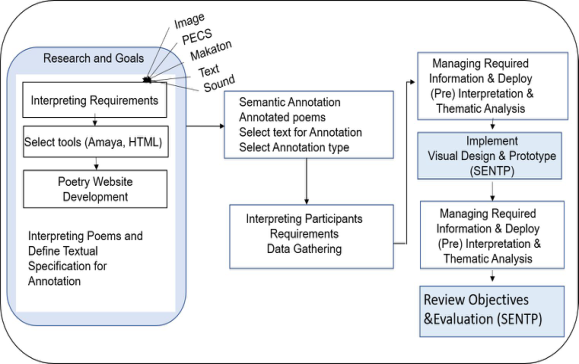
Figure 1: The SENTP model.
Figure available in the original PDF paper.
material by the linked metadata. This technique should facilitate the effective use of technology in SEN education.
RESEARCH DESIGN Design Science Research (DSR) is now an accepted research paradigm in the Information Systems (IS) field, aiming at evolving determined IT artifacts and knowledge about the design of IT artifacts (vom Brocke et al., 2017). This study follows a Design Science Research Methodology (DSRM), a rese- arch process to discover a practical solution by evaluating the results in a set of iterations (Hevner et al., 2004; March & Smith, 1995). The solution effectiveness is demonstrated through an iterative evaluation of a designed artifact(s). Artifacts include constructs, models, methods, and instantiations (March & Smith, 1995). The process includes six steps: problem identifica- tion and motivation, the definition of the objectives for a solution, design and development, demonstration, evaluation, and communication (Peffers et al., 2007). According to Design Science research, each step applies a method to an input artifact and results in an output to use as input for the next step (See Figure 1).
This study aims to build and refine a number of micro- designs (content, annotation, process) each forming part of the SENTP. As components of the prototype framework are designed, built, and tested, they become building blocks that contribute to the platform. We started by designing a model and identifying the tools required (See Table 1). Each iteration step applies an input artefact method results in an output that could be utilised as input for the next iteration step.
CONCEPTUAL FRAMEWORK
Figure 2 defines the relevant variables for our study and maps out how they relate to each other. Based on the current teaching methods used to teach pupils with special needs. We will utilise the symbol communication systems, images, or text as annotation metadata.
To test the SEN teaching framework, we designed a poetry educational website. The website’s content comprises different poetry styles selected from the national curriculum (2014), appropriate for age range (2 and a half-19 years). Although understanding poems is regarded as a challenging task for children with special needs as it can reflect emotions such as joy, sorrow, anger, which were difficult to understand for students with special needs. Also, understanding underlined meaning in poems is another challenge for children with Autism spectrum disorder (ASD) (Perko & McLaughlin, 2002). Another reason for selecting such materials for field testing is that poetry is motivating, entertaining, and ideal learning material for younger pupils
386 Dawod and Bell
Figure 2: Conceptual SEN teaching framework.
(Smart, 2005). Besides, it allows the students to revisit and reuse critical concepts and vocabulary (City of Bradford MDC, 2016). The selected anno- tations can be represented as comments, images, notes, explanations, or other remarks that can be attached to a Web document (Amaya, 2015). The sele- ction of annotation forms in the designed prototype is based on the literature review from some of the existing methods used in the UK schools.
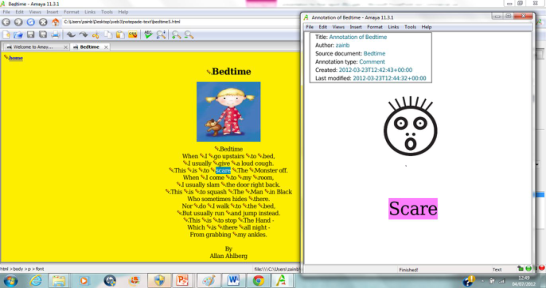
IN-SCHOOL EXPERIMENT We have created a prototype system that performs annotations with metadata for poetry sessions. The participants select the type of annotations, style, edu- cational level, and the content of the poems based on the students’ needs and age. We applied symbols as annotations from the symbol-based communi- cation (Makaton, PECS, Widgit), pictures, text with bigger font size, text, or audio. Figure 3 depicts an example of the annotation dialogue displaying the annotation body area and the annotation metadata. The annotation body area employed a Makaton symbol (“scare”). This type of annotation can sup- port communication for those with little or no speech development or literacy. Using such annotations could support language development for those with moderate to severe learning difficulties.
METHOD
Data Collection and Participant Selection We collected the data from seven schools in the UK: two nursery schools (2 and a half-5 years; two special high schools (11-19 years); one state primary school (7-11 years); and one preschool for children with speech, language and communication difficulties (2 years and 9 months-4 years). A total of 23 educators approved to participate in the study. We audio-recorded and
Enhance the Learning of SEN Children With Dynamic Content Annotations 387
Figure 3: Annotated content “scare” with Makaton symbol.
transcribed the interviews. We prepared two types of questionnaires: pre- interview and post-interview questions. Also, we collected the data from the field notes and class observations.
Data Analyses We classified the relevant data to each theme to ensure they connect with unique codes and the theme itself to conduct thematic analysis. Then, we pre- sented a model of themes to show the connections and relationships between the themes and the subthemes based on Braun & Clarke (2006).
All the interviews’ transcripts are thematically analyzed and used as part of the broader design process to elicit future requirements and, more impor- tantly, to determine artifact effectiveness (Braun & Clarke, 2006). We utilised NVivo11 to facilitate analyzing the data and to determine significance (Zamawe, 2015).
RESULTS AND DISCUSSION
Looking at the results from the study, the participants expressed their current teaching concerns toward teaching children with SEN. The results show that twenty-one of the participants (91%) currently use manual resources to teach pupils with SEN, mostly visual. This result shows the amount of pressure to complete their routine work. It outlines the need to reduce this overloaded work from the teaching staff, especially when they are short of staff.
The findings shows that applying annotation techniques to the students resources could increase the students’ engagement, encourage good beh- aviour and improve communication skills by utilising different types of annotation forms that related to each students’ needs such as real images, symbol systems, and applying appropriate font and size. Furthermore, impro- ving the students’ understanding could reduce students’ anxiety which can impact on improving students’ behaviour. The participants highlighted some current concerns that have an impact on the student learning progress such as managing big groups, emotional language, behaviour problems, working independently, preparation time, vocabulary, and reading. The interview
388 Dawod and Bell
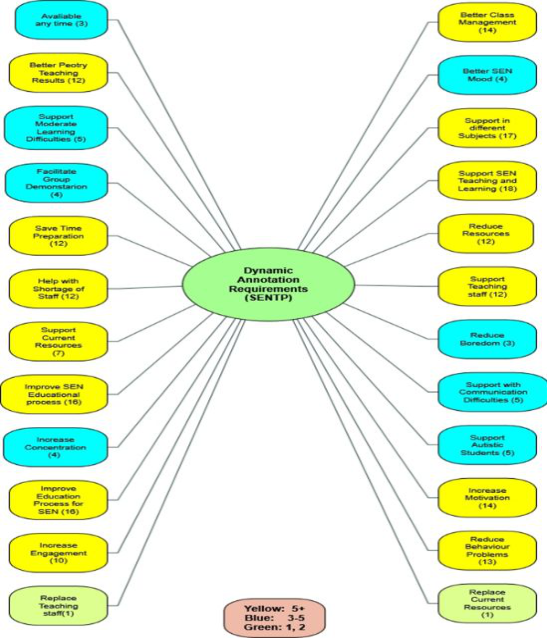
Figure 4: SENTP thematic evaluation results.
results show that SENTP has a positive impact and could provide good sup- port during the teaching process. T8-M-PI considered the preparation time as one of the main concerns: “… I think preparation is an issue because it is just a time factor [...] our teaching assistants and teachers are very good at preparing additional resources for special needs children, but it is very time-consuming”.
Dynamic annotations support autistic students who find text involving impressions, emotions, feelings, imaginative and figurative content difficult to understand without special visual aids. There was considerable agreement among participants across the teaching staff that teaching emotions, underl- ying meanings, and imagination are challenging for students with SEN. This concept was expressed by T8-M-P: “Poetry is about impressions, emotions, and feelings. The thing that they find particularly challenging is emotions, feelings, and inference. The inference is very tricky for them”. TA8-M-SMO believed that using such digital annotations with the learning resources could enhance the learning process for children with a physical disability.
CONCLUSION
We investigated the impact of dynamic semantic annotations using symbol communication systems (Makaton, Widgit, and PECS), pictures, or audio.
Enhance the Learning of SEN Children With Dynamic Content Annotations 389
We designed an educational poetry website for a range of age groups. Then, we selected an appropriate annotation editor to test the SENTP prototype. Design science research (DSR) methodology directed the SENTP artifacts, including the construct, model, method, and instantiation. The artifacts included applying communication symbols (construct). Then, interviewed educators and reviewed literature (method).
The final results show that classrooms could benefit from reduced behavi- oral problems and increased students’ understanding to achieve better class management. Teaching with such learning resources could support the educa- tors with the routine lesson preparations. There is a clear need to investigate with a wider data collection approach to avoid any bias that could occur during the interviews.
ACKNOWLEDGMENT
The authors would like to thank all the schools and teaching professionals for supporting this research by generously sharing their time, views, perceptions, cooperation, and experience. We are also grateful to Makaton, PECS, and Widgit Trusts for supporting this project by permitting us to use some of the symbols for research purposes.
REFERENCES
Amaya (2015). Amaya User Manual. https://www.w3.org/Amaya/User/doc/Manual.
html Berners-Lee, T (2009). The next Web of open, linked data [TED Talks Website] (Berners-Lee . TED2009). http://www.ted.com/talks/tim_berners_lee_on_the_nex t_web.html Berners-Lee, T., Hall, W., Hendler, J.A, O’Hara, K. Shadbolt, N. & Weitzner, D.J.
(2006). A Framework for Web Science, Foundations and Trends® in Web Science, 1(1), 1–130. http://dx.doi.org/10.1561/1800000001 Berners-Lee, T., Hendler, J. & Miller, E. (2002). Integrating applications on the Semantic Web. http://www.w3.org/2002/07/swint Berners-Lee, T., Hendler, J. and Lissila, O. (2001). The Semantic Web. A New Form
of Web Content That is Meaningful to Computers Will Unleash A Revolution of New Possibilities. Scientific American (May 17). http://sciam.com/article.cfm?ar ticleID=00048144-10D2-1C70-84A9809EC588EF21. Blissymbolitics (2016). Blissymbolitics. www.blissymbolics.org Bondy, A. & Frost, L. (2001). The Picture Exchange Communication System.
Behavior Modification, 25, 725–744. Bondy, A., & Frost, L. (2011). Topics in autism. A picture’s worth: PECS and other visual communication strategies in autism (2nd ed.). Woodbine House. Braun, V., & Clarke, V. (2006). Using thematic analysis in psychology. Qualitative
Research in Psychology. 3(2), 77–101. https://doi: 10.1191/1478088706qp063oa Braun, V., & Clarke, V. (2013). Teaching Thematic Analysis: Overcoming Challenges and Developing Strategies for Effective Learning. The Psychologist, 26(2), 120–123. Bulgren, J. A., & Carta, J. L. (1992). Examining the instructional contexts of students
with learning disabilities. Exceptional Children. Sage Journals 59(3), 182–191. https://journals.sagepub.com/doi/10.1177/001440299305900302
390 Dawod and Bell
Chorianopoulos, K., & Giannakos, M. N. (2013). Usability design for video lectures. In Proceedings of the 11th European conference on interactive TV and video, 163–164. New York: ACM. City of Bradford MDC (2016). Strategies for Supporting Pupils with SEN. Retrieved
from www.bradford.gov.uk Davis, P., & Florian, L. (2004). Teaching Strategies and Approaches for Pupils with Special Educational Needs: A Coping Study, Department of Education and Skills, RR 516. Gregory, G. H. & Chapman, C. (2013). Differentiated Instructional Strategies: One
Size Doesn’t Fit All, Corwin, Sage. Hevner, A., March, S., Park, J,. & Ram, S. (2004). Design Science in Information Systems Research. MIS Quarterly, 28, 75–106. Ilioudi, C., Giannakos, M. N., & Chorianopoulos, K. (2013). Investigating differe-
nces among the commonly used video lecture styles. In WAVe 2013: The workshop on Analytics on Video-based Learning, 938, 21–26. https://doi.org/10.13140/2.1. 3524.9284 Jamet, E. & Colliot, T. (2018). How does adding versus self-generating a hierarchical outline while learning from a multimedia document influence students’ performa- nces? Computers in Human Behaviour, 80, 354-361. https://doi.org/10.1016/j.ch b.2017.11.037 Liu, C. & Elms, P. (2019). Animating student engagement: The impacts of cartoon
instructional videos on learning experience, Research in Learning Technology, 27. https: doi.org/10.25304/rlt.v27.2124 Loong, E. Y., & Herbert,S. (2012). Student perspectives of Web-based mathematics, International Journal of Education Research, 53, 117–126. https: Loprestl, E., Bodine, C., & Lewis, C. (2008). Assistive Technology for Cogni-
tion [Understanding the Needs of Persons with Disabilities], IEEE Engineering in Medicine and Biology Magazine 27(2), 29–39. Makaton Charity. (2020). Retrieved from https://singinghands.co.uk/about/what-is -makaton/ March, T. S., & Smith, F. G. (1995). Design and Natural Science Research on
Information Technology. Decision Support Systems, 15, 251–266. ELSEVIER. Marshall, C., & Rossman, G. (1989). Designing Qualitative Research. California: Sage. National Curriculum (2014). Policy. https://www.gov.uk/government/collections/na
tional-curriculum Norwich, B., & Lewis, A. (2001). Mapping a Pedagogy for Special Educational Needs. British Educational Research Journal, 27(3), 313–329. O’Brien, C. (2019, Jan 24). Special schools struggling to cope as pupils’ needs
become more complex. The Irish Times. https://www.irishtimes.com/news/educ ation/special-schools-struggling-to-cope-as-pupils-needs-become-more-complex -1.3768307 Pahl, C., & Holohan, E. (2009). Applications of Semantic Web Technology to Support Learning Content Development. Interdisciplinary Journal of E-Learning and Learning Objects, 5. Paton, G. (2014). Special Needs Rate in England Five Times EU Average, Daily
Telegraph, 1. Peffers, K., Tuunanen, T., Rothenberger, M.A., & Chatterjee, S. (2007). A Design Science Research Methodology for Information Systems Research. Journal of Management Information Systems, 24 (3), 45–77.
Enhance the Learning of SEN Children With Dynamic Content Annotations 391
Perko, S. & McLaughlin, T.F. (2002). Autism: Characteristics, Causes And Some Educational Interventions. International Journal of Special Educations, 17(2), 59–68. Roschelle, J., Shechtman, N., Tatar, G. D., Hegedus, S., Hopkins, B., Empson,
S., Knudsen, J., & Gallagher, L.P. (December 2010). Integration of technology, curriculum, and professional development for advancing middle school mathe- matics. American Educational Research Journal, 47(4), 833–878. https://doi.org/ 10.3102/0002831210367426 Smart, C. (2005). Using poems to develop productive skills, BBC, British Council. ht tps://www.teachingenglish.org.uk/article/using-poems-develop-productive-skills Snowdon, K. (2020). Proportion of pupils with SEND continues to rise, and 4 more
findings, The national school of education and teaching. https://schoolsweek.co.u k/send-pupil-proportion-rise-dfe/ Tan, E., & Pearce, N. (2012). Open education videos in the classroom: exploring the opportunities and barriers to the use of YouTube in teaching introductory sociology. Research in Learning Technology, 19. https://doi.org/10.3402/rlt.v19i 3.7783 Thousand Oaks, CA: Sage Publications. Wang, H. L. (2009). Should all students with special needs be included in mainstream
education provision? A critical analysis. International Education Studies, 2(4), 155–157. Zamawe, F.C. (2015). The Implication of Using NVivo Software in Qualitative Data Analysis: Evidence-Based Reflections. Malawi Med Journal 27(1), 13–15. doi.org/10.4314/mmj.v27i1.4. vom Broker, J., Fettke, P., Gau, M., Houy, C., Maedche, A., Morana, S., &
Seidel, S. (2017). Tool-Support for Design Science Research: Design Princi- ples and Instantiation. https://ssrn.com/abstract=2972803orhttp://dx.doi.org/10. 2139/ssrn.2972803 doi.org/10.1016/j.ijer.2012.03.002.
Read this individual research paper free through the original publisher, or explore the full digital proceedings book.
ISBN 978-1-958651-44-5
Explore this ISBN in the AHFE Bookstore ↗Listed in the July 2026 bookstore catalogue; search by ISBN to confirm current availability · Digital book purchase optional