Steven Guerrero Granda, Luis Serpa-Andrade, Luis Guerrero (2022). Playful strategies to enhance teaching-learning and the inclusion of children with Down syndrome. In: Human Interaction & Emerging Technologies (IHIET 2022): Artificial Intelligence & Future Applications. AHFE Open Access, vol. 68, pp. 766–773. https://doi.org/10.54941/ahfe1002804
1 Research Group on Artificial Intelligence and Assistive Technologies – GIIATa Universidad Politécnica Salesiana, Cuenca, Ecuador ↗
2 Research Group on Artificial Intelligence and Assistive Technologies – GIIATa Universidad Politécnica Salesiana, Cuenca, Ecuador; Research Group on Applied Embedded Hardware – GIHEA, Universidad Politécnica Salesiana Cuenca, Ecuador ↗
Down Syndrome is a genetic disorder characterized by the appearance of an extra chromosome in the human genome, discovered in 1866. This is one of the few genetic disorders where there are other chromosomes that are compatible with life. In Ecuador, Down syndrome occurs in 1 in 550 live births, an average much higher than the world rate of 1 in 700. The phenotypic characteristics that can occur in DS, there are 12 to 14 characteristics, but in each individual, it is presented between 6 to 8 the common ones are epicanthus, rounded head, short stature, coated and protruding tongue, wide and shorthands, psychomotor and mental-physical development is delayed, people with DS have a shorter average life than normal approximately 50 years, a large part of mortality is due to respiratory diseases, and cardiac malformation, the incidence of leukemia 20 times higher than the normal population. A systematic review is generated in the main repositories that cover the subject, using the PRISMA methodology to answer questions such as: What are the playful strategies used by children with Down Syndrome, What changes are generated by the use of technologies in people with DS, What aspects are should be considered for the correct motor stimulation of children with DS to contribute to motor development in an effective way.
DS is a genetic disorder characterized by the appearance of an extra chromo- some in the human genome, discovered in 1866. It is one of the few genetic disorders in which there are other chromosomes compatible with life. In Ecuador, Down syndrome occurs in 1 in 550 live births, an average much higher than the world rate of 1 in 700. The phenotypic characteristics that can appear in DS are 12 to 14 characteristics, but in each individual, there are between 6 and 8, the common ones are epicanthus, rounded head, short sta- ture, prominent tongue, broad and short hands, physical, psychomotor and mental development. This study presents information from a systematic sea- rch in databases of great relevance to education and in recent years there has
Playful Strategies to Enhance Teaching-Learning and the Inclusion of Children 767
been a greater interest in the development and use of new methods and tech- niques for the learning process in a very practical way in children. with DS, promoting active and interactive learning, increasing motivation and commi- tment of students towards playful learning strategies. (Latorre-Cosculluela, 2022). This degree work serves to analyze the importance of playful strategies in the teaching of children with Down syndrome, training, and implemen- ting of these playful strategies, with the aim of achieving true inclusion and improving their skills and teaching in the classroom, remembering that the teacher is a leader of training and a guide of teaching for students, teachers should have various strategies for children to learn and develop their skills and improve their learning through teaching within the classroom. (da Cruz Netto O. R., 2020).
In the same way, playful strategies help parents to apply them at home for the education of those students with Down Syndrome and improve their behavior and learning, since the home is the first place of integral formation of every human being.
Playful Environment for Children With DS A playful environment is understood as a harmonious environment where the child relates to his habitat through play, which is initiative, imagination, deci- sion making, physical-mental-verbal combination, and expression, a child suffering from DS like any other child needs support and additional help, the use of special teaching methods, adding fun and the use of the computer can improve the memory processes of these children (Fitzgerald, Lynch, Martin, & Cullen, 2021).
The virtual environment was developed to help children with Down syn- drome memorize the action sequences of their daily routine. The virtual environment is designed with a pleasant graphical interface; framing mecha- nisms and interactivity; i.e., characteristics that define computerized gaming. This game environment favors the motivation of children with DS, the desire to complete a task, creativity, knowledge sharing, and sharing plans and emotions with other children, etc. (Hamm, Mistrett, & Ruffino, 2005).
Play as a Playful Strategy for People with DS Play provides the means for children with DS to practice and master a reper- toire of skills necessary for childhood and later adult life, for example, play helps develop cognitive, language, motor, and social skills by engaging in play, parents who have children with DS adapt playful literacy environments to enhance their children’s learning development, where they use symbo- lic games as well as virtual games, thus confirming previous studies that children with DS achieve some higher than expected literacy skills with the implementation of games as play strategies (Starling DSV, 2019).
Special education students placed in high-inclusion playful settings per- form better in reading and math than special education students placed in low-inclusion settings. Parent-reported quality of life for children with DS showed changes in the domains of functional ability, vitality, mental health,
physical and social aspects, and general health status. Evidence shows that playful exercise games were successful in improving mainly learning, subse- quently improving activities of daily living and social participation with other children and adolescents with and without DS (Ricci, 2011).
Systematic Review Process Our review focuses on children with Down syndrome with the aim of introducing play as a playful teaching strategy in this population.
To conduct this review, a formula was performed to find articles that are related to the topic of study, the formula was as follows: Search String = (“Down’s Syndrome” OR “Down Syndrome” OR “Tris- omy 21”) AND (“playful strategies” OR “playful activities” OR “educatio- nal practices”) AND (“teaching” OR “learning” OR “inclusion”).
This Search String contains the keywords of the topic, such as DS, educati- onal practices, ludic strategies, and inclusion, this formula will be introduced in virtual platforms such as WEB OF SCIENCE- SPRINGER-ScienceDirect- MDPI-SAGE-WILEY-PUBMED-ERIC-SCOPUS.
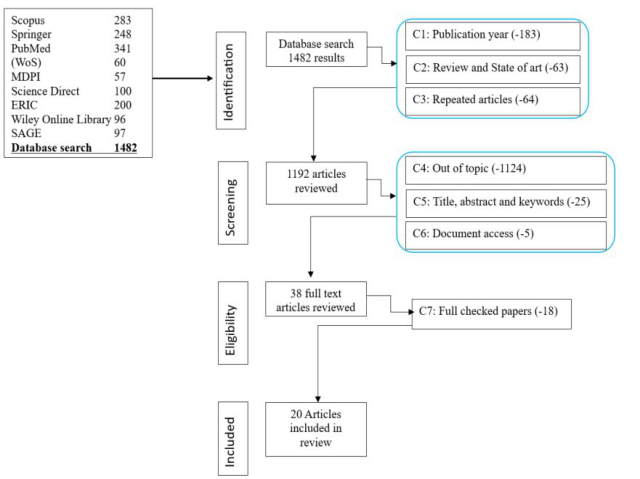
The prism flowchart helps us to discard information that is not related to the topic of study, leaving a total of 20 valid articles for the systematic review.
After having collected the number of scientific articles, we selected them by criteria, where C1: year of publication, C2: Review and state of the art, C3: Repeated articles, C4: Off-topic, C5: title, abstract, and keywords, C6: Access to documents (availability), C7: Full articles reviewed (see Figure 1).
In criterion 1 we selected articles from the year 2000 to the present, because before 2000 very little was known about DS and there were no game strategies contributing to this systematic review.
In criterion 2 we reviewed the state of the art that allows the study of the accumulated knowledge within the specific area.
In criterion 3 what we did was to remove from our general table the repe- ated articles, this study was done only by analyzing the titles of the articles obtained in each Platform.
In criterion 4, we reviewed the titles of the articles and eliminated those that were not related to the topic. However, if there are indications in the titles that there may be information related to the topic, they should not be eliminated.
In criterion 5, each article was searched, but not downloaded. For all articles it is possible to access the abstract and keywords. This should be reviewed for more accurate filtering. At this point we can already know if the remaining articles are related or not to the topic of study.
For criterion 6 it is necessary to download the articles and in this case only those to which access is not available are eliminated. This should be done after all download options have been tried.
In criterion 7, once we have the articles downloaded, we must review the document completely and identify that it is really valuable for our work. We mainly check that it has a clear methodology, results, discussion and conclusions.
Playful Strategies to Enhance Teaching-Learning and the Inclusion of Children 769
Figure 1: The prism flow chart helps us to discard information that is not related to the topic of study, leaving a total of 20 valid articles for the systematic review.
Results From the Point of View of Strategies, Methodology, and Materials The objective was to determine how these variables influence playful strate- gies, improvement of skills through games, and types of materials to work with and improve learning in children with DS.
Once the review by criteria is carried out, it is observed that the playful strategies are intended to be a harmonious learning environment and that it also helps counseling that allows the infant’s state of mind to be identified and proceeds through an intelligent system to deliver specific tasks aimed at improving the quality of life of children with DS and reduce the learning deficit that some of these children have, in addition to helping concentra- tion through the intervention of various games. The proposal of the playful environment as an aid to the treatment of infants with DS, has different alternatives such as recreational game strategies, strategies with tics, play- ful strategies of teaching games, affective strategies, organizational strategies, playful strategies of guided games, strategies playful learning games, etc. large that the child with DS makes with his arms, legs, feet, or his whole body and in turn help learning, among the most used games are the imagination of the teacher or parents who are with children with this disorder, initiative and symbolic games, an important game for teachers who have children with DS is dance, it is considered a playful strategy for learning as a game since it improves the quality of life of children since it presents encouraging results in the domains of functional capacity, vitality, mental health, physical and social aspects, and general health status.
The following subsections review the results obtained for e ach of the research questions.
1.- What are the ludic strategies used in children with Down Syndrome. The ludic strategy used in children with DS is the game within these use different methods and strategies for learning, these strategies serve to improve learning, the analysis also revealed that children with DS progressed along with a continuous therapy with the use of ludic strategies (da Cruz Netto, y otros, 2020).
Children with DS use mobile games, which was a solution found for their learning, as games promote intellectual, social and moral development, and it is the type of game they choose most often due to the fact that mobile is the most used platform for playing games nowadays. Mobile gaming helps to learn not only for people with Down syndrome but for all children because it improves children’s concentration and interest in handling it (Huffman, 2011). According to (Pelosi, 2020), he uses a playful strategy for teaching that consists of the methodology of collective case studies, and the research included the application of pre-test, intervention, and post-test. These stra- tegies are wearable to fluently read words with simple syllabic structures (consonant-vowel) of up to 4 syllables, such as “PIRULITO” (lollipop), and perform small text interpretations, with this word structure thus achieving better performance and learning in the children with DS.
A playful strategy used is the organizational strategy that according to (Hargreaves, Holton, Baxter, & Burgoyne, 2021) use the guardianship of people who live with them, to improve their learning use the collaboration of parents who perform dynamic games, manual games and pampering with the idea of integrating children to all the rights of education in their field of study, with these strategies it was found that students participated in most academic and social activities together with their peers.
Parents who have children with DS mostly chose to use literacy environ- ments based on play strategies and found that their children’s developmental levels improved, achieving some skills, especially literacy, at a higher rate than expected. Another important skill is reading improvement for this population (Junior, 2019).
Since the playful environment is intended to be a friendly and fun system using different play strategies such as mimes, puppets, etc., which allows to identify the mood of the infant and the interest in reading, this strategy helps to improve the quality of life. and reduce the level of disinterest of children with DS towards reading, another skill that is obtained with these strategies is the concentration and independence of the same is that they no longer always depend on their parents for the development of their school activities (Tsikinas, 2020).
Using the video games according to the claim of (Aguilar, 2019) proso- dic knowledge can be applied and used in the field of oral communication teaching with a video game-based learning approach, the video game-based learning approach is especially suitable for students with special needs since the video game, thanks to its particular characteristics, enhances the learning of soft skills such as psychomotricity, logical thinking.
Playful Strategies to Enhance Teaching-Learning and the Inclusion of Children 771
2.-What materials are commonly used to help in the learning process of children with DS: Within these materials, we have informative material where generally que- stion modules, tests, etc. are used. Digital and didactic materials, where we have serious games, digital games in the classroom, smartphones, drawings, and images. Informative material generally uses encyclopedic texts based on didactic content (Elvas, 2020).
According to Adorno, he says that the practice of dance helps children with DS to improve the mobility of their limbs and at the same time socialize with the different environments that surround them (Adorno ET, 2020).
For the independence of children with DS, the application of playful strategies that generate a positive change for their development with the implementation of oral hygiene techniques is used, in addition to different knowledge about structures of the oral cavity, oral hygiene implements, and healthy habits (Vargas-Ramírez, 2021).
For the learning process of children with DS in mathematics, games are used such as mathematics based on animated tasks, play shopping, etc., with these didactic games the teaching of mathematics pedagogy is guaranteed to students with SD but as the school year progresses, teachers improve playful strategies according to the support needs of children by changing acade- mic learning games and implementing other activities to curricular programs according to students’ learning progress (Faragher, 2021).
CONCLUSION
We can conclude that the objective proposed at the beginning has been sati- sfactorily achieved since we have collected several play strategies applied to children with DS, which facilitate the learning process.
Once the play strategies have been implemented in children with DS, it is important to emphasize that this process should be permanent and adapted to the study population, especially to children with more complications due to DS, so that they can improve learning, concentration, and socialization with the surrounding environment.
An effective ludic strategy is the inclusion of games in a virtual envi- ronment where they are designed with a pleasant and easy-to-use graphic interface; where they use plot mechanisms and interactivity, that is, they use characteristics that define the computerized game. This game environment favors children with DS the motivation, the desire to finish a task, creativity, knowledge sharing, and sharing plans and emotions with other children.
The first contact with a society that a child with Down syndrome has in the school, so it is important that the environment is appropriate and provides the necessary to overcome their physical and psychological difficulties because otherwise they cannot communicate and express what they feel.
Play strategies have proven to be useful in helping children with Down syndrome because they present alternative ways to encourage learning. Inno- vating the way children with Down syndrome are educated can help them develop further in the society in which they live so that they are not excluded.
Finally, we find it interesting to note that the strategies implemented along with their activities had positive results in teaching and learning. At the end of the systematic review, we found several activities that complement learning.
REFERENCES
Adorno, E. T., Dos Santos, D. C. de J., DeJesus, B. M., Passos, A. A., & Teixeira- Machado, L. (2021). Dance, functioning and quality of life in children with Down syndrome and autism spectrum disorder dance, functioning and quality of life in Down syndrome and autism spectrum disorder. Clinical Child Psychology and Psychiatry, 13591045211061796. https://doi.org/10.1177/13591045211061795 Aguilar, L. (2019). Learning prosody in a video game-based learning appro-
ach. Multimodal Technologies and Interaction, 3(3), 51. https://doi.org/10.3390/ mti3030051 Almendra, R. A., & Elvas, M. (2020). Inclusion of children with down syndrome through the creation and use of a “learning object.” In Advances in Intelligent Systems and Computing (pp. 292–300). Springer International Publishing Da Cruz Netto, O. L., Rodrigues, S. C. M., de Castro, M. V., da Silva, D. P.,
da Silva, R. R., de Souza, R. R. B., de Souza, A. A. F., & Bissaco, M. A. S. (2020). Memorization of daily routines by children with Down syndrome assi- sted by a playful virtual environment. Scientific Reports, 10(1), 3144. https: //doi.org/10.1038/s41598-020-60014-5 Faragher, R., & Clarke, B. (2016). Teacher identified professional learning needs to effectively include a child with down syndrome in primary mathematics: Profes- sional learning needs for primary mathematics. Journal of Policy and Practice in Intellectual Disabilities, 13(2), 132–141. https://doi.org/10.1111/jppi.12159 Fitzgerald, J., Lynch, J., Martin, A., & Cullen, B. (2021). Leading inclusive lear-
ning, teaching and assessment in post-primary schools in Ireland: Does provision mapping support an integrated, school-wide and systematic approach to Inclusive Special Education? Education Sciences, 11(4), 168. https://doi.org/10.3390/educ sci11040168 Hamm, E. M., Mistrett, S. G., & Ruffino, A. G. (2005). Play outcomes and satisfaction with toys and technology of young children with special needs. Journal of Special Education Technology: A Publication of Utah State University, the Associ- ation for Special Education Technology, and the Technology and Media Division of the Council for Exceptional Children, 21(1), 29–35. https://doi.org/10.1177/ 016264340602100103 Hargreaves, S., Holton, S., Baxter, R., & Burgoyne, K. (2021). Educational expe-
riences of pupils with Down syndrome in the UK. Research in Developmental Disabilities, 119(104115), 104115. https://doi.org/10.1016/j.ridd.2021.104115 Huffman, L. F., Bray, N. W., Fletcher, K. L., & Grupe, L. A. (2004). Similarities and differences in addition strategies of children with and without mental retar- dation. Education and Training in Developmental Disabilities, 39(4), 317–325. http://www.jstor.org/stable/23880211 Latorre-Cosculluela, C., Liesa-Orús, M., & Rivera-Torres, P. (2022). Opportunities
to learn for children with autism spectrum disorders: Effects of the percei- ved efficacy of teacher practices and drivers of inclusion. Focus on Autism and Other Developmental Disabilities, 37(2), 108–119. https://doi.org/10.1177/ 10883576211073692 Lopes, J. L., & Oliveira, C. R. (2021). Inclusive education in Portugal: Teachers’ professional development, working conditions, and instructional efficacy. Education Sciences, 11(4), 169. https://doi.org/10.3390/educsci11040169
Playful Strategies to Enhance Teaching-Learning and the Inclusion of Children 773
Nascimento, L. S., Martins, L. B., Villarouco, V., de Carvalho, W., & Junior, R. L.
(2019). Recommendations for the development of accessible games for peo- ple with down syndrome. In Advances in Intelligent Systems and Compu- ting (pp. 1712–1723). Springer International Publishing. Pelosi, M.B., Silva, R.M.P.da, Santos, G.dos, & Reis, N.H.(2018). Atividades Lúdicas para o Desenvolvimento da Linguagem Oral e Escrita para Crianças e Ado- lescentes com Síndrome de Down. Revista brasileira de educação especial, 24(4), 535–550. https://doi.org/10.1590/s1413-65382418000500005 Ricci, L. (2011). Home literacy environments, interest in reading and emergent
literacy skills of children with Down syndrome versus typical children: Home envi- ronment and emergent literacy in DS. Journal of Intellectual Disability Research: JIDR, 55(6), 596–609. https://doi.org/10.1111/j.~1365--2788.2011.01415.x Sheehy, K., Rix, J., Nind, M., & Simmons, K. (2004). Perspectives on inclusive education: learning from each other. Support for Learning, 19(3), 137–141. https://doi.org/10.1111/j.~0268--2141.2004.00336.x Starling, D. S. V., Moreira, B. F. T., & Jaeger, A. (2019). Retrieval pra- ctice as a learning strategy for individuals with Down syndrome A preliminary study. Dementia & Neuropsychologia, 13(1), 104–110. https://doi.org/10.1590/1980-57642018dn13-010012 Tsikinas, S., & Xinogalos, S. (2020). Towards a serious games design framework
for people with intellectual disability or autism spectrum disorder. Education and Information Technologies, 25(4), 3405–3423. https://doi.org/10.1007/s10639- 020-10124-4 Vargas-Ramírez, J., Cardona-Cañas, M. F., Rivera-Suárez, M. F., Guerrero-Jaramillo, A. N., Duque-Mejía, M., Ospina-Metheus, P. A., & García-Oyuela, A. F. (2021). Playful Environment as an Aid to the Treatment of ADHD in Times of Pande- mic. Hacia la promoción de la salud, 26(2), 23–37. https://doi.org/10.17151/hpsa l.2021.26.2.3 Zindler, R. (2009). Trouble in Paradise: A Study of who is Included in an Inclusion
Classroom. Teachers College Record (1970), 111(8), 1971–1996. https://doi.org/ 10.1177/016146810911100809
Read this individual research paper free through the original publisher, or explore the full digital proceedings book.
ISBN 978-1-958651-44-5
Explore this ISBN in the AHFE Bookstore ↗Listed in the July 2026 bookstore catalogue; search by ISBN to confirm current availability · Digital book purchase optional