Richard Paccha - Lapo, Luis Serpa-Andrade, Andres Viscaino - Quito, Roberto Garcia'Velez (2022). Methodological Proposal Based on the Use of Multisensory Technological Tools as a Contribution to the Motivation of Children With Intellectual Disabilities in the Educational Field. In: Human Interaction & Emerging Technologies (IHIET 2022): Artificial Intelligence & Future Applications. AHFE Open Access, vol. 68, pp. 475–484. https://doi.org/10.54941/ahfe1002767
Publisher statistics will load when you open Metrics.
AHFE OPEN ACCESS OPEN ACCESS CONFERENCE PROCEEDINGS PAPER
Methodological Proposal Based on the Use of Multisensory Technological Tools as a Contribution to the Motivation of Children With Intellectual Disabilities in the Educational Field
1 Research Group on Artificial Intelligence and Assistive Technologies – GIIATa Universidad Politécnica Salesiana, Cuenca, Ecuador; Research Group on Applied Embedded Hardware – GIHEA, Universidad Politécnica Salesiana, Cuenca, Ecuador ↗
2 Research Group on Artificial Intelligence and Assistive Technologies – GIIATa, Universidad Politécnica Salesiana, Cuenca, Ecuador ↗
The use of a multisensory tool through an adapted technological App is a proposal to work with a group of students who have unique personal characteristics but all with intellectual disabilities and who study in a Specialized Education Center; whose purpose is to improve motivation, by carrying out certain activities related to their learning, combating adverse effects that sometimes lead to a monotonous or traditional job. This research is quantitative. We started from a diagnosis for which we used observation logs, interviews with Teachers, and a survey of Legal Representatives, to determine the types of activities or games that motivate students; as well as the use and implementation of technology means that promote learning; which allowed the design of the respective App with its subsequent validation of the same by expert professionals and based on the results obtained by the intervention achieved in our sample population, denote that the use of this technological tool has positively influenced in achieving motivation in our students about the proposed activities. And that the use of this proposal can become very significant in its use in People with Intellectual Disabilities, since technology is global, our students can also benefit from it
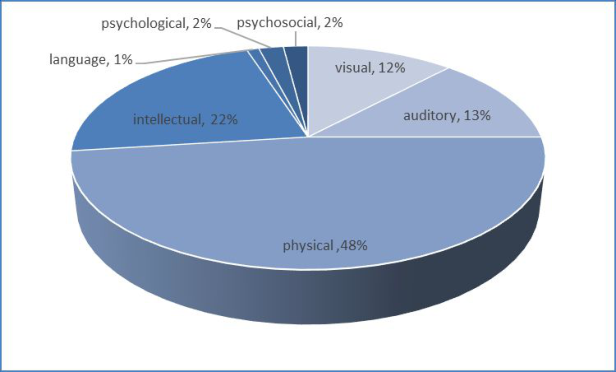
In our country there are approximately 401,508 people with disabilities, of which 33,067 are included in the national education system and specifically in Azuay there are 2,081 students enrolled. At a general level, disability can be classified as: moderate 19%, serious 26% and very serious 55%. Of the students who enter the institutions, Figure 1 shows the percentages of disability.
Figure 1: Percentages with disabilities according to type. Source: national registry of disabilities, ministry of public health of ecuador, August 2015.
We will consider first that in the educational field, motivation is described as the interest that the student has for his own learning or for the activities that lead to it and that it can be acquired, maintained, or increased by internal or external factors.
At present, in ordinary and specialized education there are different tech- nological devices that can be used as learning tools; There are several applications for these devices that tend to alternative and augmentative com- munication, multisensory agendas, teaching programs for reading, writing and calculation, serial games, story software, support for the recognition of emotions, among others and that promote motivation in the students to the achievement of activities. For this reason, the implementation of a multi- sensory technological tool through an App for motivation in students with intellectual disabilities and that improves their learning predisposition, will undoubtedly be an important support in the development of their general and functional skills.
The present proposal was carried out in a Specialized Education Center of the Canton of Gualaceo, in the province of Azuay; where the need for the implementation of a technological tool that can be applied to students with intellectual disabilities is seen; since the mimes basically handle technology, especially the cell phone, and that the App has a positive impact on their motivation when carrying out certain activities, which were done in a traditi- onal way, taking into account that the Institution does not have technological Tools or adapted technological App and that can be very useful to students.
In recent years, mobile applications have been a technological revolution. But what exactly are they? Under the acronym Apps, in English, these are computer tools designed to facilitate the execution of a specific task (personal, professional, commercial, educational, etc.), they have become allies for the person with disabilities and allow norm many aspects of your life (Fundación- ADECCO, 2017).
Methodological Proposal Based on the Use of Multisensory Technological Tools 477
In the first instance of the proposal, it is based on the diagnosis through techniques and instruments: such as direct observation, observation logs, surveys of PPFF or Representatives, and interviews with Teachers and The- rapists; data that will serve as a basis to determine their motivating activities, preferential activities and their needs; as well as basic use of common technological means.
After that, the diagnostic data is shown, with the design of the multisen- sory technological tool or adapted Apps; which was developed in order to promote openness or motivation to activities from a technological version than a traditional one, considering that it has software that is easy to use and apply so that its methodology is equally simple and consistent with our sample.
And a last instance after the application, the respective validation is indi- cated; same that was presented to experts; whose purpose was, to have the respective observations and suggestions for the intervention and arrive at the results obtained; same that was satisfactory in a general way in our case stu- dies, pointing out that the use of these means is very useful and necessary also in the population with intellectual disabilities for their motivation, knowledge and gradual progress.
RELATED WORKS Learning based on digital games such as role-playing games, and playful games according to (Breien & Wasson, 2021) generates positive effects on motivation and learning. One of the important features of digital games is their design as it influences the desired results in order to examine the relationship it has with learning.
The use of conventional learning methods leads students to have a lear- ning deficit according to (Anastasiadis et al., 2018). They seek to generate learning through attention. With the growth of technology and the popula- rity of digital games, attractive experiences can be offered, and interactive environments improve attention and learning procedures. It should also be noted that such work promotes educational environments to gradually tran- smit concepts and lead a student towards a final goal. The motivation for this revealed that introverted children were slightly motivated and the possibility of opening up to games in collaborative environments.
Teachers opt for new methods and tools to reach their students as indi- cated in (Ojeda et al., 2020). The use of ICTs as a means to present digital games helps the learning process and creates an environment that stimulates students, capturing their interest and motivating them. As a result, a high level of motivation is evidenced in children from the beginning to the end of the activities of digital games and it is concluded that games and learning are linked.
Video games and playful simulations are cataloged as didactic tools that favor learning as indicated in (Herrero Vázquez et al., 2020), it is important and necessary to previously evaluate each game developed, identifying the content, strategies, skills, and competencies that can be developed, contribu- ting to the construction of didactic and playful dimensions. Methodologies
based on digital games ensure that the use of video games can help optimize teaching and learning processes in areas of study.
With the increase of mobile devices in the market, a technological era began, said in (Casañ Pitarch, 2019), thus resulting in innovation, which has undergone changes in communication, social relations, and education. These digital tools bring a new learning method with the creation of digital games where contextually in the area of pedagogy, technological improvement has developed new dimensions in terms of the fusion of games and teaching in foreign languages, suggesting that video games bring benefits pedagogical where teachers have the facility to use resources improving the application method and timing.
The use of digital tools such as Kahoot is described in (Rojas Viteri et al., 2021). It is a motivating element for the teaching and learning process that uses an empirical-analytical methodology of descriptive cuts that provides results where it is revealed that the students participating in the project were more motivated in the learning process, encouraging them to participate more actively.
The learning process can also be improved by knowing the behavior of children when they are doing homework. (Berrezueta-Guzman et al., 2020) (López-Pérez et al., 2020) and (Dolón-Poza et al., 2020) present a smarth- ome development to support children with ADHD. The results of a pilot experiment carried out by (Berrezueta-Guzman, Pau, et al., 2021) show how the performance improves whit this system instead of the traditional way. Another analysis carried out by (Berrezueta-Guzman, Robles-Bykbaev, et al., 2021) that compares this system with related work, shows that it is necessary to apply the technology to support learning processes.
METHODOLOGY
Regarding the methodological part, quantitative research was carried out, since a sample of students will be used to statistically show achievements; with a correlational scope, since we are going to look for predictions based on our problem, of how it influences the motivation of students when using a multisensory tool or App in their learning. With an inclusive approach, basic technology can also be used in students with disabilities, and partici- pants in a community. Direct and indirect observation will be used as a tool, for which an observation log was made, in which he informed us about the preferences and activities carried out by the child during the therapy session, where pleasure and attention in preferred activities, for example joining dots, parts of the body, painting, graphics of emotions, unlike activities of greater complexity, however those were monotonous or boring when carried out at a traditional level (on sheets, with drawing, painting, cutting, glued and others).
On the other hand, a semi-structured interview was conducted with teach- ers and therapists (7) in order to determine the importance of motivation in learning processes, as well as the knowledge and use of technological Apps or multisensory tools.
Methodological Proposal Based on the Use of Multisensory Technological Tools 479
A survey was also made to the PPFF or representatives (5) with the aim of knowing about the use of electronic or cellular media as well as technological apps and their benefit in the motivation and learning of their children.
A multisensory tool will be made, an App whose methodological part is based on an easy access and tactile manipulation Software that consists of images, objects for attention and discrimination, audio files, signals for emo- tions, sound effects in the resolution of various activities as games; that allow the student and therapist to interact. It can be installed on any cell phone, as a more accessible medium, as well as on a tablet or computer. Carried out in order to improve motivation in the resolution of activities that can be develo- ped. The sample has been selected in a group of 5 children who worked in a traditional way in the first instance and later the application of the App was used, with the respective consents. The sample has been selected in students of various levels, since the problem was common. All students have intelle- ctual disabilities, with ages ranging from 8 to 14 years of chronological age and corresponding from fourth to ninth levels of Basic Functional General Education.
The proposal was validated by a Professor at the Salesian Polytechnic Uni- versity, as well as the Artificial Intelligence and Assistive Technology Research Group (GI-IATA of the Salesian Polytechnic University).
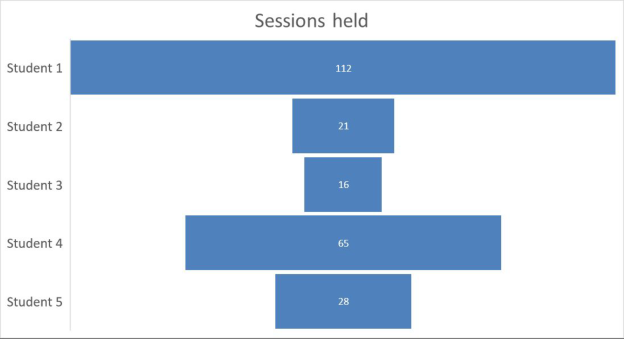
It confirmed that the multisensory tool, a technological App adapted both at a technological and methodological level, responds positively to an improvement in the motivation of the different activities developed in the participating students. It was confirmed that the number of sessions perfor- med was high and very high in one case; sessions that could hardly have been achieved at face-to-face level; Since the App was initially intended to be deve- loped in physical interaction between students and professional researchers, although due to sporadic and gradual assistance from the students partici- pating in the study, it was carried out from their homes with the support of their parents at the time of entering the system. It was possible to verify that the more income in the activities of interest, the greater the motivation, and it was even demonstrated by the less time that the students spent in the chosen activity, also denoting the activities or games of greater pleasure as those of displeasure, due to little income or scores obtained in said activity. The cri- teria that were evaluated were: Accessibility, Predisposition and motivation; understanding of slogans, attentional periods, learning channels and solution of activities.
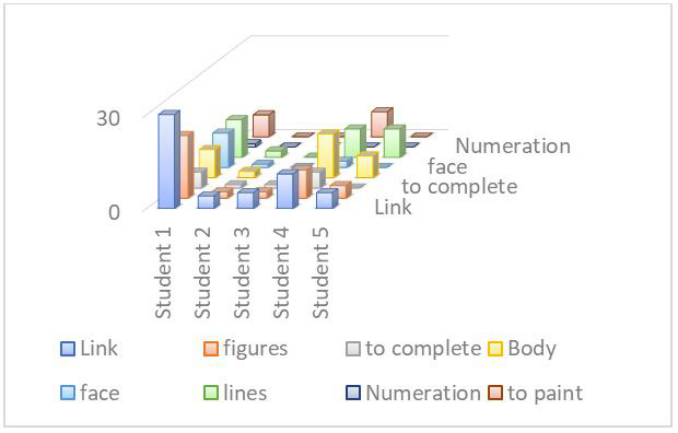
Among the activities carried out, we can make known which activities are the ones that attract the attention of the children.
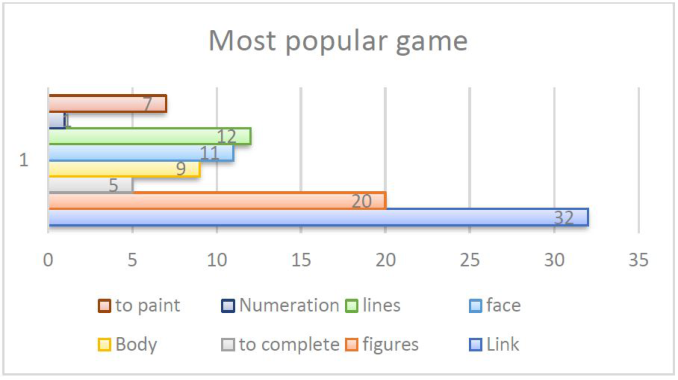
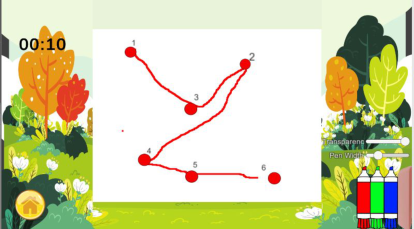
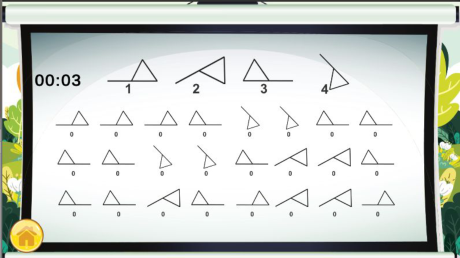
As we can see in Figure 3, the game that was most popular is the activity in which the patterns must be joined and form a figure, and the least popular activity is numbering, which is a little more difficult to do it.
With what is obtained, we will indicate that the most popular game has previous knowledge of the sample group as a background, even considering that the union of points with the formation of free or specific figures is an ini- tial base or predecessor to many learnings and that despite the fact that each case is unique or specific; It is also a group that has tried throughout student time to stimulate knowledge in basic numbers, not only with memorization,
Figure 2: Sessions held for students.Figure 3: Game with the most acceptance among the activities.
but also with recognition, with previous work in traditional activities and even with playful activities in wide and limited spaces, activities of punch- ing, painted pasting, how of association and discrimination, also of basic counting for daily activities, for which it is ensured that it has been a process of chaining and of greater pleasure to our students, without neglecting the visual, auditory and kinesthetic with their fingers and that has allowed them to use and work with the designed App.
While in the less popular game, based on what was obtained in our sample group; that despite having previously worked in a traditional way with stu- dents and having the attractiveness of the audiovisual and kinesthetic aspects of the App used; we can assume that the time to complete the game or task has been somewhat short, despite the fact that there was extra time to complete the activity in the App; we can also consider certain difficulties of selective attention and visuomanual discrimination in certain students when it comes
Methodological Proposal Based on the Use of Multisensory Technological Tools 481
Figure 4: View of the game with the most reception.Figure 5: View of the game with less reception.
to finding or associating the figure with the correct number; so perhaps the selection of other figures of less complexity but that also promote learning with association, could be a better alternative; considering that the figures selected in the App were taken as a degree of complexity, so they could vary in favor of learning with motivation in the students.
With what has been exposed and observed in Figure 3. We can say that the use of the App in the five students with intellectual disabilities has had a positive impact on motivation, regarding the solution of games and learning activities proposed; being an important contribution to improve motivation in students.
Parents and educators can select different programs or apps, appropriate to their ages, and interests and anchored in educational values. Thus, they are more likely to find the right answer than in the physical world, receiving positive reinforcement that increases interest in the app. This fact makes apps
Figure 6: Speed table.
an object of interest for parents and educators (Rugel Caicedo & Benedictis Zambrano, 2015).
As part of the results we say that global has been favorable; since all stu- dents showed predisposition and openness to work with the technological App implemented and applied to our students; unlike working traditionally; however, there was a student with lower income to the system; that obviously the results of it were not entirely satisfactory in solving the proposed activi- ties and it could even suggest other types of activities of less complexity for general and equitable progress; although, without a doubt, the individual dif- ferences of each subject and external factors that did not allow better results will have to be taken into account. However, the use of the technological tool is of greater interest in the motivation of their learning. Consider that today the use of multisensory tools, digital technologies or Apps aimed at a specific purpose such as learning, is even more entertaining for students due to all the technological elements that involve the use of these tools; unlike presenting content in a traditional way, which is certainly not bad or out of date; but rather, highlight the complement with other strategies that can also serve and benefit the population with intellectual disabilities in favor of learning.
CONCLUSION
We can conclude that the use of the multisensory tool through the APP implemented and applied to our case studies gave a positive scope of results due to the motivation they achieved in the different games and/or activi- ties proposed; same that also managed to stimulate their attention, slogans, discrimination, reasoning and knowledge through this positive means of learning.
Methodological Proposal Based on the Use of Multisensory Technological Tools 483
Considering that initially a diagnosis was made through observation logs, an interview aimed at teachers and therapists; as well as a survey to the PPFF or representatives to determine their motivating activities and use of technological means that help their learning.
Regarding the research question, how does the use of technological tools favor the learning motivation of students with intellectual disabilities? The general result is positive; since the predisposition and motivation of activities is greater than to carry them out traditionally, verifying that the App both at a technological and methodological level is very viable to work with our sample population. Same that can be evidenced with the validation carried out by experts, where the implementation and application of the designed App has been easily accessible and feasible development in its activities, becoming an innovative and strategic tool to work at an educational level.
Concluding that today science and technology advance inexorably and a well-used technology leads to great benefits. For this reason, the imple- mentation, application and perhaps subsequent generalization could generate great changes both at the motivational level and in the acquisition of kno- wledge; taking into account that the population with intellectual disabilities also needs to incorporate new technologies into their learning and that they serve as a strategic and motivational means in the acquisition of knowledge and improvements in their quality of life, how their intervention and general developments.
REFERENCES
Anastasiadis, T., Lampropoulos, G., & Siakas, K. (2018). Digital game-based learning and serious games in education. International Journal of Advances in Scientific Research and Engineering, 4(12), 139–144. Berrezueta-Guzman, J., Pau, I., Martín-Ruiz, M.-L., & Máximo-Bocanegra, N.
(2020). Smart-home environment to support homework activities for children. IEEE Access, 8, 160251–160267. Berrezueta-Guzman, J., Pau, I., Martín-Ruiz, M.-L., & Máximo-Bocanegra, N.
(2021). Assessment of a robotic assistant for supporting homework activities of children with ADHD. IEEE Access, 9, 93450–93465. Berrezueta-Guzman, J., Robles-Bykbaev, V., Pau, I., Pesántez-Avilés, F., & Martín- Ruiz, M.-L. (2021). Robotic Technologies in ADHD Care: Literature Review. IEEE Access. Breien, F. S., & Wasson, B. (2021). Narrative categorization in digital game-based
learning: Engagement, motivation & learning. British Journal of Educational Technology, 52(1), 91–111. Casañ Pitarch, R. (2019). Principios pedagógicos en la adquisición de lenguas extranjeras mediante el enfoque basado en juegos digitales. Tonos Digital, 37(0). Dolón-Poza, M., Berrezueta-Guzman, J., & Martín-Ruiz, M.-L. (2020). Creation
of an intelligent system to support the therapy process in children with ADHD. Conference on Information and Communication Technologies of Ecuador. Fundación-ADECCO. (2017). Un 60% de las personas con discapacidad ya utiliza Apps específicas para facilitar las tareas de su vida cotidiana. https://fundacionadecco.org/notas-de-prensa/las-personas-discapacidad-apps- especificas-facilitar-sus-tareas/
Herrero Vázquez, M., Torralba Burrial, A., & Moral Pérez, M. E. d. (2020). Revisión de investigaciones sobre el uso de juegos digitales en la enseñanza de las ciencias de la vida en primaria y secundaria. Enseñanza de las Ciencias, 38. López-Pérez, L., Berrezueta-Guzman, J., & Martín-Ruiz, M.-L. (2020). Development
of a home accompaniment system providing homework assistance for children with ADHD. Conference on Information and Communication Technologies of Ecuador. Ojeda, M. J. C., Herrera, D. G. G., Mediavilla, C. M. Á., & Álvarez, J. C. E. (2020). El juego como motivación en el proceso de enseñanza aprendizaje del niño. Revista Arbitrada Interdisciplinaria Koinonía, 5(1), 430–448. Rojas Viteri, J., Álvarez Zurita, A., & Bracero Huertas, D. (2021). Uso de Kahoot
como elemento motivador en el proceso enseñanza-aprendizaje. Rugel Caicedo, M. M., & Benedictis Zambrano, D. C. (2015). Desarrollo de aplicación para móviles dirigido a padres de familia y parvularias como herramienta para promover, difundir y ofrecer una guía de alimentación sana para niños de 0-3 años de edad, que asisten a la Guardería" Kids House" de la ciudad de Guayaquil.
Read this individual research paper free through the original publisher, or explore the full digital proceedings book.
ISBN 978-1-958651-44-5
Explore this ISBN in the AHFE Bookstore ↗Listed in the July 2026 bookstore catalogue; search by ISBN to confirm current availability · Digital book purchase optional