Lucas Paletta, Michael Schneeberger, Martin Pszeida, Jochen Mosbacher, Florian Haid, Julia Tschuden, Herwig Zeiner (2024). Resilience Scores from Wearable Biosignal Sensors for Decision Support of Worker Allocation in Production. In: Cognitive Computing and Internet of Things. AHFE Open Access, vol. 124, pp. 155–165. https://doi.org/10.54941/ahfe1004713
Mental health and well-being have to be considered on an equal footing when designing digitalized workplaces in production. We present the configuration of selected wearable sensor technologies together with the architecture of the Intelligent Sensor Box to enable monitoring resilience scores at the production site. The wearables include a Garmin vivosmart 5 fitness tracker to provide cardiovascular data, the greenTEG CORE body temperature sensor, Pupil Labs Neon eye tracking glasses and an optional sanSirro QUS smart shirt with textile biosignal measurements of vital parameters. We provide a framework to integrate a sequence of daily strain scores within a pre-determined time window of a preceding working period, and finally integrate this into a current resilience score. We present the estimation of the daily strain score based on the wearable sensing data that were captured in the Human Factors Lab in Austria during activities that are characteristic for the car production workplace. Furthermore, we demonstrate how resilience scores would impact the decision-making in the use case of daily dynamic worker allocation.
Sustainability, human-centricity, and resilience are the hallmark features of Industry 5.0 (European Commission, 2020). The worker is not to be con- sidered as a ‘cost’, but rather as an ‘investment’ position for the company, allowing both the company and the worker to develop. This implies that the employer is interested in investing in skills, capabilities, and the well-being of its employees, to attain its objectives. Mental health and well-being must be considered on an equal footing when designing digitalized workplaces. While there are new risks associated with digitized ways of working, such as the risk of burnout due to the always-online and always-available work- ing culture, digital technologies could be used to support workers in better controlling and managing the risks and impact of the new working environ- ment on their mental health and well-being. Digital solutions and wearables could open new channels for alerting workers and their general practitioners
about critical health conditions, both physiological and mental. They could also support workers in adopting healthy behaviors in the workplace. This is moreover likely to bring economic benefits and savings due to productivity gains and avoidance of accidents, long-term illness, and absenteeism.
The European project FAIRWork (Paletta et al., 2023) brings human, AI, data, and robots together by supporting decision-makers in making decisions thus positively affecting the work balance between workers and machines. One key aspect for the daily decision-making on worker allocation in pro- duction processes is to consider the resilience of individual workers in the context of fostering well-being and avoiding illness and absences.
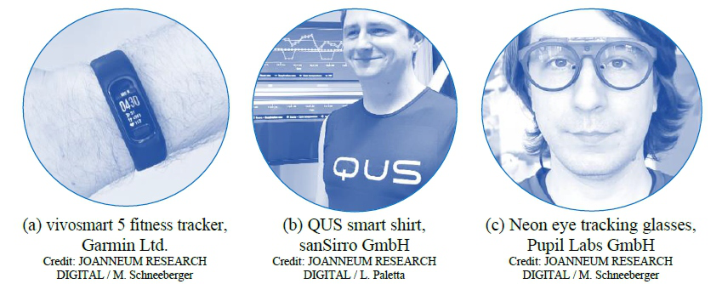
Figure 1: Wearable biosignal sensor technologies proposed to be applied in the pro- duction environment for studies and daily monitoring: (a) fitness tracker and (b) smart shirt for recording cardiovascular data, and (c) eye tracking glasses for cognition data.
Psychological resilience is a meaningful adaptation in persons’ psycho- logical traits and experiences that allows them to regain or remain in a healthy mental state during crises without long-term negative consequences (Southwick et al., 2014). Resilience has shown that it plays a crucial role in promoting mental health and well-being: resilient people are better equipped to navigate situational challenges, maintain positive emotion and motivation, and recover from setbacks. They demonstrate higher levels of self-efficacy, optimism, and problem-solving skills, which contribute to their ability to adapt and thrive in adverse situations.
The architectural construct of the Intelligent Sensor Box (ISB; Paletta et al., 2023) enables the measurement of worker’s physiological strain and psy- chological stress while performing tasks and provides information about the workers estimated resilience. It consists of a framework for a set of stationary and wearable sensors, AI-based analytics for assessment and opti- mization functions. It can be applied to evaluate the ergonomics and design of industrial training and work environments.
We present the concrete development of a set of wearable sensor tech- nologies together with the ISB dedicated software architecture that enables monitoring and analysis to study resilience scores at the production site. The wearables include a “Garmin vivosmart 5” fitness tracker to provide heart
Resilience Scores From Wearable Biosignal Sensors for Decision Support 157
rate (HR) and heart rate variability (HRV), the greenTEG “CORE” body temperature sensor to be attached to the chest, Pupil Labs “Neon” eye track- ing glasses to provide eye tracking data with 200 Hz sampling rate, and optionally a “QUS” biosignal shirt of sanSirro GmbH for measuring HR, HRV and breathing rate. The raw data are interpreted to provide the esti- mated Physiological Strain Index (PSI; Moran et al., 1998) and a heuristic cognitive-emotional stress score. The raw data and processed features can be monitored in a dashboard for human experts’ decision-making either for research or at the production site.
We present an early prototype version that estimates a daily strain score based on sensing data that were captured in the Human Factors Lab in Austria during exercises intended to mimic characteristic activities in an auto- motive production workplace. Furthermore, we demonstrate how resilience scores would impact the decision-making in the use case of daily dynamic worker allocation.
RELATED WORK
Work-related stress usually occurs when the demand exceeds the worker’s capacity to perform (Wegner, 1988). Exposure to stress has been shown to be related to adverse effects in the way people feel, think, and behave (Griffiths, 1995), and generally, it is demonstrated to have psychological consequences on workers, such as, states of anxiety and frustration (Brunzini et al., 2021). At the physiological level, it can alter vital processes, such as heart and breathing activity, whereas from the physical point of view, it affects nat- ural posture and body activity (Brunzini et al., 2021). Industry 5.0, as a new human-centered perspective, puts human workers at the center of production processes and ensures that technology adapts to their requirements (Yeow et al., 2014). However, stress has further consequences on production activ- ity due to the positive correlation with errors and periods of distraction at work, reducing the quality and performance of the worker (Zizic et al., 2022) and leading to new costs and losses for companies.
Blandino (2023) provides a review on the measurement technologies on stress in smart and intelligent manufacturing systems. This review identifies and summarizes a growing body of literature that recognizes the importance of human-centered manufacturing systems (Wang et al., 2020; Nguyen et al., 2022) and the consequent human factors, especially workload, physical and mental fatigue (Villani et al., 2019), ergonomics (e.g., Stefana et al., 2022) and related indicators (Argyle et al., 2021; Digiesi et al., 2020). From the psychological perspective, studies review traditional standard questionnaires in order to adapt them to new manufacturing contexts. For example, Lesage et al. (2012) focused on the properties of the Perceived Stress Scale. On the physiological perspective, the literature includes significant studies (Leone et al., 2020) proposing a multi-sensor platform to monitor stress in man- ufacturing contexts. Han et al. (2017) designed a wearable device for the detection of work-related stress; and that of Setz et al. (2009) who described a wearable device for discriminating the phenomenon of stress from the cog- nitive load. On the other hand, Khamaisi et al. (2022) proposed strategies
for identifying potential causes of stress for workers, which may be induced by collaboration with robots, as explored by Arai et al. (2010). deVries et al. (2019) presented a framework for the integration of stress and resilience of employees that was initially based on questionnaires, ecological momentary assessment (EMA) as well as wearable monitoring. In this wider context, Dunghana et al. (2021) presented a concept for flexible production planning that incorporates human workers and investigates different scenarios of task allocation between humans and machines and their impact on production workflows.
One of the rare research works on wearable sensing of stress and resilience was provided by Adler et al. (2021) in which a system was created to find indicators of resilience using passive wearable sensors (Fitbit armband) and smartphone-delivered EMA. This system that was specialized on the workplace of care professionals (resident physicians) identified resilience indicators associated with physical activity (step count), sleeping behavior, reduced heart rate, increased mood, and reduced mood variability.
The innovative contribution in the FAIRWork project focusses on the esti- mation of human resilience as a functional of stress monitoring, especially in the industrial environment of the specified use cases (e.g., worker allocation). In this context, we present an initial stage of a complete model on resilience. This model would be extended based on further research on wearable sensor data and digital Human Factors analytics. Furthermore, this model would include additional sensors, such as, a smart shirt as well as eye tracking glasses, for further refinement based on multisensory-based assessment of resilience scoring.
DECISION SUPPORT FOR WORKER ALLOCATION The process of workload balance is triggered by an event which makes an allocation or reallocation of workers necessary (e.g., planning the weekly production, a change in the production lines etc.). The start event is followed by two parallel tasks, where one concerns availability of the operators and the other the production plan. Before assigning people to certain lines or positions, their availability, their capabilities and ideally also their preference need to be checked by accessing a database. Capabilities of operators include their resilience status, among other data, such as, passed trainings, skills, and medical conditions. After all input data is collected, the allocation of workers is done in two stages, where both stages should be supported by the decision support system. In the first stage, possible allocation scenarios are identified, considering the competence and availability of the workers. From all iden- tified scenarios it needs to be checked which of them are feasible. Feasible scenarios should be able to reach the daily production goal, should respect product quality, and are realizable in terms of machine and resource capac- ities. The best fitting solution is chosen and may include minor adjustments to fit the workers preferences and priorities, as this is the main goal in this use case scenario. If an optimal solution is found the result is hand over to production.
Resilience Scores From Wearable Biosignal Sensors for Decision Support 159
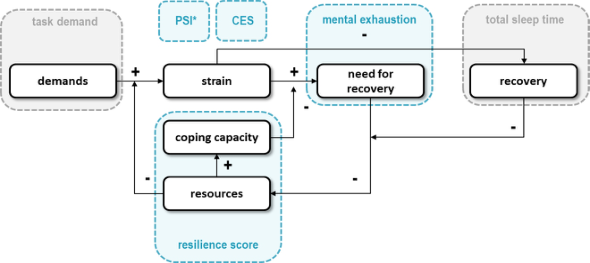
RESILIENCE SCORE COMPUTING The conceptual framework of the resilience risk stratification model (RRSM) is presented in Figure 1. It illustrates our hypotheses on how the accumula- tion of the negative consequences of stress has a cyclical nature and how it can contribute to a loss spiral. This framework is based on the Trans- actional Model of Stress and Coping (Lazarus & Folkman, 1987), the Job Demands-Resources Model of Burnout (Bakker & Demerouti, 2007), the Effort-Recovery Model (van Veldhoven, 2008) and the Conservation of Resources Theory (Hobfoll, 2001), as well as the WearMe project (deVries et al., 2019).
Psychophysiological strain accumulates when (job) demands, such as time pressure or physical workload are appraised as a threat due to inefficient available resources to adaptively cope with them (Lazarus & Folkman, 1987).
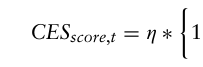
In our proposed work on RRSM, we are estimating the Physiological Strain Index (PSI) as well as the Cognitive-Emotional Strain Score (CES, Haid et al., 2024). The workload of a worker is estimated using a heuristically defined measure, as follows,
,
Equation reproduced from the original PDF.
1 − HRVt −HRVmin HRVmax −HRVmin
+ HRt −HRmin HRmax −HRmin
+ Tskin,t −Tskin,min Tskin, max −Tskin,min
Equation reproduced from the original PDF.
Based on the threat of fundamental strain, an individual’s need for recov- ery, characterized by feelings of exhaustion and reduced vigor to undertake new activities, depends on the individual’s ability to utilize the available resources to adaptively cope with the demands (Lazarus & Folkman, 1987; Bakker & Demerouti, 2007). A high need for recovery (i.e., little vigor to undertake activities) has a negative impact on an individual’s resources to appraise and cope with new demands, such as, a demanding work that should be allocated to workers. However, recovery may counteract and alleviate this effect (van Veldhoven, 2008).
In our specific RRSM model, we model a measure of mental exhaustion in terms of the daily total strain score as a function of data from wearable sensors and PSI- and CES-oriented data analytics (Figure 1). The accumulat- ing effect of mental exhaustion is then represented by another functional that integrates daily score contributions within a predefined extent of recency. The resilience score that would represent the risk stratification, as it is modelled at this stage, is then further outlined by an inverse function of the mental exhaustion. This score implicitly represents an orientation of the long-term resilience dynamics rather than a short-term construct.
The RRSM framework also includes a cyclical nature that is supported by the Conservation of Resources theory (Hobfoll, 2001), which states that initial loss of resources increases one’s vulnerability to stress. Since addi- tional resources are necessary to battle stress, this may lead to a depletion of resources or a loss spiral. The motivation of the development of this RRSM framework is to prevent this loss spiral for the benefit of the worker as well as the economic impact of the manufacturing company.
Figure 2: Modelling wearable-based measurements and resilience scores into the worker’s resilience risk stratification model (RRSM) that is based on the transactional model of stress and coping (Lazarus & Folkman, 1987), job demands-resources model of burnout (Bakker & Demerouti, 2007), effort-recovery model (Van Veldhoven, 2008), conservation of resources theory (Hobfoll, 2001), and the conceptual framework for employee‘s resilience (de Vries et al., 2019).
The resilience risk stratification is of central importance for the allocation of workers for specifically stressful work. Persistent stressful work can have an impact on the mental exhaustion, and this is an important parameter for the overall resilience risk stratification as a key objective in the work of Dig- ital Human Factors Analytics. The resilience score would indicate levels of risks for decision support to the manager that assigns work to workers and can have an important impact on the complete economic situation of the manufacturing company. Finally, these scores can provide a relevant input to optimization routines that would provide higher long-term benefits to the worker, to the company and ecologically relevant aspects.
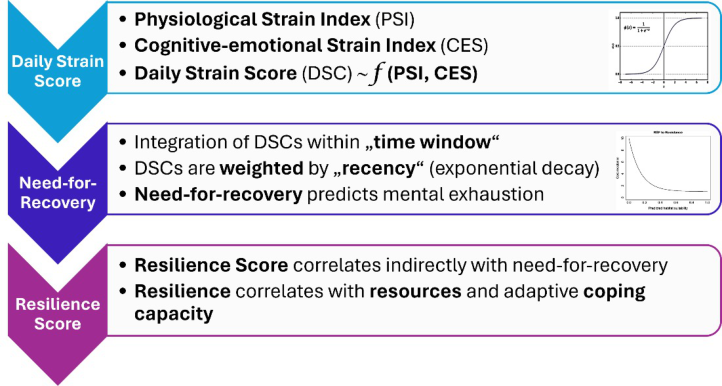
Figure 3: Stages of the computation of the resilience score that underlies the resilience risk stratification model (RRSM).
Resilience Scores From Wearable Biosignal Sensors for Decision Support 161
RESILIENCE MONITORING
Figure 2 represents the major processing stages of the resilience risk strati- fication model. In the first stage, the Daily Strain Score (DSC) is produced. This score integrates contributions from the Physiological Strain Index (PSI) as well as from the Cognitive-Emotional Stress (CES) score (Haid et al., 2024) into an integrated quantity, i.e., DSC(n) for each individual day n. The integrated input to DSC(n) is normalized by the Sigmoid function.
In a next processing step, the individual components DSC(n) of each day within a pre-defined time window, exemplary n = 20 working days, are inte- grated being weighted by recency, downscaling all contributions of DSC(n) with an exponential decay function with a time constant τ. We then build a weighted and normalized sum from these weighted contributions for each day. This quantity eventually represents an equivalent of a score for aspects of mental exhaustion or the “need for recovery” (NFR).
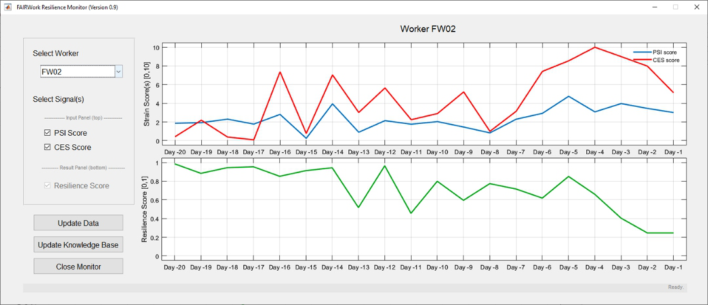
Figure 4: Resilience monitor with GUI for the estimation of resilience scores (profile, bottom) from physiological and cognitive-emotional strain computation (profiles, top).
Finally, the “resilience score” (RS) is computed, in a first degree of estima- tion, as RS = 1.0-NFR. RS represents the resources that would be reduced by the size of the NFR outcome by a linear scale. Resilience risk stratification will be provided by means of pre-defined thresholds that will be determined in a future field study concerning input of experts from the industry and from health psychology.
Figure 3 represents the “Resilience Monitor”as a component that provides a visualization of the time course of various types of strain synchronized with the resilience score. The diagram extends from a pre-selected day for decision- making to a time window of recency with a pre-defined number of working days, neglecting so far rehabilitation periods, such as, weekends and vacation. In this first stage of the development, we selected a time window of n = 20 working days.
In Figure 3, the top sub-window represents a sample time course of PSI and CES scores, for an exemplary decrease in both strain scores. Conversely, the resilience score is visualized to increase with a certain inertia and delay.
The individual quantities of PSI and CES that are associated with each day are each computed to represent the physiological and cognitive-emotional strain, respectively, of a single day. The calculation of this single representa- tive quantity is on-going research, however, in a first degree of estimation, we are using mean descriptors of the PSI as well as the CES score, respec- tively, from measurements of experimental work within time intervals of ca. 30 minutes. Figure 3 provides a characteristic example of the generation of PSI and CES scores in the JR Human Factors Lab, Graz, Austria. The result- ing strain scores of limited-time experimental sessions are finally mapped to a Daily Score (i.e., DSC(n)) of a specific day n, representing input data for the computation of the resilience score.
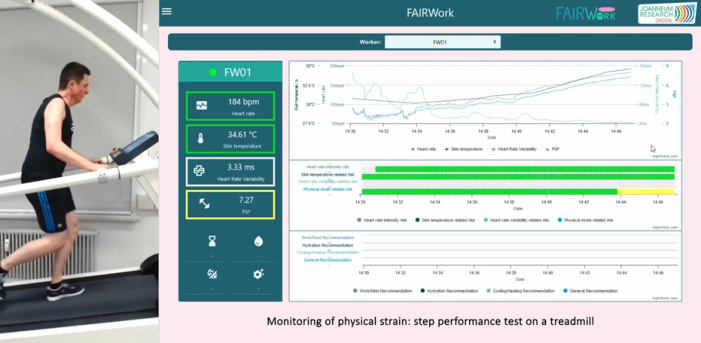
Figure 5: Monitor for the visualization of vital data synchronized in real-time. The dashboard to the right shows the time course of raw/processed data (top), risk lev- els in semaphore-like color code (mid) and recommendations for contingency actions (below).
Figure 4 shows an expert-oriented monitor for the visualization of vital data synchronized in real-time with the physical activity on the treadmill (left) that causes physiological strain.
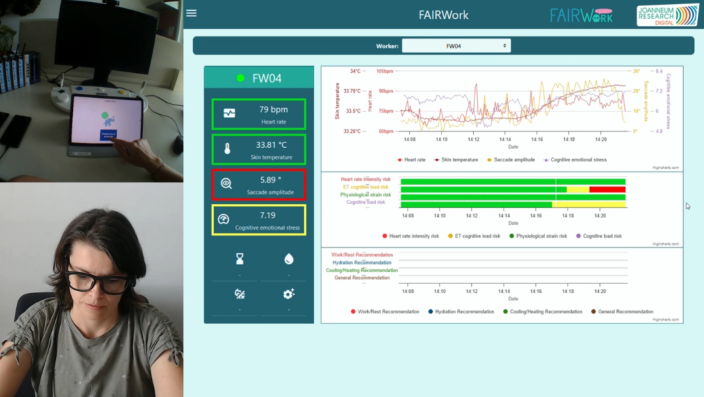
Figure 5 demonstrates another specialized monitor for the visualization of vital data synchronized in real-time with the cognitive-emotional strain expe- rienced during a cognitive task (left), with gaze data (green point) within the scene. With eye tracking glasses, additional psychophysiological infor- mation can be investigated via the analysis of eye movement features. In first explorative studies on cognitive-emotional strain we involved the participant into a challenging cognitive load task, i.e., the n-back task (Kirchner, 1958; Jaeggi et al., 2003) that requires excellent short-term memory to appropri- ately react in time to a sequence of images presented to the operator. The psychophysiological response to this task is monitored being synchronized with the video of the participant in action (see Figure 5), as well synchro- nized with the video of the egocentric camera oriented towards the screen with gaze visualization in real time. In the monitoring dashboard, real-time raw data output of skin temperature, heart rate, eye tracking based cognitive
Resilience Scores From Wearable Biosignal Sensors for Decision Support 163
load score, with a resulting metadata stream represented by a so-far heuris- tic index for cognitive-emotional strain. below again the synchronized risk stratification in traffic light-based color coding.
Figure 6: Monitor for the visualization of vital data synchronized in real-time with the cognitive-emotional strain experienced during a cognitive task (left), with gaze data (green point) within the scene. The dashboard to the right shows the time course of raw and processed data (top), risk levels in traffic light-based color coding (mid) and recommendations for contingency actions (below).
CONCLUSION AND FUTURE WORK This work proposed a complete framework for the integration of wear- able biosignal sensor information into a resilience stratification. A major long-term application in the production environment is to prevent sickness, absenteeism, and at the same time, improve motivation and well-being for the company. The focus of this first prototype is on the representation of the time course of resilience; more refined representations of strain at the work- place and rehabilitation, such as, considering weekends and vacation, will be outlined in the future.
ACKNOWLEDGMENT
This work was funded in part from the project FAIRWork (grant No 101069499) of the Horizon Europe research and innovation program of the European Commission.
REFERENCES
Adler, D. A., Tseng, V. W., Qi, G., Scarpa, J., Sen, S., and Choudhury, T. (2021).
Identifying Mobile Sensing Indicators of Stress-Resilience. Proc. ACM Interact Mob. Wearable Ubiquitous Technol. 2021, 5(2):51. doi: 10.1145/3463528.
Arai, T., Kato, R., and Fujita, M. (2010). Assessment of operator stress induced by robot collaboration in assembly. CIRP Ann. Manuf. Technol. 2010, 59, 5–8. Argyle, E. M., Marinescu, A., Wilson, M. L., Lawson, G., and Sharples, S. (2021).
Physiological indicators of task demand, fatigue, and cognition in future digital manufacturing environments. Int. J. Hum. Comput. Stud. 2021, 145, 102522. Bakker, A. B., and Demerouti, E. (2007). The Job Demands-Resources model: state of the art. J. Manag. Psychol. 22:309–328. doi: 10.1108/02683940710733115. Blandino, G. (2023). How to Measure Stress in Smart and Intelligent Manufacturing
Systems: A Systematic Review. Systems. doi: 10.3390/systems11040167. Brunzini, A., Peruzzini, M., Grandi, F., Khamaisi, R. K., and Pellicciari, M. (2021).
A preliminary experimental study on the workers’ workload assessment to design industrial products and processes. Appl. Sci. 11, 12066. de Vries H., Kamphuis W., Oldenhuis H., van der Schans C., and Sanderman R.
(2019). Modelling employee resilience using wearables and apps: a conceptual framework and research design. Int. J. Adv. Life Sc. 11:110–117. Dhungana, D., et al. (2021). Enabling Resilient Production Through Adaptive Human-Machine Task Sharing. In Andersen, A.-L. et al. (Eds.), Towards Sus- tainable Customization: Bridging Smart Products and Manufacturing Systems, 198–206. Springer Nature Switzerland AG. doi: 10.1007/978-3-030-90700-6_22. Digiesi, S., Manghisi, V. M., Facchini, F., Klose, E. M., Foglia, M. M., and Mummolo,
C. (2020). Heart rate variability based assessment of cognitive workload in smart operators. Manag. Prod. Eng. Rev. 11, 56–64. European Commission, Directorate-General for Research and Innovation (2020).
Industry 5.0 – Human-centric, sustainable and resilient. Publications Office. doi: 10.2777/073781. Haid, F., Schneeberger, M., Carballo-Leyenda, B., Rodríguez-Marroyo, J., Ladstätter, S., Weber, A., Almer, A., and Paletta, L. (2024). Semantic Decision Support for Action Forces with Risk Stratification from Estimated Physiological Strain, Cognitive-Emotional Stress and Situation Awareness. In Proc. 15th AHFE 2024, Nice, France. Han, L., Zhang, Q., Chen, X., Zhan, Q., Yang, T., and Zhao, Z. (2017). Detecting
work-related stress with a wearable device. Comput. Ind., 90, 42–49. Hobfoll, S. E. (2001). The Influence of Culture, Community, and the Nested-Self in the Stress Process: Advancing Conservation of Resources Theory. Applied Psychology. 50, 337–421. doi: 10.1111/1464-0597.00062. Jaeggi, S. M., et al. (2003). Does excessive memory load attenuate activation
in the prefrontal cortex? Load-dependent processing in single and dual tasks: functional magnetic resonance imaging study. Neuroim. doi: 10.1016/s1053- 8119(03)00098-3. Khamaisi, R. K., Brunzini, A., Grandi, F., Peruzzini, M., and Pellicciari, M. (2022).
UX assessment strategy to identify potential stressful conditions for workers. Robot. Comput.-Integr. Manuf., 78, 102403. Kirchner, W. K. (1958). Age differences in short-term retention of rapidly changing information. J Exp Psychol. Apr; 55(4): 352–8. doi: 10.1037/h0043688. Lazarus, R. S., and Folkman, S. (1987). Transactional theory and research on
emotions and coping. Eur. J. Pers. 1, 141–169. doi: 10.1002/per.2410010304. Leone, A., Rescio, G., Siciliano, P., Papetti, A., Brunzini, A., and Germani, M. (2020).
Multi sensors platform for stress monitoring of workers in smart manufacturing context. In Proc. I2MTC 2020, Dubrovnik, Croatia, 1–5.
Resilience Scores From Wearable Biosignal Sensors for Decision Support 165
Lesage, F. X., Berjot, S., and Deschamps, F. (2012). Psychometric properties of the French versions of the perceived stress scale. Int. J. Occup. Med. Environ. Health, 25(2):178–84. doi: 10.2478/S13382-012-0024-8. Moran, D. S, Shitzer, A., and Pandolf, K. B. (1998). A physiological strain index to evaluate heat stress. Am. J. Physiol. 275, R129–34. doi: 10.1152/ajpregu.1998.275.1. R129. Nguyen Ngoc, H., Lasa, G., and Iriarte, I. (2022). Human-centred design in industry
4.0: Case study review and opportunities for future research. J. Intell. Manuf., 33, 35–76. Paletta, L., Zeiner, H., Schneeberger, and M., Quadri, Y. (2023). Digital Shadows and Twins for Human Experts and Data-Driven Services in a Framework of Demo- cratic AI-based Decision Support. In: Lucas Paletta, Hasan Ayaz and Umer Asgher (eds.), Cognitive Computing and Internet of Things. doi: 10.54941/ahfe1003971. Setz, C., et al. (2009). Discriminating stress from cognitive load using a wearable
EDA device. IEEE Trans. Inf. Technol. Biomed. 14, 410–417. Southwick, S. M., Bonanno, G. A., Masten, A. S., Panter-Brick, C., and Yehuda, R.
(2014). Resilience definitions, theory, and challenges: interdisciplinary perspec- tives. Eur. J. Psychotraumatol. 5(1). doi: 10.3402/ejpt.v5.25338. Stefana, E., Marciano, F., Rossi, D., Cocca, P., and Tomasoni, G. (2021). Wearable Devices for Ergonomics: A Systematic Literature Review. Sensors, 21, 777. van Veldhoven, M. J. P. M. (2008). Need for recovery after work: An overview
of construct, measurement and research. In Houdmont J., and Leka S. (Eds.), Occupational health psychology. 1–25. Nottingham University Press. Villani, V., Gabbi, M., and Sabattini, L. (2022). Promoting operator’s wellbeing in Industry 5.0: Detecting mental and physical fatigue. In Proc. SMC 2022, Prague, Czech Republic, 2030–2036. Wang, B., Xue, Y., Yan, J., Yang, X., and Zhou, Y. (2020). Human-Centered
Intelligent Manufacturing: Overview and Perspectives. Chin. J. Eng. Sci. 2020, 22, 139. Wegner, D. M. (1988). Stress and mental control. In Fisher, S., and Reason, J. (Eds.), Handbook of Life Stress, Cognition and Health. 683–697, John Wiley & Sons Ltd. Yeow, J. A., Ng, P. K., Tan, K. S., Chin, T. S., and Lim, W. Y. (2014). Effects of
stress, repetition, fatigue and work environment on human error in manufacturing industries. J. Appl. Sci. 14, 3464–3471. Zizic, M. C., Mladineo, M., Gjeldum, N., and Celent, L. (2022). From Industry 4.0 towards Industry 5.0: A Review and Analysis of Paradigm Shift for the People, Organization and Technology. Energies 2022, 15, 5221.
LISTED IN THE AHFE DIGITAL BOOKSTORE CATALOGUE
Explore the complete digital volume
Cognitive Computing and Internet of Things
Read this individual research paper free through the original publisher, or explore the full digital proceedings book.
ISBN 978-1-964867-00-7
Explore this ISBN in the AHFE Bookstore ↗Listed in the July 2026 bookstore catalogue; search by ISBN to confirm current availability · Digital book purchase optional