Bart Accou, Fabrizio Carpinelli (2024). Is there a future for Safety Management Systems?. In: Safety Management and Human Factors. AHFE Open Access, vol. 151, pp. 39–46. https://doi.org/10.54941/ahfe1005300
The concept of Safety Management Systems (SMS) to control the risks of operational activities has already been introduced in high-risk industries some decades ago. Nevertheless, this SMS is often criticized as burdensome and complex. The introduction of the legal obligation to develop a SMS may also have introduced a misunderstanding in terms of how to do it. Through its requirement to formalise all main activities, the SMS is perceived as bureaucratic and as a vehicle for pure compliance, often detached from an organisation’s core and operational activities, and it is questioned whether it can deliver the safe performance that was hoped for.Moreover, the complexity of the socio-technical system in most of the high-risk industries has increased significantly in recent decades and continues to do so, making the overall performance of the system less predictable and less transparent for the human operator. In addition, because of climate change and other global challenges, surprises of different kinds have become part of our expectations, which requires from safety-critical systems that they be able to adapt to an uncertain and potentially fast changing environment. All of this has led to questioning the traditional way of managing safety and to alternatives being sought, resulting in a multitude of often conflicting opinions and models. The idea, however, that the performance of a (socio-technical) system should be approached in its entirety, seems to be endorsed by a large part of the safety management community. This requires acknowledging (human) variability as well as considering the complex and emergent phenomena that result from system interactions, to complement more traditional safety approaches. Against this background of very distinct and possibly contradicting approaches that have dominated the discussions on safety management over the last decades, and with SMS as a clear artifact of a more traditional approach, the relevance of SMS as a viable concept can be questioned as well as whether more traditional and newer approaches can ever be reconciled or coexist in harmony. To answer the existential question whether the concept of SMS can effectively contribute to the new perspective(s) on safety management, and with the aim of understanding better how to build resilience and adaptability into the railway system, this paper builds on the logic of the Extended Safety Fractal (Accou and Reniers, 2020) to re-think the traditional building blocks of an SMS from the perspective of controlling (human) performance variability. This requires that influences on/from human and organisational factors are explicitly identified as elements of the safety strategy to follow. Furthermore, this will require from organisations and its leaders as well as regulators to develop the capability to perceive, understand and pro-actively manage the tensions between (changing) demands for stability and flexibility, for which solutions should then be consequently implemented through both formal and informal cultural enablers.
The concept of Safety Management Systems (SMS) to control the risks of operational activities has already been introduced in high-risk industries some decades ago. Nevertheless, this SMS is often criticized as burdensome and complex. The introduction of the legal obligation to develop a SMS may also have introduced a misunderstanding in terms of how to do it. Through its requirement to formalise all main activities, the SMS is perceived as bureaucratic and as a vehicle for pure compliance, often detached from an
organisation’s core and operational activities, and it is questioned whether it can deliver the safe performance that was hoped for.
Moreover, with the rapidly increasing digitalisation of safety critical sys- tems as part of Industry 4.0, the complexity of the socio-technical system in most of the high-risk industries has increased significantly in recent years and continues to do so, making the overall performance of the system less predictable and less transparent for the human operator. In addition, because of climate change and other global challenges, surprises of different kinds have become part of our expectations, which requires from safety critical systems that they be able to adapt to an uncertain and potentially fast chang- ing environment. All of this has led to questioning the traditional way of managing safety and to alternatives being sought, resulting in a multitude of often conflicting opinions and models (Swuste et al., 2020).
The idea, however, that the performance of a (socio-technical) system should be approached in its entirety, seems to be endorsed by a large part of the safety management community. This requires acknowledging (human, technical or organisational) variability as well as considering the complex and emergent phenomena that result from system interactions, to comple- ment more traditional safety approaches. Against this background of very distinct and possibly contradicting safety approaches that have dominated the discussions on safety management over the last decades, and with SMS as a clear artifact of a more traditional approach, the relevance of SMS as a viable concept can be questioned as well as whether more traditional and newer approaches can ever be reconciled or coexist in harmony.
To answer the existential question whether the concept of SMS can effec- tively contribute to the new perspective(s) on safety management, and with the aim of understanding better how to build resilience and adaptability into the railway system, this paper builds on the logic of the Extended Safety Fractal (Accou and Reniers, 2020) to re-think the traditional building blocks of a SMS from the perspective of controlling (human, technical or organ- isational) performance variability. This requires that influences on as well as from human and organisational factors are explicitly identified as ele- ments of the safety strategy to follow. Furthermore, this will require from organisations and its leaders as well as regulators to develop the capabil- ity to perceive, understand and pro-actively manage the tensions between (changing) demands for stability and flexibility, for which solutions should then be consequently implemented through both formal and informal cultural enablers.
CONSTRUCTING THE SMS OF THE FUTURE To revitalise the concept of SMS, we need to start at the basis of what is safety management and what is a safety management system. Despite (or maybe because of) the industry-wide introduction of SMS as the cornerstone for safety management in many different high-risk industries, there is no real consensus about what a SMS is and how it should be managed. According to Li and Guldenmund (2018), who summarised the literature on SMS from the aspects of definition, evolution, underlying models, purpose and constituting
Is There a Future for Safety Management Systems? 41
elements, there are two groups of models informing SMS: accident-related models and organisational models. While the accident-related models affect the way an organisation will think about safety, the organisational or man- agement models describe (and often prescribe) the process and structures that need to be put in place to manage safety. The link between both is the existence of barriers or risk control measures that are inserted to prevent non-tolerated events and for which the management system needs to provide resources to ensure their adequate performance.
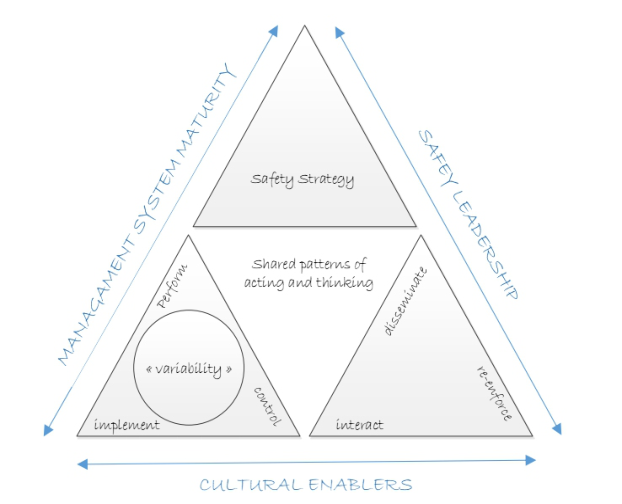
Recognising that, even in a highly automated environment, sustainable and safe performance of a system will always rely heavily on the ability of peo- ple to ensure its continuous functioning and achievement of set objectives, Accou and Reniers (2020) highlighted the need to also consider the informal aspect of safety management. Analysing elements of SMS and SMS maturity, safety culture and safety leadership, that all have been identified as essen- tial to organise resilient and sustainable performance, an “Extended Safety Fractal” was developed, as shown in Fig. 1.
Figure 1: The extended safety fractal (Accou and Reniers, 2020).
The left side of this figure shows at the bottom the basic concept of SMS which represents the effort required for formal and organised safety man- agement. This is called the Safety Fractal. Three distinct levels are identified to observe the functioning of a process: A first level of process performance represents the direct functioning of the components that interact during pro- cess execution. This is also the level where variations in relation to process specifications and/or expectations can be observed. A second level of process
42 Accou and Carpinelli
implementation provides the resources and means to ensure the correct func- tioning of the process components during process execution. The third level of process control, finally, ensures the sustainable control of risks related to all activities of the system. This matches very well the organisational model of SMS as identified by Li and Guldenmund (2018), while their safety-related SMS model then fits in again with the need for a systematic implementation of an explicit safety strategy that is the top of this Extended Safety Fractal. Management system maturity then measures the extent to which the safety strategy is also effectively embedded in the SMS or the underlying processes. The right side of the figure represents the extent to which leaders across the organisation promote and support that same agreed safety strategy in their daily activities to achieve sustainable safety management. The bottom right side, finally, collects the elements identified as the enablers for the devel- opment of an organisational culture. The “shared patterns of acting and thinking”, in the middle of the figure, is then the (safety) culture that emerges as the result of the interaction between the surrounding elements. The need for safety and organisational models to co-exist in an explicit way can also be deducted from the metaphor used by Pariès et al. (2019) that describes the SMS as the “piping” of the system (i.e. the organisational model), generating safety while the substance that “should flow through the pipes” is then the safety strategy, being the (safety-related) models or theories that can help us making sense of the diversity and variations that can be observed in the real world.
Since the beginning of their introduction, standards and legislation have had a significant contribution to the implementation and the development of SMSs. When critically looking at the European legislation (EU, 2018) that describes the SMS requirements that need to be satisfied to be able operate on the European railway network, one can only concludes that this is a model that is highly organisational oriented, without hardly any explicit reference to a safety-related model. Only the requirement for continuous improvement is made explicit (as also in other ISO-based management systems), while other, more safety-related aspects, are absent or hidden within more formal require- ments. In essence, this is also the case for the Hale’s generic SMS reference model that is used by Li and Guldenmund (2018) to compare the content of 43 SMSs. Furthermore, the inventory they present of the safety models that introduce barriers, the management of which they consider the essence of SMSs, clearly shows that these find their origin mainly in sequential (e.g. Heinrich’s Domino and Reason’s Swiss Cheese) and/or energy transfer models (e.g. Johnson’s MORT).
This should not be a surprise. After all, as Borys et al. (2009) describe, the introduction of SMS can be considered as a third “age of safety” in the evolution of safety management, following a first, technical age and a sec- ond, human factors age. But the evolution of safety science did not stop with the introduction of the SMS: A fourth age of “integration” was introduced, stressing the need not to lose the previous ways of thinking but rather to build upon them. And more recently Borys et al. (2009) introduced a fifth age of safety: an “adaptive age” that transcends all other ages without discount- ing them and that introduces the concept of “adaptation” or “resilience”
Is There a Future for Safety Management Systems? 43
to sustain required operations under both expected and unexpected condi- tions. This raises the existential question for SMS of how, without giving up the essence of barrier management, the principle of systems thinking, and complexity can still be integrated.
In line with the overview of safety models provided by Li and Guldenmund (2018), Grant et al. (2018), with a specific focus on system-based safety mod- els, explored how these could predict and prevent the occurrence of accidents. They concluded that ‘despite the diversity in the models there is considerable agreement regarding the core tenets of system safety and accident causation’ and propose 15 core systems thinking tenets which may provide a suitable approach for predicting system states. These tenets were then compared with the elements of the Extended Safety Fractal to assess how they can be inte- grated in the development of a SMS. Details of the analysis made can be found in Annex 1, where the first two columns represent the tenets of system safety with each time its simplified definition, as proposed by Grant et al. (2018). The following columns then map the description of what a safe system under each tenet would mean on the constituting elements of the Extended Safety Fractal.
In general, this analysis indicates that it should be perfectly possible to adapt the (mainly) organisational part of the SMS to support the control of complex systems. Where the tenet ‘Vertical integration’ will have to rely also largely on the more informal part of the SMS implementation, this can be strongly supported by organisational (control as well as implemen- tation) processes of the SMS. For the other tenets, a distinction can be made between three groups. A first group contains the tenets ‘Constraints’, ‘Functional dependencies’, ‘Linear interactions’, ‘Modularity’ and ‘Feedback loops’. These tenets are very similar to the traditional processes that make up a SMS and should therefore be a logic part of its design, mainly at the level of control processes. A second group of tenets, composed of ‘Cou- pling’, ‘Non-linear interactions’, ‘Decrementalism’, ‘Unruly technologies’ and ‘Contribution of the protective structure’ require variability to manage the performance of the system. This means that not only the control processes of the SMS should be designed in such a way that they allow for this operational variability, but that also the necessary attention will be required at the level of the SMS implementation processes. Finally, a third group that contains the tenets ‘Emergence’, ‘Normal performance’, ‘Sensitive dependence on initial conditions’ and ‘Performance variability’ has mainly variability as the result of system performance. Here, it will be important to create the capability for detecting this variability in an early stage and to adapt the system adequately, but also this could be built in the control processes of the SMS.
OVERSEEING THE SMS OF THE FUTURE As the legislation and standards on SMS are mainly based on organisational models, it should not surprise that the current safety auditing approach is mainly based on management principles and looking for compliance. As recognised by Le Coze (2005), our understanding of SMS performance
44 Accou and Carpinelli
should be enriched with other dimensions that are not captured by the sole structural definition of it.
The Extended Safety Fractal summarises a set of essential elements needed for an organisation to come to a sustainable, safe and resilient performance. This offers a new scope for measuring the effectiveness of the safety man- agement for complex systems that will require a combination of different techniques with a clear and explicit focus on an organisation’s safety strategy and the underlying safety model(s). The proposed approach should combine questionnaires to capture SMS ownership and safety beliefs with traditional audit techniques, like document review, interviews and observations, to result in an integrated picture of SMS performance.
With a strategic alignment being a prerequisite for excellent performance, measuring the effectiveness of safety management goes beyond checking pure compliance with an organisational model. It will require to assess how the different elements of the Extended Safety Fractal are (more or less) aligned to implement the defined strategy and whether this strategy is appropriate for the given context. Depending on the situation and the scope and context of the assessment, the focus may move from the whole system towards more detailed implementation and control processes, and vice versa, making opti- mal use of the self-similar attributes of the proposed model. With SMS still the cornerstone of regulatory safety management obligations in several high- risk industries, assessments using the developed model can help regulators to move from pure compliance to a more integrated approach for oversight, based on dialogue.
CONCLUSION
The concept of a SMS to control the risks of operational activities has already been introduced in high-risk industries some decades ago. Nevertheless, this SMS is often criticized as burdensome, complex, and reflecting an outdated way of thinking about safety. Re-thinking the traditional building blocks of the SMS from the perspective of controlling performance variability will help us understanding how to build resilience and adaptability into the railway system. This requires that not only an organisational model is chosen but also a system-oriented safety model is more explicitly identified as the safety strategy to follow.
To get there, organisations and their leaders need to develop the capabil- ity to perceive, understand and proactively manage the tensions between on the one hand the demand for stability and predictability, and on the other hand, the need for operational flexibility, for which solutions should then be consequently implemented through both the organisation of the SMS and the more informal cultural enablers that are needed for a “living” practical implementation. Preferably, the regulators also recognise this need to be more explicit about the required safety models and integrate this in future legisla- tion and related oversight activities. To achieve this, the presented Extended Safety Fractal offers a systematic and more comprehensive framework to understand, organise and assess the sustainable management of safety.
Is There a Future for Safety Management Systems? 45
Decisions and actions at the
higher levels filter down to
lower levels and impact
behaviour.
Information regarding the status
of the system filters back up the
hierarchy and influences higher
level decisions and actions.
need for variability to manage
performance
/ need for variability to manage
performance
need for variability to manage
performance
/ need for variability to manage
performance
need for variability to manage
performance
performance
need for variability to manage
performance
higher levels filter down to
lower levels and impact
behaviour.
adaptation through a
mechanism that is beyond the
scope of what is was designed
for affording flexibility
effective, flexible and adaptable
in maintaining controls
cope with adverse conditions performance variability as result
Performance varies to meet the needs of
changing conditions performance variability as result
Protective structures are effective, flexible and
adaptable in maintaining controls Protective structures are
Information regarding the status of the system
filters back up the hierarchy and influences
higher level decisions and actions.
hazardous processes
and sustained
Emergent behaviours that support the goals
of the system performance variability as result
adverse conditions Behaviour is flexible enough to
evident Loose: recovery from disturbances in
the system is possible
dependable
The system is resilient to breakdowns,
replacement or substitutions of components
and organisation of sub systems can be easily
made
allowing for the control of hazards
adaptations are required to maintain
optimisation
Mechanisms for monitoring changes are
available performance variability as result
behaviour to meet the conditions in the world and
environment in which the system must operate
intended to optimise the system, instead they do the
opposite
components within a system Specific constraint introduced to control
system Relationships between functions are expected
interactions between components in the system that
cannot be fully explained by examining the
components alone
system, regardless of formal rules and procedures Behaviour is flexible enough to cope with
their behaviour; both tight and loose interactions Tight: connections between components are
components where the outcome is not predictable. Allows for adaptations in the system need for variability to manage
where the outcome is predictable Actions and outcomes are predictable and
components interact but are designed and operate
largely independently of each other
evaluate control requirements of hazardous processes Feedback is received on system breakdowns
result in large changes Complex systems need to adapt, small
are amplified throughout and alters the way the system
operates (interconnected webs of relationships).
Safety Strategy (tenets / event model) Control Implement Perform Cultural Enabler
Performance
variability Systems and components change performance and
Contribution of the
protective structure The organised structure and system control that are
Annex 1. Tenets of system safety mapped on the constituting elements of the extended safety fractal.
Vertical integration Interaction between levels in the system hierarchy Decisions and actions at the
Constraints Influences that limit the behaviours available to
Functional
dependencies The necessary relationships between components in a
Emergence An outcome or property that is a result of the
Normal performance The way that activities are actually performed within a
Coupling An interaction between components that influences
Non Linear
interactions Interactions are complex. Relationships between
Linear interactions Direct cause effect relationships between components
Modularity The organisation of a system where sub systems and
Feedback Loops Communication structure and information flow to
Decrementalism Small changes in normal performance that gradually
Sensitive dependence
on initial conditions Characteristics of the original state of the system that
Unruly technologies Unforeseen behaviours or consequences of technologies Technology that supports
46 Accou and Carpinelli
REFERENCES
Accou, B., Reniers. G., (2020). Introducing the Extended Safety Fractal: reusing the concept of Safety Management Systems to organise resilient organisations. International Journal of Environmental Research and Public Health, 17, 5478. Borys, D., Dennis, E., Leggett, S., (2009). The fifth age of safety: the adaptive age.
Journal of Health &Safety Research & Practice. Volume 1, Issue 1, 2009. EU, (2018). Commission Delegated Regulation (EU) 2018/762 of 8 March 2018 establishing common safety methods on safety management system requirements pursuant to Directive (EU) 2016/798 of the European Parliament and of the Council and repealing Commission Regulations (EU) No 1158/2010 and (EU) No 1169/2010. Grant, E., Salmon, P., Stevens, N., Goode, N., Read, G., (2018). Back to the future:
What do accident causation models tell us about accident prediction?. Safety Science, 104, 99–109. Le Coze, J.-C., (2005). Are organisations too complex to be integrated in technical risk assessment and current safety auditing?. Safety Science 43 (2005), 613–638. Li, Y., Guldenmund, F., (2018). Safety management systems: A broad overview of
the literature. Safety Science 103 (2018) 94–123. Pariès, J., Machi, L., Valot, C., Derhavengt, S., (2019). Comparing HRO and RE in the light of safety management systems. Safety Science, 11è, 501–511. Swuste, P., Groeneweg, J., van Gulijk, C., Zwaard, W., Lemkowitz, S., Oosterdorp, Y., (2020). The Future of safety science. Safety Science, 125.
LISTED IN THE AHFE DIGITAL BOOKSTORE CATALOGUE
Explore the complete digital volume
Safety Management and Human Factors
Read this individual research paper free through the original publisher, or explore the full digital proceedings book.
ISBN 978-1-964867-27-4
Explore this ISBN in the AHFE Bookstore ↗Listed in the July 2026 bookstore catalogue; search by ISBN to confirm current availability · Digital book purchase optional