Fabrizio Carpinelli, Bart Accou (2024). "Stop investigating events": Combining in-depth and HOF driven analysis of work, as performed in the reality of day-to-day operations. In: Safety Management and Human Factors. AHFE Open Access, vol. 151, pp. 56–68. https://doi.org/10.54941/ahfe1005302
In high-risk industries, a lot of time and effort is invested in reporting and investigating accidents, incidents, and other types of events, to finally result – very often – in a collection of little useful information vis-à-vis explicit safety- and/or risk management. This leaves the loop of continuous improvement of the organisation of safety open, and similar events to happen again. With such an approach, the future of the safety management system (SMS) seems compromised.There are several reasons for this. The scope of the investigations is often limited to the immediate causes and operational decision-making close to the adverse occurrence, insufficiently addressing essential elements of safety management. The investment in event investigation is often too dependent of the consequences (damages), with its corollary of attributing responsibilities and judging errors, instead of analysing deficient barriers “before or after” the variability of performance. Reporting is not encouraged enough, and what is considered relevant to report is not taken from an operators’ view, the difficulties they experience in day-to-day activities, or the residual risks managed. More education, training and methods are needed to better understand the real practice of a SMS, particularly when it is about integrating the influences of/on human and organisational factors and creating an environment that fosters the development of a positive safety culture. The key question is: how are these events made possible in our current SMS practice and how to improve it? Therefore, instead of limiting the analysis of these occurrences to understanding what happened, and investigating only the event, investigators should explore the composite elements of the SMS that is -often by law or recognised standards- expected to control the risks related to these operational activities. They can do that by linking the findings close to operations that explain the occurrence (being the elements investigators are first confronted with) with the relevant set of control and implementation processes that influenced the chain of events and form part of the SMS. When doing this in a supportive and structured way, it guides investigators through the different operational, tactical, and strategical levels that together form a socio-technical system. The proposed method also supports to go beyond one SMS, taking all stakeholders’ contributions into account when needed, even at the level of regulatory authorities.Building on the SAfety FRactal ANalysis (SAFRAN) method (Accou and Carpinelli, 2022), and describing our didactical attempts to disseminate it, this paper explores how to combine in-depth and HOF driven analysis of work, as performed in the reality of day-to-day operations, with an understanding of the organisational settings in which this work takes place, taking also into account the SMS as reference. This, in turn, is expected to result in recommendations that, rather than focusing on technical and operational aspects, address the capability of responsible organisations to manage safety critical variability, leading them towards closing the loop of continuous improvement and, at the end, towards a more sustainable, safe and resilient performance.
Traditional accident investigation practices in high-risk industries often fail to provide substantial insights into safety and risk management due to a narrow focus on immediate causes and local decision-making, hindering con- tinuous improvement – which is on the contrary a long-term condition to reduce accidents. The main objective of accident investigations should not be merely understanding how an event occurred but rather how it developed within the existing safety management system (SMS), aiming to identify latent
“Stop Investigating Events”: Combining In-Depth and HOF Driven Analysis of Work 57 weaknesses and enhance resilience of the organisation. This paper describes the important pieces that are needed for a more comprehensive approach to safety analysis, emphasizing the need for a training path on Investigating SMS, which is often overlooked (ESReDA, 2015; Johnson, 2003, 2009).
The fundamental purpose of understanding accident mechanisms is to take preventive measures and avoid similar events in the future (EU, 2020; Dekker, 2006, 2014). Investigations typically limit their scope to immediate or nearly immediate causes, neglecting important contributing factors (conditioners, triggers, delayers, accelerators, aggravators, accumulators, etc.) failing to dig into safety management processes and procedures, by acting as if the event had occurred in isolation in an unorganised environment. With this some- what ironic title, we are arguing that the objective is not to understand how an unacceptable event occurred, but how it occurred within the current SMS that is in place, agreed, managed, controlled, etc. Basically, there is a need to investigate the practical context created by the organisations, through the day-to-day implementation of their SMS practices, and therefore there is also the need to better prepare investigators to face this challenge.
The SAfety FRactal ANalysis (SAFRAN) method (Accou et al., 2019a–b, 2022; Accou, 2023) is explained as a tool and as a training, to guide investiga- tors in analysing events in SMS, questioning HOF interactions and identifying sources of performance variability in an iterative way, searching for efficient and sustainable improvements to recommend, while digging into the SMS and beyond.
THE SUPPORT OF THE CURRENT EU LEGISLATION FRAMEWORK It is perhaps not usual to recall - nor often pleasant to read - a legal context put in place to ‘facilitate’ the management of a company or an entire sec- tor. And in this case though, it is quite useful: few people realise how much attention is now being paid in European railway safety legislation to the need for integrating organisational and human factors into the more latent man- agement processes that run deeper into the system. A bit like the evolution in quality management (ISO approach) but with a legal pressure, this allows for certifications, monitoring and supervisions done by national or Euro- pean agencies etc., with constant attention to the continuous improvement of safety, performance, as well as well-being.
Over the past two decades, significant efforts have been invested in establishing a comprehensive European regulatory framework for the socio- technical railway system. The cornerstone of this framework was first set with the adoption of the Railway Safety Directive (RSD) 2004/49/EC, then recast and amended with the RSD (EU) 2016/798 (EU, 2016). The aim is to create a unified approach to SMS across the European Union member states; intro- ducing common safety methods developed by the European Union Agency for Railways (ERA) to promote, guide and support – also with training – the proper application of the EU Legal Framework. It also mandates the certifica- tion of entities responsible for maintenance and the development of national safety rules by member states. And it addresses four key areas: modernizing and harmonizing safety regulations, removing barriers to market opening, enhancing transparency in railway regulation, and establishing procedures for accident and incident investigation. The framework sets up a gradual
58 Carpinelli and Accou
approach to harmonization, acknowledging the diversity among member states while aiming for consistent safety outcomes. The SMS emerges as a piv- otal and mandatory managerial component, requiring railway undertakings and infrastructure managers to implement systems meeting specified criteria. The SMS operates on multiple levels – strategic, tactical, and operational – to ensure safety across various activities and decision-making processes within organisations.
Nowadays, with the existing regulations for supporting the risks eval- uation and assessment, the SMS requirements and their monitoring and supervision, and last but not least for the reporting structure to be followed for railway investigation reports, this EU Legal Framework becomes more precise, not asking for more documentation but for implemented practices in work and decision-making real-life situations, with the linked evidence being produced – and verifiable – too. There are two further specific considerations for those who want to investigate a non-tolerable event.
a) First, it is necessary to treat these legal references as a comparative instance with the practices within the organisations and stakeholders examined during an investigation: an investigator can and must be able to question the implementation of this or that aspect which is legally founded but perhaps absent or poorly implemented in practice. This should however not be done from a pure compliance perspective. b) Second, and also important, investigating an event is not anymore suf- ficient: the investigation objective, the mindset to keep, and the way of doing it are also legally clarified with, among others: (EU, 2016, 2018, 2020)
The objective of the investigation shall be to improve, where possi- ble, railway safety and the prevention of accidents. In other words, the investigation product is made of the lessons learned for the improve- ment of safety and safety management. The investigation shall in no case be concerned with apportioning blame or liability. It shall be carried out independently, in a full cooperation with the authori- ties responsible for any judicial inquiry who ensure that the railways investigators are given access as soon as possible to information and evidence relevant for the investigation.
The investigation shall be carried out with as much openness as pos- sible, so that all parties can be heard and can share the results. The relevant infrastructure manager and railway undertakings, the national safety authority, the Agency, victims and their relatives, owners of dam- aged property, manufacturers, the emergency services involved, and the representatives of staff and users shall be given an opportunity to provide relevant information in order to improve the quality of the investigation report. The investigating body shall also take account of the reasonable needs of the victims and their relatives and keep them informed of the progress made in the investigation.
The investigation report shall be issued following a structure that sup- ports and details a neutral and thorough description of the occurrence and its chain of events, and then, in a differentiated stage, a system analysis based on a set of contributing factors: roles and duties, rolling
“Stop Investigating Events”: Combining In-Depth and HOF Driven Analysis of Work 59
stock and technical installations, human factors, feedback and control mechanisms incl. risk and safety management as well as monitoring, supervision or authorisations processes, and previous occurrences of a similar character if existing. And all of this, also for what happened after the occurrence (measures taken to protect and safeguard as well as the efforts of the rescue and emergency services).
In summary, the rail regulations not only set standards, but require their practical implementation, and its verification, and its continuous improve- ment – especially in case of occurrence. They highlight the necessary evolution from developing excellent documentation to implementing evidence-based processes and risk management practices. In this context, investigators are tasked with comparing legal standards with the actual organisational prac- tices and focusing on improving safety management rather than assigning blame and liability. The investigation function is described in such a way as to accentuate openness, involvement of relevant stakeholders and to require in-depth analysis of all contributing factors in order to continuously improve safety management in the rail sector.
WHY THE SMS IS SO IMPORTANT AND SO UNDERESTIMATED The SMS is a crucial tool for ensuring safety in the rail sector, described in detail in Regulation (EU) 2018/762. It aims to effectively manage risks, to align safety with strategic priorities and maintain a high level of safety in all operations. The SMS places responsibility on railway undertakings and infrastructure managers to implement a functional system that integrates seamlessly with daily business processes and evolves in line with organisa- tional growth. Despite criticisms of its complexity and compliance-driven nature, SMS is a dynamic tool that supports a coherent safety strategy. It operates on a Plan-Do-Check-Act (PDCA) cycle enhanced with more infor- mation on the Context of the organisation, on the Leadership responsibilities and activities, and on the various Support functions which can become cru- cial when organising the resources needed. The process approach encourages the interconnection of management system processes in order to effectively achieve the organisation’s objectives. While formal processes such as risk management are essential, informal aspects such as policy development and strategy promotion also play an important role. Understanding and imple- menting SMS principles at strategic, tactical and operational levels is essential to achieving sustainable safety results.
Investigating accidents, incidents or near misses can be challenging, as it can be challenging to link operational failures to one or more SMS processes that are being (or have been) documented and/or (more or less) implemented elsewhere, somewhere, with other people or reporting lines, at some point in the past. Addressing this challenge requires in-depth analysis potentially at all levels of the organisation, enabling comprehensive investigations with a lot of contacts with different stakeholders, identifying ways to improve safety man- agement capabilities. The real question that comes to mind is inevitably how an investigator, even one with a great amount of experience in the railway field, possibly in several areas, can also navigate through several European and national regulations with ease, to identify problems a fortiori among
60 Carpinelli and Accou
unknown stakeholders or on their interfaces, on the basis of their day-to-day practices, and so on. There is not necessarily one right answer. But what we were looking for here is a mean, a reliable tool for standardisation and simpli- fication, which facilitates neutral descriptions and analyses, while remaining linked to the legal framework and in particular to the SMSs in place.
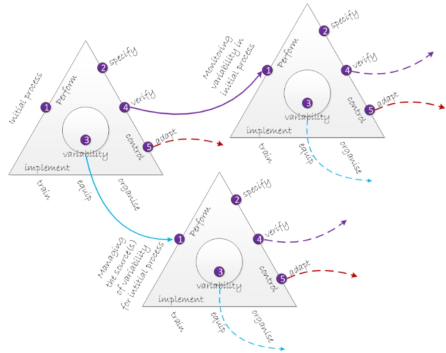
Accou et al. (2019a–b, 2022), Accou (2023) have developed, tested and disseminated an ultra-simplified diagram that represents virtually all the main functions and processes of a SMS very well. It is easy to memorise, can be visually represented by triangle and/or of a table, and it is therefore usable at any time during the investigation and especially while analysing the evi- dence. As explained, the authors wanted first to understand what is needed to manage the proper functioning of safety related activities at all levels in an organisation, and to further identify this, the high-level requirements for SMS have been compared with standards that put requirements on process capa- bility, which resulted in a set of generic requirements assembled in a triangle, as described in Annex 1.
This Safety Fractal symbolises and “operates” an entire SMS and allows to raise - repeatedly - the two key questions, productive in terms of organ- isational learning: How can these critical variabilities be better detected, identified, monitored? How can the sources, the origins of these critical variabilities be better managed?
SMS INTEGRATES HOF INTERACTIONS, SO SAFETY FRACTAL TOO With the Safety Fractal logic, the investigators are encouraged to explore and question the composite elements of the SMSs, connecting operational find- ings with relevant control and implementation processes that influence the chain of events. As described, the triangle centre “variability” (number 3, Annex 1, Figure 2) represents all the potential variabilities happening every day in all processes, including at the human, technical and organisational performance levels. Hopefully, it is only in some cases that this variabil- ity becomes critical for safety. And, precisely, the safety fractal logic and its questioning approach has been made to incorporate and cover the HOF variabilities and their sources.
This is also reflected in the Regulation (EU) 2020/572 (EU, 2020) on the reporting structure to be followed for railway accident and incident inves- tigation reports: “Where causal or contributing factors or the consequences of an occurrence were related to human actions, attention shall be paid to the particular circumstances and the manner in which routine activities are performed by staff during normal operations and the human and organi- sational factors that may influence actions and/or decisions” and it gives a list of factors on which the investigators have to focus to characterise the variability in task performance. Indeed, in HOF an important principle is to keep in mind the end-users, their capabilities, their limitations and their real life / actual working conditions. We consider that such interactions (HOF) are at the heart of safety operations and management, simply said because at every level, in every process, there are people who decide for operating, controlling, planning, resourcing, training, budgeting, buying. These interac- tions play a key role for both Operational Safety and Occupational Safety. And that is why there is a specific requirement to make a bridge between
“Stop Investigating Events”: Combining In-Depth and HOF Driven Analysis of Work 61 both, as necessary: “determining, providing and sustaining a safe working environment which conforms to applicable legislation, in particular Direc- tive 89/391/EEC” (EU, 2018), in the Well-being national legislation in most EU Countries.
One of the most widely accepted definition about HOF (International Ergonomics Association) describes it as a scientific discipline concerned with the understanding of interactions between humans and other elements of a system, and the profession that applies theory, principles, data, and other methods to design in order to optimize human well-being and overall system performance. Outside of the rail sector, HOF is often referred to as either Human Factors (HF) or Ergonomics. All three terms have the same definition and focus on interactions. With the SMS, as practiced in railways, HOF ques- tioning involves taking a system perspective where the interactions between human, technological and organisational factors are considered through a lifecycle approach (including subcontractors).
There are various HOF models, some of which have been published and used for several decades, and the fact is that Human factors remains central to the incident investigation process (Gibson et al., 2017). The point is to use a model – and because of the WYLFIWYF mechanism (Lundberg et al., 2009) – which supports the practice of the SMS, and from which you can ask questions while investigating, while analysing or assessing risks or changes, while calibrating supports and resources to operate, while preparing moni- toring and making it, while designing or reengineering tools or procedures, etc. Competing lists of various lengths with such “performance shaping fac- tors” (PSFs) exist, with mostly domain specific factors, or strongly referring to situational, organisational and environmental elements of the purpose or field they were developed for. Most of the time, with these taxonomies or check-lists still subsist the temptation to reduce Human Factors to the Human Error (techniques, understanding, taxonomies) (Hollnagel, 1983), however it shows soon limitations when trying to link findings with SMS practices and promoting efficient recommendations.
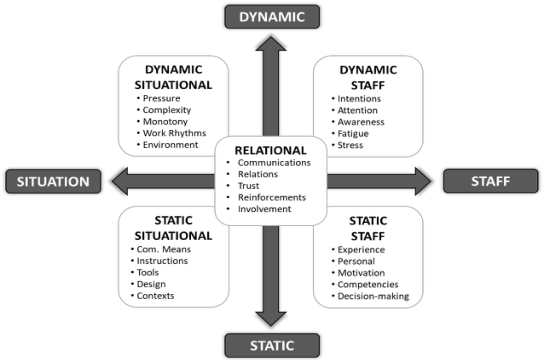
The HOF 5×5 model, described in Annex 2 Figure 3, is generic and has been developed with railways professionals (in Accou et al., 2022, inspired by: e.g. Kyriakidis, 2015; Leplat, 1997; Rasmussen, 1997, 2000; Reason, 1997, 2003,2008; Woods, 1994). It contains 5 categories of 5 factors, and sets of generic questions. It aims to facilitate questioning about the inter- actions between the system and the human capabilities and limitations. It is kept neutral vis-à-vis the concept of human error (it requires to qualify the intention of an action), it makes notion of performance variability and shaping or interacting factors. Its structure is balanced: a distinction is made between factors that are more dynamic or static, and between factors more related to the situation or to the staff. This is to consider that safety-related activities are dynamic and take place in real time, and also that they are prepared, organised and decided beforehand, in a more static situation with other kinds of activities still safety-related. Finally, the model also includes topics that are more relational which encourages to consider that there are no ‘isolated’ individuals in organised systems, that are defined by layers of contributions and responsibilities, as it is the case in our regulated socio- technical railway system. All those 25 factors should not be seen in isolation
62 Carpinelli and Accou
but as a list of interacting factors contributing to improve or weaken the well- being, the safety performance (the risk management) and, seen as a whole, the performance of the organisation.
The ERA also supports the use of this model in several other train- ing, tools, and its inclusion in common safety methods. HOF questioning is currently supported via 2 sets of questions for exploring the 25 fac- tors and their interactions: integrated in HOF Change Management Toolkit Guidance, and in the training modules for Investigating SMS and Organisa- tional Just Culture (https://www.era.europa.eu/content/safety-training-and- assistance-rail-stakeholders). The HOF 5x5 model is also introduced as a taxonomy for the contributing factors referred to in future legislation for assessing the safety level and the safety performance of railway operators at national and Union level. Railway stakeholders can use this model to iden- tify the interactions and better detect and manage HOF influences within their risk management processes from the design stage and for its continuous improvement: Analysing risks and assessing them, implementing risk con- trol measures, designing operations or procedures, planning objectives and making adequate resources or support available, monitoring how and what is achieved, reinforcing organisational learning and safety culture.
BEYOND INDIVIDUAL SMS: QUESTIONING THE RAILWAY SYSTEM Applying this SAFRAN logic in a systematic way will lead you deep into an organisation’s SMS, assessing its capability to monitor the critical variabili- ties and manage their sources, identifying possibilities for improvement from the operational level up to the board of directors. This should however not stop at the boundaries of one single organisation. The socio-technical systems have many complex hierarchical layers that are in place to ensure its safety, covering both operations and manufacturing, from down the operational level executing the activities up to safety authorities and other governmental organisations setting policies and imposing legislation (e.g. Rasmussen, 1997, 2000). To reach a good understanding of how an accident occurred, all players in the system should be considered with their roles, responsibilities, resources, etc.: although the infrastructure managers and the railway undertakings are the main responsible for running safe trains, everything in the system has to be designed, implemented, maintained, controlled, changed, etc.
The proposed method extends itself, with exactly the same structure and questions, beyond any individual SMS, incorporating contributions from all stakeholders, including regulatory authorities. Of course, to go beyond the only SMS concerned by the event at the start of the analysis, the investi- gators have to face other challenges: their capability, their willingness and their organised independence to overcome stakeholders’ reluctance whenever it arises. And, ultimately, to provide system-focused recommendations that are appropriately linked to stakeholders who may be involved to reduce the occurrence or the consequences of such an event in the future.
“Stop Investigating Events”: Combining In-Depth and HOF Driven Analysis of Work 63
FOUNDATION OF SYSTEM-ORIENTED RECOMMENDATIONS In order to define appropriate countermeasures to prevent future similar occurrences, and at the same time to convince with the explanations of how the event was made possible in the current SMSs, the investigators need to take care of building of the recommendations. Firstly, and especially when they are expert in one or more concerned areas, the investigators should pay attention about any bias and search for an explicit external control of their reasoning and ensure the availability of the adequate evidence for each step of the recommendations reasoning.
Secondly, when investigating an event in organised systems, it is necessary to ensure to go beyond the treatment of local factors (ex. lack of training, so training is recommended), and to reach the real origin of the facts, other similar weaknesses or failures, using system-based analysis (like substitution places or peers, partial or full simulations, etc.).
Thirdly, formulating the appropriate system recommendations to be applied to specific elements of the SMS/HOF requires to integrate such ques- tions during the analysis in a neutral but well-informed way. If no underlying SMS/HOF model is used, no related questions will be asked, and if no ques- tions are asked, no evidence can be found or related areas for improvement identified (e.g. Lundberg et al., 2009). Where possible, it is thus necessary to link all the operational activities of the organisation that were at the origins of this event to the generic management activities aimed at better monitoring and managing those risks in a more systematic way. Applying the approach promoted by ATSB (e.g. Fitzpatrick, 2018), the investigators should build the recommendations explaining link-by-link the progressive influencing rela- tionship and interaction between the contributory factors, demonstrating how some distant influence is still active in the system, and how similar event can be impeded elsewhere with someone else if adequate recommendations are implemented.
EDUCATIONAL AND DIDACTICAL TRIALS This paper highlights 5 important pieces of a puzzle that are combined to investigate SMS: the current safety EU legal framework, the Safety Fractal logic, and its incorporated HOF 5x5 questioning, then the need to go beyond one single SMS most of the time, and the need to justify the choice and explain the recommendations.
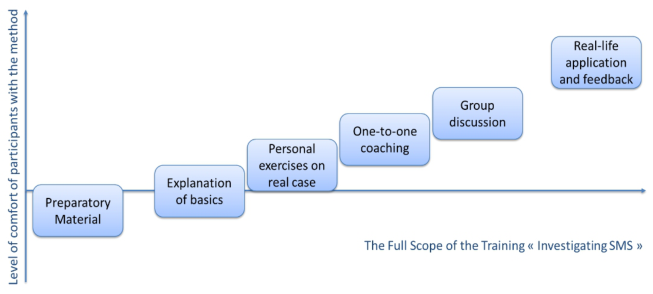
What is also of high importance is about how to share this SAFRAN method with the investigators, professional or occasional, with more or less knowledge and practice of the SMS or, of the interactions HOF, and even- tually also with their management, and train all of them in an efficient way. Several trials were needed, but we have started to stabilise a didactical path to reach a good level of feedback from participants, with even some of them sharing their final real-life application, asking for trainers’ feedback. This path is reassembled in the Figure 1., showing how the full scope of the training “Investigating SMS” looks like, and how we think that the level of participants’ comfort can be improved in their understanding and use of the SAFRAN method.
Just simply informing the participants is not sufficient. Neither to share or send a demonstration paper with a case. Not even combining informing and
64 Carpinelli and Accou
demonstrating the approach. In fact, a series of graduated personal efforts is needed, along with some coaching to discuss findings, progress, or per- sonal feedback. What is also of importance is to invite them to use one real (railway) case, and even preferably, if possible, to have them to use their own personal well-known case. The group discussion has also been fruitful and let the participants exchange about their ‘new’ findings, etc. The very last step of the training, also seen as a fruitful transfer from the training to participants’ real life, is when participants propose us to give some feedback on a personal analysis using the method, at a time deferred from the training course. The training time (online or onsite) organised as described takes 3 days: with one to two hours maximum for the theory in the morning, then an individual preparation of exercises during two to three hours, then an individual coach- ing time lasting twenty minutes to half an hour, then back in group for a collective closure lasting maximum one hour at the end of the afternoon.
Figure 1: The full scope of the training “investigating SMS”.
We are aware that we need to continue this dissemination effort and also gather more data about the transfer of the SAFRAN method to the train- ing participants. In the meantime, and it is not only a way of softening the effort needed: we also invite the participants to really enjoy investigating and rediscover the pleasure of finding useful industrial “truths” about the system functioning. We have also experimented a tabletop gamification approach several times where the theoretical background is short and given after hav- ing applied the method on a real railway case (e.g. see Accou et al., 2022b; or for the network Prime in Vienna, Subgroup Safety Culture, September 2023). In addition, an e-learning tool for discovering the method is being created and will be tested this year.
CONCLUSION
This paper advocates for a paradigm shift in the investigation of accidents and incidents in high-risk industries and for the need of a supporting train- ing to disseminate it. The 5 important pieces of the SAFRAN method were explained, and the educational and didactical path has been shared. We believe that by adopting the system approach grounded in the SAFRAN method, which integrates by nature the combination of a structured HOF
“Stop Investigating Events”: Combining In-Depth and HOF Driven Analysis of Work 65 questioning and an organisational analysis, organisations can move beyond the conventional focus on human or on technical or operational aspects.
Our goal is to enhance the capability of responsible organisations to man- age safety-critical variability, leading to the closure of the loop of continuous improvement of their SMS, and ultimately fostering a more sustainable, safe, and resilient performance within high-risk industries.
ANNEX 1
Figure 2: The SAfety FRactal ANalysis (SAFRAN) method.
The Safety Fractal (Accou et al., 2019a–b, 2022; Accou, 2023) is each one of these triangles represented in Figure 2. The safety fractal analysis is an analysis method, which starts during and after a solid and neutral descrip- tion of a non-tolerable event occurring in an organised socio-technical system. Looking first at the triangle on the left of the image, we compare what hap- pened in number 1 with what was expected (analysed in number 2). The critical variability (analysed in number 3, with the HOF 5x5 questioning (see Figure 3 in Annex 2 or any other questioning method well suited e.g. for technical functioning) that emerges from this comparison can have been anticipated and its sources being under control by risk management: then, other sub-processes of management can be analysed following the same steps (triangle on the bottom, symbolising the exploration of risk management sub- processes), and so on. On the other hand, the same initial critical variability, because critical, can have already been identified, and put under monitor- ing represented by number 4) - which is also organised into subprocesses and can therefore also be explored following the same steps (triangle on the right). With the optional number 5, whenever there is a recurrence of a similar event, the organisational learning subprocesses can also be further explored in the same way. The repetition - as needed - of this single view through the whole system, to explore and analyse the subprocesses or function in place to man- age or monitor such critical variabilities, through several SMSs if needed, has been seen as a fractal unit of analysis.
66 Carpinelli and Accou
Perform: The activity is executed, responding to real life constraints and disturbances (i.e. work as done, as has been done). All the operations of each function or process have to be performed.
Specify: The scope and desired outcome of an activity is specified, with its objectives, roles and responsibilities identified, disrupting events are antic- ipated and risk control measures (rules, barriers) are designed (i.e. work as imagined, as planned, as expected,…).
Implement: Train, Equip, Organise: all is done to have activities per- formed by enough competent people, adequate technical resources are put available and maintained, work products and resources to be used are iden- tified and work is planned in detail. Classically this is where (more or less critical) variabilities are found and discussed, and to be explained by some interaction(s) between factors of influences, making possible two subsequent analysis: How such variabilities are supposed to be monitored in the current SMS? How are they kept under control by managing their sources?
Verify: The function/process or the system’s performance is monitored (incl. the efficiency of the risk control measures, the variabilities) i.e. verifying the match between work as designed and work as actually performed, as well as the elements that could affect this performance in the near term.
Adapt: Whenever there is a recurrence of a similar event, it is known (in principle) what has happened and what were the lessons learned from expe- rience, and the adequate changes to control, or the implementing of elements that were introduced.
ANNEX 2
Figure 3: HOF 5x5 model (Accou & Carpinelli, 2022).
This model and its sets of questions form a pragmatic tool with the ambi- tion of supporting a neutral and balanced questioning of the performance shaping factors linked with a SMS in a socio-technical system. In any Safety
“Stop Investigating Events”: Combining In-Depth and HOF Driven Analysis of Work 67 Fractal, the critical variability (analysed in number 3, see Figure 2, Annex 1) is questioned with the HOF 5x5.
Dynamic Situational Factors: temporary or very short-term charac- teristics of the situation that can influence individuals and the teams or the course of the situation.
Dynamic Staff Factors: temporary or very short-term characteristics of individuals and teams that can influence the course of the situation or other concerned staff.
Static Situational Factors: lasting characteristics or repetitive elements of a situation that can influence the individuals and the teams or the course of the situation.
Static Staff Factors: lasting characteristics or repetitive elements in the concerned individuals and teams that can influence the course of the situation or other concerned staff.
Relational Factors between the concerned staff, or between several concerned groups of staff (incl. hierarchy levels), which can influence the course of the situation, or influence the people themselves in their reactions, attitudes, beliefs and perceptions.
REFERENCES
Accou, B., 2023. Exploring the potential of Safety Management Systems to support New Approaches based on Safety Fractals. Dissertation (TU Delft), Delft University of Technology. Accou, B., Carpinelli., F., 2022a. Systematically investigating human and organisational factors in complex socio-technical systems by using the “SAfety FRactal ANalysis” method. Applied Ergonomics, 100 (2022) 103662. https://doi.org/10.1016/j.apergo.2021.103662 Accou, B., Carpinelli, F., Murton, D., 2022b. Investigating Safety Management Sys-
tems: Stop Investigating Events. Workshop, International Railway Safety Council, Sevilla, Spain. Accou, B., Reniers, G., 2019a. Developing a method to improve safety management systems based on accident investigations: The Safety Fractal Analysis. Safety Science 2019, 115, 185–293. Accou, B., Reniers, G., 2019b. Analysing the depth of railway accident investi-
gation reports on over-speeding incidents, using an innovative method called “SAFRAN”. In Accident Investigation and Learning to Improve Safety Man- agement in Complex System: Remaining Challenges. Proceedings of the 55th ESReDA, Romania, October 2018. Dekker, S., 2006, The Field Guide to Understanding Human Error. Ashgate Publishing. Dekker, S., 2014. The psychology of accident investigation: epistemological, pre-
ventive, moral and existential meaning making. Theoretical issues in Ergonomics Science. ESReDA, European Safety Reliability and Data Association, 2015. Guidelines for Preparing a Training Toolkit in Event Investigation and Dynamic Learning. http://www.esreda.org EU, 2018, Commission Delegated Regulation (EU) 2018/762 of 8 March 2018
establishing common safety methods on safety management system require- ments pursuant to Directive (EU) 2016/798 of the European Parliament and of the Council and repealing Commission Regulations (EU) No 1158/2010 and (EU) No 1169/2010. Available online: https://eur-lex.europa.eu/legal- content/EN/TXT/PDF/?uri=CELEX:32018R0762&from=EN.
68 Carpinelli and Accou
EU, 2020, Commission Implementing Regulation (EU) 2020/572 of 24 April 2020 on the reporting structure to be followed for railway accident and incident investigation reports. https://eur-lex.europa.eu/legal- content/EN/TXT/PDF/?uri=CELEX:32020R0572 EU, 2016, Directive (EU) 2016/798 of 11 May 2016 on railway safety (recast). https://eur-lex.europa.eu/legal-content/EN/TXT/PDF/?uri=CELEX: 32016L0798&from=DA Fitzpatrick, H., 2016. Investigating Linkages Between an Occurrence and an Organisation’s Safety System Performance. International Society of Air Safety Investigators. https://www.isasi.org/ Gibson, H., Mills, A., Gregory, J., Harrison, C., Woods, M. 2017, The Role of
Human Factors in Supporting Safety Learning from Railway Incidents. Interna- tional Railway Safety Council, HK. Hollnagel, E., 1983. Human Error. Position paper for NATO Conference on Human Error. Italy. Hollnagel, E., 2014, Human factors/ergonomics as a systems discipline? “The
human use of human beings” revisited. Applied Ergonomics, 45, 40–44. https://doi.org/10.1016/j.apergo.2013.03.024 Johnson., C. W., 2009. Review of accident investigation methodologies - Final report.
European Railway Agency contract ERA/2009/SAF/NP/02. Johnson., C. W., 2003. Failure in Safety-Critical Systems: A handbook of incident and accident reporting. Glasgow University Press. Kyriakidis, M., Majumdar, A. and Ochieng, W. Y. 2015, Data based framework to
identify the most significant performance shaping factors in railway operations. Safety Science, 78, 60–76. Leplat, J., 1997, Regards sur l’activité en situation de travail, Contribution à la psychologie ergonomique, Paris, PUF. Lundberg, J., Rollenhagen, C., & Hollnagel, E. (2009). What-You-Look- For-Is-What-You-Find—The consequences of underlying accident models in eight accident investigation manuals. Safety Science, 47(10), 1297–1311. https://doi.org/10.1016/j.ssci.2009.01.004 Rasmussen, J., 1997. Risk management in a dynamic society: A modelling problem. Safety Science, Vol. 27 (182–213). https://doi.org/10.1016/S0925- 7535(97)00052-0 Rasmussen, J., Svedung, I., 2000. Proactive Risk Management in a Dynamic Society;
Swedish Rescue Services Agency: Karlstad, Sweden. Reason, J., 1997. Managing the risk of organisational accidents. Ashgate Publishing. Reason, J., Hobbs, A., 2003. Managing Maintenance Error: A practical guide.
Ashgate Publishing. Reason, J., 2008. The human contribution: Unsafe acts, accidents and heroic recoveries. Ashgate Publishing. https://doi.org/10.1201/9781315239125 Woods, D. D., Johannsen, L. J., Sarter, N. B., 1994. Behind human error: Cogni-
tive systems, computers and hindsight, SOAR report 94–01, Wright-Patterson Air Force Base.
LISTED IN THE AHFE DIGITAL BOOKSTORE CATALOGUE
Explore the complete digital volume
Safety Management and Human Factors
Read this individual research paper free through the original publisher, or explore the full digital proceedings book.
ISBN 978-1-964867-27-4
Explore this ISBN in the AHFE Bookstore ↗Listed in the July 2026 bookstore catalogue; search by ISBN to confirm current availability · Digital book purchase optional