Ali Aljaroudi (2024). Ergonomic Risk Factors of Musculoskeletal Injuries in Aviation Maintenance. In: Social and Occupational Ergonomics. AHFE Open Access, vol. 152, pp. 44–50. https://doi.org/10.54941/ahfe1005319
The aviation maintenance mechanic faces a multitude of occupational hazards each day due to the complex nature of the work they perform on aircrafts. The most common problem reported by aviation maintenance mechanics was work related musculoskeletal disorders (WMSDs). Studies have shown that aviation maintenance mechanics suffer WMSDs, most often affecting the back, head, neck and lower extremities. The objective of this study is to assess the risk of WMSDs and propose innovative engineering control of ergonomic hazards associated with aviation maintenance work in a local aviation maintenance hanger. The ergonomic assessment tool used was the Rapid Entire Body Assessment (REBA). This ergonomic assessment tool uses a systematic process to evaluate whole body postural and risks associated with job tasks. Using the REBA worksheet, the evaluator assigns a score for each of the following body regions: wrists, forearms, elbows, shoulders, neck, trunk, back, legs, and knees. The scores for each of these body parts vary. The lower arm score can either be valued as a 1 or 2. The neck and wrist REBA score can range from 1 to 3. The legs are scored 1 to 4. The trunk is on a scale of 1 to 5 with the upper arm stretching as high as a score of 6. Although these scores have different boundaries, the lower they are, the better. Scoring a 1 in all these categories would ensure the workplace is ergonomically friendly and free of wide exposure to WMSDs. The assessment body region score was complied with the risk factor variables, (force/load score, coupling score and activity score) generating a single score that represents the risk level of WMSDs. This individual number tells the evaluator how urgent change is needed. After observing the aviation maintenance mechanics repairing an aircraft engine, an ergonomic risk assessment of the mechanic was conducted using the REBA tool. The final ergonomic assessment resulted in an average REBA score of 9, which represents the risk level of WMSDs. This score indicates that aviation mechanics are at a high risk of WMSDs. Interventions are recommended to reduce the risk of harm to aviation maintenance mechanics. Our study results show that aviation mechanics working at the assessed maintenance hanger are at high risk of WMSDs due to improper engineering controls. The aviation mechanics are subjected to musculoskeletal pain while working in awkward positions and repetitively repeating tasks with no ergonomic benefits. Implementing the recommended engineering controls that re-engineer work practices, processes, posture and body movement will reduce the potential risk of WMSDs. Utilizing ergo chairs, anti-fatigue mats, and ergonomically designed tools will improve the REBA score, resulting in low risk. The common theme of poor posture and lack of ergonomic friendly tasks throughout the worksite will be reduced to an acceptable level through ergonomic interventions.
Ergonomic Risk Factors of Musculoskeletal Injuries in Aviation Maintenance 45
INTRODUCTION
Aircraft Aviation maintenance is paramount to the safety of pilots and the millions of airline passengers. The industry would face monumental disaster without the support of aviation mechanics. It is essential to maintain health and safe work environments among aviation maintenance workers in order to prevent disaster and catastrophic events. One of most occupational injuries reported by aviation mechanics was work related musculoskeletal disorders (WMSDs).
Several studies have shown that aviation maintenance mechanics suffer WMSDs, most often affecting the back, head, neck and lower extremi- ties. That’s what Asadi found when conducted an ergonomic risk assess- ment that included 235 aviation maintenance employees. The study found that the back, head, neck and lower extremities were the most-affected body parts that needed ergonomic intervention (Asadi, 2019). In 2016, a research study investigated work-related lower back pain in aviation main- tenance mechanics who had never had an accident involving the lower back region. The results show that WMSDs often result from risk factors involving heavy physical work, lifting, forceful movements and awkward postures (Ghazali, 2016). Another study of 52 aircraft mechanics, focused on chronic lower back pain. This study showed that factors associated with chronic discomfort included time on shift and physical load, both static and dynamic. Chronic back pain was prevalent among the 52 aviation mainte- nance mechanics in the study (Rodriguez, 2016). Irwin studied 21 aircraft painters to determine the level of ergonomic risk they faced and the specific sources of risk (Irwin, 2015). The study used motion capture instruments, a system of time-based task requirement counts and Rapid Entire Body Assessment (REBA) scoring. Shoulder injuries represented the biggest area of ergonomic risk for aircraft painters, but they also experienced cervical prob- lems, hand/wrist problems and lumbar problems (Irwin, 2015). Additionally, repetitive tasks, task duration, awkward body postures and tool vibration are contributors to WMSDs faced by aviation maintenance mechanics. Stader found this to be true when he conducted a study of aircraft mechanics in a small aircraft maintenance business. This study did not specify hazard controls but did suggest task cycle and rest break modifications along with providing ergonomically designed work equipment (Stader, 2013). Similar ergonomic risk factors include “torso forward bending, squatting or kneel- ing, and awkward postures” were identified in a study conducted by Gharib and his colleagues of 64 aircraft maintenance workers (Gharib, 2021). Many of the studies conclude that the use of lift platforms, scissor lifts, man- ual material handling and resting periods can have a significant effect on reducing WMSDs. A research study found this to be true when they con- ducted a 2022 questionnaire-based musculoskeletal disorder assessment of 150 aircraft maintenance technicians (Yazgan, 2022). Several research studies have examined the occupational safety and health issues faced by aviation maintenance workers, with a specific focus on ergonomic factors that contribute to WMSDs. However, there is a clear need for additional research due to the ongoing presence of ergonomic risks in
46 Aljaroudi
the aviation maintenance sector. One notable gap in the current literature is the lack of tailored ergonomic assessments for small aviation maintenance facilities, as most studies have centred on larger operations. Therefore, it is crucial to conduct a thorough investigation of ergonomic challenges in smaller aviation hangars and repair stations to enhance workplace safety measures comprehensively.
The primary objective of this pilot research study was to assess the preva- lence and potential risk factors contributing to WMSDs among aviation mechanics operating in the dynamic environment of a small aviation main- tenance hangar. Furthermore, the study aimed to investigate the ergonomic hazards associated with this profession and propose innovative engineering remedies to mitigate these risks, ultimately establishing a safer and more secure working environment for aviation maintenance personnel stationed in small maintenance and repair facilities.
METHODS
In order to thoroughly evaluate the risk factors for WMSDs among aviation mechanics, the Rapid Entire Body Assessment (REBA) tool (Hignett, 2000) was utilized. This tool has been widely used in various industries to assess the ergonomic risks associated with different job tasks. The study completed on 10 full-time aviation mechanics who were responsible for performing main- tenance on Diamond aircraft engines. These aviation mechanics were selected from the flight maintenance hangar at Embry-Riddle Aeronautical University in Daytona Beach, Florida, USA.
To ensure a comprehensive and unbiased assessment, the aviation mechan- ics who were observed and the observation times were randomly chosen. This was done to eliminate any potential bias in the selection of participants and to ensure that a representative sample was used for the study. The observations were carried out during normal working hours, which allowed for a realistic and accurate representation of the mechanics’ daily tasks and movements. This was important in order to accurately identify any potential risk factors that may contribute to the development of WMSDs.
The REBA tool consists of a series of body postures and movements that are assigned a score based on their level of risk. This includes factors such as posture, force exertion, duration of task, and repetition. Each factor is evaluated on a scale from 1-3, with a higher score indicating a higher risk for injury. By utilizing this tool, the researchers were able to objec- tively assess the mechanics’ work tasks and identify any potential areas of concern.
The data gathered from the observations was then analyzed and com- pared to established guidelines for safe working postures and movements. This allowed for a thorough evaluation of the mechanics’ risk for developing WMSDs. By identifying any potential risk factors, appropriate interventions can be implemented to reduce the likelihood of injury and promote a safer working environment for aviation mechanics.
Ergonomic Risk Factors of Musculoskeletal Injuries in Aviation Maintenance 47
RESULTS
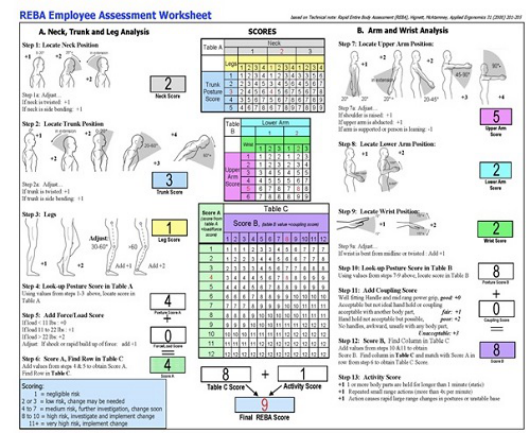
After observing 10 Aviation Mechanics performing maintenance on Dia- mond aircraft engines, the ergonomic risk assessment of the WMSDs were completed using the REBA worksheet. Figure 1 shows the average summary of completed REBA assessment.
Figure 1: Average scores from REBA assessment.
The risk assessment was conducted in two parts, resulting in a Score A and a Score B. The evaluator began the ergonomic risk assessment by performing a Neck, Trunk and Leg analysis to obtain Score A. The neck position scored an average score of 2 due to the subjects’ neck being greater than 20 degrees away from its origin. The trunk position scored an average of 3 due to the subjects’ trunk being between 20 and 60 degrees away from its origin. The leg position scored an average of 1 because the subjects’ legs were straight and not bent at an angle requiring a higher score. Using the values from the neck, trunk and leg assessments, a Posture Score A was derived from Table A, resulting in an average Posture Score A of 4. Next the average Load/Force score was calculated. Since the load is less than 5 kg (the tools are the load being measured in this assessment), the average Load/Force score is 0. The Load/Force score is added to the Posture Score A, which resulted in Score A of 4. To determine the Score B, the evaluator performed an ergonomic risk assessment of the Arms and Wrist. In this assessment, the upper arm position scored an average of 5 due to the subjects’ upper arm being extended at an angle between 45 and 90 degrees (score of 3), with the subjects’ shoulders raised and their upper arm was abducted, each resulting in one more point totalling to 5. The lower arm position scored a 2 due to the subjects’ arm exceeding an angle of 100 degrees from the center of the body. The wrist position scored a 2 due to bending of more than 15 degrees. Using the values
48 Aljaroudi
from the arms and wrist assessments, a Posture Score B was derived from Table B, which resulted in a Posture Score B of 8. An assessment of the cou- pling showed a well-fitted handle and mid-range power grip, resulting in a Coupling Score of 0. The Coupling Score is added to the Posture Score B, which resulted in Score B of 8. Using the assessment body region scores, the evaluator compiled the risk factor variables, generating a single score. The final postural assessment resulted in a REBA score of 9, which represents the level of MSD risk. This score indicates that the subjects are at a high risk of WMSDs. Interventions are recommended in order to reduce the risk of harm to aviation maintenance mechanics.
RECOMMENDATIONS Engineering hazard controls play a critical role in reducing the risk of injuries to aviation maintenance mechanics, particularly in light of the ergonomic challenges they encounter. To address the potential hazards identified through the REBA assessment, we suggest a comprehensive strategy that includes three key solutions. These recommendations are designed to improve both the physical well-being and efficiency of mechanics in their demanding work environments.
To begin with, the introduction of ergonomic chairs or adjustable height work seats is a crucial step. Mechanics often perform tasks that require awk- ward postures, leading to strain and discomfort, especially in the back and neck areas. The use of durable ergonomic chairs or adjustable work seats with versatile backrests not only allows for optimal positioning but also enhances comfort and support during long periods of work. By relieving pres- sure points and promoting better alignment, these ergonomic seating options significantly reduce musculoskeletal issues, creating a more conducive work environment that supports sustained focus and productivity.
Additionally, incorporating anti-fatigue mats is another effective strategy to alleviate the physical strain of prolonged standing. These mats enhance cir- culation, posture, and joint health by providing cushioning and support for the feet, ankles, knees, hips, and lower back. By reducing pressure and min- imizing fatigue-related discomfort, anti-fatigue mats improve the ergonomic quality of the work surface, thereby lowering the risk of chronic injuries resulting from extended standing. This initiative demonstrates our dedication to prioritizing the well-being and longevity of maintenance staff.
Lastly, the utilization of ergonomically designed tools is a proactive mea- sure to reduce strain and enhance performance during aircraft maintenance tasks. Equipping mechanics with tools that have customized features, such as pliers with molded plastic handles for improved grip and comfort, can significantly improve their working conditions.
CONCLUSION
The study results show that the assessed aviation mechanics are at high risk of WMSDs due to improper engineering controls or lack thereof. The avi- ation mechanics are subjected to musculoskeletal injuries while working in
Ergonomic Risk Factors of Musculoskeletal Injuries in Aviation Maintenance 49
awkward positions and repetitively repeating tasks with no ergonomic bene- fits. Implementing the recommended engineering controls that re-engineering work practices, processes, posture, and body movement will the potential for WMSDs. Utilizing ergo chairs, anti-fatigue mats, and ergonomically designed tools will improve the REBA scores, resulting in low biomechanical loads. The common theme of poor posture and lack of ergonomic friendly tasks throughout the worksite should be reduced to an acceptable level through ergonomic interventions. Although we focused on engineering controls, other controls like administrative controls are necessary to adequately provide an ergonomic-friendly work environment.
ACKNOWLEDGMENT
The author would like to acknowledge thank the aviation mechanics partic- ipated in the study. Also, the author would like to thank the following cap- stone students for their assistance: Susan Nitch, Avery Williamson, Katrina Nelson.
REFERENCES
Asadi, H., Yi, D., & Mott, J. H. (2019). Risk factors for musculoskeletal injuries in airline maintenance, repair & overhaul. Science Direct, 70. Chae, D. H., & Kim, J. H. (2005). Risk factors for musculoskeletal symptoms in
aviation maintenance technicians. Korean Journal of Occupational and Environ- mental Medicine, 17(3), 173–185. Gharib, S., Martin, B., & Neitzel, R. L. (2021). Pilot assessment of occupational safety and health of workers in an aircraft maintenance facility. Safety Science, 141, 105299. Ghazali, N. I., & Mohammad, R. (2016). Work-related low back pain among main-
tenance technician of fighter jet. Proceedings of the 1st Master Project Symposium on Occupational Safety and Health, 196–207. Hignett S., Mcatamney L. (2000). Rapid entire body assessment (REBA). Applied Ergonomics. Vol. 31:201–205. Haris, S. R. M. (2021). Noise and Time Pressure Effects on Situation Awareness and
Aviation Maintenance Tasks. Doctoral Dissertations and Master’s Theses, 643. Irwin, E., & Streilein, K. (2015). Use of Field-based Motion Capture to Augment Observational data in ergonomic Assessment of Aircraft Maintenance. Procedia Manufacturing, 3, 4501–4508. Mahmood, M., Naseem, A., Ahmad Y., & Mirza, M. Z. (2022). Work Demand and
Prevalence of Work-related Musculoskeletal Disorders: A Case Study of Pakistan Aviation Maintenance Workers. 2022 IEEE International Conference on Indus- trial Engineering and Engineering Management (IEEM), Kuala Lumpur, Malaysia, 0324–0328. Rodriguez, F., Hugo, A., Mayorga, O., & Viviana, A. (2016). Characterization of low back pain in pilots and maintenance technicians on a commercial airline. Aerospace Medicine and Human Performance, 87, 705–799. Stader, S. A. (2013). Ergonomic evaluation of aircraft wing recovering tasks in general
aviation maintenance. Proceedings of the Human Factors and Ergonomics Society Annual Meeting, 57(1), 1249–1253.
50 Aljaroudi
Tang, L., Fang, L., Xiong, Y., Dong, Y., & Wu, Q. (2019). BRIEF and PLI- BEL methods to evaluate musculoskeletal disorders of maintenance personnel. In International Conference on Aviation Safety and Information Technology. Thulasy, T. N., Rahim, N. A., Amrin, A., & Aziz, S. A. (2021). Ergonomic risk
assessment of musculoskeletal disorders among the aircraft technicians: Evidence from Royal Malaysian Air Force. In The 2nd International Professional Doctorate and Postgraduate Symposium (pp. 343–347). Yazgan, E., Ozkan, N. F., & Ulutas, B. H. (2022). A questionnaire-based musculoskeletal disorder assessment for aircraft maintenance technicians. Aircraft Engineering and Aerospace Technology, 94(2), 240–247.
LISTED IN THE AHFE DIGITAL BOOKSTORE CATALOGUE
Explore the complete digital volume
Social and Occupational Ergonomics
Read this individual research paper free through the original publisher, or explore the full digital proceedings book.
ISBN 978-1-964867-28-1
Explore this ISBN in the AHFE Bookstore ↗Listed in the July 2026 bookstore catalogue; search by ISBN to confirm current availability · Digital book purchase optional