Maximilian Engel, Martin Jung, Florian Wozny (2025). Cost-Effectiveness of the "Digital Air Traffic Controller". In: Human Interaction and Emerging Technologies (IHIET-AI 2025): Artificial Intelligence and Future Applications. AHFE Open Access, vol. 161, pp. 32–40. https://doi.org/10.54941/ahfe1005894
Our paper analyzes the economic cost-effectiveness of "Digital Air Traffic Controller" (Digital ATCO), an AI-supported system developed by the Project “Collaboration of aviation operators and AI systems” (LOKI) of the German Aerospace Center (DLR). In Europe, delays due to air traffic control constraints—particularly staffing shortages—impose annual costs of around €1.9 billion on airlines. Additionally, the annual employment costs for air traffic controllers reach approximately €2.9 billion. With air traffic on the rise, these costs are anticipated to grow further. Currently, two air traffic controllers work collaboratively to manage a sector. The Digital ATCO system aims to significantly reduce the workload of air traffic controllers. This innovation reduces staffing requirements, allowing reallocation of personnel to address shortages or build capacity where needed. Our findings indicate that the benefits of Digital ATCO are very likely to outweigh its costs, demonstrating strong potential for economic and operational efficiency in air traffic management.
Since the recovery in flight numbers following the COVID-19 pandemic, EUROCONTROL projects that in 2050 it will handle approximately 16 million flights—marking a 44 % increase over 2019 levels (EUROCONTROL, 2024a). Pre-COVID forecasts suggest similar growth trends (Gelhausen et al., 2019), highlighting a robust rise in demand for air traffic controllers and other aviation-related jobs. Currently, around 17,100 air traffic controllers oversee European airspace, with their annual employment costs reaching €2.9 billion (EUROCONTROL, 2024b). Despite efforts to expand training capacity, there remains a significant shortage of both trained air traffic controllers and trainees (airliners.de, 2023), a challenge EUROCONTROL identifies as a primary concern for the coming years (EUROCONTROL, 2023).
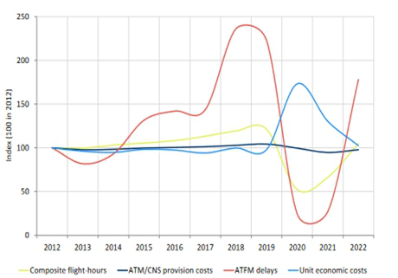
Figure 1 shows that from 2012 to 2019, European air traffic experienced sustained growth (green line), accompanied by a significant rise in Air Traffic Flow Management (ATFM) delays (red line), peaking in 2018. Following a brief recovery during COVID-19, delays are again climbing rapidly. The rising unit costs of ATFM delays have outpaced the reductions in ATM/CNS provision costs (dark blue line). This has led to a relatively stable unit economic cost between 2012 and 2019, encompassing both the provision
Cost-Effectiveness of the “Digital Air Traffic Controller” 33
cost per composite flight-hour and the unit cost of ATFM delays. Thus, recent productivity gains have been offset by increased delays, which now account for 20 % of the economic costs of European air traffic control (EUROCONTROL, 2024b).
Figure 1: Long-term trends in traffic, ATM/CNS provision costs and ATFM delays. (Source: EUROCONTROL, 2024b).
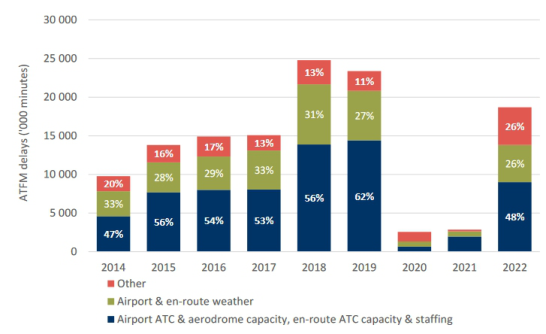
Over the last decade, capacity constraints and staffing shortages in air traffic control have been major contributors to delays in European airspace, as shown in Figure 2. Each minute of delay costs airlines an estimated €119, covering expenses such as crew wages, fuel, and maintenance (EUROCONTROL, 2024b). In 2023, approximately 18 million minutes of en-route delays occurred in airspace managed by EUROCONTROL (EUROCONTROL 2024c), with 49 % of these delays stemming from air traffic control constraints (EUROCONTROL, 2024b). In 2022 en-route delays costed airlines around €1.9 billion (EUROCONTROL, 2024c). A system capable of significantly reducing such delays could lead to substantial cost savings in air traffic management, with the potential for rapid amortization.
Figure 2: Changes in main reasons for ATFM delays (2014–2022) (source: EUROCONTROL, 2024b).
In an increasing number of work environments, humans are collaborating with AI (artificial intelligence) systems (Acemoglu et al., 2022). AI systems are particularly effective in tasks where stable, systematic relationships exist between inputs and decisions (Webb, 2020). Consequently, AI holds significant potential to alleviate the air traffic controller shortage in the long term, reduce employment costs, and accommodate higher traffic volumes. Once staffing shortages are addressed, productivity gains could be passed on to airlines in the form of reduced Air Traffic Control (ATC) charges. EUROCONTROL estimates that AI applications in air traffic management could deliver efficiency gains of 20–30 % (EUROCONTROL, 2019).
Our paper analyzes the economic cost-effectiveness of “Digital ATCO” an AI-supported system developed by the LOKI project. Beyond safety considerations, cost-effectiveness is essential for the successful implementation of such a system. In a typical air traffic control setup, each sector has a designated capacity (or theoretical maximum)—for example, 60 flights per hour. At peak times, this capacity may be reached, while at other times, traffic remains below this threshold. Currently, two air traffic controllers (ATCOs) collaborate to manage a sector, jointly overseeing flights with a clear division of responsibilities. The “Digital ATCO” system aims to significantly reduce the workload of ATCOs. This reduces staffing requirements for the same operational capacity, allowing the reallocation of personnel toward capacity-building efforts and addressing staffing needs where they are most critical to avoid delays.
The Digital ATCO The DLR funded research project LOKI of the German Aerospace Center aims to analyse approaches of collaboration between humans and AI systems, the investigation of metrics for recording the condition of the human partner, the development of prototypes of domain-specific AI systems, the development of guidelines for the design of the interface between users and AI systems and the derivation of requirements for users of AI systems for the selection and training of aviation personnel. Part of this Project is also the development of a Digital ATCO prototype based on AI as a team partner called Digital Interactive Reliable Controller (DIRC).
DIRC actively collaborates with a human ATCO on air traffic control tasks in the upper area control (en-route sector), forming a team of human and AI-based systems. DIRC is able to automatically identify and solve conflicts or coordinate handover of aircraft to adjacent en-route sectors. It uses AI methods and techniques to make independent decisions based on continuous information analysis from various sources. It then translates this information into actions through its central decision-making module and can implement the selected solution. DIRC does not need approval from human ATCOs for every action. However, it is essential to communicate with humans to ask for help or share information to work together to find a solution when necessary or requested by humans.
The shortlisted functionalities are handling flight, traffic assessment, conflict detection and resolution, and attention guidance, which are selected
Cost-Effectiveness of the “Digital Air Traffic Controller” 35
based on the ATCO task analysis and feedback from workshop with ATCOs. The first functionality is “handle flight”. It enables DIRC to provide guidance to a flight that passes through a sector and perform related tasks such as receiving on the frequency, level change and send over to the next sector. The second functionality is “traffic assessment”, which enables DIRC to generate an estimate of the traffic situation and provides capability to judge a flight under its control is becoming complex i.e. passes through a congested section of the sector or high probability of developing conflict and DIRC cannot handle it safely. The third is “conflict detection”, and resolution, which can also be considered as a primitive operation as it allows to maintain safe separation between aircraft and in the event of potential loss of separation take a corrective action. The last functionality considered is “attention guidance”, with the primary purpose to grab attention of the human ATCO on special events that require immediate intervention (Tyburzy et al., 2024).
Initial tests in the DLR funded research project DIAL with real controllers have shown that a single controller can handle up to 80 % of the maximum traffic of a sector with the support of DIRC. There was no negative impact on safety, operational performance or environmental impact. Without DIRC, this would require two controllers (Hunger et al., 2024). Based on these analyses, we currently use a conservative estimate of 35 % workload takeover by DIRC. For a single controller with DIRC to take over 100 % of a sector, the sectors would have to be reorganized or reduced in size and traffic.
Cost-Effectiveness of Air Navigation Service Providers and the Digital ATCO To evaluate the economic impact of the Digital ATCO, we assess its cost- effectiveness by examining whether its implementation improves the cost- benefit ratio of air traffic control. Our analysis considers both the Air Navigation Service Providers (ANSPs) and the broader air transport system. The introduction of the Digital ATCO would likely be most feasible if the benefits for ANSPs outweigh the associated implementation costs. The primary question is to determine the conditions under which cost savings, compared to the current air traffic control system, can be realized.
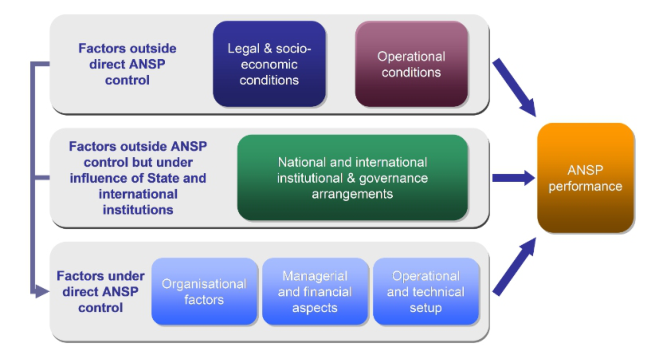
The cost-effectiveness of ANSPs can generally be influenced on multiple levels. The factors directly under the control of the ANSPs, highlighted in blue in Figure 3, include:
Organization (e.g., recruitment and training, personnel management, optimization of internal processes),
Operations and Technical Equipment (e.g., air traffic management, human-computer interaction, investment decisions). Especially the design of operation and technical setup can influence labor productivity and costs (EUROCONTROL, 2024b). That is where the Digital ATCO would step in.
Figure 3: Factors influencing the cost efficiency of air navigation service providers (ANSPs) (source: EUROCONTROL, 2024b).
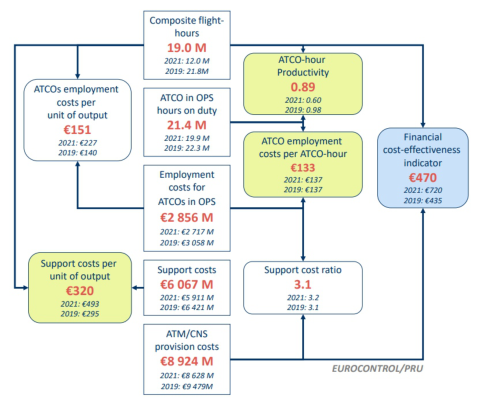
According to Figure 4, in 2022 approximately 32 % of air traffic control costs were direct expenses for employing air traffic controllers, while around 68 % were allocated to supporting functions (EUROCONTROL, 2024b). For 19 million composite flight-hours, employment costs for ATCOs amount to €2.9 billion, with infrastructure costs totaling approximately €6 billion. This results in employment costs of €133 per composite flight-hour, with total costs reaching €470 per flight-hour.
Figure 4: Cost effectiveness of air navigation service in Europe, 2022 (source: EUROCONTROL, 2024b).
These numbers highlight substantial potential for cost savings. By maintaining the current quality of Air Traffic Flow Management (ATFM)
Cost-Effectiveness of the “Digital Air Traffic Controller” 37
while reducing the ATCO staffing requirement by 35 %, Digital ATCO potentially reduces employment costs, in a tight labor market. EUROCONTROL divides ATCOs into ACC and APP + TWR ATCOs. ACC stands for area control center and ACC ATCOs, thus, are also known as en- route ATCOS. In 2022 en-route ATCOs account for 55 % of all ATCOs in operations (EUROCONTROL, 2024b). According to Figure 4, employment costs for en-route ATCOs are €1.6 billion (55 % of employment costs for all ATCOs in OPS). Considering the estimated reduction in staffing requirements of 35 % by the Digital ATCO, this results in savings up to €560 million. Consequently, for the system to be cost-effective at the ANSP level, the combined average annual investment and service costs of Digital ATCO should not exceed €560 million.
ANSPs could reassign some of the released controllers to build a reserve workforce, enhancing flexibility in managing staffing shortages. Additionally, these controllers could support capacity-building initiatives, such as reducing the size of airspace each ATCO is responsible for managing. Accounting for the costs of delays of €1.9 billion per year, €900 million of which are caused by ATCO capacity and staffing issues, and applying the 35 % anticipated productivity gain from the Digital ATCO, this strategy could result in annual savings of €360 million for airlines (EUROCONTROL, 2024c). Airlines, in turn, might pass a portion of these savings on to consumers through lower airfares, stimulating demand. A share of this increased consumer surplus could be internalized by ANSPs via ATC charges, helping to amortize Digital ATCO investments. In Europe, navigation charges are collected by EUROCONTROL (specifically through the Central Route Charges Office, or CRCO) on behalf of ANSPs and member states (for details on air navigation charge calculations, see Castelli and Ranieri (2007)). Additionally, minimizing delays would yield broader benefits, including enhanced passenger satisfaction and reduced follow-up costs (European Consumer Centre Germany, 2024).
The main costs of introducing the Digital ATCO arise from investments incurred at the start of the implementation. While relatively low hardware costs are expected, the bulk of investment costs come from the acquisition of the AI assistance system. The development costs, which must be borne by the users, are particularly noteworthy. A comparable project to the Digital ATCO aiming to improve the ATCO environment is iCAS (iTEC Center Automation System). iCAS is an advanced software dedicated to make air traffic management more efficiently and safe. It helps ATCOs with tools like 4D trajectory management and integrated radar displays to predict flight paths, detect conflicts early, and improve situational awareness. By eliminating traditional digital control strips and streamlining operations, iCAS modernizes air traffic control (DFS, 2023). The costs of iCAS – including development costs – amount to €300 million for Germany’s ANSP Deutsche Flugsicherung (DFS) (Eiselin, 2023; EUROCONTROL, 2024d). Due to economies of scale, it can be assumed that with widespread adoption in the EUROCONTROL area, the investment costs for additional users will decrease significantly.
However, significant costs may also arise during implementation. These could stem from internal personnel costs on one hand, and from the engagement of external service providers on the other. Additionally, costs for adapting the system are a potential driver of implementation expenses, as the assistance system must be compatible with existing systems for monitoring, securing, and optimizing air traffic. Additional potential costs may arise from recurring software updates or further development of the assistance system. However, the continuous updating of an AI system requires ongoing maintenance and support to ensure it remains stable and secure. Security measures must also be developed and adapted for the assistance system and possible updates. Additionally, expenses are expected for the training and further education of air traffic controllers (and pilots). New system versions, in particular, may require training for end users to ensure effective use of new functionalities.
A rough estimate of the upper bound for the total investment volume of the Digital ATCO can be derived by using the costs associated with the implementation of Enterprise Resource Planning (ERP) systems as a reference. Similar to the Digital ATCO, ERP systems are implemented organization-wide and involve expenses for software acquisition as well as costs during the rollout phase, such as training and customization. As a guideline, these costs typically range between 1–4% of annual revenue, including purchase costs, implementation costs and operating costs over 5–10 years (Ippolito, 2024; Wood, 2024; ERP Scout, 2024; Panorama Consulting Group, 2011). The annual revenue of the ANSPs under EUROCONTROL adds up to €9.8 billion in 2023 (EUROCONTROL, 2024e). Consequently, the total investment costs could be located on a rather large interval between €98 million and €393 million.
As discussed before, in the long term, Digital ATCO potentially reduces annual employment costs for ANSPs by up to €560 million. The Digital ATCO also has the potential to reduce annual delay costs for airlines by €360 million. These numbers are close to the upper bound of the estimated total investment costs for the Digital ATCO and suggest significant cost- effectiveness of the investment.
CONCLUSION
The implementation of the Digital ATCO represents a transformative step in the evolution of air traffic management. By allowing air traffic controllers to manage increased volumes efficiently, the system not only addresses immediate staffing shortages but also offers a scalable solution that can grow with anticipated rises in air traffic demand. This technology fosters operational cost-effectiveness and promotes a higher level of resilience in air traffic management, ultimately contributing to more reliable and affordable air travel for both providers and consumers.
Investing in the Digital ATCO, even at the upper end of the estimated cost range (€393 million), is highly cost-efficient when considering the €360 million in delay costs that could be saved annually. A substantial reduction in delays not only offsets the initial investment but also delivers long-term
Cost-Effectiveness of the “Digital Air Traffic Controller” 39
economic and operational benefits for airlines, ANSPs, and passengers alike. In the long term, air navigation service providers could reduce annual personnel costs by €560 million in Europe.
In the broader context, the successful deployment of the Digital ATCO depends on its seamless integration into existing air traffic management systems. Ensuring compatibility with current communication, navigation, and surveillance infrastructure, as well as the operational frameworks within which ATCOs operate, remains a priority. Additionally, the adaptation of this system may necessitate policy changes to address new safety, regulatory, and operational standards. As the system becomes more prevalent, ongoing evaluations will be crucial to measure its real-world cost savings and overall impact on air traffic efficiency and safety.
A primary limitation of this study is that DIRC remains in a prototype stage and is still under development. Consequently, its functionalities have yet to be fully evaluated in real-world contexts. Furthermore, additional workshops are required to gain a more comprehensive understanding of DIRC’s capabilities, thereby enabling a thorough assessment of its performance. Future research should focus on assessing the Digital ATCO’s performance under various operational conditions and determining its effectiveness across diverse airspace sectors and traffic densities. In parallel, continuous improvements in artificial intelligence and machine learning are expected to further enhance the system’s capabilities, allowing it to handle increasingly complex tasks with greater accuracy and reliability. The Digital ATCO thus not only presents a compelling business case but also opens pathways for continued innovation in the aviation industry, with far-reaching economic benefits.
REFERENCES
Acemoglu, D., Autor, D., Hazell, J. and Restrepo, P. (2022) ‘Artificial intelligence and jobs: Evidence from online vacancies’, Journal of Labor Economics, 40(1), pp. 293–340. Airliners.de (2023) ‘Fehlende Fluglotsen: DFS intensiviert Ausbildung’, 28 June.
Available at: https://www.airliners.de/fehlende-fluglotsen-dfs-intensiviert-ausbil dung/69514 (Accessed: 8 January 2025). Castelli, L. and Andrea R. (2007) ‘Air navigation service charges in Europe’ Seventh USA/Europe Air Traffic Management Research and Development Seminar. DFS (Deutsche Flugsicherung) (2023) ‘The next system generation takes over at
the DFS control centre in Munich’, 30 June. Available at: https://www.dfs.de/ homepage/en/media/press/2023/30-03-2023-the-next-system-generation-takes- over-at-the-dfs-control-centre-in-munich/?utm_source=chatgpt.com (Accessed: 8 January 2025). Eiselin, S. (2023) ‘Wie ein neues System die Arbeit der Flugsicherung erleichtert’, Aerotelegraph, 16 July. Available at: https://www.aerotelegraph.com/wie-ein-ne ues-system-die-arbeit-der-flugsicherung-erleichtert (Accessed: 8 January 2025). ERP Scout (2024) ‘Was kostet ein ERP System?’. Available at: https://erpscout.de/er
p-kosten/ (Accessed: 8 January 2025). EUROCONTROL (2019) ‘Why artificial intelligence is highly relevant to air traffic control’, 29 November. Available at: https://www.eurocontrol.int/article/why-arti ficial-intelligence-highly-relevant-air-traffic-control (Accessed: 8 January 2025).
EUROCONTROL (2023) ‘European Network Operations Plan 2023-2027’, 4 July.
Available at: https://www.eurocontrol.int/sites/default/files/2023-07/eurocontrol- nop-2023-2027-ed1-2.pdf. EUROCONTROL (2024a) ‘Standard Inputs for Economic Analyses’, 24 May.
Available at: https://www.eurocontrol.int/publication/performance-review-repor t-prr-2023. EUROCONTROL (2024d) ‘ANSPs individual cost-effectiveness performance’.
Available at: https://ansperformance.eu/economics/ace/ansp-ceff/ (Accessed: 8 January 2025). EUROCONTROL (2024e) ‘ANSP Financial Dashboard’. Available at: https://ansp erformance.eu/economics/finance/ (Accessed: 8 January 2025). Europäisches Verbraucherzentrum Deutschland (2024) ‘Entschädigung nach Flugverspätung oder Flugausfall: Wer hilft wirklich, wer zockt ab?’, 19 August. Available at: https://www.evz.de/reisen-verkehr/reiserecht/flugzeug/entschaedigu ng-nach-flugverspaetung-oder-flugausfall-wer-hilft-wirklich-wer-zockt-ab.html (Accessed: 8 January 2025). Gelhausen, M. C., Berster, P. and Wilken, D. (2019) ‘Airport capacity constraints and
strategies for mitigation: A global perspective’, Academic Press. Hunger, R., Christoffels, L., Friedrich, M., Jameel, M., Pick, A., Gerdes, I., von der Nahmer, P. M. and Sobotzki, F. (2024) ‘Lesson Learned: Design and Perception of Single Controller Operations Support Tools’, in 21st International Conference on Engineering Psychology and Cognitive Ergonomics, EPCE 2024, held as part of the 26th HCI International Conference, HCII 2024, 14693, pp. 15–33. Springer Cham. Ippolito, J. (2024) ‘How Much Does ERP Cost?’, Projectline, 14 March. Available at:
https://www.projectline.ca/blog/how-much-does-erp-cost (Accessed: 8 January 2025). Panorama Consulting Group (2011) ‘2011 ERP REPORT’, Available at: https://cd n2.hubspot.net/hubfs/4439340/2011-ERP-Report.pdf. Tyburzy, L., Jameel, M., Hunger, R. and Böhm, J. (2024) ‘Empowering Human-AI
Collaboration in Air Traffic Control through Smart Interaction Design’, in 43rd IEEE/AIAA Digital Avionics Systems Conference (DASC), pp. 1–9. Webb, M. (2020) ‘The impact of artificial intelligence on the labor market’. Wood, L. (2024) ‘How Much Does ERP Cost?’, Software Connect, 20 August. Available at: https://softwareconnect.com/learn/erp-pricing/#what-is-erp- tco (Accessed: 8 January 2025).
LISTED IN THE AHFE DIGITAL BOOKSTORE CATALOGUE
Explore the complete digital volume
Human Interaction and Emerging Technologies (IHIET-AI 2025): Artificial Intelligence and Future Applications
Read this individual research paper free through the original publisher, or explore the full digital proceedings book.
ISBN 978-1-964867-37-3
Explore this ISBN in the AHFE Bookstore ↗Listed in the July 2026 bookstore catalogue; search by ISBN to confirm current availability · Digital book purchase optional