Andrew Thatcher, Mpho Lekitlane, Divia Riga (2021). Beyond Convenience: The Role of Emotions in the Adoption of Sustainable Technologies. In: Advances in Affective and Pleasurable Design. AHFE Open Access, vol. 14. https://doi.org/10.54941/ahfe100562
The slow adoption of sustainable technologies is cause for concern in an increasingly resource strained world. This study attempts to build on two main bodies of research: (1) a general technology adoption framework; i.e. the Unified Theory of Acceptance and Use of Technology (UTAUT) and (2) work on the psychological design for affect; i.e. affective design. The purpose of this study is to report on the development and psychometric properties of the scales that will be used to assess the adoption of the Interface® Urban RetreatTM carpets (a sustainable carpet using recycled materials and possessing biophilic characteristics) in a follow up study. The Semantic Differential Scale developed for these carpets produced a wide range of affective qualities. The scale did not, however, support the underlying structure of Evaluative, Potency, and Activity as proposed by Osgood et al. (1957). The UTAUT scales presented with reasonable to good internal reliability and with the exception of ‘perceived effort’, the subscales were correlated with intention to adopt. Based on these two preliminary studies, the scales will be revised and then administered to determine the complementary roles of the utilitarian factors (based on the UTAUT) and emotional factors (based on the semantic differential scale developed for this purpose).
Many market innovators and designers will be familiar with the experience that not every effectively engineered innovation is successful in the marketplace. There is little reason to suspect that sustainable technologies should be any different from other types of technologies. Despite the development of numerous sustainable technological innovations a number of authors have warned about the slow adoption of these technologies by States and individuals (Hekkert et al., 2008; Hensley et al, 2009; Kassie et al., 2009). There are many factors that determine whether a specific technology is a success or a failure. The most common reason for the success (or lack therefore) is often (sometimes incorrectly) attributed to the cost of a particular technology (Lenhart et al., 2003). While cost is obviously an important component, Green (2001) suggests that the adoption and use of technology is less about cost and the technical qualities of the technology and more about being socially bound; being determined by access to education and training, the perceived application within a society, and by individual ability. Douthwaite et al. (2001) noted that an overlooked component of why innovative technologies fail is because they neglect to take into account the role of the user in the adoption process.
There are a number of reasons why people would not adopt a technology or not continue to use a technology. First, people need to know about the technology. This is largely about marketing the technology, making sure that the potential user population gets to know about a particular technology (technology developers and governments have a role to play here). Second, people might know about the technology but they see little value in making a change. Change is associated with costs which include sourcing costs (e.g. getting access to technology often has costs associated with finding suppliers), monetary costs (of buying and installing new technology), lost opportunity costs (it takes time to learn to use a new technology), and risk-taking (not all new technologies perform as advertised). Again, this is primarily about marketing to ensure that appropriate and accurate information about the benefits (and problems) reach the potential user population to help them make informed decisions (again, technology developers and governments have a role to play here). Third, people access the technology but soon stop using it. This could be due to problems of non-intuitive design, training, operational support (e.g. a hydrogen car needs a hydrogen fuel support system), or maintenance amongst other reasons. Finally people could access technology but not use it properly (e.g. use a sustainable technology in a non-sustainable way). This paper focuses on how people adopt and accept sustainable technologies. How people use green technologies and whether they use them in a way that supports sustainable behaviour falls beyond the scope of this paper but are also important area to consider.
AFFECTIVE DESIGN Jordan (2000) makes a distinction between functional elements (i.e. usability) and aesthetic components (including pleasure and other emotional experiences). Another branch of technology adoption has therefore also considered the emotional or aesthetic appeal of the innovation or technology. This is an area of study broadly referred to as “affective design”. In general, affective design considers the full range of human emotional experience in a variety of contexts. Affective design (and design for emotion in general) considers a far greater range of connections for emotion and interactions with products and other systems, both pre- and post-adoption. This paper focuses on exploring affect up to the point where the decision to acquire/adopt a particular product or system is taken. Theories of affective design emphasise the relationships between the end user and the qualities of the technology. Affective design (Khalid, 2006) attempts to understand how a user’s feelings and emotions towards a product or system influence their likelihood of adoption. Affective human factors design focuses on maximizing positive experiences with products and systems. This is supported by a number of studies that have found that positive affect leads to the greater acceptance of a design (Helander, 2003; Sonderegger & Sauer, 2010), greater perceive usability (Ben-Bassat et al., 2006; Sauer and Sonderegger, 2009), and objectively better user performance (Sonderegger & Sauer, 2010). Previous evidence also suggests that designs that produce positive affect also tend to be perceived as having greater utilitarian impact (Ben-Bassat et al., 2006).
The most common method of assessing the emotional factors related to the design of a product is through a semantic differential scale The semantic differential scale technique makes use of a questionnaire where participants are asked to rate signs, words, or objects on bipolar scales (Osgood, et al., 1957). These bipolar scales are defined as contradicting adjectives at each end of the emotional range where participants are required to check off the position which best represents how well each adjective suits the target technology (Karlsson et al., 2003). Osgood et al. (1957) argued that the dimensions underlying the scales were Evaluation, Potency, and Activity. The Evaluative factor can be explained by the adjective pair “good-bad” in that it captures the amount of goodness or badness a person associates with a concept. (White et al., 2008). The Potency factor captures the amount of powerfulness or weakness associated with a particular concept, while Activity captures the amount of liveliness or quietness of the concept.
UNIFIED THEORY OF ACCEPTANCE AND USE OF TECHNOLOGY (UTAUT) Venkatesh et al. (2003) produced a theoretical framework that combined various technology adoption models (i.e. Technology Acceptance Model (Davis, 1989) and the Innovation Diffusion Theory (Rogers, 1962) together with the model of PC utilisation (Thompson et al, 1991), called the Unified Theory of Acceptance and Use of Technology (UTAUT). The central component of the UTAUT is the Technology Acceptance Model (TAM) which is one of the most widespread and empirically tested models of technology acceptance. The TAM is loosely based on Ajzen and Fishbein’s (1980) psychological Theory of Reasoned Action. The TAM replaces many of the attitudinal components in the Theory of Reasoned Action with only two technology-related attitudes, perceived usefulness of the technology and perceived ease of use of the technology. Davis (1989) argued that high positive ratings of these two attitudes would lead first to intentions to use a particular technology and then, if the intention levels were high, this would lead directly to the actual use (behaviour) of that technology. The TAM has been tested successfully on a wide variety of technologies including general information systems, computer applications, email, telemedicine technology, the World Wide Web, and mobile phone applications, amongst many other technological applications. In the original conceptualisation of the TAM, Davis (1989) used a “catch all” factor called external variables to incorporate unexplained influences on the relationships. Typical external variables used in previous studies included past experience, gender, age, and previous education. Venkatesh and Davis (2000) extended the original TAM (i.e. TAM2) to include social influences (i.e. social norms, voluntariness, and image), perceived instrumental factors (i.e. perceived relevance and perceived output quality), and the user’s past experience.
Performance Expectancy
Effort Expectancy
Behavioural Intention
Actual use of technology Social Influence
Facilitating Conditions
Voluntariness Age Gender Experience
Figure 1. Unified Theory of Acceptance and Use of Technology – UTAUT (Adapted from Venkatesh et al,
Figure available in the original PDF paper.
2003; p. 447).
The Innovation Diffusion Theory is a decision-theoretic model with five predictors: relative advantage, compatibility, complexity, trialability and observability. According to Karahanna et al. (1999) relative advantage is an approximate for perceived usefulness and complexity is interchangeable with perceived ease of use as proposed by the TAM. Compatibility is also a close approximate of perceived relevance in TAM2 and observability is conceptually similar to perceived output quality in TAM2. It is argued that trialability is the only attribute within Innovation Diffusion Theory that was not encompassed by the expanded TAM2 and is also not included in the UTAUT. Essentially, the model of PC utilisation included two aspects absent from the earlier models; job-fit and facilitating conditions (i.e. objective factors that make a specific technology easy to use). Venkatesh et al. (2003) argued that many of the concepts contained within these models were conceptually similar (see Table 1), but found moderate to poor empirical support for each of the theoretical models applied separately. The UTAUT (see Figure 1) is comprised of four determinants (i.e. performance expectancy, effort expectancy, social influence, and facilitating conditions) that predict intentional behaviour, which predicts actual behaviour. In addition, the model hypothesises that there are four moderating factors (i.e. gender, age, experience, and voluntariness) that influence the strength of the relationships between the determinants and behavioural intention. Venkatesh et al. (2003) found good empirical support for the UTAUT in two organisational settings.
Table 1: Comparison between UTAUT determinants and variables contained in other technology acceptance theories
Table available in the original PDF paper.
Determinant/Variables Theory Empirical evidence Performance Expectancy
Perceived usefulness TAM/TAM2 Davis (1989) Relative advantage IDT Moore & Benbasat (1991)
Job-fit MPCU Thompson et al (1991) Perceived relevance TAM2
Effort Expectancy Perceived ease of use TAM/TAM2 Davis (1989)
Complexity IDT/MPCU Moore & Benbasat (1991) Social Influence
Subjective norms TAM2 Thompson et al (1991) Social factors MPCU
Image TAM2 Facilitating Conditions
Compatibility MPCU Facilitating conditions IDT
TPB Taylor & Todd (1995)
Perceived behavioural control TAM=Technology Acceptance Model; TAM2= Extended Technology Acceptance Model; MPCU= Model of PC Utilisation; IDT=
Innovation Diffusion Theory
THE ADOPTION OF SUSTAINABLE TECHNOLOGIES Applying affective design to sustainable technologies, Midden et al. (2007) considered four roles: 1) intermediary role (i.e. getting people to use sustainable technology); 2) amplifier role (i.e. technology amplifies the attainment of sustainability goals but also amplifies the use of resources); 3) determinant role (i.e. technology shapes behaviour by its presence/absence or affordances/constraints); and 4) promoter role (i.e. technology specifically influences behavioural choices). This paper is concerned with understanding products (i.e. technology) from an intermediary role perspective by understanding how affective properties might influence decisions to adopt sustainable technologies. Other than theoretical work (e.g. Thatcher, 2012) there are no studies that have looked at the impact of aesthetic and effective properties on the adoption of sustainable technologies. There is only a limited amount of published work that has applied UTAUT or its predecessor theories to sustainable technologies. Arkesteijn and Oerlemans (2005) looked at an extended version of the TAM by considering technological factors, individual factors, and economic factors associated with the adoption of green electricity. They found that ease of switching, knowledge of the energy sources, attitudes towards the environment, and willingness to pay were all important determinants of intention to adopt green energy. In other work on the adoption of green electricity, Gerpott and Mahmudova (2010) found that a consumer’s attitudes towards the environment were an important determinant of adoption, together with the influence of close social contacts, although they found there were differences among
high power uses and moderate power users. Moons et al (2009) used a combination of the Innovation Diffusion Theory and the Theory of Planned Behaviour (a derivative of the Theory of Reasoned Action) to examine people’s adoption of electric vehicles. The found that aspects such as perceived complexity, relative advantage, compatibility, social norms, and perceived behavioural control were all important determinants in the adoption of these cars. In addition, they found that past experiences and emotional reactions to these cars were also important determinants. Hong et al (2013) applied the same theoretical framework to understand the adoption of hybrid vehicles in Malaysia. They found that perceived behavioural control, relative advantage, and compatibility were the best predictors of adoption intentions.
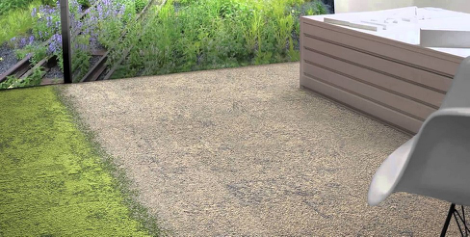
Given the dearth of literature on the adoption of sustainable technologies, in this paper we describe two independent studies that were used to develop scales to assess the applicability of the UTAUT and affective design. The target sustainable technology in these studies was the Interface® Urban RetreatTM range of carpets (see Figures 2 and 3 for examples of the carpets in this range). These carpets were considered a sustainable technology because 81% of the yarn recycled, 35% of which is post-consumer (from used fishing nets), the backings are made from 50% recycled products (mostly backings from other carpets), and the adhesive method to attach the carpets to the underlying floor is 100% volatile organic compound free. The Urban RetreatTM range has been verified by several third parties on its reduced impact on the environment. The Urban RetreatTM range was also specifically chosen because these carpets were designed to look like products from nature (a concept known as biophilia – Wilson, 1984). The research questions in this paper were (1) to report on the development and psychometric properties of the Semantic Differential Scale used to assess affective qualities of the Urban RetreatTM range and (2) to report on the development and psychometric properties of the UTAUT dimensions used to assess the intention to adopt the Urban RetreatTM range.
Study 1: Semantic Differential Scale – affective factors In Study 1, Auty and Elliot’s (1998) generic semantic differential scale was adapted based on in-depth interviews with two carpet experts and a focus group with six employees (two interior designers and four architects) from an architecture firm that had already installed these carpets. The scale consisted of 25 word-pairs that required respondents to respond on a 7-point scale ranging from -3 to +3, with 0 indicating the neutral point The biographical questions and adapted scale (i.e. the questionnaire) were administered in paper-based form to a sample of employees from a range of industries (i.e. manufacturing, clothing, architecture, and education). Attached to the questionnaire was a short visual presentation of the Interface® Urban RetreatTM carpet range, provided by the South African distributors. A total of 219 completed questionnaires were returned from 236 that were distributed (giving a response rate of 93%). The sample consisted of 101 males and 118 females, with a mean age of 32.65 years (SD = 10.17), and 96 respondents having their first language as English (84 respondents used isiZulu as their first language, but all respondents worked in organisations where the medium of communication was English). The respondents came from a wide variety of job positions including students (N=41), operators (N=26), managers (N=25), team leaders (N=16), supervisors (N=12), and administrative staff (N=11).
Study 2: UTAUT factors In Study 2, the UTAUT scales published by Venkatesh et al. (2003) and Marchewka et al. (2007) were adapted to relate to the sustainable carpet. These adapted scales were shown to two experts in the field who verified the consistency of the items with the underlying theory. A pilot study was conducted prior to data collection to evaluate the reliability and face validity of the adapted UTAUT scale. The questionnaire was administered to 15 employees in an organisation. This resulted in several changes to the precise wording of the items. The final scale consisted of 3 items each for the perceived performance, perceived effort, social influences, facilitating conditions, and intentions subscales. Attached to the questionnaire was information on the carpets that respondents were required to read. This information described the characteristics of the carpets as well as pictures representing the carpet range and was supplied by the South African distributors of the carpets. The adapted scales were administered electronically to a sample of 150 employees working in a law firm that was considering installing Interface ® Urban RetreatTM carpets. A total of 114 responses were received (giving a response rate of 76%). The sample consisted of 31 males and 82 females, with a mean age of 43.15 years (SD = 12.63), and 71 respondents having their first language as English (all respondents worked in organisations where the medium of communication was English). The sample was well- educated with 44 respondents having completed a University education and a further 23 respondents having completed a post-matriculation diploma. The job positions included attorneys and candidate attorneys (N=27), directors and managers (N=22), and administrative staff (N=63).
Both studies captured biographical information for descriptive purposes. Nisbet et al’s (2009) Nature-relatedness scale was also administered in both studies. This was a scale of 20 questions that asked each participant to rate how well each item described them using a 5-point scale ranging from 1 (disagree strongly) to 5 (agree strongly). Higher scores indicated a stronger cognitive, affective, and physical connection with nature. The newly developed scales and subscales were correlated with the Nature-relatedness scale to check that they were related to environmental sustainability. In Nisbet et al.’s (2009) original study, they found good internal reliability (a Cronbach’s alpha of .87), good test-retest reliability (correlations between .66 and .85), and good face validity.
RESULTS
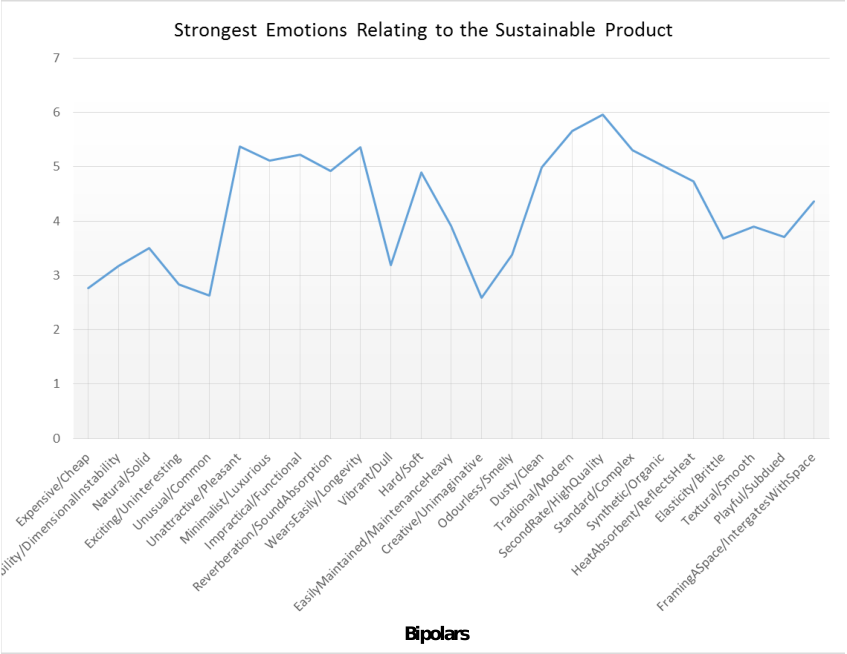
Study 1: Semantic Differential Scale – affective factors In Study 1, only those items that scored one standard deviation above or below the mean (i.e. a score of 5 and above or a score of 3 and below). The dominant affective characteristics of the Urban Retreat™ range were expensive (M=2.76), high quality (M=5.96), exciting (M=2.83) and creative (M=2.58), where it elicits a high sense of visual stimulation, has unusual (M=2.64) and interesting or complex (M=5.30) patterns and colours adding to the carpets stimulating effects. The carpets were perceived as pleasant (M=5.38) and luxurious (M=5.11) in appearance, functional (M=5.22), durable (longevity) (M=5.36), and modern (M=5.66) in design, and organic (M=5.02) (see
Figure 3). The internal reliabilities of the three dimensions’ of Evaluative (α =.36), Potency (α=.14), and Activity (α=.47) proposed by Osgood et al (1957) were poor suggesting an alternative factor structure for this particular product. Further exploratory factor analytic analyses would be suggested to uncover any underlying factor structure in the Semantic Differential Scale with respect to the Interface® Urban Retreat™ range.
Bipolars
Figure 3. Semantic Differential Scale pattern of responses in relation to Interface® Urban RetreatTM carpet.
Study 2: UTAUT factors In Study 2, means and standard deviations for the UTAUT items and subscales are presented in Table 2. The Cronbach alphas for the various UTAUT factors were α=0.43 for performance expectancy, α=0.52 for effort expectancy, α=0.57 for social influences, α=0.74 for facilitating conditions, and α=0.73 for intentions to adopt the sustainable technology. The facilitating conditions and intentions components of the UTAUT demonstrated acceptable internal reliability for social science research. Performance expectancy, effort expectancy, and social influences demonstrated questionable reliability. Performance expectancy (r=0.43; p<0.01), effort expectancy (r=0.20; p<0.05), facilitating conditions (r=0.32; p<0.01), and social influences (r=0.40; p<0.01) were, as expected, significantly correlated with intentions. Effort expectancy was significantly correlated with intentions, but the correlation was weak. Combined with the poor internal reliability, this would suggest that the perceived effort subscale requires further revision, and the performance expectancy and social influences subscales also require further investigation.
Table 2: Means and standard deviations for the UTAUT subscales
The internal reliability for the Nature-relatedness scale was 0.79 for Study 1 and 0.73 for Study 2. These compare favourably with Nisbet et al.’s (2009) original study. The correlations between the bi-polar pairs and the Nature- relatedness scale were generally small to moderate, ranging between 0.01 (the cheap/expensive bipolar) and 0.30 (the functional/impractical bipolar). The bipolar pairs that were significantly related to the Nature-relatedness scale were functional/impractical (r=0.30; p<0.001), playful/subdued (r=-0.27; p<0.001), odourless/smelly (r=-0.24; p<0.001), creative/unimaginative (r=-0.22; p<0.001), pleasant/unattractive (r=0.20; p<0.01), vibrant/dull (r=-0.26; p <0.01), exciting/uninteresting (r=-.21; p<0.01), dimensional stability/imbalance (r=-19; p<0.01), sound absorption/reverberation (r=0.17; p<0.01), textural/smooth (r=-0.17), natural multi-toned/solid tones (r=-0.16; p <0.05), longevity/wears easily (r=0.16; p<0.05), elasticity/brittle (r=-0.15; p<0.05), and easily maintained/heavy maintenance (r=-0.15; p <0.05). It is therefore expected that these are the qualities of the Interface® Urban RetreatTM carpet that respondents would have most closely associated with nature.
The Nature-related scale was significantly correlated with perceived effort (r=0.20; p<0.05), facilitating conditions (r=0.24; p<0.05), and intentions (r=0.20; p<0.05) although the correlations were fairly weak. The correlations with perceived performance (r=0.01; p>0.05) and social influences (r=0.12; p>0.05) were statistically non-significant. Given the wording of some of the UTAUT subscales and the fact that respondents have not yet physically encountered any Interface® Urban RetreatTM carpets, these results are not surprising.
DISCUSSION AND CONCLUSIONS The analysis of the Semantic Differential Scale’s bipolar descriptors, suggests that these cover a wide range of emotional and affective characteristics of the Interface® Urban Retreat™ range under investigation. The dominant affective characteristics that are considered when choosing an office carpet were expensive, high quality, exciting, creative, high visual stimulation, complex patterns, pleasant, luxurious, functional, longevity, modern, and organic. Affective and Pleasurable Design (2021)
Based on the significant correlations with the Nature-relatedness scale it is tentatively suggested that the functional, playful, odourless, creative, pleasant, vibrant, exciting, dimensional stability, sound absorption, textural, natural multi-toned, longevity, elasticity, and easily maintained qualities are those most closely associated with biophilia in these carpets (at least in this sample of respondents). It is interesting that only the functional, exciting, creative, pleasant, and longevity qualities overlapped between qualities that respondents felt strongly about in a carpet and those qualities that were related to nature. Nevertheless, these could be qualities that could be further developed to harness biophilic tendencies. The lack of support for Osgood et al.’s (1957) underlying dimensions of Evaluation, Potency, and Activity suggest that further exploratory factor analysis is required to determine the emergent factor structure of this Semantic Differential Scale.
The internal reliability measures for the UTAUT subscales was poor to good. The poorest measures of internal reliability were for the perceived performance, perceived effort subscales, and social influences subscales. Two of the items in the perceived performance subscale assess elements of personal workspace and one item assesses personal work performance, so it is unsurprising that the internal reliability is low. These items were developed to gain an understanding of the breadth of performance, but clearly these questions require rethinking. A careful reading of the items in the perceived effort subscale suggests that each item refers to the effort of another person rather than the individual effort of the person answering the items (e.g. perceived effort of the person installing the carpet, and perceived effort of the people responsible for maintaining and cleaning the carpet – there were no maintenance or cleaning staff in the sample). Therefore, it is unsurprising that this subscale demonstrated the lowest correlation with intentions. The items in these subscale will need to be carefully re-thought in order to relate to the effort that an individual employee would need to invest. For example, items could possibly refer specifically to the responsibility of each and every employee to avoid the carpet getting dirty, worn, or damaged. The items in the social influences subscale also demonstrated a poor internal reliability. These items assess the social influences from a wide range of people (i.e. superiors, peers, and clients) and it is quite likely that the individual influences of each of these groups would differ and so the poor internal reliability was understandable. The correlations of both perceived performance and social influences with intentions were both high and therefore there is an argument to be made for considering these subscales as they are currently worded.
The Semantic Differential Scale has demonstrated sound psychometric qualities and assesses a wide variety of emotional reactions to the Interface® Urban Retreat™ carpets. On the other hand, at least one of the subscales of the UTAUT (i.e. perceived effort) requires re-working and a further subscale (i.e. perceived performance) requires some reconsideration to improve coherence. One problem with the technology acceptance and diffusion theories is that they assume that the adoption of technology is based entirely on the perceived qualities of the technology. This is what Green (2001) refers to as “technological determinism”(p. 2). The future research will also explore whether the perceived qualities in the user are as important in determining the adoption of a sustainable product. After refinement, these measures will be administered to a new sample to assess the differential impact of utilitarian and affective qualities on the adoption of the Interface® Urban Retreat™ range. The next stage in the larger research project is to use the Semantic Differential Scale and the UTAUT scale to determine the relative contributions of affective and instrumental factors in the adoption (or intention to adopt) this sustainable product. Further investigations might also include concern for the environment and moral disengagement as possible moderator variables in these relationships.
REFERENCES
Ajzen, I. & Fishbein, M. (1980). Understanding attitudes and predicting social behavior. Englewood Cliffs, NJ: Prentice-Hall. Arkesteijn, K. & Oerlemans, L. (2005). The early adoption of green power by Dutch households: an empirical exploration of factors influencing the early adoption of green electricity for domestic purposes. Energy Policy, 33(2), 183-196. Auty, S., & Elliot, R. (1998). Social identity and the meaning of fashion brands. European Advances in Consumer Research, 3, 1-
10. Ben-Bassat, T., Meyer, J. & Tractinsky, N. (2006). Economic and subjective measures of the perceived value of aesthetics and usability. ACM Transactions on Computer. Human Interaction, 13(2), 210–234. Davis, F. D. (1989). Perceived usefulness, perceived ease of use, and user acceptance of information technology. MIS Quarterly,
13(3), 319-340. Douthwaite, B., Keating, J.D.H. & Park, J.R. (2001). Why promising technologies fail: the neglected role of user innovation during adoption. Research Policy, 30(5), 819–836. Green, L. (2001). Communication, technology and society. London: Sage Publications. Gerpott, T.J. & Mahmudova, I. (2010). Determinants of green electricity adoption among residential customers in Germany. Affective and Pleasurable Design (2021)
International Journal of Consumer Studies, 34(4), 464-473. Hekkert, M., Negro, S., Farla, J., Alkemade, F., Suurs, R., Weterings, R., Vandeberg, R. & van Alphen, K. (2008). The troublesome build up of low carbon innovation systems. Retrieved 15 November 2013 from the WWW: http://www.dime- eu.org/files/active/0/Hekkert.pdf Helander, M.G. (2003). Forget about ergonomics in chair design? Focus on aesthetics and comfort! Ergonomics, 46(13-14),
1306-1319. Hensley, R., Knupfer, S. & Pinner, D. (2009). Electrifying cars: how three industries will evolve. McKinsey Quarterly, 2009 (3), 87-96. Hong, Y.H., Khan, N. & Abdullah, M.M. (2013). The determinants of hybrid vehicle adoption: Malaysia perspective. Australian
Journal of Basic and Applied Sciences, 7(8), 347-454 Jordan, P.W. (2000). Designing pleasurable products: an introduction to the new human factors. London: Taylor & Francis. Karahanna, E., Straub, D.W. & Chervany, N.L. (1999). Information technology adoption across time: a cross-sectional comparison of pre-adoption and post-adoption beliefs, MIS Quarterly, 23(2), 183-213. Karlsson, S. A., Aronsson, N., & Svensson, K. A. (2003). Using semantic environment description as a tool to evaluate car
interiors. Ergonomics, 46(13/14), 1408-1422. Kassie, M., Zikhali, P., Manjur, K. & Edwards, S. (2009). Adoption of organic farming techniques. Evidence from a semi-arid region of Ethiopia. Environment for Development. Discussion paper Series, January 2009 Khalid, H. (2006). Embracing diversity in user needs for affective design. Applied Ergonomics, 37(4), 409-418. Lenhart A., Horrigan J., Rainie L., Allen K., Boyce A., Madden M., et al. (2003). The ever-shifting internet population: a new
look at internet access and the digital divide. The Pew internet and American life project. Retrieved 10 October 2013 from the WWW: http://www.pewinternet.org/Reports/2003/The-EverShifting-Internet-Population-A-new-look-at-Internet- access-and-the-digital-divide.aspx. Marchewka, J. T., Liu, C. & Kotiswa, K. (2007). An application of the UTAUT model for understanding student perceptions of using course management software. Communications of the IIMA, 7(2), 93-104. Midden, C.J.H., Kaiser, F.G. & McCalley, L.T. (2007). Technology’s four roles in understanding individuals’ conservation of
natural resources. Journal of Social Issues, 63(1), 155-174. Moons, I., De Bont, C.J.P.M., De Pelsmacker, P. & Standaert, A. (2009). The motivational determinants in adopting sustainable products. Proceedings of the 2009 International Association of Societies of Design Research Conference, 18-22 August, 2009, Seoul, South Korea. Moore, G.C. & Benbasat, I. (1991). Development of an instrument to measure the perceptions of adopting an information
technology innovation. Information Systems Research, 2(3), 193-222. Nisbet, E. K., Zelenski, J. M., & Murphy, S. A. (2009). The nature relatedness scale: linking individuals’ connection with nature to environmental concern and behaviour. Environment and Behavior, 41(5), 715-740. Osgood, C. E., Tannebaum, P. H., & Suci, G. J. (1957). The measurement of meaning. Urbana: University of Illinios Press. Rogers, E.M. (2003). The diffusion of innovations (5th Ed). New York: Free Press. Sauer, J. & Sonderegger, A. (2009). The influence of prototype fidelity and aesthetics of design in usability tests: effects on user
behaviour, subjective evaluation and emotion. Applied Ergonomics, 40(4), 670-677. Sonderegger, A. & Sauer, J. (2010). The influence of design aesthetics in usability testing: effects on user performance and perceived usability. Applied Ergonomics, 41(3), 403-410. Taylor, S. & Todd, P. (1995). Understanding information technology usage: a test of competing models. Information Systems
Research, 6(2), 144-176. Thatcher, A. (2012). Affect in designing for sustainability in human factors and ergonomics. International Journal of Human Factors and Ergonomics, 1(2), 127-147.
Thompson. R.L., Higgins, C. A., & Howell, J. M. (1991). Personal computing: toward a conceptual model of utilization. MIS Quarterly, 15(1), 124-143. Venkatesh, V. & Davis, F.D. (2000). A theoretical extension of the technology acceptance model: four longitudinal field studies.
Management Science, 46(2), 186-204. Venkatesh, V., Morris, M.G., Davis, G.B. & Davis, F.D. (2003). User acceptance of information technology: toward a unified view. MIS Quarterly, 27(3), 424-478. Wilson, E.O. (1984). Biophilia. Cambridge, MA: Harvard University Press.
LISTED IN THE AHFE DIGITAL BOOKSTORE CATALOGUE
Explore the complete digital volume
Advances in Affective and Pleasurable Design
Read this individual research paper free through the original publisher, or explore the full digital proceedings book.
ISBN 978-1-4951-2109-8
Explore this ISBN in the AHFE Bookstore ↗Listed in the July 2026 bookstore catalogue; search by ISBN to confirm current availability · Digital book purchase optional