Yun Hee Lee, Kyungbo Min, Ji Eun Kim, Yoolee Kim (2021). A Suggestion on the Development of Children’s Safe Clothes Design Using Complementary Colors Effect. In: Advances in Affective and Pleasurable Design. AHFE Open Access, vol. 14. https://doi.org/10.54941/ahfe100584
Some of pedestrian accidents are caused the drivers can’t distinguish pedestrians from surroundings, especially on the rainy/foggy/snowy days and nights. To reduce the pedestrian accidents, some children’s raincoats are designed with evident colors. And street cleaner’s uniforms use fluorescent fabric in the same purpose. According to the recent reports, flickering lights can improve object’s visibility more than fluorescent colors in the dark environment. The purpose of the proposed study is to develop safe clothes design applying complementary colors and blinking and moving LED lights. The implementation technology of complementary color and blinking LED effect for improving visibility of pedestrians that help to reduce the number of traffic accidents. This study contains 3 contents. First, before verifying a hypothesis that complementary color helps pedestrian to be recognized, it needs to be formed an algorithm. Inevitably, general color sensors hardly detect surrounding colors. Unless they are approached to subject’s surface to detect, its accuracy would not have enough effectuality. So, in this paper tries to find the algorithm that helps effective detecting by using camera. It includes computer vision technology and helps to find accurate surrounding environment’s colors. Second, this study developed a children’s raincoat applying technology that detect main color of the surrounding environment and show LED lights of its complementary color. The raincoat would help to reduce children’s traffic accidents on a rainy/foggy/snowy or any type of day. We also developed user scenario in order to explain several situations. The last, we conducted the examination to verify the effectiveness of technology and suggest the possibility of various clothes design. The method and steps for examination are as follows. Build 4 Color sensors(TSC3200S), LEDs, Arduino platform in rain coat. The color sensors attached front, back, right, left sides on raincoat detect each main color of surroundings. Then Arduino platform convert the detected color to complementary color then, show LEDs. This study would be useful to street cleaners’ uniform design who exposed to more danger and general pedestrians’ accessories.
According to car accident data in 2009, there were 18,092 car accidents whose victims were under 14-years old, 17,810 of preschool children and elementary school students, and 5,785 of middle school students. Among OECD countries, Korea has been ranked to 8th highest country and 1.2 times higher than the average of OECD countries` car accident (1.6 of 100,000).
Furthermore, it is well known that weather conditions are closely related with the number and severity of traffic accidents. The bad weather such as rain, fog and snow has been the cause of thousands car accidents year in and year out. It can be difficult for drivers to see other cars and pedestrians due to less attractiveness. Because the bad weather makes the light scatter and thus driver's ability to recognize the distance is decreased. Park, Jun-tae(2010) suggested to improve the driver’s visibility in order to reduce the probability of car accidents.
One of the ways to reduce children’ car accidents, some raincoats for children are designed with evident colors. The uniforms of street cleaner and police use fluorescent fabric in the same purpose. We found that pedestrian attractiveness improvement by color can be main approach to prevent car accidents in bad weather. It was found that the vivid or fluorescent color worked more effectively than achromatic and low chroma color on children's rain coat in terms of visibility and attractiveness.
STUDIES ON IMPROVEMENT OF VISUAL ATTRACTIVESS More specifically, in order to have validity, we examined the ways of improving driver's attractive through literature review, surveys. Ko, Sangkeun et al.(2012) intended to improve traffic safety in work zones using fluorescent orange color traffic signs. And it was found that the fluorescent color worked more effectively than other colors in terms of visibility and conspicuity in work zone sign system. Won-Jung Choi et al.(2013) analyzed that the main causes of traffic accidents while driving a car is the driver's visual distraction. To solve the problem, they focused on color visibility of driving information device and proved the correlation.
Song Mi, Lim et al.(2012) analyzed public uniform design focusing on typical public uniforms, such as police, fire fighter, and street cleaner in domestic and foreign countries. Its main color is dark PB(Purple blue), to mitigate visual fatigue and enhance comfort, and an accent color scheme is used, to effectively raise visual attention and safety. For example, the street cleaner uniform has high chroma and fluorescent colors, for increased attention during day and night work, to stress safety.
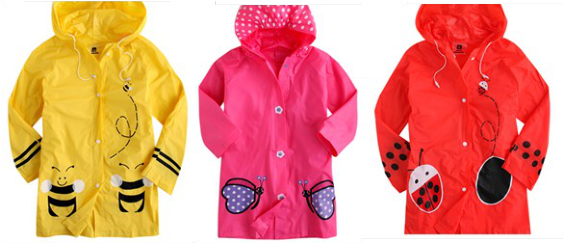
And in recent years, children rain coats with vivid colors can be seen more often in the same context (see Figure 1).
Figure 1. Examples of Children rain coats with vivid colors
To sum up, The color change is one of main strategies to improve attractiveness for preventing car accident through high pedestrian’s attractiveness.
DESIGN CONCEPT AND VALIDITY VERIFICATION Concept suggestion
As a result of prior research, we identifid that attractiveness of color is effective and universally applicable for reduction of car accidents. The purpose of this paper is to suggest children’s rain coat design for the prevention of car accidents and develop a working model. The design development, depending on the complementary color and blinking LED effects, were suggested.
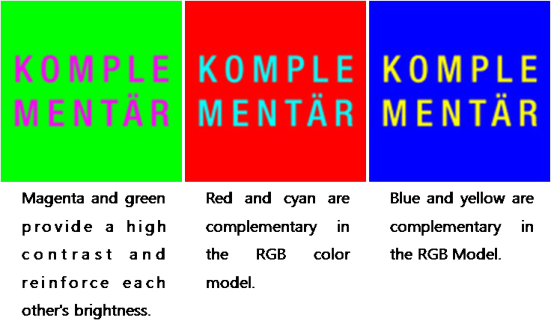
First, complementary colors are pairs of colors which, when combined in the right proportions, produce white or black. When placed next to each other, they create the strongest contrast and reinforce each other(see Figure 2).
Figure 2. Examples of complementary colors
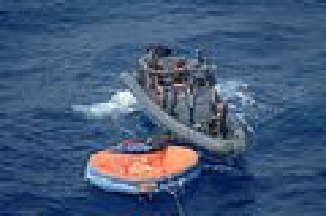
Complementary colors are widely used in art, design and also have more practical uses. Because orange and blue are complementary colors, life rafts and life vests are traditionally orange, to provide the highest contrast and visibility when seen from ships or aircraft over the ocean. Orange life rafts provide the highest contrast and visibility seen against blue water (see Figure 3).
Figure 3. Example of Complementary color application: orange color life raft over the ocean, blue color
Second, to enlarge effect, Complementary colors are widely used in art, design and also have more practical uses. Nowadays it is suggested that flickering lights effect is more effective than safety reflector (Hankyoreh newspaper, 1997). And Lee, jae-un invented and registered a patent a safety band with itself lighting emitting means applying LED for polices, street cleaners and construction workers (Lee, jae-un 2001). And nowadays LED began to grab the attention in fashion design due to functionality, creativity and uniqueness.
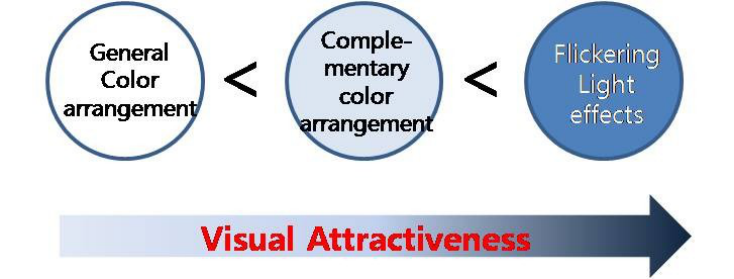
Based on prior research, we summarized the strategy on improvement of visual attractiveness, i) arrangement of complementary colors each other is effective than general, and ii) flickering light effects increase double in the aspect of visual concentration (see Figure 4).
Figure 4. Design strategy to improve visual attractiveness
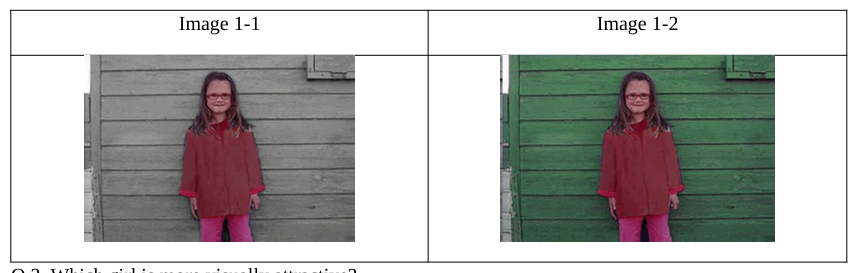
A experiment for concept verification To verify validation of suggested concept, the experiment was conducted through questionnaires. In total, 24 people participated, 13 men and 11 women. The mean age was 26. The participants were shown two pair of images and asked to compare and rate the visual attractiveness of each child using 5-point scale(from 1 to 5).
Table 1: Questionnaire for experiments
Q 1. Which girl is more visually attractive?
Compare and evaluate from 0 to 5 scales for Image 1-1, Image 1-2..
Q 2. Which girl is more visually attractive?
Compare and evaluate from 0 to 5 scales for Image 2-1, Image 2-2.
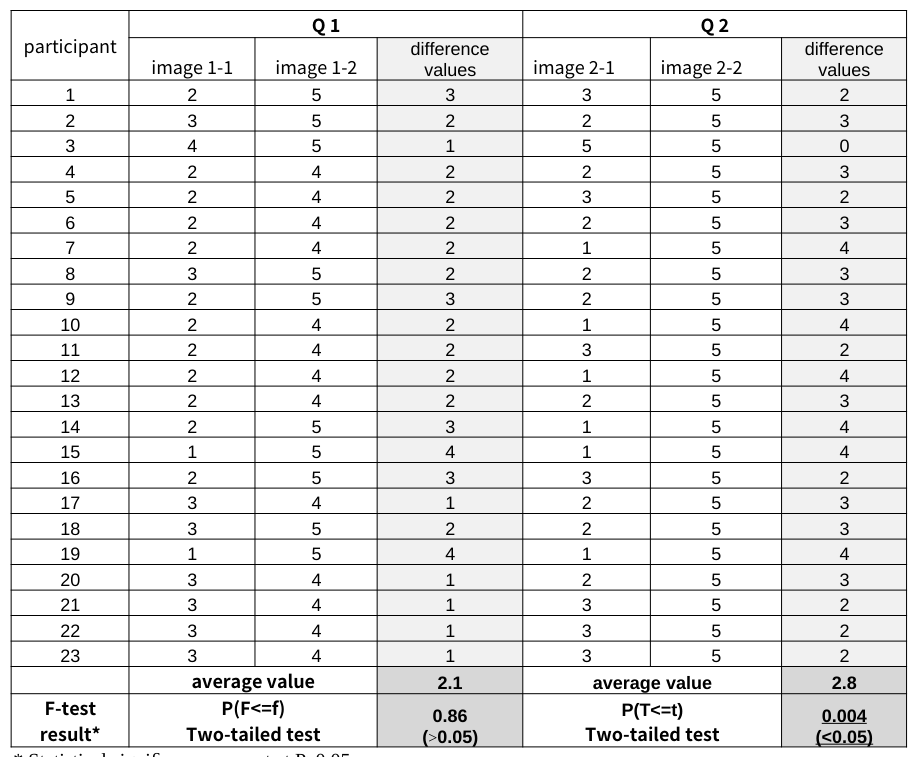
At first, to confirm the differences of effectiveness between2 experiments, difference values were calculated and compare the average values. And then F-test and T-test(Independent-sample t-test) were used to compare all variables between two groups(see Table 2). A null hypothesis of T-test is : average value Q1 = average value Q2.
UNDERSTADING TECHNOLOGY AND DESGIN DEVELOPMENT In order to make prototype of raincoat for special function application, several technologies have been examined and chosen to perform the features properly. There are a few issues to find appropriate solutions, one of them was which platform is suitable and easy to modify the system, another one was what output object to use for coloring, and the other was how to scan the major color of surrounding atmosphere.
Arduino
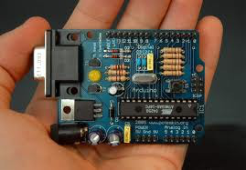
For the further research, platform has to be compatible with any other add-on, because this research is yet to finish. So, it is expected to apply unexpected functions or objects. For such reason, arduino is the most adaptable platform, since it has various applications and references. Arduino can sense the environment by receiving input from a variety of sensors and can affect its surroundings by controlling lights, motors, and other actuators. While in lab, it allows to try many things and to imagine various alternatives (see Figure 5).
Figure 5. Arduino platform and Examples
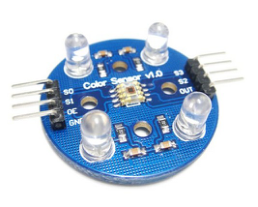
Color sensor Before converting and expressing complementary colors, detecting the original color is needed. True color recognition sensors “read” colors by emitting white light, analyzing three beams of reflected colored light (red, blue, green), then measuring the level of light reflected back on each wave length. Color sensors open up a field of diverse applications in sectors such as packaging technology, robotics, automation, quality assurance, and the process control industry. Simplify and speed up automated processes with diverse color sensors - for the detection of shade in rugs and textiles and of color markings on packaging and labelsi. And we use the color sensor, TCS3200D that is a appropriate sensor for arduino. It recognizes the color that it is exposed to. That recognized color is then used to select a complementary color which ends up being illuminated through the LED lights i.e. red light recognized with green light being illuminated. Color calculation would be followed the procedure below.
First, the sensor read each RGB values from surroundings. After that, the values should be calculated in 256 RGB color system. They couldn't exceed the 255, because the value on arduino code would represent 0 to 255. Then, complementary color could be computed by algorithm. It would figure out accurate values in way which is using biggest and smallest number. After adding two numbers, each complementary RGB value could be extracted by subtracting original value from added value before.
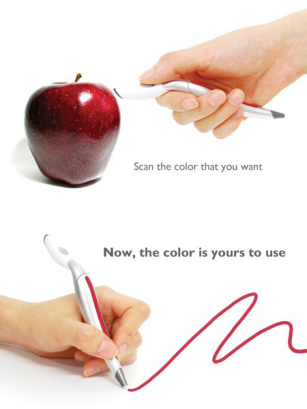
Figure 6. Color sensor(left) and color sensor with arduino boardFigure 7. Example of color sensor application : Chameleon Scarf 2.0 with FLORA
Figure available in the original PDF paper.
Figure 7. Example of color sensor application : ‘Color Sensing’ Pen Reproduces Any Color That It
Detects
RGB LED Strips For flicker effects, we considered RGB LED strips. RGB LED is universally applicable and useful in most industries including fashion.
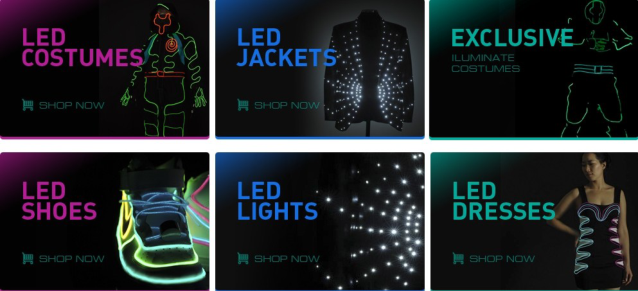
Figure 8. LED application cases in fashion(http://led-clothing.com/) LED clothing and accessories have become a highly spectacular and unique union of fashion and technology used for extra-modern show and performance. Due to LEDs placement and dynamic lighting effects, we are able to improve specific function, e.g. safety and create a unique design (see Figure 9).Figure 9. Examples of LED in fashion for certain function
Figure available in the original PDF paper.
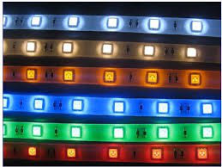
There is LED strip named ‘NeoPixel Digital RGB LED Weatherproof Strip’ which is able to control each RGB LED separately. It has lots of references and easy to apply diverse animations to show (see Figure 10).
Figure 10. Examples of LED strips in fashion CASE STUDY: DEVELOPMENT OF CHILDREN'S RAINCOAT IMPROVED ATRRACTIVENESS
Scenario and system design In this paper, we suggest a children’s safety clothes design for prevention of car accident that is expected to improve the attractiveness by applying complementary color and flickering lights. Through prior research and examination, we proved the validation of the suggested design concept and found possible technologies to realize.
Based on the findings, to specify the design concept, we conducted the case study: a children raincoat development. At first, we developed the user scenarios
Table 3: User scenarios for case study
Table available in the original PDF paper.
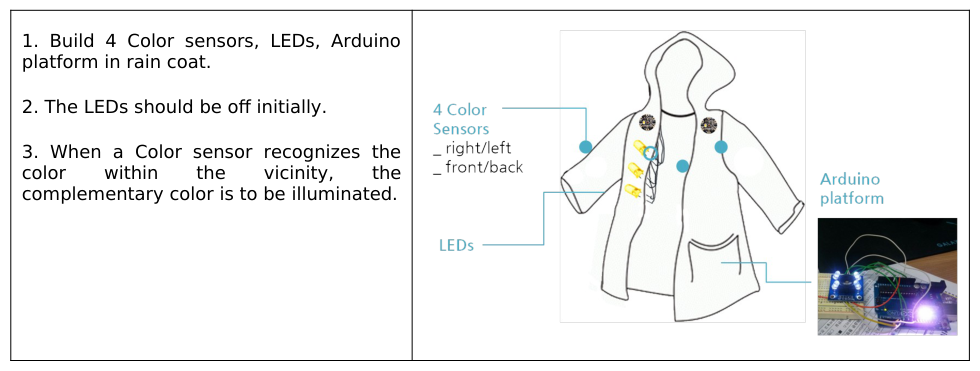
To realize the scenarios, system design including color sensors, LED strips, Arduino and Arduino source code were also developed (see Table 4, Table 5).
Table 4: System design for case studyTable 5: Arduino source code
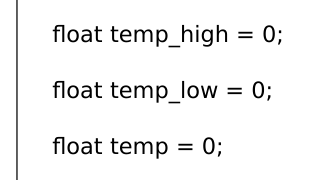
Serial.println("\ncomplementary color calculation has been finished");
According to the arduino source code, the words that named red, green, and blue in parenthesis on the top mean figures of converted color in 255 format. Each of these brings them from global to this function to convert.
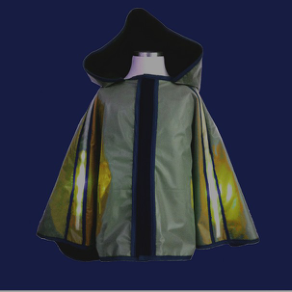
Lastly, we made a children’s raincoat to apply color sensor, Led strips and arduino platform and confirmed whether it operates well or not. As a result, the LED light colors were changed to complementary colors according to surrounding colors, i) if surrounding color is dark blue, LED light colors become yellow with animation effect and ii) if if surrounding color is red, LED light colors become green (see Figure 11). They are complement each other.
Figure 11. Results of Case study : children's safety clothes
CONCLUSIONS
From various literature reviews, complementary color and flickering LED light issues have been discussed. The methods which are discussed in this paper have adapted on rain coat and applied with several technologies. Examining the hypotheses above, we found complementary coloring and light flickering effects are effective to enhance pedestrians’ visibility. It means that the methods would be expected to be helpful to reduce the number of accidents in a day with low-level illumination.
There is limitation that the color sensor works only in several centimeters nearly attached to surrounding, so the problem is that it would hardly get precise color values from surrounding atmosphere. Accordingly, another technology is needed to effectively solve the problem, so further research that finds solution and its adaption would be computer vision technology. This technology on further research will be contained an algorithm. Its details is that cameras mounted on surface of clothe would take a shot of surrounding atmosphere periodically to analyze which color is mainly composed and which is average value, and extract complementary color based on calculation. In further progress, tests will be proceeded and with proper solution.
This study would be useful to street cleaners’ uniform design who exposed to more danger and general pedestrians’ accessories.
REFERENCES
Eon-Jeong Kim, Young-Sun Yoo. (2011), “A Study on the Method to Apply LED to Fashion Design and Its Expression Characteristic, Journal of the Korea Fashion & Costume Design Association” Vol. 13 No. 3, pp.15~29 Ko, sangkeun et al. (2012), “A conspicuity effect study of fluorescent orange color traffic sings for work zone application” , The
Journal of Korean Society of Civil Engineers, Volume 32 No. 5, pp.437~444 Lee, Jong-Hak et al. (2004), “A study on the Characters of traffic accidents in the foul weather according to weather condition”, The Journal of Korean Society of Civil Engineers, pp 3867~3870 Song Mi, Lim Mi Suk, Lee. (2012), “An Analysis of Public Uniforms Design, Journal of the Korean Home Economics
Association”, Volume 50, pp.51-65 Young Nam Lee et al (2007), “A study on the relationship between the fatal traffic accidents and meteorological factors”, The Journal of Korean Police Studies Association
Won-Jung Choi․Won-Jung Lee․Seol-Hee Lee․YungKyung Park. (2013), “Vehicle HUD’s cognitive emotional evaluation - Focused on color visibility of driving information”, Korean Journal of the science of Emotion & sensibility, Vol.16, No.2, pp.195-206 http://www.nytimes.com/2008/06/25/us/25engineer.html http://www.arduino.cc http://www.hani.co.kr/ http://designtaxi.com/news/354177/Color-Sensing-Pen-Reproduces-Any-Color-That-It-Detects/ http://www.balluff.com/balluff/MUS/en/products/Full-Color-Detection.jsp
i
LISTED IN THE AHFE DIGITAL BOOKSTORE CATALOGUE
Explore the complete digital volume
Advances in Affective and Pleasurable Design
Read this individual research paper free through the original publisher, or explore the full digital proceedings book.
ISBN 978-1-4951-2109-8
Explore this ISBN in the AHFE Bookstore ↗Listed in the July 2026 bookstore catalogue; search by ISBN to confirm current availability · Digital book purchase optional