Zan Mengyao, Chunrong Liu (2022). An Analysis of Influential Factors to the Elderly’s Intention to Use Public Physical Exercising Facility Based on DEMATEL Approach. In: Human Factors in Aging and Special Needs. AHFE Open Access, vol. 38, pp. 144–149. https://doi.org/10.54941/ahfe1001674
The concept of keeping healthy through exercising is widely accepted by people. In parks or green lands in Chinese cities, public physical exercising facilities have been set up for the general public to improve their own health for free. In this paper, DEMATEL method was used to analyze the influence mechanism of the elderly's intention to use public physical exercising facilities. 16 influential factors were collected from viewpoint of the human-machine-environment system, and 11 senior citizens over sixty years old who had the habit of using public physical exercising facilities were invited to carry out the DEMATEL questionnaire survey. The findings show(1)’the habit of physical exercise’, ‘the safety of public physical exercising facilities’, ‘versatility and convenience of public physical exercising facilities’, ‘the entertainment facilities around the public physical exercising facilities’, and ‘the solid ground around the physical exercising facilities ensuring the elderly stand firmly’ have a significant impact on elderly's usage intention of public physical exercising facilities; and(2)among all the factors, ‘the habit of physical exercise’ is the most dominant influential factor. Finally, based on the findings, three design strategies that may enhance elderly’s intention to use public physical exercising facilities were proposed: (1)incorporating the concept of keeping exercise into the design of public physical exercising facilities; (2)setting up public physical exercising places in or near the neighborhood; (3)building activity centers for the elderly around public physical exercising facilities.
The concept of keeping healthy through exercising is widely accepted by people. In parks or green lands in Chinese cities, public physical exercising facilities have been set up for the general public to improve their own health for free. However, higher requirements are put forward for the design of these facilities because of the special physical and mental conditions of the elderly (Xuan, 2011).
Many researches had been done in China, but few research abroad. Xuan focus on public physical exercising facilities’ current situation and their uni- versity for the elderly, and proposed design criteria from four aspects of site
An Analysis of Influential Factors to the Elderly’s Intention 145
selection, space layout, styling and color. Inclusive design criteria for public physical exercising facilities for the elderly was proposed by Wang based on the analysis of existing facilities. A targeted plan for intelligent transforma- tion of physical exercising facilities was proposed by Dong, which took the example of the physical exercising facilities in Tianjin University.
Researches on the use of physical exercising facilities by elderly are con- stantly deepening and expanding, but few research on the usage intention of the elderly.
ANALYSIS OF THE INFLUENTIAL FACTORS Man-Machine-Environment System
The research on the influential factors of the elderly’s intention to use public physical exercising facility focuses on the elderly, public physical exercising facility, the environment of facility and the interaction betw- een them, which conform with the concept of man-machine-environment system. Therefore, the influential factors were sorted out based on the man-machine-environment system.
Construction of Influential Factors Index System The influential factors were analyzed from seven aspects, which is the elderly, the public physical exercising facility, the environment the facility located, the interaction between the elderly and the facility, the interaction between the elderly and the environment, the interaction between the facility and the environment, and the interaction between the elderly. The final influential factors index system is shown in Table 1.
Analysis of the Influence Mechanism Based on DEMATEL Method 11 senior citizens over sixty years old who had the habit of using public physical exercising facilities were invited to carry out the DEMATEL questi- onnaire survey. The score of influential factors is 0 (no influence), 1 (small influence), 2 (medium influence) and 3(Great influence). DEMATEL method was used to calculate the results, and the relation between various factors was obtained.
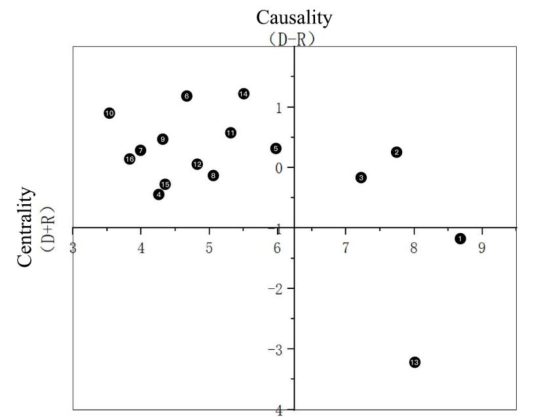
According to the data in Table 2, the causal diagram of influential factors of the elderly’s intention to use public physical facilities was drawn as shown in Figure 1.
In order to figure out a clear hierarchical relationship among the influen- tial factors, four subdivision calculations of the cause factors were conducted. The rows and columns of the effect factors are crossed out in each subdivi- sion calculation, and the matrix was rebuilt. Repeat the calculation until the subdivision cannot be continued.
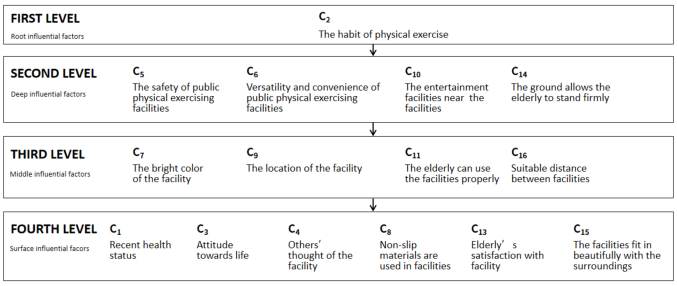
The structural hierarchy diagram of influential factors was drawn accor- ding to the subdivision calculations. All influential factors are divided into four levels. The factors’ degree of influence decreases from the first level to the fourth level (Li, 2020).
146 Zan and Liu
Table 1. Index system of influential factors to elderly’s intention to use public physical exercising facility.
Table available in the original PDF paper.
Influential factors References
Man-machine-environment system Elderly C1 Recent health status Xie, M.H. (2007) C2 The habit of physical exercise Dong, Y. (2019) C3 Attitude towards life C4 Others’ thought of the facility Public physical exercising C5 The safety of public physical exercising facilities
C9 The location of the facility Dong, Y. (2019)
Xie, M.H. (2007) Wang, Y.M. (2019) Dong, Y. (2009) C6 Versatility and convenience of public physical exercising facilities C7 The bright color of the facility C8 Non-slip materials are used in facilities The environment the facility located Wang, Y.M. (2019)
C10 The entertainment facilities near the facilities Xuan, W. (2011)
Interaction between the elderly and the facility
C11 The elderly can use the facilities properly
Dong, Y. (2009)
C12 The amount of time, money and energy the elderly expend while using facilities C13 Elderly’s satisfaction with facility Interaction between the elderly and the environment
C14 The ground allows the elderly to stand firmly Xuan, W. (2011)
Interaction between the facility and the environment
C15 The facilities fit in beautifully with the surroundings
Xie, M.H. (2007)
Interaction between the elderly C16 Suitable distance between facilities
DISCUSSION
Cause Factors and Effect Factors The 16 influential factors can be divided into cause factors which are the media (Li, 2020) that affect elderly’s usage intention and effect factors which are direct factors that affect elderly’s usage intention. Focusing on cause factors in the design can effectively increase the intention of the elderly to use the facility. The effect factor can be changed by external influence easily, which makes it the most effective factor in a short term (Li, 2020). Therefore, short-term measures can be formulated based on effect factor.
The Causality of Influential Factors The influential factors are distributed in a multi-level ladder pattern, among which ‘The habit of physical exercise’ is the most core influential factor while ‘The safety of public physical exercising facilities’, ‘Versatility and convenie- nce of public physical exercising facilities’, ‘The entertainment facilities near the facilities’ and ‘The ground allows the elderly to stand firmly’ are deep
An Analysis of Influential Factors to the Elderly’s Intention 147
Table 2. The calculation results of the relationship between the influential factors.
Figure 1: Causal diagram of influential factors of elderly’s intention to use public exercising facilities.
influencing factors. These factors have a great impact on the intention of the elderly to use physical exercising facilities.
The Centrality of Influential Factors The higher the centrality, the stronger the negative effect of the influential factors. ‘Recent health status’, ‘Elderly’s satisfaction with facility’, ‘The habit
148 Zan and Liu
Figure 2: Structural hierarchy diagram of influential factors.
of physical exercise’ and ‘Attitude towards life’ are factors with highest cen- trality, which makes them the key nodes to improve the intention of elderly to use public exercising facilities.
Comprehensive Analysis Based on the Causal Diagram of Influential Factors According to the causal diagram, influential factors can be divided into four types: driving factors, core factors, independent factors and assisting factors.
‘The habit of physical exercise’ and ‘Attitude towards life’ are in the first quadrant, which means they are driving factors. They have high centrality value and are also the cause factors which should be focused on.
“Recent health status”and “Elderly’s satisfaction with facility”are the core factors in the fourth quadrant. They are effect factors with high centrality value and low causality value, implying their effect on elderly’s intention to use public physical exercising facilities is susceptible to other cause factors.
Twelve factors, including ‘Others’ thought of the facility’ and ‘The safety of public physical exercising facilities’ are assisting factors in the second qua- drant. They are factors with low centrality value and high causality value, implying they can affect elderly’s intention to use public physical exercising facilities through influencing other factors.
DESIGH STRATEGIES Incorporating the Concept of Keeping Exercise into the Design of Public Physical Exercising Facilities
‘The habit of physical exercise’ is not only the driving factor but also the cause factor of elderly’s intention to use physical exercising facilities, which has the greatest impact on other factors. This means that whether or not the elderly use public physical exercising facility depends largely on their physical exercise habits. We can convey new exercise concepts to the elderly through labels and slogans on public physical exercising facilities to get them into the habit of exercising with these facilities.
An Analysis of Influential Factors to the Elderly’s Intention 149
Building Activity Centers for Elderly Around Public Physical Exercising Facilities ‘Versatility and convenience of public physical exercising facilities’, ‘The entertainment facilities near the facilities’ and ‘The ground allows the elderly to stand firmly’ are not only the second-level influential factor but also the cause factor, showing that the elderly extremely concern about public physi- cal exercising facilities and their surroundings. To build exercise center for the elderly around public physical exercising facilities, where the elderly can not only exercise but also entertain and have a rest, can greatly improve elderly’s satisfaction with these facilities.
Setting Up Public Physical Exercising Places in or near The Neighborhood ‘The location of the facility’ is not only the third-level influential factor but also the cause factor. In the survey, most of the elderly mentioned that they prefer public physical exercising facilities close to their home, which makes them not only take less time on the road but also provides convenience for social contact.
REFERENCES
Dong, Y., Yuan, R.B. (2019). Zhi Hui Cheng Shi Bei Jing Xia Dui Gong Gong Chang Suo Lao Nian Ren Jian Shen She Shi De Si Kao [Reflections on the Fitness Facilities for the Elderly in Public Place Under the Background of Smart City]. Architecture & Culture(09), pp. 115–117. Li, J.H., Wang, X.S. and Zhang, S.J. (2020) Ji Yu DEMATEL-ISM Mo Xing De
Chan Ye Ji Shu Ying Xiang Yin Su Fen Xi: Yi Zhi Hui Gang Kou Wei Li [Analysis of Influence Factors of Industrial Technology Based on DEMATEL-ISM Model: Case Study of Smart Port]. Information Research(06), pp. 54–61. Wang, Y.M., Xiao, J. (2019). Lao Nian Ren Gong Gong Jian Shen She Shi Bao Rong Xing She Ji Yan Jiu [Research on the Inclusive Design of Public Fitness Facilities for the Elderly]. Design(12), pp. 12–113. Xie, M.H. (2007). Cheng Shi Lao Nian Ren Shi Wai Jian Shen She Shi De She Ji Fen
Xi Yu Yan Jiu [Study on Out Door Body-building Facilities Design for the Urban Elderly]. (Master’s Thesis, Shandong University). https://kns.cnki.net/KCMS/deta il/detail.aspx?dbname=CMFD2007&filename=2007087111.nh Xuan, W. (2011). Ren Kou Lao Ling Hua Bei Jing Xia De Gong Gong Jian Shen She Shi Tong Yong She Ji Yan Jiu [Universal Design of Public Service for Physical Fitness in Contemporary Aging Society]. Hundred Schools in Arts(S1),pp. 89–91.
LISTED IN THE AHFE DIGITAL BOOKSTORE CATALOGUE
Explore the complete digital volume
Human Factors in Aging and Special Needs
Read this individual research paper free through the original publisher, or explore the full digital proceedings book.
ISBN 978-1-958651-14-8
Explore this ISBN in the AHFE Bookstore ↗Listed in the July 2026 bookstore catalogue; search by ISBN to confirm current availability · Digital book purchase optional